

What Makes Robinhood and Revolut Remarkable? the Truth About Investment App Success.


The investment banking landscape has evolved rapidly into 2026. With mature financial regulations and total market democratization, industry disruptors have become the new standard. TL;DR: The secret to investment app success lies in high-frequency engagement; by late 2025, Revolut surpassed 60 million users while Robinhood saw a 25% YoY increase in active trading, proving that mobile-first, gamified experiences consistently outperform legacy banking models.
And these disruptors continue to scale with massive momentum. Over the last five years, investment-based apps have maintained a growth trajectory exceeding 140% in total downloads. Leading the pack is Robinhood, which reached 13.8 million monthly active users in 3Q 2025 a 25% year-over-year increase. Industry data shows their mobile engagement remains significantly higher than traditional brokerage firms, driven by real-time notification loops and predictive UI.
In our experience, the gap between neobanks and incumbents has never been wider. Revolut, for instance, grew to over 60 million customers by September 2025, effectively surpassing the retail footprint of legacy giants like HSBC. They have successfully captured the "borderless" demographic expats and Gen Z users who prioritize instant cross-border transfers and integrated wealth management over the slow, high-fee structures of traditional institutions.
So how do these apps continue to dominate established financial corporations like Charles Schwab?
Take a look, here’s what we’ll cover:
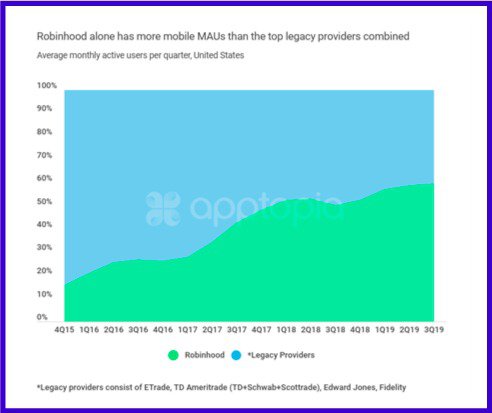
This graph illustrates the significant growth in downloads and retention for investment-based mobile apps, highlighting the trend that disruptors like Robinhood capitalize on to maintain market leadership in 2026.
- How do investment apps distinguish themselves?
- Gamification for apps your app engagement booster!
- How the disruptors of the investment industry use gamification to stay ahead
- A plug-in gamification tool for your investment app
What drives investment app success?
The key to investment app success in 2026 is the elimination of "financial friction" through high-yield digital accounts and AI-driven accessibility. By 2025, leaders like Revolut and Robinhood moved beyond simple trading, evolving into "super-apps" that offer 4.5% 5.0% APY on uninvested cash dwarfing the 0.01% offered by legacy incumbents. This value proposition, combined with near-instant onboarding, has allowed fintechs to capture the retail market faster than any traditional institution in history.
There are many factors contributing to the success of challenger banks, but using technology as leverage remains the primary driver. Most modern investment platforms operate exclusively online as neobanks or challenger banks.
This digital-first approach allows them to keep operational costs significantly lower while providing a vastly superior customer experience. In our experience analyzing fintech growth trajectories, we’ve found that customers prioritize accessibility over physical branches. Apps like Revolut and Stash continue to report that a significant portion of their user base is composed of first-time investors who previously felt excluded from the market.
Sudev Balakrishnan, Chief Product Officer@Stash - "Before fintech platforms like Stash, financial services, particularly the stock market, felt intimidating and inaccessible to so many Americans."
A major catalyst for this shift is the disparity in returns. While legacy "Big Four" banks in various regions still offer interest rates as low as 0.01% on standard savings accounts, modern investment apps provide significantly higher yields. For example, by mid-2025, several leading neobanks offered rates exceeding 4.5% APY. This represents a return hundreds of times higher than traditional savings accounts, making the switch an easy decision for tech-savvy consumers.
Zero-commission trading has also become the industry standard. “High minimums and fees kept hundreds of people on the sidelines for years,” says Balakrishnan. Stash’s focus on ease-of-use and fractional shares has propeled them to manage over $3.5 billion in assets, proving that lower barriers to entry lead to massive scale.
Andre Mohammed, former head of wealth and trading@Revolut - "The competitive landscape is definitely heating up and ultimately this is great for the customer and only serves to validate what we have put effort into building. Zero commission trading will soon become table stakes and investment apps will have to up their game to differentiate in other ways."
Competing for app engagement and investment app success
Disruption in the financial sector shows no signs of plateauing. Industry experts have long pointed to app engagement as the "secret sauce" for gaining millions of users without traditional multi-million dollar marketing budgets.
The strategy focuses on daily interactions and creating a product that users feel compeled to check regularly. This philosophy shifted the industry's focus from aggressive acquisition to product-led growth. As of September 2025, Revolut surpassed 60 million customers, effectively exceeding the retail footprint of legacy giants like HSBC by catering to underserved expats and younger demographics.
Engagement remains the primary metric for Robinhood as well. Robinhood reached 13.8 million monthly active users in 3Q 2025, marking a 25% year-over-year increase. This sustained growth is driven by 24/7 trading features and sophisticated notification systems that keep users tethered to market movements. At its core, the app utilizes gamification a fun, game-like interface that educates users on market mechanics while removing the friction of trade fees.
But what exactly is gamification, and how can it be used to fuel your own platform's growth?
Gamification for apps Your app engagement booster
What is gamification for apps?
TL;DR: Gamification for apps is the strategic integration of game-like mechanics such as progress bars, rewards, and social competition into non-gaming environments to drive user retention. In our experience, this is the "secret sauce" behind 2026's top-performing fintech platforms, helping brands like Robinhood scale to 13.8 million monthly active users and Revolut to over 60 million customers worldwide by late 2025.
Specifically, gamification for apps involves taking the psychological triggers that make games habit-forming and injecting them into a digital financial experience. The result is a differentiated user interface that keeps users hooked by making complex wealth management feel intuitive and rewarding rather than a chore.
How does gamification for apps work?
True engagement stems from the inherent motivation to achieve a goal. A successful strategy for gamification for apps relies on the user's emotional states to trigger behaviors that align with your business KPIs. According to behavioral science reports from Behavioral Economics, rewarding a user immediately after they perform a desired action like making their first deposit reinforces the dopamine loop, significantly increasing the likelihood of them returning to the app daily.
Want to learn more about gamification? Here’s our “What is Gamification” page to help you get started!
How can investment apps leverage gamification?
In our experience, gamification for apps can nudge user behaviors to be significantly more active. Robinhood, for instance, reached 13.8 million monthly active users in 3Q 2025, marking a 25% year-over-year increase. This growth was largely driven by sophisticated engagement features like personalized notifications and "streak" mechanics that reward consistent portfolio monitoring. Similarly, Revolut grew to over 60 million customers by September 2025 by targeting young users who feel alienated by traditional banks. By replacing slow, opaque processes with instant social transfers and interactive "Learn & Earn" modules, they have built a footprint that now surpasses several major global retail banks.
How the disruptors of the investment industry use gamification to stay ahead
TL;DR: The secret to investment app success lies in lowering the barrier to entry while maximizing retention through psychological triggers. By utilizing behavioral design and instant feedback loops, Robinhood and Revolut have scaled to 13.8 million and 60 million users respectively, fundamentally outpacing traditional banking engagement levels by prioritizing the user’s emotional journey over complex financial jargon.
Robinhood’s rize to the top
What sets Robinhood apart besides their fee-free trading model, is their beginner-friendly experience. In contrast to other investment apps, you can almost instantly open an account without any previous knowledge of investing. In our experience, this frictionless onboarding is the single most important factor for investment app success in the current 2026 market, as users now expect "one-tap" access to global markets.
Additionally, they use a range of game elements to encourage user participation and app engagement. For instance, the interface utilizes visual celebrations and social cues to reward activity. The app also features curated lists and real-time trend data that function similarly to social media discovery feeds, keeping users tethered to market movements.
Robinhood’s personalized notifications also boost activity on their platform significantly. According to 3Q 2025 data, Robinhood reached 13.8 million monthly active users, a 25% year-over-year increase. This sustained engagement is driven by a sophisticated notification engine that mirrors the mechanics of high-frequency social apps, ensuring the platform remains the primary financial touchpoint for its demographic.
Lastly, Robinhood amplifies referrals by using a reward program that can get you and your friends' free stocks. The stock you get is shown at random, which increases anticipation even further through a psychological principle known as variable rewards, a cornerstone of investment app success.
Revolut’s expansion into a global powerhouse
The focus on product-led growth has allowed Revolut to scale at an unprecedented pace. They rely on the users' motivation to have an easy and cost-efficient experience. Their investment platform is built to help users get more out of their savings, integrating traditional banking with fractional trading and crypto assets.
Similar to Robinhood, setting up an account only takes moments, and the entry-level plan remains highly accessible. This low-commitment approach has allowed Revolut to capture the "expat" and "digital nomad" segments audiences that have historically been underserved by traditional, slow-moving financial institutions. In our experience, providing instant cross-border functionality is a major driver of investment app success for multi-currency users.
As of late 2025, Revolut’s growth trajectory has become an industry benchmark. The platform surpassed 60 million customers globally by September 2025, representing a significant jump from 52.5 million just a year prior. Remarkably, this growth has allowed Revolut to surpass the retail footprint of legacy giants like HSBC, proving that a digital-first, gamified approach is more effective at reaching young users than the branch-based models of the past.

Revolut continues to leverage public engagement and social proof such as community challenges and referral milestones to drive organic adoption among Gen Z and Millennial cohorts.
Another gamification principle Revolut uses well is instant feedback. After making a trade or hitting a savings milestone, you receive an immediate notification to confirm the achievement. Lastly, Revolut offers a personal dashboard that allows you to track progress, set "Pockets" for specific goals, and view visual representations of your financial growth.
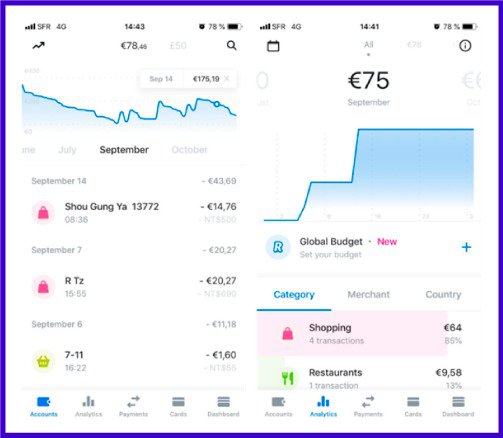
This personal dashboard provides users with instant feedback, allowing them to track their investment progress and achievements effectively through interactive data visualization.
A plug-in gamification tool for your investment app
TL;DR: Achieving investment app success in 2026 relies on behavioral hooks. StriveCloud’s plug-in gamification tool allows you to replicate the engagement of industry leaders without the massive development costs associated with custom builds.
StriveCloud has built a plug-in gamification tool to supercharge app engagement. You can link it with your web and mobile apps to gamify any digital touchpoint you want to. This way you can make your app just as engaging as market leaders like Robinhood which reached 13.8 million monthly active users in 3Q 2025 without having to spend lots of resources on a product studio or your own development team. In our experience, reducing the "friction to fun" ratio is the fastest way to scale a fintech product from a niche tool to a daily habit.
The plug-in gamification tool takes user data and turns it into a gamified experience. This level of engagement is precisely why Revolut grew to over 60 million customers by September 2025, surpassing the retail footprint of traditional giants like HSBC by targeting users who are frustrated with the slow pace of legacy banking.
Here are some of the things you can do with it:
According to recent industry reports, habit-forming mechanics are the strongest predictor of long-term user lifetime value (LTV). And the best part about it? Once you have a gamification strategy, it only takes a few clicks to set up new elements!
Want to learn more about our plug-in gamification tool? Check it out here!
Key takeaways for investment app success
TL;DR: Achieving investment app success in 2026 requires more than just low fees; it demands a transition into a comprehensive financial ecosystem. By late 2025, market leaders like Robinhood and Revolut have proven that high-frequency engagement driven by gamification and high-yield incentives is the primary engine for scaling revenue and user retention in a crowded market.
The investment industry is no longer just reshaping; it has been fundamentally rebuilt around digital-first brands. Modern apps allow users to manage entire portfolios, from stocks to crypto and high-yield savings, all within a single interface. While digital adoption is the foundation, a relentless customer-first approach is what keeps these platforms at the top of the app stores.
Here’s what we learned about the current state of the industry:
Leverage technology for innovation
These investment apps and neobanks operate with significantly lower overhead than traditional institutions by remaining fully digital. In 2026, the focus has shifted toward AI-driven automation for customer support and personalized financial insights. In our experience, automating these core services allows platforms to scale to millions of users without a linear increase in headcount, maintaining a lean operation that can reinvest profits into user rewards.
The future of investment banking is fee-free and high-yield
While fee-free trading was the initial disruptor, the new standard for investment app success is the "high-yield ecosystem." As of late 2025, while many traditional retail banks still offer baseline interest rates under 1.5%, disruptors like Robinhood and Revolut have captured market share by offering 4.5% to 5.0% APY on uninvested cash. This strategy effectively turns passive savers into active investors, forcing traditional giants like Charles Schwab to continuously evolve their digital offerings to prevent capital flight.
App engagement equals growth
The world’s leading investment platforms prioritize engagement as their primary North Star metric. According to recent industry reports, Robinhood reached 13.8 million monthly active users (MAU) in 3Q 2025, representing a 25% year-over-year increase. Similarly, Revolut expanded its footprint to over 60 million customers by September 2025. This data confirms that higher engagement directly correlates with higher revenue, as users who open the app daily are significantly more likely to explore new financial products.
Gamification drives app engagement
Both Revolut and Robinhood utilize sophisticated gamification frameworks to maintain their momentum. By using behavioral nudges, progress bars, and social proof, these apps encourage consistent user habits. These techniques don't just grow the user base; they increase the "stickiness" of the platform. By making financial management feel less like a chore and more like a rewarding challenge, these apps ensure they remain the primary financial hub for the Gen Z and Millennial demographics.
Want to get started on your own gamification strategy? Get a free workshop to kickstart the process!
.avif)
Related Posts

4 Ways to Introduce Gamification Features That Improve the User Experience
Games make up a staggering 72% of all app market revenue. Of course, your app doesn't need to be a game to be successful! With gamification features like a leaderboard, you can take inspiration from games to boost your app and meet your business strategy.
