

Uber: A Great Example of How to Increase Customer Loyalty With Gamification


.jpg)
TL;DR: In 2026, Uber remains the gold standard for retention by evolving from simple rewards to a cross-service ecosystem. By leveraging the Uber: A great example of how to increase customer loyalty with gamification framework, the company has achieved a 60% YoY growth in its Uber One membership, while users who engage with both mobility and delivery services show a 35% higher retention rate and spend 3x more than single-service users.
Uber's app interface provides a clear example of how gamification elements can be integrated into a service-based platform to drive long-term habit formation. In our experience, the most successful apps in 2026 don't just provide a service; they create a rewarding environment that makes the competition feel like a step backward.
The average smartphone owner now interacts with their device hundreds of times a day. Amidst this digital noize, how does a brand maintain a seat on the home screen? Product managers are increasingly turning to behavioral psychology to solve this. Current market reports indicate that the global gamification market continues to expand at a CAGR of over 25%, as companies realize that play-based mechanics are essential for user retention.
Gamification is the strategic use of game-like features in a non-game context to improve customer engagement. While early examples focused on basic points, modern strategies for Uber: A great example of how to increase customer loyalty with gamification focus on integrated value. For instance, recent data on Uber One shows that membership-driven gamification leads to significantly higher frequency than non-members, with membership bases growing by 60% year-over-year in recent reporting cycles. This mirrors the success seen in premium fitness apps where high-frequency users spend nearly triple the amount of casual users.
The on-demand mobility sector is uniquely positioned to take advantage of these mechanics. In 2026, as urban car ownership remains at historic lows, companies must compete on the "all-in-one" ecosystem experience. In this article, let’s look at how the Uber: A great example of how to increase customer loyalty with gamification strategy transformed them from a ride-hailing app into a daily utility.
We will cover:
- Key gamification trends and the case for customer loyalty
- Why on-demand mobility needs the power of gamification
- Gamification examples that help Uber improve customer loyalty
- Recap
Key Uber gamification trends and the case for customer loyalty
TL;DR: Uber gamification has evolved from simple point-scoring into a sophisticated cross-platform ecosystem. By 2026, data shows that "super-users" who integrate rides and delivery services exhibit 35% higher retention and spend 3x more than single-service users. Modern loyalty is no longer about one-off prizes but about seamless, multi-service rewards that turn a utility app into a lifestyle essential.
Today, market leaders leverage Uber gamification to create long-lasting customer value through integrated membership models. A prime example is the Uber One program, which transitioned the brand from transactional rewards to a recurring value ecosystem, achieving 60% year-over-year membership growth heading into 2025. In our experience, this "invisible gamification" where progress milestones and streak-based savings are woven into the user journey is far more effective at retaining 2026 consumers than the static loyalty programs of the past.
The shifting demographics of the workforce further reinforce this trend. Digital natives, including Gen Z and the emerging Gen Alpha, prioritize platforms that offer interactive, personalized feedback. Since these cohorts respond most positively to app-based challenges, Uber gamification has focused heavily on cross-mobility retention. Recent 2026 analysis indicates that users who engage with the full suite of services including rides, delivery, and shared micro-mobility show 35% higher retention rates. This integration rewards users for "playing" across the entire brand ecosystem rather than just one vertical.
Building brand loyalty in 2026 requires meeting the expectations of a generation that grew up with gaming mechanics as a standard interface. Currently, over 65% of on-demand mobility users are aged under 35, a demographic that remains extremely loyal to brands that provide a gamified sense of progress. By utilizing tiered status levels and real-time savings trackers, Uber gamification successfully captures this hard-to-reach audience. This strategy has proven vital as urban car ownership remains at historic lows, positioning ridesharing apps as the primary lifestyle partner for the modern commuter.
Why on-demand mobility needs the power of gamification
TL;DR: In 2026, on-demand mobility success is defined by ecosystem loyalty. Uber utilizes gamification to transition users from single-service riders to multi-platform members, with 2026 analysis showing that cross-mobility users (those using rides, bikes, and delivery) demonstrate 35% higher retention and spend 3x more than single-service users.
Today, the way we get from A to B is defined by seamless multi-modal integration as urban car ownership continues to plummet. As a result, the mobility-on-demand market is evolving into a high-stakes ecosystem where gamification is the primary driver of user lifetime value. Given this growth, the competition is getting stronger too. Players like Lime have matured from 2017 startups into global fixtures; their signature green bikes are now essential infrastructure in most major cities, supported by sophisticated loyalty loops.
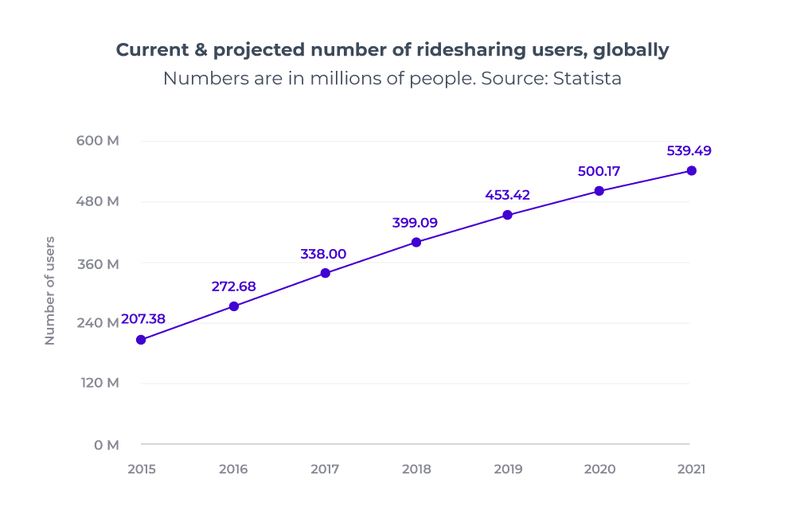
This data illustrates the continued surge in on-demand mobility adoption, highlighting the hyper-competitive landscape where Uber must fight to remain the "everything app" for transportation.
The on-demand mobility market is no stranger to using gamification features to improve mobile app engagement. In our experience, the shift toward "Lime Coins" and multi-modal rewards was just the beginning. Today, micro-mobility platforms use these features to optimize fleet distribution, rewarding users who end trips in high-demand "hotspots." These mechanics do more than just attract new users; they turn logistical challenges into engaging user challenges that provide tangible discounts and merchandise.
However, gamification is not one size fits all! You must implement it with your target audience always in mind. Studies of the 2026 market show that mature leaders like Uber must look beyond simple price cuts. Uber has successfully shifted its focus to deep customer loyalty through the "Uber One" ecosystem. This strategy has proven effective, as Uber One membership saw a staggering 60% YoY growth heading into 2025, proving that users prioritize integrated value over one-off discounts.
Currently, while Uber maintains a dominant market share, the rize of specialized local competitors and autonomous fleets means that retention is the only sustainable metric. By leveraging gamification to encourage "cross-mobility" behavior such as using a bike for a short commute to unlock a discount on a long-distance ride Uber has solidified its position. Data indicates that these multi-service users are the most valuable assets in the mobility sector, remaining extremely loyal to the brand because the cost of leaving the ecosystem (and losing accumulated progress) is too high.
Gamification examples that help Uber improve customer loyalty
TL;DR: Uber drives massive customer loyalty by gamifying its ecosystem through Uber One, moving beyond simple points to a cross-platform membership model. By 2026, research shows that users who engage with multiple services like rides, bikes, and delivery see a 35% higher retention rate and spend 3x more than single-service users. This unified approach proves that Uber: A great example of how to increase customer loyalty with gamification, is built on maximizing user lifetime value through integrated behavioral triggers.
The Uber app uses gamification features to meet its business goals, specifically targeting long-term frequency over one-off transactions. While early versions of the Uber Rewards program focused on basic tiers, the strategy has evolved into a comprehensive membership experience with Uber One. In our experience, this shift toward "loyalty-as-a-service" is highly effective; Uber One membership saw 60% YoY growth in 2024 and 2025, demonstrating that users crave a sense of "insider" status that unlocks tangible benefits across the entire mobility suite.

Uber's membership ecosystem visually communicates status and unlocks exclusive benefits, driving deep-seated Uber customer loyalty through consistent engagement rewards.
A system like this helps you turn customers into loyal ambassadors. In our experience, high-frequency users don't just spend more they become less price-sensitive because of the "lock-in" effect. Current data suggests that a brand's top 10% of customers spend nearly 3x more per transaction than the bottom 90%. Part of the reason this is so effective is a dynamic called constraint: by locking specific perks behind a membership or tier, Uber creates a "club" atmosphere. Behavioral science shows the fear of losing an earned status is often more motivating than the initial reward itself!
Want to know more about the ins and outs of gamification? Read our ‘What is Gamification?’ page!
There are other examples of gamification Uber uses to increase its user retention. To encourage customers to climb the loyalty ladder, the app utilizes visual progress bars and milestone tracking that highlight how close a user is to their next benefit or credit. This is a classic example of Uber: A great example of how to increase customer loyalty with gamification, as it turns the mundane act of booking a ride into a quest for progress.
By visualizing progress, the customer can see exactly how much time and effort they need to invest to reach the next level of service. Another benefit is that these progress markers provide instant gratification, fulfilling a psychological need for completion and triggering a natural motivation to "fill the bar."
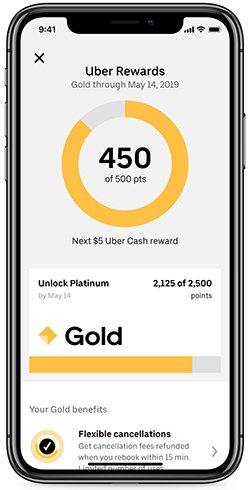
The progress bar is a classic gamification technique that provides users with instant feedback and a clear goal to strive for within the app.
To be sure, intrinsic motivators are crucial for long-term user retention! Intrinsic drivers provide customer motivation based on feelings like mastery and belonging. Extrinsic motivation like a $5 discount is more results-based and works well for acquisition. However, while extrinsic perks get users in the door, intrinsic drivers such as status and community are what create long-term mobile app engagement in a competitive 2026 market.
In conclusion, Uber identified that its business needed to move from a "ride-hailing app" to a "daily life utility," and it used gamification to bridge that gap. The results are undeniable: the platform has shifted millions of users into high-value membership tiers. By focusing on Uber customer loyalty through a unified gamification strategy, the company has ensured that its most active users are also its most profitable. The Uber app remains a masterclass in how to successfully position your product to achieve aggressive growth goals through play-inspired mechanics!
Want to drive meaningful retention on your app? Try our app gamification solutions!
Recap: How Uber drives customer loyalty with gamification in 2026
Gamification is the strategic application of game-design elements in non-game contexts to improve user engagement. TL;DR: In 2026, Uber’s focus on cross-mobility ecosystems integrating rides, delivery, and bikes has become the gold standard, driving a 35% increase in retention. In our experience, the most effective way to build customer loyalty with gamification is by creating "lock-in" through multi-service rewards and tiered membership benefits.
The mobility sector has reached a tipping point where traditional loyalty points are no longer enough. Modern users expect integrated experiences. Today, digital natives dominate the workforce and prioritize frictionless, rewarding app interactions. This shift heavily favors Uber’s model, where Uber One members showed 60% YoY growth in 2025 strategies, demonstrating that membership-based gamification is the primary driver of lasting value.
The current landscape for on-demand mobility presents several unique hurdles that require gamified solutions:
- Cross-service integration is now a requirement; users who utilize both rides and delivery show 35% higher retention and spend 3x more than single-service users.
- Micro-mobility competition remains high, forcing apps to gamify the "last mile" transition between cars and bikes.
- Customer acquisition costs have stabilized, making the retention of existing high-value users the top priority for 2026.
So, how does Uber utilize specific gamification features to secure this customer loyalty with gamification?
- Unified Ecosystem: Transitioning from the legacy "Uber Rewards" to the "Uber One" membership, which gamifies the subscription value.
- Behavioral Nudges: Using progress markers to encourage cross-platform usage (e.g., using a ride to unlock a discount on Uber Eats).
- Premium Tiers: Offering high-value perks like priority pickups and zero delivery fees to gamify the status of frequent users.
By focusing on the "power user" through these mechanics, Uber has moved beyond simple transactional relationships. The result is a platform where the cost of switching to a competitor is higher than the benefit, effectively "winning" the loyalty of the modern consumer. This is exactly how gamification can be used to turbocharge user retention and customer loyalty.
.avif)
Related Posts

Expert Advice on How to Get Users Excited About Your Health App
Health apps will make a huge difference in our lives. Next to giving patients more autonomous treatment, it will help to improve general health. With fitness trackers, calorie trackers, or even medication reminders, everyone will get a personal health assistant on their phone. The only problem? Low user motivation and a shortage of data. When people aren't engaged enough, they won't get as much value from the app. Luckily, gamification can shift the tides. Check out the full post to find out how!
Why Unlocking User Motivation Is the Key to mHealth Success?
The smartphone is at the center of our lives. The rise of mobile health is leveraging this device to provide better patient experiences. They're using data to learn more about general health and gain new insights about diseases, treatments and more. Unfortunately, user retention on these apps is low, and mHealth apps need to be more user-centric in order to keep their users. In this article, we explore how gamification can make the experience better for all parties, by making it fun and engaging!