

How Gamification Helps Streetcrowd Fight the Greatest Challenge in Shared Mobility



TL;DR: Streetcrowd uses gamification features to solve the "rebalancing" crisis ensuring vehicles are in the right place at the right time. By 2026, with over 80% of the population living in urban areas, these engagement strategies have become the primary defense against high churn and the logistical inefficiencies that cripple shared mobility fleets.
Streetcrowd's gamified mobile app is at the forefront of tackling efficiency problems within the shared mobility industry. Today, 81% of the world's population lives in cities and towns. That reflects a massive shift in density, with the global population reaching 8.2 billion in 2025. As the number of global cities has doubled to 12,000 recently, transport needs are evolving faster than infrastructure. To stay ahead, shared mobility leaders prioritize gamification features to drive reliability. Take Uber, whose reward system focuses on customer loyalty and user retention. Likewize, Streetcrowd has mastered how to increase app retention by turning fleet rebalancing into a rewarding user experience.
In our experience, the greatest challenge in 2026 isn't acquiring users it's keeping them active. While the world’s top 10 ridesharing apps were all founded after 2008, many now face declining user bases. Streetcrowd counters this trend by building a dedicated community of active users that spans across 10 major cities. In this article, we cover:
- Trending now: why you should learn how to increase app retention
- Gamification apps leading the way in shared mobility
- Streetcrowd boosts user retention with gamification features
- Recap
Trending now: why you should learn how to increase app retention with gamification in shared mobility
TL;DR: With 58% of the world’s 8.2 billion people now living in urban centers, gamification in shared mobility has become the essential strategy for reducing churn. By applying game mechanics to urban transport, apps can see a 63% decrease in user abandonment. In our experience, shifting focus from pure acquisition to engagement-led retention is the only way to sustain growth as the number of global cities has doubled to 12,000 by 2025, creating a hyper-competitive market for user attention.
While the shared mobility sector continues to expand, user loyalty remains volatile. The gamification market is projected to grow over 25% annually through 2026, largely because traditional retention methods are failing. Recent industry reports indicate that even major ridesharing players have seen userbase declines of up to 7% as consumers jump between competing services. Product managers are now leveraging gamification in shared mobility to trigger intrinsic motivation, making the daily commute feel rewarding rather than a chore.
Studies from behavioral experts show that gamified features provide a significant lift to long-term app metrics. By rewarding specific behaviors, apps see a 63% decrease in user churn. Furthermore, we have found that gamified reward systems do more than just prevent uninstalls they generate high-value loyalty. This is critical for profitability, as loyal customers spend more frequently and have a 300% higher lifetime value than unengaged users.
Want to know more about the ins and outs of gamification? Read our ‘What is Gamification?’ page!
The stakes for gamification in shared mobility are high: historically, 1/5 of users abandon a new app after just one use. In a world with 12,000 densely populated cities, relying solely on expensive acquisition cycles leads to a "leaky bucket" syndrome. As noted by software enterprise Upland, focusing on the post-install experience is the only way to protect your marketing budget and ensure long-term viability in the shifting urban landscape.
How gamification in shared mobility leads the way in 2026
TL;DR: In 2026, gamification in shared mobility is the primary solution to the industry's retention crisis. With 81% of the world’s 8.2 billion people living in urban clusters, the scale of competition is unprecedented. Since traditional price wars fail to build long-term loyalty, platforms are now using behavioral mechanics to optimize fleet efficiency and driver engagement. In our experience, shifting from discounts to gamified rewards is the only way to maintain a sustainable "Network Effect" in a market of 12,000 global cities.
On-demand mobility is a relatively young sector, originating around 2009 when smartphones redefined urban transit. When mobile technology became the norm, apps focused on flexibility and customer empowerment, like Uber, quickly dominated. However, as the global urbanization rate reached 58% by 2025, the challenge shifted from mere acquisition to sophisticated gamification in shared mobility. Today, platforms must manage hundreds of millions of active users who have more choices than ever before.
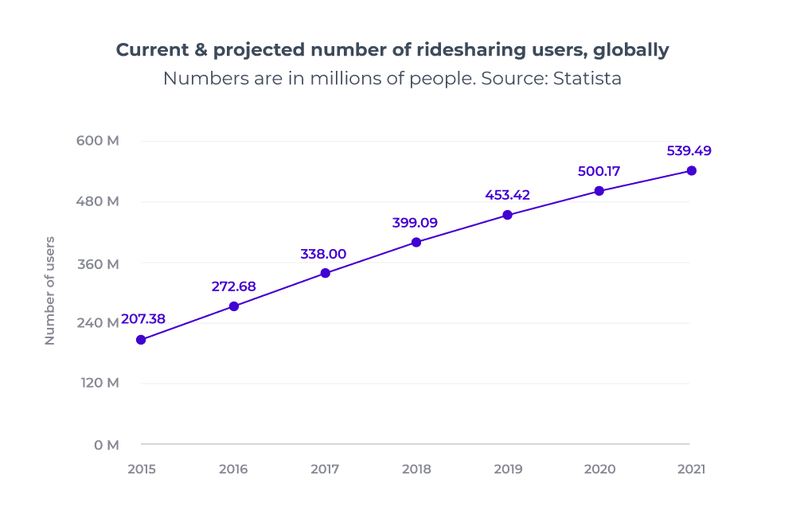
This graph illustrates the competitive landscape in the ridesharing market, showing shifting user loyalty between an established player and a rizing challenger.
Even market leaders are fighting a constant battle against churn. In our experience, user loyalty is increasingly fragile; historical data shows that even top-tier players have faced 7% declines in userbase over four-year periods while rivals like Lyft utilized aggressive expansion tactics. To counter this, gamification in shared mobility has become a core product pillar. For example, Uber’s evolution of its reward systems demonstrates a strategic shift toward high-frequency behavioral nudges rather than one-off financial incentives.
The story is consistent across the sector: rapid growth demands smarter retention. To illustrate, the world’s top 10 ridesharing apps were all founded after 2008, yet they now serve a planet where the number of cities has doubled to 12,000 in recent years. This massive urban density makes operational efficiency the ultimate competitive advantage.

The table lists the top 10 ridesharing apps, highlighting the sector's rapid growth and recent emergence in the last decade.
The "get big fast" motto of the mobility sector is driven by the Network Effect, where a product's value scales with its user base. A mobility app is useless without drivers, and drivers won't log on without customers. While companies historically used heavy discounts to solve this chicken-and-egg problem, we have found that price-cutting actually erodes long-term wallet share and fails to improve user retention.
Under these circumstances, apps must find innovative ways to stay afloat. The industry is now prioritizing operational efficiency identified by consultancy firm Arthur D. Little as the greatest challenge facing shared mobility today. To turn this threat into an opportunity, Streetcrowd is leading the way by integrating gamification in shared mobility to solve the complex puzzle of vehicle rebalancing and user engagement.
Want to drive meaningful retention on your app? Try our app gamification software!
Streetcrowd boosts user retention with gamification features
TL;DR: Streetcrowd solves the "idle vehicle" problem where car usage rates in shared mobility sit at a low 10% by using gamification to turn operational fleet rebalancing into an engaging user experience. By incentivizing the "crowd" to relocate vehicles to high-demand zones, Streetcrowd increases efficiency and counters the high churn rates currently affecting the mobility market in 2026.
Streetcrowd is an app that supports mobility providers by making their operations more efficient. Its mission is customer experience optimization. Using gamification features, the app engages users through a reward system to do odd jobs, such as moving a parked car in the company’s 5,500 vehicles to a more desirable place.
In other words, where the car is more likely to meet customer demand, rather than sit idle. This maximizes profit! Clearly, it is needed: industry data shows that current car usage rates for many mobility apps remain at a shockingly low 10%.

The chart highlights the low utilization rate of vehicles in mobility apps, a key operational challenge that Streetcrowd aims to solve.
In 2025, 81% of the world's population resides in cities and towns, a massive shift that has forced providers to rethink urban logistics. With the number of global cities doubling to 12,000 by 2025, the pressure to maintain an available fleet is higher than ever. For customers, a higher car utilization rate means the car is easier to allocate because it’s closer to users. In our experience, benefits like these drive customer loyalty and user retention much more than a simple discount. With this in mind, Streetcrowd sets out to increase rates by implementing a range of gamification features:
A reward system that motivates users to achieve goals
In 2026, gamification is the primary defense against app churn. While some major ridesharing players have seen userbase declines of up to 7% in recent years, Streetcrowd incentivizes users through financial rewards, paying them for their time. This is an extrinsic motivator, meaning that it is a results-based driver. However, this reward system is most useful in the discovery phase. Behavioral research shows that long-term user retention is instead achieved through intrinsic motivation.
Challenges that encourage users to complete tasks
Applying gamification to operational tasks appeals to the user’s self-worth, an intrinsic motivator. In addition, challenges are fun! If users succeed, they feel the reward and the dopamine hit that comes with it. In our observations, a highly effective challenge involves moving a specific number of vehicles in a fixed timeframe to unlock a "pro-mover" status or bonus reward, which keeps the user returning to the app daily.
Empowerment through an interactive interface
Empowerment is a principle mechanic of app gamification. Users select which vehicles they want to move and transparently see what is required. While the world’s top 10 ridesharing apps were all founded after 2008, the most successful ones in 2026 are those that empower the user through the UI. A visually pleasing map with greens, reds, and clearly mapped routes makes the task feel less like a job and more of a strategic quest!

This screenshot of the Streetcrowd app displays its interactive map, which turns vehicle relocation into a quest-like experience for users.
Progress indicators and digital confetti give users instant gratification
When you are logging a vehicle, a progress indicator guides you during the wait for acceptance. This simple yet effective gamification feature assures the user that the system is working. Additionally, scientific research from the Nielsen Norman Group shows that it minimizes cognitive load. In other words, instead of focusing on the wait, the progress indicator reduces the user’s perception of time by providing a visually stimulating experience.
Streetcrowd pairs this with digital confetti, showing a celebratory splash in the middle of the screen. This provides instant gratification, which contributes to creating customer loyalty! By reinforcing that their contribution has immediate value, the app builds a habit-forming loop that traditional utility apps lack.

The app's reward screen uses digital confetti to provide instant gratification, reinforcing positive user behavior and building loyalty.
As a result of their gamified app, Streetcrowd has created customer loyalty in cities across the world. Users’ continued engagement and reward for participation create loyalty for the Streetcrowd brand. By leveraging gamification to increase operational efficiency, they have solved the biggest bottleneck in shared mobility. The faster service and higher utilization rates give them a definitive competitive edge over legacy brands in the 2026 urban landscape.
Recap: Solving the Mobility Efficiency Gap with Gamification
TL;DR: With global fleet utilization rates stalled at a mere 10%, shared mobility providers face a massive profitability crisis. Streetcrowd uses gamification to solve this by incentivizing users to handle fleet rebalancing. As urban populations reach 8.2 billion in 2026, these engagement strategies help platforms overcome the 7% userbase decline seen in traditional ridesharing models by turning logistics into a rewarding user experience.
While the peak of app uninstall volatility has passed, the competition for user attention in the 2026 mobility market is fiercer than ever. Data indicates that even major ridesharing players have seen significant userbase declines some down 7% over a four-year period as users seek more value and engagement. To combat this, industry leaders have integrated gamification reward systems to stabilize retention and increase daily active usage.
While user retention is a high-profile hurdle, the single greatest challenge the sector faces is a lack of operational efficiency. Today, the number of global cities has doubled to 12,000, and with 58% of the world’s population now living in urban areas, the demand for shared cars is at an all-time high. Yet, the average utilization rate for a vehicle in a mobility fleet remains stuck at 10%. Streetcrowd was built specifically to disrupt this stagnation.
In our experience, the most effective way to optimize a fleet is to move the logistics into the hands of the community. Streetcrowd supports mobility providers by making their operations more efficient through a crowdsourced model. Using gamification, the app engages users to complete operational tasks, such as moving a parked vehicle from a low-traffic zone to a high-demand "hotspot" where it is statistically more likely to be booked.
Streetcrowd utilizes several core behavioral mechanics to drive these results:
By applying these gamification strategies, Streetcrowd has successfully built loyalty across global urban hubs, proving indispensable to providers struggling with idle inventory. As the world population hits 8.2 billion people, the ability to turn a logistics problem into a rewarding game is the only way to ensure shared mobility remains sustainable and profitable.
.avif)
Related Posts
The 7-step Gamification Blueprint to Change mHealth Apps for the Better
In 2020, European spending on mobile health apps jumped 70%. But how can mHealth apps succeed in retaining users, improving their health, and drive app engagement, all the while competing in a market of over 100,000 apps? Gamification for mHealth gets your users moving! Want to find out how it can help you? Read the full post!
Top 34 Customer Experience Statistics to Boost Your App Growth
46% of businesses say that customer experience is their most important priority in the next 5 years. To be sure, improving your CX is a solid route to growth for apps, and here are 34 statistics that can guide your journey in optimizing your CX in 2022.