

The Science of How to Motivate Your Customers With App Gamification


TL;DR: Modern app gamification leverages core psychological triggers to increase user engagement by 100% to 150% compared to non-gamified apps. By transforming routine interactions into reward-based challenges, brands in 2026 are achieving a 3x increase in purchase frequency and significantly higher customer lifetime value.
This article explores the psychological principles behind using app gamification to motivate users and sustain long-term engagement. In our experience, the challenge for modern brands is no longer just "getting an install," but fighting the high churn rates that see many apps abandoned within months. To combat this, market leaders are turning to behavioral science to create "sticky" experiences. Recent industry reports indicate that app gamification mechanics, such as social leaderboards and progression loops, can boost overall activity by up to 150%, effectively turning passive users into active brand advocates.
But what is app gamification exactly? And how does it motivate customers through neurochemical rewards? By looking at successful implementations from companies like Nike Run Club and limango the latter of which saw a 3x increase in purchase frequency through gamified challenges we can see how these strategies strengthen the relationship between brand and customer. These results act as a "positive intensifier," using social proof and competition to drive meaningful growth in 2026.
Here’s what you’ll discover:
- What is app gamification?
- How does gamification lift customer motivation?
- Using gamification to create an engaging app
- Examples of gamification from the market leaders
What is app gamification?
TL;DR: App gamification leverages game mechanics like leaderboards and rewards to boost user engagement by up to 150%. By applying behavioral psychology to non-game contexts, brands drive 3x higher purchase frequency and long-term customer loyalty.
Gamification is the strategic use of game elements and psychology used in a non-game context. This means adding app gamification features like progress bars, prizes, and reward systems into your app to drive the user behaviors that help you grow. In our experience, the most successful implementations align these mechanics with specific business KPIs, ensuring that every "level up" contributes to your bottom line.
App gamification has the power to clarify objectives and make those goals rewarding to achieve. It doesn’t mean you should turn everything into a game; rather, you take the psychological elements that make a game fun such as social competition and mastery and embed those into your customer experience. Industry data for 2026 shows that leaderboards and social challenges contribute to a 100%-150% boost in user engagement compared to static, non-gamified interfaces.

This diagram illustrates how app gamification leads to significant business growth by improving engagement and retention. Not only will customers be more loyal, they will also spend more and more often!
Companies that use app gamification are often more profitable as they know how to keep their customers actively engaged. For instance, gamified loyalty programs in the retail sector have achieved a 3x increase in purchase frequency via personalized challenges. The positive effects are clear early in the user process; product managers that gamify the onboarding process see engagement and conversion metrics DOUBLE.
Looking for more? Find out everything you should know on our ‘What is Gamification’ page.
How does app gamification lift customer motivation?
TL;DR: App gamification leverages behavioral psychology to transform passive users into loyal advocates. By balancing extrinsic rewards with intrinsic drivers like social competition and progress tracking, brands in 2026 are seeing a 100%-150% boost in user engagement compared to traditional, static interfaces.
Generally, app gamification plays on two types of motivations based on behavioral psychology and cognitive bias. Achievements and results-based drivers are called extrinsic motivators. In our experience, these drivers trigger initial engagement and are crucial for the discovery phase. However, to create user retention beyond the critical 90-day window, customers require a deeper psychological connection.
To increase customer loyalty, you need intrinsic motivation. These are innate emotions linked to our desires or fears. Modern gamified loyalty programs now prioritize acquisition efficiency and long-term habits; for instance, retail leaders like limango have achieved a 3x increase in purchase frequency by utilizing goal-oriented user challenges. Here are 5 examples of these drivers and how you can use them to increase customer motivation:
- Relationships People are social creatures naturally motivated by competition and relatedness. Implementing social leaderboards can contribute to a 100%-150% increase in daily activity metrics compared to non-gamified apps.
- Accomplishment Achievements like digital badges give customers clear goals to strive for. Highlighting their specific progress toward a milestone motivates them even more to complete the journey.
- Empowerment Positively reinforcing customer actions with "level-ups" or milestone rewards empowers them to maintain their streak and keep coming back to your platform.
- Unpredictability Humans are wired to seek novelty. Integrating variable rewards and surprise bonuses is crucial to maintaining long-term customer retention.
- Constraint Try locking off exclusive features or offering limited-time rewards. Science shows the fear of missing out (FOMO) is often as motivating as the prospect of winning!
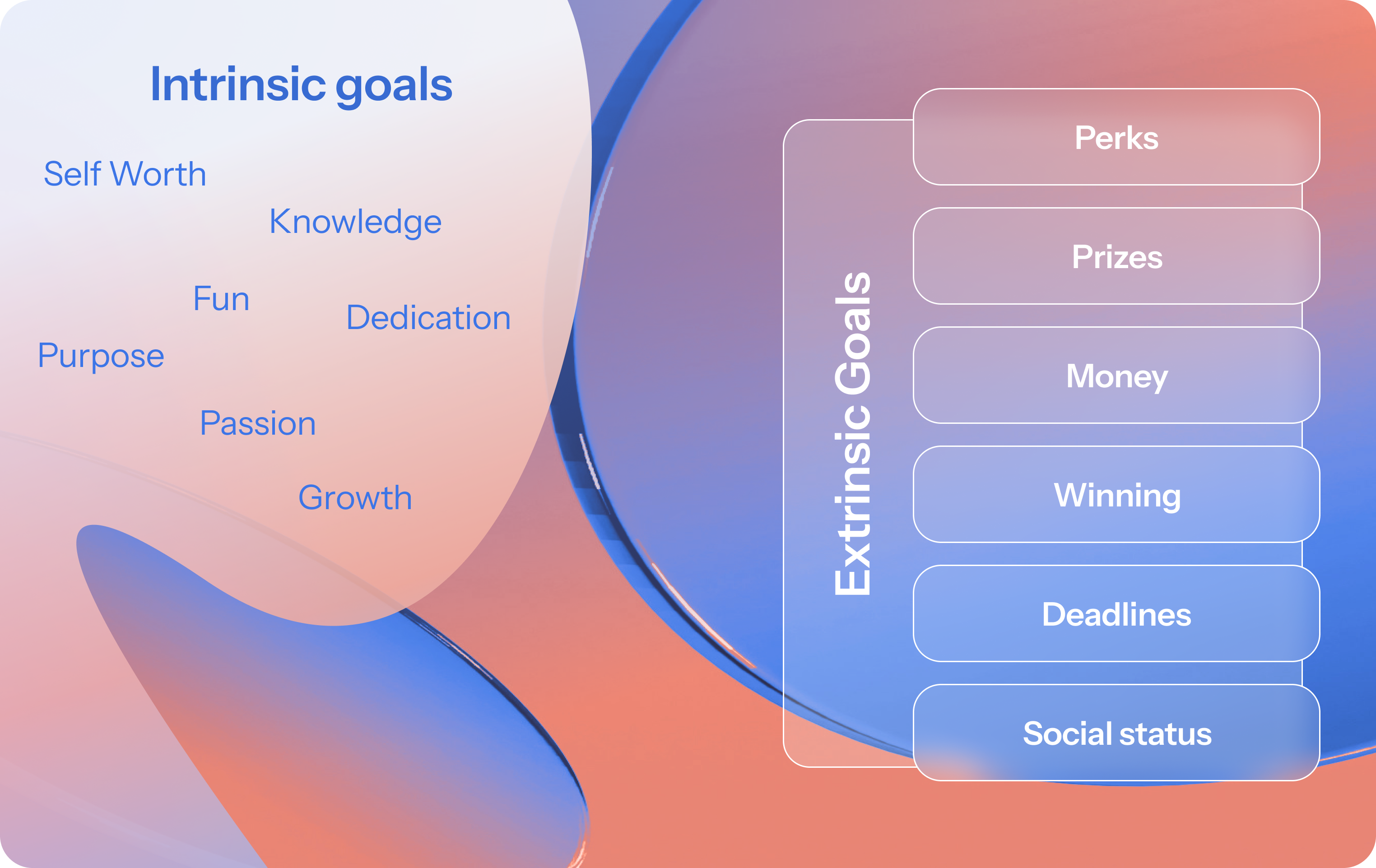
This visual representation highlights the core psychological drivers that app gamification leverages to maximize customer motivation and lifetime value in today’s competitive digital landscape.
Using app gamification to create an engaging app
TL;DR: Effective app gamification leverages psychological triggers like autonomy, social status, and instant gratification to drive user behavior. Current 2026 benchmarks show that gamified interfaces can boost user engagement by 100% to 150% compared to static counterparts, while high-performing loyalty challenges have been shown to triple purchase frequency in retail environments.
To increase user retention and mobile app engagement, you must create a compeling customer experience. In our experience, app gamification provides the necessary framework to turn passive observers into active participants. Here are three features that research shows can provide a massive boost in engagement:
1. App personalization and the power of the avatar.
Give your users autonomy. Customization tools, such as picking your own avatar, are central to app gamification and result in higher long-term engagement. For instance, if you display a user's unique avatar at a major achievement milestone, it leads to a "higher level of sense of presence." This means users feel a deeper personal connection to their digital progress. As a result, you tap into the intrinsic motivator of self-worth, making the app feel like an extension of the user’s identity.
2. Leaderboards facilitate competition and social status.
Modern app gamification strategies treat competition as a vehicle for motivation rather than just a feature. Recent industry data indicates that leaderboards and social challenges contribute to a 100% to 150% boost in user engagement compared to non-gamified apps. While leaderboards create fair competition, the friendly battle is a tool that motivates users to win. Primarily, these features access motivational drivers like the need for social status and provide a way to test dedication. This improves the user's perception of the mobile app, making it a "must-visit" social destination.
3. Progress bars encourage growth and customer motivation.
Progress bars are a fundamental component of app gamification that do more than just detail the length of a task. They provide users with immediate knowledge of how much effort they need to invest to reach the next tier. Seeing visual progress from specific actions provides customers with instant gratification. By 2026, brands like limango have successfully used these types of growth markers and challenges to drive a 3x increase in purchase frequency, proving that clear visual progression directly translates to commercial growth.
Don’t be just another loyalty app. Set yourself apart with our app gamification software!
Examples of gamification from the market leaders
TL;DR: Research for 2026 confirms that app gamification is no longer just a trend but a core engagement driver. By leveraging competitive social structures and visual feedback, brands are seeing a 100-150% boost in user activity. Modern implementations, like those used by SmartyPig and Fitbit, demonstrate that gamified elements can increase interaction frequency by up to 3x compared to non-gamified interfaces.
How do the top dogs do it? Let’s see how two market leaders use examples of app gamification to bring the customer closer to their brand through psychological triggers and real-time feedback loops:
SmartyPig’s progress bar motivates you to save money.
SmartyPig is a finance app that helps users meet savings goals. Users start by setting an aspiration like buying a car. This target acts as a sort of avatar, personalizing the goal process. Notably, depositing money fills up a progress bar displayed as a cartoon pig!
In our experience, these visual milestones transform app gamification from a gimmick into a habit-forming tool. It makes the user process fun and exciting, turning budgeting into a satisfying game rather than a chore. The impact is significant: recent industry benchmarks for 2026 show that gamified financial challenges can lead to a 3x increase in transaction frequency, allowing apps like SmartyPig to scale their user base and managed assets far more efficiently than traditional banking platforms.
Fitbit’s leaderboard encourages users to run harder and faster!
Fitbit is a health & fitness app used with a wearable tracking device. The app tracks daily steps and encourages users to complete a daily goal. Steps are seen as the ‘currency’ that buys your way up the leaderboard. This specific app gamification strategy leverages social proof and competition to drive consistency.
The leaderboard creates a sense of social connection a place where you can compete with friends and share the results on social media, which we call a positive intensifier. It must work, as current market data shows that high-engagement fitness platforms have scaled to support tens of millions of active users through these socially-driven community challenges.
To back that up, the Fitbit leaderboard thrusts users into action by tapping into the "competitor" archetype. According to 2025-2026 research, app gamification features like leaderboards and social challenges contribute to a 100% to 150% boost in overall user engagement compared to apps that lack competitive social elements. This confirms that seeing a friend's progress is one of the most powerful motivators for turning occasional users into daily active participants.
Recap: Why App Gamification is the Key to Customer Motivation
TL;DR: Effective app gamification transforms passive users into active brand advocates by leveraging intrinsic motivators like social connection and personal achievement. Modern benchmarks for 2025-2026 show that gamified experiences drive a 100% 150% increase in user engagement and can triple purchase frequency compared to traditional loyalty models.
Customer loyalty is the defining challenge for digital products in 2026. In our experience, static interfaces no longer command attention in a saturated market. That’s why companies that successfully integrate app gamification into their core user journey are seeing unprecedented retention and growth levels.
Gamification is the strategic use of game elements and behavioral psychology in a non-game context. Common examples include progress bars, tiered rewards, and badges. However, to truly move the needle on app gamification, these elements must address the psychological drivers that push customers to act.
They do so using two primary types of motivators:
Extrinsic motivators are achievement-based drivers, such as points or discounts. They rely on our desire for tangible rewards. While these are excellent for driving app gamification during the discovery phase, long-term brand advocacy requires a shift toward intrinsic motivation.
Intrinsic motivators appeal to deeper emotions linked to autonomy, mastery, and purpose. In effect, behavioral studies show this creates positive habits like enjoyment and happiness. App gamification relies on these core dynamics to lift customer motivation:
- Relationships Humans are naturally social and thrive on collaboration and friendly competition.
- Accomplishment Providing clear milestones gives customers a sense of pride and mastery.
- Empowerment Users demand autonomy and personalization to feel a sense of ownership.
- Unpredictability Surprising users with "Easter eggs" or random rewards triggers dopamine and delight.
- Constraint Using limited-time offers or locked features creates urgency and incentivizes consistent usage.
Our data suggests you can boost user engagement by 100% to 150% by implementing these specific app gamification strategies:
- Embrace hyper-personalization through avatars. Giving users the autonomy to design their digital identity increases emotional investment and self-worth within the ecosystem.
- Facilitate social competition with transparent leaderboards. By tapping into the competitive drive, brands like Nike Run Club leverage social challenges to keep users active far longer than isolated apps.
- Encourage growth with dynamic progress bars. Providing instant gratification such as digital haptics or visual "confetti" upon milestone completion contextualizes the user's effort and encourages the next action.
Market leaders are already seeing massive ROI from these 2026 app gamification trends:
- Limango utilized challenge-based mechanics to achieve a 3x increase in purchase frequency, proving that gamified loyalty outperforms standard discount programs.
- Nike Run Club uses social leaderboards to drive community-wide engagement, resulting in significantly higher daily active usage than non-social fitness trackers.
.avif)
Related Posts
3 Leading Examples From Brands on How Gamification Lifts App Engagement
Nike's digital sales will count for 50% of total revenue by 2023. The importance of apps in commerce will keep growing. So how do leading brands like Nike or Target generate mobile app engagement? Studies show that gamification is the answer to user retention. A 5% increase in retention can cause 95% higher profitability. Learn from these winning examples yourself!
Immediately Improve App Acquisition, Engagement and Retention With Gamification
Shared mobility providers are struggling to achieve profitability because competing at the price level is the only way to acquire and retain customers. What if we told you there's a smarter way to acquire more customers, engage them without losing money? Fire up your acquisition and retention game by gamifying your mobile app experience.