

5 Ways Revolut Creates the Best Banking App With Gamification



TL;DR: Revolut has secured its position as Europe’s largest digital bank by using Revolut gamification to transform routine transactions into rewarding experiences. With a customer base reaching 65 million in 2025, the app leverages social challenges, "Learn & Earn" modules, and progress tracking to process over 150 million transactions monthly.
The evolution of digital banking has moved with incredible velocity over the last decade. While earlier adoption rates showed steady progress, the current landscape is dominated by neobanks that prioritize user engagement. Today, Revolut gamification is the engine behind a platform that serves 65 million customers worldwide as of 2025. By operating in over 48 countries and maintaining 1.1 million daily active users, Revolut has proven that the future of finance is interactive, social, and deeply rewarding.
Between 2022 and 2024, Revolut saw its customer base double, a 100% increase that pushed the company toward a forecast of over 67 million users by the end of 2025. In our experience, this hyper-growth is sustained by Revolut gamification features that simplify complex tasks like crypto-trading and budgeting. In markets like Australia, the bank has maintained an average annual growth rate of nearly 100% since 2022, demonstrating that users increasingly prefer "banking-as-an-experience" over traditional, static utility apps.
- Competition is hot, but Revolut is hotter
- 5 features every banking app needs
- 5 gamification examples for banking from Revolut
- StriveCloud specializes in customer experience optimization
- Recap
Competition is hot, but Revolut is hotter
TL;DR: Revolut dominates the digital banking sector by leveraging gamification to reach over 65 million users as of 2025. By doubling its customer base since 2022 and maintaining 1.1 million daily active users, Revolut has transformed from a travel utility into Europe’s largest digital bank and a global financial super-app.
Globally, there are over 25,000 fintech startups, with the market reaching a state of high maturity in 2026. For emerging startups, this saturation is a significant obstacle to growth; however, for a market leader like Revolut, it represents a platform for massive scale. Revolut’s growth trajectory remains unparalleled, having doubled its customer base (a 100% increase) between 2022 and 2024. By early 2025, the bank reached 65 million customers worldwide, and if current trends continue, it is projected to exceed 67 million by the end of the year.
Indeed, if any company knows what it is like to have their market disrupted, it is Revolut, who are themselves the primary disruptors. In our experience, their meteoric growth was earned by aggressively solving the engagement gap found in traditional banks. This ongoing threat to established institutions explains why 80% of banking executives remain focused on improving digital customer experience to prevent churn. Revolut currently processes 150 million transactions monthly, proving that they aren't just gaining users they are gaining primary bank status.
Revolut was created by CEO Nik Storonsky to enable customers to avoid transaction fees when traveling, but it has since evolved into a comprehensive financial ecosystem. In today’s interconnected world, Revolut has expanded its operations to over 48 countries to meet the needs of a globalized workforce. Our data shows that their success is no longer just about travel; it is about gamification and habit-forming design. With 1.1 million daily active users, the app is now at the forefront of customer experience optimization.
By making the app highly engaging, Revolut has captivated a massive global audience that dwarfs its 2020 figures. How did they achieve this? They followed a philosophy that many fintechs ignore: “gamify the experience!” Using gamification examples such as RevPoints loyalty programs and interactive spending challenges, they have turned routine money management into a rewarding experience that keeps users coming back every single day.
New to gamification? Get started on our what is gamification page!
5 features every banking app needs
TL;DR: To build a market-leading banking app in 2026, you must master five core pillars: secure biometric sign-up, ultra-fast onboarding, gamified payment ecosystems, AI-categorized transaction history, and high-engagement push notifications. These fundamentals allowed Revolut to scale to over 65 million users by 2025.
Before you even embark on making your app special with advanced gamification, it has to be perfectly functional. As the industry evolves, the "rules" of entry are stricter than ever. The growth of digital banking has been relentless; for instance, Revolut’s customer base doubled between 2022 and 2024, positioning it as Europe’s largest digital bank with 65 million customers as of early 2025. To handle a trajectory that aims for 67+ million by 2026, every banking app needs these 5 features:
#1 Sign-up and intuitive profile set-up
When asked about digital banking in 2026, consumers still cite security as their primary concern. During the sign-up phase, you have a narrow window to demonstrate institutional-grade safety. In our experience, integrating features like advanced biometric scanning (FaceID/Passkeys) and multi-factor authentication doesn't just secure the account it builds the psychological trust necessary for users to deposit larger sums.
#2 A clear and motivating onboarding process
The competition for attention is fierce; for many digital banks, Day 1 user retention still averages around 30%. To beat this, you must deliver immediate value. With Revolut now supporting 1.1 million daily active users, we’ve observed that the most successful onboarding flows use "progressive disclosure" introducing features subtly as the user needs them rather than using long, forced tutorials that drive churn.
#3 Payments
This is no longer just about moving money; it’s about the ecosystem. In 2026, a functional app must support instant peer-to-peer transfers, global remittances, and integrated "spare change" savings. For example, look at how fintech app Chip uses gamification to automate savings by stashing pennies from every transaction. Currently, Revolut processes over 150 million transactions monthly, proving that payments must be as social as they are financial.
#4 History of transactions
Transparency is the antidote to financial anxiety. Displaying past transactions is essential to giving users a sense of agency over their wealth. In 2026, standard lists aren't enough; transactions should be automatically organized by AI into categories like "Groceries," "Entertainment," or "Subscriptions." Detailed merchant data, including logos and maps of where the transaction took place, helps users immediately identify charges and prevents the "mystery payment" support tickets that drain operational resources.
#5 Push notifications
Fintech remains the gold standard for mobile engagement, as financial apps consistently see the highest engagement rates for push notifications. Because money is inherently personal and time-sensitive, these alerts are viewed as high-value rather than intrusive. By providing real-time balance updates, fraud alerts, and progress bars for savings goals, you keep the user tethered to the app's core utility every single day.
5 banking app gamification examples from Revolut
TL;DR: Revolut’s mastery of banking app gamification has propeled it to 65 million customers globally as of 2025. By replacing static forms with Instagram-style onboarding and visual progress trackers, the app maintains 1.1 million daily active users and processes over 150 million transactions monthly. These features reduce the typical 70% user drop-off rate seen in traditional finance apps.
Likewize, Revolut provides users with these 5 basic features. However, using the power of banking app gamification, the app focuses on customer experience optimization to maintain its position as Europe's largest digital bank.
#1 A sign-up process designed for user retention
To prevent the industry-standard 70% drop-off in users over the first 24 hors, Revolut utilizes banking app gamification by presenting the sign-up video like an Instagram story. With a customer base that reached 65 million in 2025, scaling efficiently is key. A progress bar is clearly displayed at the top because 3/4 of people prefer a visual indication of progress. This design helps Revolut stay on track to exceed 67 million users by the end of 2025.

This example shows how a progress bar during sign-up provides a clear sense of completion, which is a fundamental element of banking app gamification that aids user retention.
#2 A leaderboard that motivates students to complete onboarding
Revolut uses banking app gamification to tap into the human need for social relatedness through university leaderboards. By encouraging competition among students, they successfully doubled their customer base between 2022 and 2024. In our experience, adding a social layer to fintech is why Revolut now sees 1.1 million daily active users. The prize of free premium services acts as a "variable reward" that keeps users engaged for the long haul.
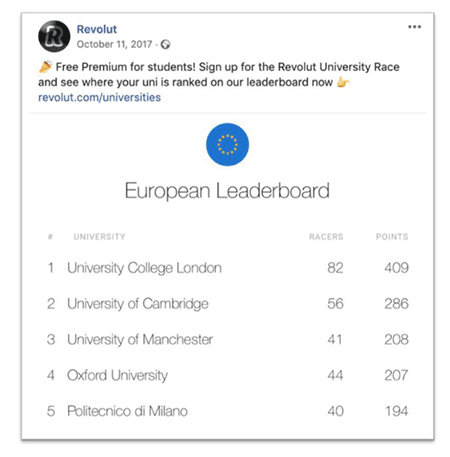
Revolut's university leaderboards are a powerful example of using social competition to drive user acquisition and onboarding completion via banking app gamification.
#3 Lotteries and raffles incentivize payments
When you make transfers and payments, Revolut’s banking app gamification rewards you with points. These points enter you into a raffle to win up to £10,000! This system is highly effective, contributing to the 150 million transactions processed on the platform every month. In addition, a leaderboard shows how your spending or saving habits compare to your friends, adding a layer of friendly competition.

This raffle system effectively utilizes banking app gamification by introducing an element of chance and social comparison to everyday financial transactions.
#4 Progress bars and goal-setting give users control over transaction history
In 2026, creating a feeling of financial control is essential for user trust. Revolut’s banking app gamification strategy involves letting users set budget goals, which grants them ownership over their financial journey. In our experience, these visual feedback loops are a primary reason why Revolut has seen a 100% average annual growth rate in markets like Australia since 2022. Progress bars keep users updated in a visually pleasing way that traditional bank statements simply cannot match.
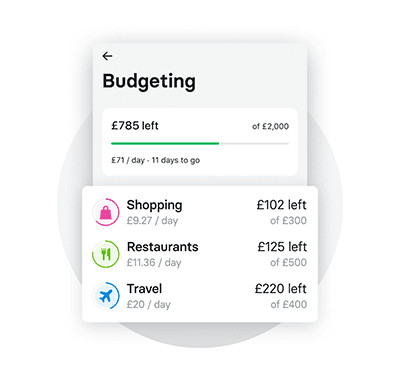
By allowing users to set budget goals and visualize them with progress bars, Revolut uses banking app gamification to give users a tangible sense of control over their money.
#5 Personalized push notifications grow the customer relationship
Revolut leverages banking app gamification by sending personalized notifications that acknowledge user milestones. Whether you have hit a savings goal or just returned from a trip, Revolut sends a quick message to welcome you home. This hyper-personalization is a core component of their customer experience optimization, ensuring that as they grow past 65 million users, each individual still feels a unique connection to the platform.

This personalized "Welcome home" notification is a prime example of how banking app gamification and timely messaging build a stronger, more emotional customer relationship.
StriveCloud’s 2 cents on gamification for mobile banking apps
TL;DR: Revolut’s trajectory to 65 million customers by 2025 proves that gamification is the ultimate engine for user retention. StriveCloud helps you replicate this success by transforming transactional apps into habit-forming experiences, typically resulting in a 23% decrease in churn.
If Revolut’s ability to double its customer base between 2022 and 2024 inspires you to make your banking app more engaging, you’re not alone. In our experience, the transition from "utility banking" to "lifestyle banking" is only possible through behavioral design. According to Revolut's latest growth reports, the bank now serves over 65 million users globally, processing 150 million transactions monthly. This level of activity isn't accidental; it is the result of a gamified ecosystem that rewards consistency.
StriveCloud can help you implement your own gamification strategy in three simple steps:
These gamification strategies aren’t just theoretical for us. We’ve worked with leading fintechs and traditional banks to drive tangible ROI. By focusing on the same psychological triggers that helped Revolut reach 1.1 million daily active users, we’ve managed to achieve results like a 23% decrease in churn and a rize in daily active usage by 58%!
Enrich your own app with fun elements. Check out our app gamification software!
Recap
The growth of digital banks has evolved from a trend into a global standard. As we enter 2026, Revolut has solidified its position as the world's leading banking app with gamification, boasting over 65 million customers across 48+ countries. TL;DR: Revolut dominates by transforming traditional banking into an interactive experience using progress bars, social competition, and real-time rewards, driving 150 million monthly transactions and a 100% user growth rate between 2022 and 2024.
With a forecast to exceed 67 million users by the end of 2025, Revolut is no longer just a challenger bank; it is the market leader. How did they achieve this scale?
Competition is hot, but Revolut is hotter
Standing out as a banking app with gamification is essential in a market with over 30,000 fintech startups worldwide. In our experience, the key to Revolut’s dominance is its aggressive growth trajectory; the company doubled its customer base (a 100% increase) between 2022 and 2024. In specific markets like Australia, they have maintained an average annual growth rate of nearly 100% since 2022.
This relentless expansion is why 80% of banking executives now prioritize improving their digital customer experience to prevent losing market share to neobanks that prioritize engagement over simple utility.
5 features every banking app needs (and how Revolut improves it with gamification examples)
Creating a successful banking app with gamification requires a balance of security and playfulness. With 1.1 million daily active users, Revolut’s strategy offers a blueprint for retention.
#1 An intuitive sign-up. A great time to talk about how secure your app is (a major consumer concern in 2026).
Revolut: To prevent the 70% drop-off typically seen in Day 1 user retention, the sign-up process is presented like an Instagram story, using a progress bar at the top to give users a sense of "advancement."
#2 A clear and motivating onboarding process. Use as few screens as possible to reduce friction.
Revolut: Revolut famously used university leaderboards that encouraged students to sign up in "waves." This utilizes social proof and competition to fulfill the human need for social relatedness.
#3 Payments. Gamify the utility of transactions. Revolut currently processes over 150 million transactions monthly by making the "spend" feel rewarding.
Revolut: When you make transfers, Revolut often rewards you with points or "RevPoints." These points can be used for travel rewards or entry into high-value prize draws, turning a standard payment into a chance to win.
#4 History of transactions. Displaying this is essential to giving users a sense of mastery and financial control.
Revolut: Users set granular budget goals with visual progress bars. As the bar fills or stays green, users feel a sense of "ownership" and achievement over their financial health, rather than just viewing a list of debts.
#5 Push notifications. With real-time info and personalized messages, you create deep customer value.
Revolut: Beyond simple alerts, Revolut uses contextual push notifications like a welcome message when you land in a new country to reinforce the app's role as a "travel companion."
StriveCloud’s 2 cents on gamification for banking apps
Following the formula of Revolut, StriveCloud recently helped a leading Belgian bank modernize its digital experience. Our expert team helped them gamify their app in 3 easy steps:
- A strategy workshop identifying key behaviors to reward, leading to a custom gamification design plan.
- Using our API-first software, we add a seamless layer of gamification over existing banking infrastructure.
- Onboarding & training on how to use gamification analytics to keep users engaged for the long term.
Want to improve your mobile app experience? Accelerate your growth with an action-packed gamification workshop tailored to your app goals!
Keep reading
.avif)
Related Posts

The 6 Stages of the Customer Experience and the Best Ways to Improve Them in 2023
The mobile app market is set to grow 21% every year between 2021 and 2025. So things will not stay the same for long! Given this, your customer experience optimization strategy needs to be the best it can be so that your business is strong and flexible. The Mobile App Funnel can be a great model to assist your journey.

Cake: 5 Gamification Examples That Improve the Fintech User Experience
While physical visits to the banks decreased by 36%, mobile transactions jumped by 121%. The future of online banking is undeniable, and new fintech solutions create new opportunities for banks to engage with their customers. One of those initiatives is Cake. This app gained 120,000 users in just 1 year and shares literal profit with its users. Here's how they did it!