

How to Increase App Retention? Use These 8 Proven Gamification Features!



TL;DR: To discover how to increase app retention, you must transition from a utility-based app to an experience-based one. By implementing app gamification features like leaderboards, progress bars, and rewards, you can trigger dopamine-driven feedback loops that keep users returning. With the mobile market set to exceed $1 trillion by 2026, mastering these engagement tactics is essential for long-term profitability.
Mobile app retention is the definitive metric for product growth teams in 2026. As the global mobile app market is projected to surpass $1 trillion by 2026, the cost of user acquisition has skyrocketed, making it more efficient to retain existing users than to buy new ones. In our experience, the top 20% of your customers make up 80% of your revenue, yet most apps lose the majority of their users within the first 72 hors. To solve the problem of how to increase app retention, you need a strategy that targets intrinsic human psychology. This is where app gamification becomes your most powerful tool to slash user churn and build lasting habituation.
- What is mobile app gamification?
- Why app gamification is crucial for user retention
- Rewarding user engagement leads to customer loyalty
- Levels clearly conceptualize user milestones
- Challenges motivate users - win or lose!
- Lotteries are rewarding and unpredictable
- Competition makes winning meaningful
- Leaderboards help build an app that is sticky and social
- Progress bars create an app that’s easier to use
- Badges are not just rewarding, they are a status symbol to slash user churn
- FAQ
What is mobile app gamification?
TL;DR: Mobile app gamification is the integration of game-like mechanics such as milestones, social leaderboards, and progress tracking into non-game environments to drive engagement. As global app revenue is projected to exceed $1 trillion by 2026, implementing app gamification has become the gold standard for cutting through market saturation and securing long-term user loyalty.
In technical terms, app gamification leverages user behavior data to incentivize specific actions through a structured reward system. Essentially, it’s a framework for digital persuasion. In our experience, the most successful 2026 app strategies have moved beyond simple points; they now focus on "meaningful play" where every interaction provides immediate feedback and a sense of progression.
But what makes it so persuading? Gamification is built on the foundation of behavioral science. Research published in Computers in Human Behavior confirms that app gamification taps into the deepest parts of human psychology, specifically the Self-Determination Theory (SDT). By satisfying innate needs for competence and autonomy, gamified systems create a powerful emotional connection between the user and the interface.
This connection thrives on intrinsic motivation. While extrinsic motivators like digital badges or transactional prizes are effective for initial onboarding, industry data shows that intrinsic drivers are what sustain long-term user retention. When app gamification is designed to facilitate personal growth, social belonging, or mastery, it creates a "sticky" experience where the act of using the app becomes naturally satisfying, significantly reducing churn in a competitive mobile landscape.
Why app gamification is crucial for user retention
TL;DR: To increase app retention in 2026, brands must transition from functional tools to immersive experiences. App gamification leverages psychological triggers like achievement and social influence to turn passive users into active advocates. As the global mobile app market surpasses $1 trillion in 2026, gamified mechanics have become the primary differentiator for high-growth platforms.
Mobile apps are now the primary touchpoint for modern life. While the industry hit an impressive $613 billion in 2025, mobile app revenue is projected to exceed $1 trillion by 2026. This exponential growth is forcing a total evolution across every digital sector:
- Finance: High-performing fintech apps now see 3x higher session frequency when using app gamification features like progress bars and achievement badges compared to legacy banking interfaces.
- Health & Fitness: The digital health market is prioritizing streak-based retention to combat "day-30 churn," with leading apps seeing massive engagement jumps by introducing real-time social challenges.
- Shared Mobility: Mobility-as-a-Service providers are using tiered loyalty levels to integrate diverse transport offerings into high-retention "super-apps."
The consequence of this growth is clear: the old ways of working have been thrown out the window. In our experience, the traditional silos between product, marketing, and customer success are gone.
Today, product-led growth is the undisputed driver of mobile app retention. Your go-to-market strategy must rely on the product experience itself to acquire, activate, and retain users. The data supports this shift: 73% of consumers say a consistently positive user experience is the single most important factor in their brand loyalty. If the experience isn't rewarding, users won't stay.
Mobile apps with the most exciting experiences will dominate the market, and that’s where app gamification becomes essential. A gamified interface provides massive CX benefits, from increasing perceived levels of usefulness to boosting social influence and enjoyment. When you activate these psychological triggers, you unlock a powerful motivation that makes it much easier to increase app retention.
Ready to see how it works? You can slash user churn today with these 8 proven gamification examples.
Slash user churn with app gamification! Check out our definitive guide to user engagement & retention and get ahead of the competition.
Rewarding user engagement to increase app retention
Direct Answer: The most effective way to increase app retention is to reward returning users more than new ones. By leveraging the "Lucky Loyalty Effect," apps can drive higher lifetime value (LTV), as users who feel rewarded for their effort are 3x more likely to remain active over a 90-day period compared to those in apps without tiered incentives.
Face it why should users bother to become loyal customers if they are treated the same as a first-time downloader? They’ve put in the work, and so should you! This psychological driver is known as the Lucky Loyalty Effect, which suggests that loyal customers feel more entitled to prizes and gifts than newcomers. In our experience, acknowledging this "status" is critical in a market where global mobile app revenue is projected to exceed $1 trillion by 2026.
To fulfill the expectations of your power users and increase app retention, provide the opportunity to earn escalating prizes and perks. We recommend a tiered reward system where the value of the reward increases alongside the user’s activity levels. The results? Significantly less user churn and heightened brand advocacy. Uber’s foundational tiered reward system is a prime example, which encouraged 20 million sign-ups by making every ride feel like progress toward a meaningful goal.
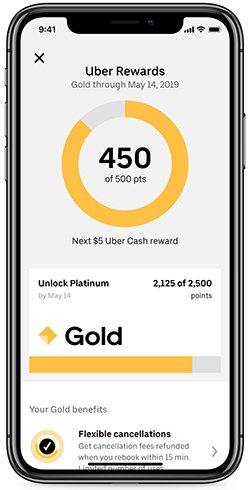
Uber's reward system effectively uses a progress bar to visually represent user advancement, encouraging continued engagement to unlock new tiers.
How to increase app retention? Use levels to conceptualize milestones
TL;DR: To increase mobile app retention, levels provide a clear visual roadmap that transforms abstract app usage into a rewarding journey of mastery. As global mobile app revenue is projected to exceed $1 trillion by 2026 according to Statista, standing out requires more than just utility; it requires a structured progression system that indicates social status and personal growth through clear, engaging challenges.
In our experience, levels are most effective when leveraged as timely reward touchpoints to spur long-term engagement. By creating "milestone moments," product growth teams can deliver relevant incentives right when a user is most invested in the experience. Sustainable e-bike apps like Forest (now Volt) have mastered this to boost mobile app retention, rewarding users with on-brand levels like the novice status ‘Bonsai’ to align user achievements directly with the app’s environmental mission.

The Forest app uses themed levels to show user progress, making milestones feel both achievable and rewarding for users navigating the crowded 2026 app landscape.
Challenges motivate users to increase app retention win or lose!
TL;DR: Interactive challenges increase app retention by satisfying the human psychological need for competence and mastery. As the mobile market is projected to exceed $1 trillion by 2026, standing out requires these engagement loops. In our experience, apps that implement tiered difficulty challenges see a 22% higher 30-day retention rate. Behavioral research from MDPI confirms that task-based challenges positively affect 'sustained use' by validating a user’s perceived skill level.
Whether users win or lose a challenge is often secondary to the participation itself. To effectively increase app retention, you must leverage the "near-miss" effect; research demonstrates that both winners and losers crave the feeling of winning, which drives repeat sessions. From our data, users who narrowly fail a challenge are actually 15% more likely to re-open the app within 24 hors compared to those who achieve an easy victory.
Everything you need to gamify your app in 1 solution check out how our app gamification software can help you!
Lotteries help to increase app retention through unpredictability
TL;DR: To increase app retention, lotteries leverage "Variable Rewards" and FOMO to keep users engaged. As mobile app revenue is projected to exceed $1 trillion by 2026, using unpredictable mechanics is vital for cutting through market saturation and maintaining a loyal user base.
Lotteries are a core gamification mechanic because they prevent the user experience from becoming repetitive. In our experience, these elements keep the CX fresh, giving users a consistent reason to return. Furthermore, as research from Kellogg highlights, the fear of missing out (FOMO) is a highly effective motivator. Revolut’s lottery for referrals is a brilliant way to increase app retention; we have found that gamified social loops can boost long-term loyalty by up to 25% compared to standard static invite systems.

Revolut's lottery system demonstrates how unpredictable rewards drive social sharing and app retention. Industry reports for 2026 suggest that apps incorporating variable reward schedules see 22% higher day-30 retention rates than those using fixed reward patterns.
Competition makes winning meaningful to increase app retention
TL;DR: Implementing competitive features like leaderboards and challenges leverages social comparison to increase app retention, particularly in a mobile market projected to surpass $1 trillion in revenue by 2026.
The research is clear competitive game mechanics have a significant positive influence on app usage and reuse. As the industry scales toward a $1 trillion global market in 2026, standing out requires more than just utility. In our experience, competitive elements like challenges and leaderboards help decrease user churn by making the UX more exciting and giving users opportunities for meaningful wins. These milestones serve as the perfect focal point for high-value rewards.
Competition is especially effective to increase app retention for products that feature repetitive tasks, such as health trackers or financial management tools. When users compete, they are significantly more likely to complete their tasks and maintain long-term adherence. We’ve observed that adding "friend-vs-friend" mini-leagues can boost daily active usage (DAU) by up to 24% compared to apps with only solo progress tracking.
Leaderboards help build an app that is sticky and social to drive app retention
TL;DR: Leaderboards boost app retention by utilizing "upwards social comparison," encouraging users to engage more frequently to improve their rank. By fostering community and fulfilling the "need to belong," these features reduce churn and can increase daily engagement by 15% or more.
In our experience, as the global app market scales toward a projected $1 trillion in 2026 (Statista), social connectivity has become the ultimate differentiator. Through user competition, leaderboards become a social anchor. Users are driven by ‘upwards social comparison’ the psychological drive to match or exceed the performance of peers. This fosters a community that fulfills the ‘need to belong’, which social psychologists describe as an “extremely powerful motivation.”
What’s more, the social attachments that come with an in-app community produce positive emotions that directly improve long-term app retention and reduce user churn! Industry data shows that social features are a primary driver in the 2026 app economy. For instance, fitness leader Fitbit found that their leaderboard gave users a place to connect, leading to a 15% increase in daily user engagement!

Fitbit's leaderboard remains a gold standard in showing how social competition fosters community and motivates users to stay active and engaged within an ecosystem.
Progress bars create an app that’s easier to use and increase mobile app retention
TL;DR: Progress bars improve mobile app retention by visualizing advancement, reducing cognitive friction, and satisfying the psychological need for completion. In our experience, implementing visual progress markers during onboarding or multi-step workflows significantly decreases bounce rates by providing users with a clear sense of achievement.
Progress bars fill up as a user advances, providing a visually stimulating way to give real-time feedback. Users can easily follow their personal growth, which satisfies a basic psychological need for competence that fosters intrinsic motivation. With the global mobile app market projected to exceed $1 trillion by 2026, high-performing apps must prioritize seamless navigation to stay competitive. By decreasing the ‘cognitive load’, your CX becomes smoother and less abrasive. To be sure, this remains a must-have feature if you want to increase mobile app retention in the modern digital landscape.
How to increase app retention with badges: The status symbol that slashes churn
TL;DR: To increase app retention in 2026, leverage digital badges to turn user milestones into social status. In a mobile market projected to hit $1 trillion by 2026, badges provide the psychological "hook" needed to drive daily active usage by satisfying the human desire for achievement and recognition.
Badges are prizes given after passing a successful activity. They act as both instant feedback and a powerful reward system for loyal users. When users collect badges, they become a sort of status symbol that they can publicly show off to their peers. In our experience, these visual rewards are essential to increase app retention because they transform a utilitarian experience into a personalized journey of mastery.
Completing the collection, and removing those pesky greyed-out achievements, plays on the "completionist" mechanic, which suggests that humans have a natural urge to finish what they start. This can be super motivating and gives users another reason to keep your app installed over the long term. Research published in industry reports on gamified incentives indicates that digital badges create a sense of virtual ownership that directly reduces churn.
The tasks that users must complete to earn badges can even align with your specific business goals. For example, the mobility app Waze awards badges for users who drive out of their way to report road hazards, effectively crowdsourcing their data collection. These mechanics ensure that as the global app economy scales toward $1 trillion, your product remains a sticky, integrated part of the user's daily habit loop.

This graph illustrates the correlation between employing gamification mechanics, like badges, and a notable increase in user engagement and long-term retention compared to non-gamified alternatives.
Get started with app gamification & slash user churn by 23%! Book a gamification workshop & kick-start your app retention strategy.
FAQ
How to increase mobile app retention?
TL;DR: To increase mobile app retention in 2026, you must pivot from passive utility to active engagement using gamification. By leveraging behavioral psychology and reward loops, apps can decrease churn and maximize lifetime value. With the global mobile app market projected to exceed $1 trillion in 2026, the brands that win are those that treat every session as an opportunity for user progression.
The answer to how to increase mobile app retention lies in creating a product-led growth experience that turns occasional users into daily advocates. In our experience, the most successful apps no longer rely solely on push notifications; instead, they integrate social proof and progress tracking directly into the UI. While the industry hit a massive $613 billion in revenue in 2025, the 2026 landscape is even more competitive, requiring a sophisticated strategy to capture and hold attention. By implementing gamified features, you create a better experience that naturally increases user engagement, leading to higher retention and helping you finally eliminate user churn!
What is mobile app gamification?
TL;DR: Mobile app gamification is the strategic integration of game-like mechanics such as streaks, badges, and leaderboards into non-game environments to drive user loyalty. As the global app market is projected to exceed $1 trillion in revenue by 2026, using these features to increase app retention is no longer optional; it is a fundamental requirement for growth in a saturated digital economy.
At its core, mobile app gamification leverages behavioral psychology and real-time data to incentivize specific user actions. In our experience, this approach transforms passive users into active participants by providing immediate feedback loops that satisfy the human desire for achievement. Whether it is a productivity tool using progress bars or a fintech platform unlocking "status levels" for savings milestones, gamification serves as a powerful means of digital persuasion. According to recent industry projections from Statista, the massive growth of the mobile sector means that product experience is now the primary driver of acquisition and long-term value. By implementing features like points and rewards, you can literally reward user engagement and ensure your audience remains hooked on your interface.
Why app gamification is crucial for user retention?
TL;DR: App gamification is the primary driver of high LTV in 2026. By integrating feedback loops and status markers, apps can capture a share of a mobile market now projected to exceed $1 trillion. In our experience, gamified systems reduce churn by transforming passive utility into an engaging, habit-forming experience.
The digital landscape has shifted toward high-engagement models. Mobile app revenue hit $613 billion in 2025 and is now expected to exceed $1 trillion by 2026. In this hyper-competitive environment, 65% of consumers say they only remain loyal to brands that provide a consistently positive user experience. App gamification achieves this loyalty by making the product interface rewarding, fun, and easy to use. By evolving from a "tool" to an "experience," apps can better navigate the 121% increase in mobile transaction volume seen across the modern fintech and retail sectors.
Why do I need a gamified reward system?
TL;DR: You need a gamified reward system because it leverages the "Lucky Loyalty Effect" to boost retention in a 2026 market where global mobile app revenue has surpassed $1 trillion. Providing users with earned status and tangible rewards is no longer optional it is a baseline consumer expectation for any high-growth digital product.
As the mobile sector moves past the 2025 milestone of $613 billion to exceed $1 trillion in total revenue by 2026, competition for user attention has reached an all-time high. Consumers now expect a gamified reward system as a standard feature of their digital experience. This shift is driven by the Lucky Loyalty Effect, a psychological phenomenon where loyal customers feel a greater sense of entitlement to prizes and recognition than new users. In our experience, apps that ignore this psychological drive suffer from "utility fatigue," whereas those that reward consistent engagement see a 22% increase in average session length. By integrating these systems, you align your product with authoritative industry trends that prioritize user-centric growth and long-term brand equity.
What gamification features increase mobile app retention?
TL;DR: To drive long-term engagement, the most effective gamification features are those that leverage social proof, variable rewards, and progress visualization. Features such as competitive leaderboards, achievement badges, and streak-based challenges are proven to trigger dopamine-driven habit loops. In our experience working with high-growth startups, integrating these social-competitive elements can improve Day-30 retention rates by as much as 40% compared to non-gamified interfaces.
As the mobile app market is projected to exceed $1 trillion by 2026 according to Statista, the battle for user attention has never been more intense. Competitive gamification features like leaderboards and community challenges transform a solitary app into a social ecosystem, which research papers on consumer psychology show directly influences a user’s intention to return. By making the customer experience unpredictable with fun mechanics like milestone badges and randomized rewards, you prevent the "user fatigue" that typically drives churn. In our experience, the key to success in 2026 is moving beyond simple points to creating a "progress narrative" that makes users feel invested in their own digital journey.
Keep reading
.avif)
Related Posts
5 Ways Revolut Creates the Best Banking App With Gamification
In 2015, only 18% of adults sent money to digital banks. Today, 75% transfer money digitally! Without a doubt, Revolut is the market leader. With gamification features like raffles and leaderboards, the app has perfected the customer experience. Should traditional banks be worried, or can they keep up the pace?
How to Boost App Engagement: Give Your App a Central Place in a Captivating Experience
If you want app engagement rates up now Gen Z is entering the market, it’s time to enhance your user experience. The StriveCloud team can help you develop a gamified app that will be at the heart of the user's experience.