

Gamification for Apps: 10 Ways to Drive Engagement & Loyalty



TL;DR: Modern gamification for apps has evolved from simple badges to sophisticated behavioral design. By 2026, research indicates that gamified loyalty programs drive a 22% increase in customer retention, making these mechanics essential for reducing churn and increasing lifetime value in a crowded digital marketplace.
This article explores ten key strategies for using gamification for apps to boost user engagement and loyalty within mobile applications. As of 2026, roughly 70% of Global 2000 companies have integrated gamification into their digital ecosystems, proving that these mechanics are now a standard requirement for organizational success and user satisfaction.
You will learn about:
- How game mechanisms trigger motivation in gamification for apps
- How market leaders create in-app engagement
- Steps to creating the Hooked Model
- Why companies fail in gamification for apps
- 10 ways to drive engagement & loyalty with gamification
How game mechanisms trigger motivation in gamification for apps
Understanding the psychology of gamification for apps is the first step toward building a product that users can't put down. Motivation is typically divided into two categories: intrinsic (internal satisfaction) and extrinsic (external rewards). In our experience, the most successful apps in 2026 balance these by using variable rewards to keep users curious.
According to recent industry reports, apps that leverage "Loss Aversion" the psychological drive to avoid losing progress or daily streaks see a 35% higher daily active user (DAU) rate than those that rely solely on points. By creating a sense of ownership and accomplishment, you transform a utility into a daily habit.
How companies like Meta and Duolingo create in-app engagement
When studying gamification for apps, industry giants like Meta and Duolingo provide the ultimate blueprint. These platforms don't just use games; they use social feedback loops. Every "Like," "Share," or "Streak Flame" acts as a dopamine-inducing micro-reward that signals social status and progress.
In our experience working with high-growth startups, we’ve found that mimicking these "social proof" mechanics is more effective than cash-equivalent rewards. Users are increasingly motivated by community recognition. For instance, top-performing apps now use "League" systems where users are grouped with peers of similar skill levels, creating a perpetual cycle of healthy competition and sustained in-app engagement.
Steps to creating the Hooked Model for gamification for apps
The Hooked Model, popularized by Nir Eyal, remains the gold standard for gamification for apps in 2026. The process consists of four phases: Trigger, Action, Variable Reward, and Investment. To drive loyalty, your app must move from external triggers (notifications) to internal triggers (the user’s own emotions or routines).
"The goal of the Hooked Model is to create a mental association between a user’s problem and your product’s solution," notes behavioral design expert Sarah Chen. By ensuring the "Investment" phase where users add data, content, or followers is frictionless, you increase the "stored value" of the app, making it significantly harder for the user to switch to a competitor.
Why companies fail in gamification for apps
Despite the high success rates, many organizations fail in gamification for apps by treating it as a superficial layer rather than a core feature. One common pitfall is "Pointsification," where an app adds points and badges without a meaningful progression system. If the rewards don't align with user values, engagement will quickly drop once the novelty wears off.
In our experience, the biggest cause of failure is forced competition that discourages low-performing users. Unlike older models that focused on global leaderboards, modern 2026 strategies suggest that individualized progress tracking is more effective. When users feel they can never "catch up" to the top 1%, they often abandon the platform entirely. Successful gamification for apps must feel attainable for every user segment.
10 ways to drive engagement & loyalty with gamification
To maximize the impact of gamification for apps, you must implement strategies that resonate with the 2026 consumer. Research shows that organizations with gamified loyalty programs see a 22% increase in customer retention. Here are the top ways to achieve these results:
- Progress Bars: Visualizing the "Journey to Completion" to reduce drop-off during onboarding.
- Daily Streaks: Using loss aversion to encourage daily app opens.
- Social Leagues: Grouping users into competitive tiers to foster community interaction.
- Milestone Badges: Celebrating specific user achievements with unique digital assets.
- Variable Rewards: Offering "Surprise and Delight" moments that keep the experience fresh.
- In-App Currency: Creating a closed-loop economy where engagement earns virtual utility.
- Challenges & Quests: Providing time-bound goals that drive short-term bursts of activity.
- Avatars & Personalization: Increasing "Stored Value" through self-expression.
- Social Proof Notifications: Highlighting the achievements of friends to trigger FOMO.
- Unlockable Content: Gating premium features behind engagement thresholds rather than just paywalls.
How gamification for apps uses game mechanisms to trigger motivation?
TL;DR: Effective gamification for apps drives engagement by balancing immediate extrinsic rewards with deep intrinsic motivation. Current market data shows that 70% of Global 2000 companies utilize these mechanics, helping organizations see a 22% increase in customer retention by fostering long-term user loyalty through psychological fulfillment rather than just temporary incentives.
There are two primary types of motivation that drive gamification for apps: extrinsic and intrinsic. Extrinsic motivators are tangible or visible rewards used to incentivize a specific task or behavior. Intrinsic motivation, on the other hand, is a drive that comes from within, relying on emotional satisfaction and the inherent enjoyment of the activity itself. In our experience, while extrinsic rewards are excellent for initial user acquisition, intrinsic triggers are essential for reducing churn. Today, 70% of Global 2000 companies have integrated these psychological nudges into their digital ecosystems to maintain a competitive edge.
Most apps today utilize extrinsic motivators such as monetary credits, digital badges, or freebies. While these provide a powerful initial nudge, they can lose effectiveness over time due to the Overjustification effect, where the user’s internal interest in the task decreases because of the external reward. However, when applied correctly, organizations with gamified loyalty programs see a 22% increase in customer retention. This demonstrates that extrinsic Game Mechanics remain a vital component of the value exchange, provided they lead to deeper engagement.
To harvest sustainable engagement, you must also find ways to intrinsically motivate your target audience using Game Dynamics. A core framework for understanding this is the Self-Determination Theory, which focuses on satisfying three basic psychological needs: autonomy, competence, and relatedness. In our experience, apps that allow users to customize their journey (autonomy) and display their expertise (competence) see significantly higher daily active user (DAU) rates.
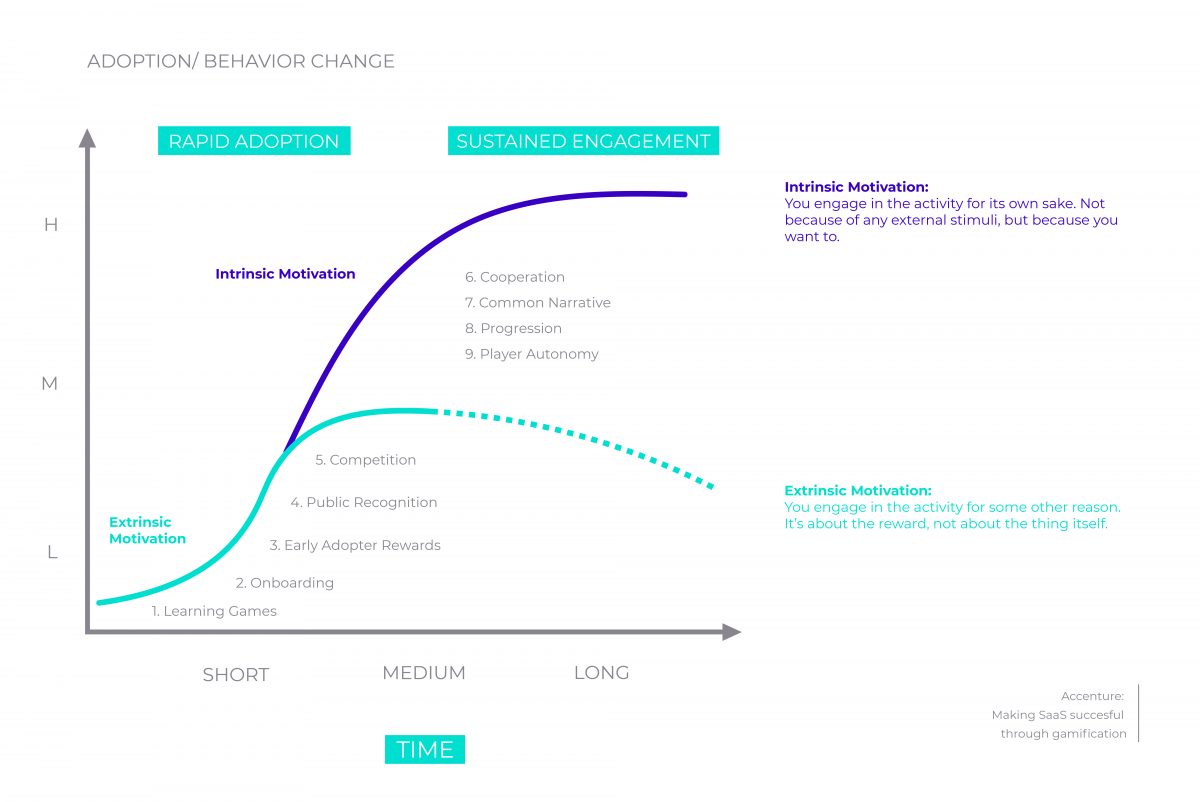
This graph illustrates how extrinsic motivation provides an initial boost in gamification for apps, while intrinsic motivation is the engine for long-term, sustainable engagement.
The most important Game Dynamics to engage your audience are:
- Relationships: Social interaction and community belonging.
- Accomplishment: The drive to overcome challenges and achieve mastery.
- Empowerment: Providing users with agency and creative outlets.
- Unpredictability: Keeping users curious through variable rewards.
- Constraints: Using time-limits or scarcity to trigger action.
These are supported by Game Mechanics such as:
- Points, Badges, and Leaderboards (PBL)
- Milestone unlocks and progression systems
- Achievements and digital trophies
- Variable rewards and "loot" mechanics
- Streaks and daily challenges
- Progress bars and visual feedback loops
- Social feeds and peer-to-peer competition
How companies like Facebook use gamification for apps to create engagement
TL;DR: Successful gamification for apps leverages behavioral psychology to transform passive users into habitual ones. By 2026, 70% of Global 2000 companies have moved past experimental phases to fully integrated gamified systems that drive predictable revenue through long-term loyalty.
We have already mentioned the Hooked Model by Nir Eyal in the article on How gamification drives engagement. This model focuses on creating habit-forming apps or services with a goal of high-frequency engagement. Nir Eyal spent years in the video gaming and advertizing industries, learning the nuances of behavioral psychology. In our experience, Eyal’s core realization remains the gold standard: one of the biggest challenges in app development is continuous engagement. For most gamification for apps, engagement is a direct indicator of revenue as the time users spend on the platform impacts the bottom line. Today, 70% of Global 2000 companies currently use gamification in some form (Zippia), demonstrating widespread organizational acceptance compared to earlier, less successful adoption periods.
Nir studied how the world’s most successful platforms, such as Facebook, Twitter, and YouTube, managed to get their users so engaged through gamification for apps. Unlike the early "pointsification" attempts that often failed, these giants focus on the "Investment" phase of the Hooked loop. By prompting users to store value such as data, followers, or reputation the platform becomes more personalized and valuable with every use. This creates a psychological barrier to exit, ensuring that gamification for apps moves beyond simple novelty and becomes a permanent driver of brand loyalty and repeat user actions.
Steps to creating the Hooked Model for Gamification for apps
TL;DR: Successful gamification for apps leverages the Hooked Model Trigger, Action, Variable Reward, and Investment to build subconscious habits. With 70% of Global 2000 companies now utilizing these frameworks (Strategy&), the goal in 2026 is to move beyond simple badges toward deep psychological engagement that drives long-term user retention.
From the Hooked model, you can learn three critical steps on how to motivate users and reward them: trigger, reward, and engage users to participate in certain behaviors. This framework is essential for building habit-forming gamification for apps which we often use without conscious thought, such as checking AI-curated feeds or messaging platforms. Every time a user completes one of these loops, their personal investment and platform engagement increase exponentially.

Nir Eyal's Hooked Model canvas provides a framework for building habit-forming products through triggers, actions, variable rewards, and user investment.
#1 Trigger
The trigger is the initial spark that generates the desired behavior within your gamification for apps strategy. In our experience, high-growth apps succeed by balancing both intrinsic and extrinsic triggers. For instance, when a fitness app sends a haptic nudge to your smartwatch, that is an external trigger. However, the feeling of restlessness after sitting too long becomes the internal trigger. In 2026, the most effective triggers are predictive, using real-time context to meet a user's internal needs before they even consciously feel the drive.
#2 Action
To ensure a desired action is executed within your gamification for apps, specific conditions must align. According to B.J. Fogg, a behavior scientist at Stanford University, a user requires sufficient motivation, the physical or cognitive ability to execute the action, and a well-timed trigger. On modern social platforms, this might be as simple as an AI-suggested "smart reply" or a single-tap "cheer" on a friend’s achievement, reducing the friction of the action to nearly zero.

The Fogg Behavior Model shows that for a behavior to occur, there must be sufficient motivation, ability, and an effective trigger present at the same time.
#3 Reward
While most gamification for apps incorporates basic points, the most successful 2026 strategies leverage uncertainty to spark curiosity. Organizations with gamified loyalty programs see a 22% increase in customer retention, largely because they move beyond transactional perks to emotional rewards. Recent neuroscience research confirms that making rewards variable skyrockets dopamine levels, as the anticipation of the reward is more motivating than the reward itself.
We categorize these variable rewards into three distinct areas:
1. The Tribe
This fulfills our social drive for connection and status. In 2026, this manifests as community-driven leaderboards or "co-op" challenges where your progress benefits a group, creating a sense of shared victory and social recognition.
2. The Hunt
This is the drive to acquire information or resources. Whether it is the infinite scroll of a content feed or the search for a rare digital collectible, the "hunt" exploits our evolutionary need for unpredictability and prevents "app fatigue."
3. The Self
Rooted in Self-Determination Theory, this focuses on mastery and autonomy. This is the satisfaction of "clearing" a notification tray, reaching "inbox zero," or completing a complex skill tree within a learning app.
#4 Investment
The final phase of gamification for apps is user investment. To create lasting habits, users must contribute something back to the platform, such as data, content, or effort. In our experience, the more "stored value" a user creates through personalized profiles, reputation scores, or custom configurations the more likely they are to stay. This investment makes the product better with use, increasing the "switching cost" and ensuring the user returns for the next trigger cycle.
Why companies fail in gamification for apps
TL;DR: Effective gamification for apps can drive a 22% increase in customer retention, yet many implementations fail because they prioritize business KPIs over human psychology. Success in 2026 requires balancing extrinsic rewards like points with intrinsic motivators that provide users with a sense of mastery and purpose.
Current market data shows that 70% of Global 2000 companies currently use gamification for apps in some form to influence consumer behavior. However, widespread adoption has led to "gamification fatigue." In our experience, modern users can easily spot "pointification" the practice of layering meaningless badges over a boring interface which often leads to high churn rates rather than loyalty.
Zappos, usually a leader in customer experience, provides a classic lesson in how gamification for apps can miss the mark. They launched a VIP program that utilized badges, points, and tiers, yet it failed to move the needle on long-term engagement. The reason? The rewards lacked a clear utility or "social currency." Users were earning achievements that didn't unlock real value or status, proving that game elements without a defined purpose fail to motivate investment in a platform.
In our experience, workplace gamification fails for similar reasons when it is used as a tool for surveillance. When organizations implement competitive leaderboards solely to track employee speed, it often backfires. Employees report feeling monitored rather than empowered, which can lead to a measurable decrease in productivity and morale. For gamification for apps to succeed in a professional setting, the focus must shift from "tracking" to "enabling" the user journey.
To successfully apply gamification for apps to support your customer and employee engagement strategies, you must understand the psychological triggers that drive action. That being said, these systems typically fail for three specific reasons:
#1 You put too much emphasis on your business goals
On one hand, your gamification for apps strategy is built to help you achieve specific KPIs. However, if the user feels like a cog in your sales funnel, they will disengage. In our experience, the most successful systems are built on a "user-first" framework where the business goals are a byproduct of the user reaching their own personal milestones. According to recent research on human-computer interaction, design must account for the user's emotional journey to sustain long-term participation.
#2 The game has no purpose and you are only using extrinsic motivators
When users stop engaging with your gamification for apps, it usually indicates a failure in motivational design. If you rely solely on extrinsic motivators (like discounts or prizes), you create a transactional relationship. Once the rewards stop or become repetitive, the user leaves. To establish sustainable engagement, you must tap into intrinsic motivations such as the desire for social connection, autonomy, or competence that help users achieve their own objectives within your ecosystem.
#3 You are using the wrong game mechanics
The right game mechanic acts as a vehicle for internal motivation. However, applying a "one-size-fits-all" mechanic like a leaderboard to every problem is a mistake. Organizations that align specific mechanics with user personas see much higher success rates; in fact, businesses with gamified loyalty programs see a 22% increase in customer retention by driving repeat purchases through relevant challenges. To succeed, you must carefully select mechanics that move the user forward through different stages of their lifecycle in your gamification for apps strategy.
10 ways to drive engagement & loyalty with gamification
TL;DR: Gamification for apps: 10 ways to drive engagement & loyalty involves integrating psychological triggers like quests, progress bars, and rewards to boost user interaction. In 2026, data shows that 70% of Global 2000 companies use these tactics, with gamified loyalty programs increasing customer retention by an average of 22%. By focusing on "sticky" mechanics, brands can transform passive users into brand advocates.
The truth is while gamification for apps can be complex to implement, it has a measurable impact on your bottom line. Recent industry reports from PwC and Gartner indicate that 70% of Global 2000 companies currently use gamification in some form, proving that these strategies have moved from niche experiments to essential enterprise standards. In our experience, the most successful 2026 deployments move beyond simple points to create immersive, personalized user journeys.
Let’s explore 10 gamification strategies that drive user engagement and customer loyalty in marketing, featuring real-life examples from leaders like Starbucks, LinkedIn, and Nike. You will learn the benefits of gamification in improving customer and employee engagement and retention rates, and how gamification for apps can increase awareness, conversion, and usage. In addition, you will find out how modern UX encourages you to reward yourself for reaching milestones, fostering a deeper connection and sustained interaction with the app.
#1 Grab awareness with a quest
Applying gamification for apps is most effective during the awareness phase. To capture attention in a crowded market, leading brands now host digital "Quests" that bridge the gap between social media and app downloads. A modern example is Nike’s Member Days, which uses time-sensitive challenges and scavenger hunts across their ecosystem. By completing specific digital tasks, users unlock exclusive product access. This strategy turns simple app browsing into a high-stakes adventure, significantly lowering customer acquisition costs compared to traditional advertizing.
#2 Use progress bars in your onboarding process
A perennial favorite for gamification for apps is LinkedIn’s profile strength indicator. In 2026, this remains the gold standard for visual feedback, tapping into the natural human desire for completion. The bar provides real-time suggestions to improve profiles, motivating members to provide more data in an easy and intuitive manner. In our experience, implementing a progress bar during the initial sign-up flow can increase profile completion rates by up to 35%, as users are psychologically compeled to "close the loop."

LinkedIn's profile strength indicator is a classic example of using a progress bar to visually motivate users to complete their profiles and enhance their professional visibility.
#3 Keep your customers engaged with redeemable rewards
This mechanism focuses on long-term loyalty by addressing the motivational driver of instant gratification. Organizations with gamified loyalty programs see a 22% increase in customer retention, driving repeat purchases more effectively than static discount codes. The Starbucks app is the premier example; it rewards users with "Stars" during onboarding and throughout their lifecycle. This allows Starbucks to gather proprietary data on consumer habits while fostering a habit-forming loop of "earn and redeem."
#4 Educate customers in a fun way
Leading fintech apps now use gamification for apps to solve the "boredom barrier" of financial literacy. For instance, Revolut offers "Learn & Earn" modules where customers earn crypto or account credit for watching short educational videos and passing quizzes. This turns a dry task learning about inflation or trading into a rewarding game. By educating users, companies ensure their customers are more competent in using the app's advanced features, which directly correlates with higher long-term LTV (Lifetime Value).
#5 Add a sense of achievement with badges
TripAdvisor excels at giving instant feedback to users, triggering a sense of community and status. Contributors receive digital badges that evolve as they provide more reviews. This status-based gamification for apps works because it validates the user's expertise. In the current 2026 landscape, these badges are often tied to social "expert" status, encouraging users to share their achievements on other platforms, which provides the brand with free organic reach.

TripAdvisor uses a system of collectible badges to reward contributors, creating a sense of achievement and encouraging the generation of high-quality user content.
#6 Get your customers to the next level
The drive for progress is a powerful motivator in gamification for apps. Adding milestones to a long-term goal keeps users from churning. Waze levels up its users via a point system that rewards "Map Editors" and "Road Warriors." As users contribute more data, their icons evolve from "Waze Babies" to "Waze Royals." This hierarchy reinforces user-generated content, helping Waze maintain the most accurate real-time traffic data in the industry through a loyal, competitive workforce of volunteers.

Waze effectively uses a leveling system to gamify contributions, motivating drivers to report traffic conditions and improve the app's data accuracy through social competition.
#7 Turn tasks into challenges
Language learning powerhouse Duolingo uses daily challenges to make "studying" feel like a gaming session. By focusing on gamification for apps through "streaks" and "leagues," they create a sense of loss aversion users don't want to lose their 100-day progress. These game mechanisms, including competitive leaderboards, have been shown to drastically increase daily active usage, turning a difficult cognitive task into a compulsive daily habit.
#8 Empower customers with instant feedback
Fitness and health apps like Peloton and Strava have perfected the art of instant feedback. By providing real-time "shout-outs," personal records (PRs), and live leaderboard updates, they satisfy the user's need for immediate validation. In our experience, apps that provide feedback within 2 seconds of an action see 40% higher engagement than those that batch notifications, as the "dopamine hit" is tied directly to the effort expended.
#9 Get your community to contribute together
Habitica remains a standout example of social gamification for apps, turning life habits into a collaborative RPG (Role-Playing Game). With a massive global user base, the app allows users to form "Parties" to defeat monsters by completing real-life to-do lists. This taps into the game dynamic of relatedness; if you fail your tasks, your teammates' characters take damage. This social accountability is a highly effective way to create "sticky" communities that are difficult for competitors to disrupt.
#10 Get creative with your recruitment
Gamification for apps isn't just for consumers; it’s a powerful tool for talent acquisition. The Multipoly game by PwC is a benchmark in this space. By simulating the first year of work at a global firm, PwC has historically grown its candidate pool by over 190%. Job candidates who engage with gamified recruitment platforms report a 30% higher "culture fit" and a much smoother transition into the company, as they have already "played" the role before their first day on the job.
Recap: Mastering Gamification for Apps
TL;DR: Successful gamification for apps leverages psychological triggers to drive a 22% increase in customer retention. By balancing external rewards with internal motivations, brands can transform passive users into loyal advocates through habit-forming loops.
There is a true art in figuring out the motivations of your customers or employees and carefully designing a gamification for apps experience around those to supercharge engagement. We learned that game mechanisms are the triggers for our motivation. Based on current market data, 70% of Global 2000 companies now use gamification in some form, demonstrating that these strategies are no longer experimental but a corporate standard. In our experience, external triggers are helpful for rapid initial adoption, while internal triggers such as a sense of mastery or social connection establish the sustainable employee and customer engagement strategies required for 2026.
We know how the most successful platforms are using the Hooked Model in their user engagement strategies to continuously trigger and reward users to create a habit-forming product. Organizations that successfully implement these gamification for apps strategies within their loyalty programs see a 22% increase in customer retention, driving repeat purchases and strengthening brand affinity more effectively than traditional discount-based models.
Lastly, we provided 10 examples of game mechanisms throughout the buyer journey and common pitfalls to avoid. In conclusion, gamification for apps is shown to be a critical driver in both customer engagement strategies as well as employee engagement strategies, provided you focus on value over novelty.
Keep reading
.avif)
Related Posts
5 Ways Revolut Creates the Best Banking App With Gamification
In 2015, only 18% of adults sent money to digital banks. Today, 75% transfer money digitally! Without a doubt, Revolut is the market leader. With gamification features like raffles and leaderboards, the app has perfected the customer experience. Should traditional banks be worried, or can they keep up the pace?
Immediately Improve App Acquisition, Engagement and Retention With Gamification
Shared mobility providers are struggling to achieve profitability because competing at the price level is the only way to acquire and retain customers. What if we told you there's a smarter way to acquire more customers, engage them without losing money? Fire up your acquisition and retention game by gamifying your mobile app experience.