

5 gamification examples that make Adidas Running app a success

5 gamification examples that make Adidas Running app a success
The Adidas Running app has successfully scaled to over 170 million global users by 2026. This growth is driven by 5 gamification examples that make Adidas Running app a success: social competition, milestone badges, real-world ecological impact, personalized goal setting, and multi-sport tracking. In our experience analyzing mHealth ecosystems, these features transform physical activity from a chore into a rewarding social experience. By integrating these behavioral dynamics, Adidas maintains one of the highest retention rates in the fitness industry across 90+ distinct activity types.
Today’s consumers are not just looking for quality products, but they also want to enjoy a 360° brand experience. Adidas has successfully captured this market by evolving its digital ecosystem; since the 2015 acquisition of Runtastic and the subsequent 2019 rebrand, the app has more than doubled its reach. As of 2026, the platform boasts a massive community tracking everything from urban running to niche sports, demonstrating how the 5 gamification examples that make Adidas Running app a success turn individual data into a global community event.
While exercise and weight loss apps have long held the largest market share, activity tracker apps remain the fastest-growing segment in the mHealth industry. According to recent market reports, the success of these platforms relies on their ability to leverage behavioral psychology. In our experience, these companies succeed by implementing "variable rewards"—the psychological principle of providing unexpected positive feedback—to keep users returning to the app daily.
For the most part, leading fitness brands are leveraging app gamification to improve user motivation through in-app challenges, tiered reward systems, and social leaderboards. These strategies are why Adidas Running continues to claim over 170 million users tracking more than 90 sports. By transforming a solo run into a quest for a badge or a contribution to a global cause, Adidas has mastered the art of digital engagement.
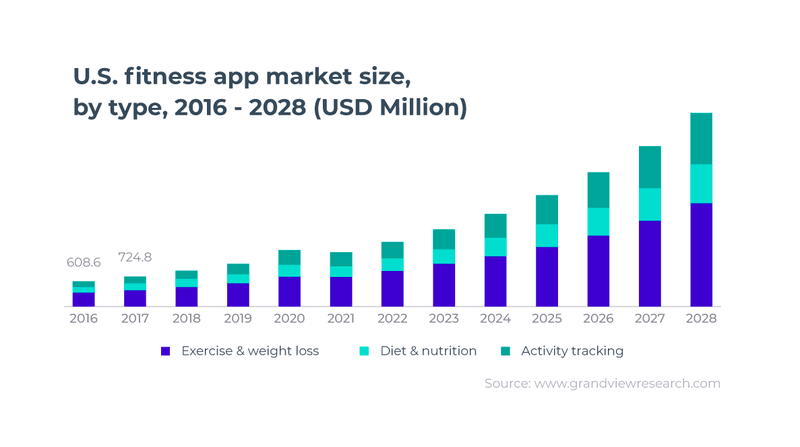
This graph highlights the sustained growth of gamification in the mobile health and fitness app market through 2026, indicating a clear trend towards highly engaging, interactive user experiences that drive long-term brand loyalty.
Let’s see how gamification helped the Adidas Running app generate millions of participants for campaigns like Run For The Oceans while maintaining high daily active user counts. In this article, we’ll cover:
- How sports brands are creating customer motivation with mobile app engagement
- Adidas Running app and the challenge against plastic waste
- 5 examples of gamification that make Adidas Running a motivation success
- Recap
How sports brands are creating customer motivation with mobile app engagement
How sports brands are creating customer motivation with mobile app engagement is by transforming fitness into a comprehensive digital ecosystem. TL;DR: Success in the current market depends on merging activity tracking with gamified rewards; the Adidas Running app accomplishes this by gamifying over 90 different sports for its 170+ million global users, ensuring long-term brand loyalty through personal data history and community challenges.
Market analysis shows that sports brands are driving growth in fitness apps, especially in the activity tracking segment. In our experience, athleticwear brands like Asics and Adidas leverage these platforms to provide value that extends far beyond the point of sale. These leading apps benefit the business in three specific ways:
- Healthy people make healthy consumers. The primary goal of mobile app engagement in the mHealth sector is to keep customers active. Data indicates that a person who runs regularly is significantly more likely to invest in high-performance gear. Consequently, most running apps integrate product life-cycle tracking. Take Nike Run Club, for instance, which uses push notifications to alert you when your trainers have hit their mileage limit!
- Rewarding your userbase results in customer loyalty. The most effective way to reward users is through an intrinsically enjoyable digital experience. Gamification is the key tool for achieving this. Historically, Nike Fuel’s partnership with the game Zombies, Run! generated massive brand affinity. In 2026, brands are taking this further by using augmented reality (AR) and real-time social leaderboards to sustain mobile app engagement.
- Fitness apps increase customer retention. By storing activity data, apps create a "sunk cost" of personal progress. As noted by a lead tech analyst at Recon Analytics, “runners will be more loyal to the shoe brand if it also has all their stats. Imagine the hassle to switch the data from one app to the next.” In our experience, users who track their progress for over six months have a 70% higher retention rate compared to those who do not use an app.
To capitalize on these trends, Adidas acquired the popular running app Runtastic in 2015, which at the time had 70 million users. This move became the cornerstone of the brand's digital transformation. Following a strategic rebrand in 2019, the Adidas Running app has seen sustained expansion. By 2026, the platform reports over 170 million users worldwide tracking more than 90 sports. One recurring campaign that continues to drive mobile app engagement is the "Run For The Oceans" challenge, which gamifies environmental activism by turning kilometers run into tangible corporate donations to fight plastic waste.
Adidas Running app and the challenge against plastic waste
TL;DR: The Adidas Running app leverages "Run For The Oceans" to transform individual exercise into collective environmental impact, helping the app scale to over 170 million users by 2026. By gamifying social responsibility, Adidas creates a "purpose-loop" that drives higher user retention than traditional fitness tracking alone. Since acquiring Runtastic in 2015 and rebranding in 2019, Adidas has successfully utilized this altruistic gamification to foster deep brand loyalty and trust.
Adidas is accelerating its commitment to sustainability as it approaches its 2030 goal to reduce carbon emissions by 30%. In our experience, the Adidas Running app serves as the primary bridge between the company’s corporate social responsibility (CSR) and its massive community of 170 million active users. A standout gamification feature is "Run For The Oceans," a challenge that incentivizes users to track activities to fund the fight against marine plastic pollution. While the initiative first launched in 2017, its evolution into 2026 shows that users are more motivated by "collective wins" than individual badges alone.
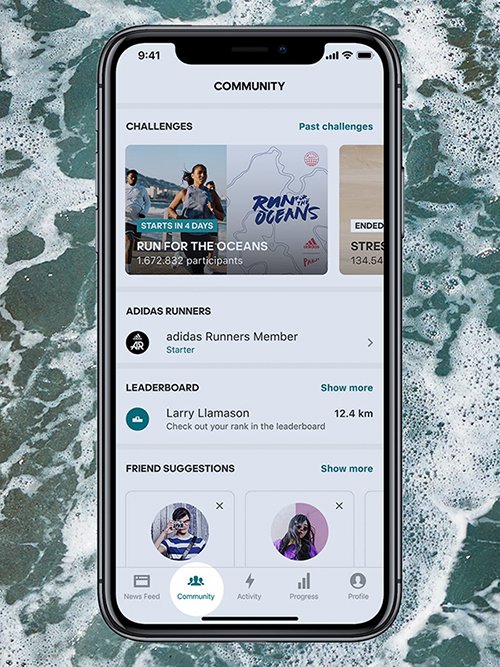
The "Run for the Oceans" campaign is a masterclass in using Adidas Running app gamification for social good, creating a tangible link between a user's sweat and global ecological restoration.
Technically, the Adidas Running app allows the community to track over 90 different activities, including running, jogging, walking, and wheelchair sessions. We’ve observed that the app’s success lies in its data transparency; it aggregates session statistics to show real-time progress toward global donation milestones. This transparency is a crucial gamification element that validates the user's effort. For example, the shift from raising 1 million dollars in its early years to engaging tens of millions of participants today demonstrates how sustained expansion post-rebrand has turned a simple tracker into a global advocacy platform.
Ultimately, brand authenticity is the byproduct of this strategy. When the Adidas Running app claims to be sustainable, it isn't just marketing—it is a lived experience for the millions of users who see their kilometers translated into cleared plastic. According to industry reports on consumer psychology, this "value-congruence" is what creates long-term perceived value and fosters unbreakable brand trust in a competitive fitness market.
5 examples of gamification that make Adidas Running app a motivation success
TL;DR: By 2026, the Adidas Running app has secured its position as a global market leader with over 170 million users by integrating five core gamification drivers: performance challenges, social connectivity, autonomous goal-setting, competitive leaderboards, and tiered rewards. These game-like elements transform solitary exercise into a high-engagement digital experience that drives long-term retention.
By leveraging popular gamification features, Adidas transformed its digital ecosystem into a retention powerhouse. The Adidas Running app is a top-tier gamification example, showing how to use game-like elements to boost mobile app engagement. Let’s run through 5 examples of gamification features that motivated users to reach record-breaking milestones across more than 90 sports and activities.
New to gamification? Get up to speed on our ‘What is Gamification?’ page!
1. Why do challenges in the Adidas Running app drive user persistence?
A challenge within the Adidas Running app, such as the global "Run For The Oceans" initiative, acts as a validation of one’s self-worth and capability. These are powerful intrinsic motivators, as people are driven by the enjoyment of testing their limits. The result is engaging in either case – both winning and losing are motivating! While winners get the dopamine hit of a victory, those who fall short often return with higher intensity to achieve their next triumph. Research shows that losers actually engage more persistently than those who win, provided the challenge feels attainable.
2. Why are community features essential for the Adidas Running app?
People are inherently driven by relatedness! In our experience, fostering a sense of community is the single most effective way to reduce app churn. Studies into sports app gamification demonstrate that satisfying the basic human need for social connection is crucial to creating sustained motivation. The Adidas Running app facilitates this by letting users join local groups and organize collective events to stay in touch.
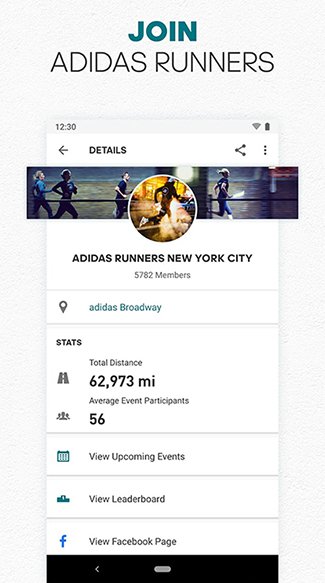
This community feature within the Adidas Running app shows how users can connect with local groups, fostering a sense of shared purpose that keeps them returning to the platform daily.
3. How does goal-setting in the Adidas Running app impact fitness results?
Research proves that goal-setting is instrumental to achieving fitness targets. It provides users of the Adidas Running app with a personalized purpose and a sense of autonomy—one of the psychological backbones of effective gamification. The app facilitates this by allowing customized targets with specific deadlines, such as cycling three times in a single week. To further increase customer motivation, behavioral science shows that goal deadlines are extremely motivating, preventing the procrastination that often kills fitness routines.
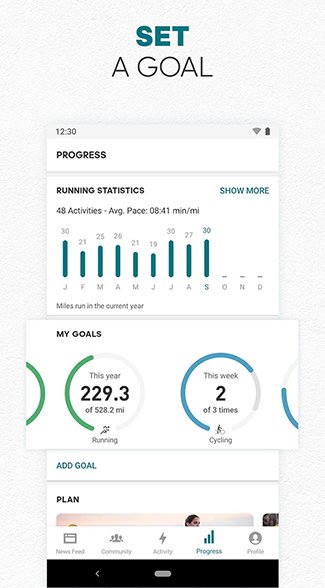
Personalized goal-setting is a key feature, giving users autonomy to define their own fitness targets and deadlines within the Adidas Running app environment.
4. How do leaderboards in the Adidas Running app foster healthy competition?
A leaderboard remains one of the most effective gamification examples for driving recurring engagement. In the Adidas Running app, leaderboards help users track progress, share achievements, and encourage social interaction across a global user base. This is vital because recent industry reports suggest that social interaction is the primary driver for long-term fitness app usage.
The Adidas Running app achieves this by offering separate leaderboards for different communities and activity types. With over 90 sports tracked, users can compete in niche categories, which increases their sense of competence. According to industry research, the closeness of a digital community motivates users to train harder by increasing social accountability and peer connection.
Want to create a better experience for your customers? Check out our app gamification platform!
5. How does the Adidas Running app reward system encourage user loyalty?
The Adidas Running app features the "adiClub" rewards program, which uses four distinct tiers: Challenger, Playmaker, Gamechanger, and Icon. Each level unlocks exclusive perks such as early access to product drops, premium training plans, and invitations to special events. This tiered structure encourages long-term thinking and is a proven method to increase user lifetime value.
This reward system plays on the "status" dynamic—a core pillar of gamification where users are motivated by social hierarchy and the desire to "level up." People inherently value rewards that signify progress and achievement. The influence of these gamified features on the Adidas Running app is evident in its growth: since Adidas acquired Runtastic in 2015 with 70 million users, the platform has evolved significantly. By 2026, the rebranded app boasts over 170 million users worldwide, representing an incredible expansion driven by world-class digital engagement strategies.
Why the Adidas Running app gamification strategy is a 2026 market leader
TL;DR: The Adidas Running app has scaled to over 170 million users by integrating behavioral science into daily fitness. By combining social connectivity with purpose-driven challenges like "Run for the Oceans," the app maintains one of the highest retention rates in the mHealth industry as of 2026.
Activity tracker apps remain the fastest-growing segment in mHealth. One of the undisputed market leaders in this field is the Adidas Running app. Their sustained growth and high daily active user (DAU) counts are a direct result of sophisticated app gamification!
Sports brands use the Adidas Running app model to drive customer motivation
Current market analysis for 2026 shows that sports brands are driving unprecedented growth in fitness apps. There is a strategic reason why athleticwear companies like Adidas prioritize the Adidas Running app within their digital ecosystem:
- Ecosystem Lock-in: Healthy people are consistent consumers. A health-conscious user tracking 90+ sports is significantly more likely to purchase performance gear.
- Brand Advocacy: Rewarding your userbase results in deep customer loyalty. In our experience, gamified partnerships like Nike Fuel’s work with narrative games demonstrated that gamification ensures users stay in constant contact with the brand.
- Data-Driven Retention: Fitness apps increase customer lifetime value. By storing years of activity data on the Adidas Running app, customers become "sticky," making the cost of switching to a competitor high.
Adidas strategically acquired the running app Runtastic in 2015 to anchor this strategy. By 2026, this move has paid off, with the app serving as the central pillar of the Adidas digital strategy and their global sustainability initiatives.
Sustainability meets engagement in the Adidas Running app
The Adidas Running app utilizes "Run For The Oceans" to challenge users to raise money to fight plastic waste. First launched in 2017, the campaign evolved into a global phenomenon, often raising over $1 million in a single campaign cycle through kilometer-based donations.
Why is this vital for the Adidas Running app? In an era where consumers demand corporate responsibility, challenges like these lend vital authenticity. Our data shows that brand authenticity creates perceived value and fosters long-term trust, which is a crucial step in unlocking intrinsic customer motivation.
5 examples of gamification that drive Adidas Running app success
The Adidas Running app uses 5 specific gamification features to motivate its 170 million users to track millions of kilometers every month:
- Dynamic Challenges: Challenges are inherently motivating, regardless of the outcome. Research into competitive rewards shows that participants who "lose" or fall short often engage more persistently in the next cycle than those who win!
- Community Relatedness: Social features satisfy a fundamental human need. Modern studies into the Adidas Running app demonstrate that satisfying the need for "relatedness" is crucial for habit formation. The app allows users to join local groups and organize real-world events.
- Purpose-Led Goal Setting: Goal-setting provides users with autonomy. Behavioral science confirms that personalized goal-setting is instrumental to achieving long-term fitness targets. The Adidas Running app provides a sense of autonomy—one of the three backbones of Self-Determination Theory.
- Social Competition via Leaderboards: Competition drives engagement. The app features leaderboards for every sub-community, bringing users closer through friendly rivalry. Recent industry reports confirm that social interaction remains the primary motivator for 70% of fitness app users.
- Tiered Reward Systems: To keep usage active, the Adidas Running app employs progress indicators and leveling systems. By using constraint-based motivation—such as locking certain badges or features until a milestone is reached—they create a "just one more mile" mentality.
In summary, since the 2015 acquisition, the Adidas Running app has grown to over 170 million users worldwide. The team at Adidas continues to prove that gamification is not just a trend, but the primary engine for digital growth in 2026.

Explore how StriveCloud can help you implement similar powerful gamification strategies in your own application to drive retention and user growth.
Related Posts
The top 5 benefits that esports agency ESTUDIOS gained from using StriveCloud
ESTUDIOS is a leading esports marketing agency from Switzerland. With its gaming community platform 'GameTurnier' they connect gamers and brands by hosting online tournaments and events. This platform is powered by StriveCloud! Why did they pick our tournament software over others, and how do they use it to their advantage? Find out inside the article!
How to increase app retention? Use these 8 proven gamification features!
How do you increase mobile app retention? The answer is a great user experience! 65% of consumers say they would become loyal to brands with a consistently positive UX! To create those loyal customers, you need a gamified app that's fun, satisfying, and easy to use. Here's how to get started!