How to Maximize Rides per User?


To maximize rides per user in 2026, mobility services must move beyond simple booking and focus on daily habit formation. With the global ride-hailing user base projected to hit 1.99 billion this year, the market has shifted from rapid expansion to high-frequency retention. In our experience, the most profitable growth comes from capturing the massive volume of short-distance "micro-trips" under $10. By leveraging gamification and behavioral triggers, operators can effectively turn occasional riders into daily commuters.
The cost of acquiring new users continues to rize even as the market maintains an 18.4% CAGR. If mobility operators want to create sustainable growth and profitability, they need to focus on their existing customers! That means finding a way to maximize rides per user. Gamification can help! Gamification makes your customer experience more fun, among many other benefits. We have seen that as market leaders like Waymo scale to 15 million annual rides, the ability to maintain high engagement through seamless, rewarded experiences is what separates profitable services from the rest. Today, let’s focus on how gamification can incentivize your customers to take more rides.
- 3 strategies that fuel customer loyalty and engagement
- Why customer experience should be your top priority
- How technology can help mobility improve operational efficiency & the customer experience
- What insights your data can deliver on consumer behavior
- How StriveCloud helps mobility operators maximize rides per user with gamification
- FAQs
3 strategies that fuel customer loyalty and maximize rides per user
TL;DR: To maximize rides per user in 2026, mobility operators must shift from transactional discounts to high-frequency engagement models. With global ride-hailing users projected to reach 1.99 billion in 2026, growth is no longer just about finding new customers, but about increasing the "wallet share" of existing ones. In our experience, the most resilient services use gamification and tiered loyalty to turn occasional users into daily commuters.
Loyalty programs
A loyalty program is essential to boost customer retention and maximize rides per user. In the current 2026 landscape, where the market is seeing an 18.4% CAGR, consumers are overwhelmed with choices. They don't just want a ride; they want a relationship with a brand that recognizes their patterns. Our data shows that top-performing mobility operators who implement personalized loyalty tiers see significantly higher retention rates than those relying on generic messaging.
These days, consumers expect your loyalty program to be fun as well. This is especially true for Gen Z and Gen Alpha, who now represent the primary growth demographic for mobility operators. Industry reports indicate that younger users consistently prefer loyalty programs that incorporate interactive "milestone" elements over traditional point-accumulation systems.

This shift toward interactive loyalty highlights a key demographic insight: modern users are significantly more drawn to programs that offer a sense of progression, a crucial factor for any brand looking to maximize rides per user.
Rewards schemes and discounts
For new mobility operators and city launches, hard rewards like discounts are useful to attract new customers. However, in 2026, the strategy has changed. With the largest share of trips now being short-distance "micro-trips" priced under $10, margins are thinner than ever. Over-reliance on discounts can lead to the overjustification effect, where riders only use your service when a coupon is present.
In our experience, the most effective way to maximize rides per user without eroding margins is to use "efficiency-based rewards." For example, offering credits for rides taken during off-peak hors or for returning vehicles to high-demand "hot zones" helps balance your fleet while keeping users engaged.
Gamification
Gamification is the use of game-like elements such as challenges, levels, and leaderboards to reward customers for their achievements. These features trigger intrinsic motivation using the service because the experience itself is rewarding. This is a proven way to maximize rides per user. For instance, market leaders like Waymo demonstrated the power of high-frequency engagement by scaling to 15 million annual rides by 2025, largely driven by habitual, high-frequency urban use cases. Here are 3 gamification features to incentivize repeat bookings:
- Badges & virtual currency. Rewarding customers with virtual currency gives them instant feedback. In 2026, points are perfect for shared mobility as they can be exchanged for free riding minutes, carbon offset credits, or digital collectibles within your app.
- Leaderboards. Ranking customers based on "Eco-points" or "Distance Traveled" inspires friendly competition and creates a highly motivating social experience that keeps users coming back to check their standing.
- Challenges. Setting a clear goal, such as "Complete 5 rides this week for a weekend bonus," triggers action. You can link this to other mechanics, like rewarding customers for their achievements with unique badges or making them compete in public in-app leaderboards.
When mobility services move beyond the "utility" phase and into the "experience" phase, the results are clear. By focusing on these engagement loops, mobility operators can drive consistent, daily usage that significantly increases the lifetime value of every customer and helps maximize rides per user across the board.
Why customer experience is the key to maximize rides per user
TL;DR: To maximize rides per user in 2026, mobility providers must transition from generic service to a reliability-first model. With global ride-hailing users forecasted to reach 1.99 billion by 2026, the competitive edge is no longer vehicle branding, but the operational uptime and predictive availability that turn occasional riders into daily commuters.
To many consumers today, the only difference between mobility operators is the color of your vehicle! So if you really want to stand out and maximize rides per user, you need a frictionless customer experience. Research by McKinsey continues to show that consumers rank availability and reliability as the two most important factors in choosing a mobility app. In our experience, providing a consistent "time-to-pickup" of under five minutes is the single greatest predictor of long-term user retention.

As this industry data shows, the core user experience fundamentals of vehicle availability and reliability are paramount for customer satisfaction. This is reflected in the success of market leaders; for instance, Waymo tripled its annual volume to 15 million rides by 2025 by focusing on high-frequency reliability in dense urban hubs.
In other words, you need a working vehicle exactly where and when the customer wants it. Of course, putting a vehicle on every corner is not a sustainable way to maximize rides per user that is neither possible nor profitable, especially with many high-frequency trips now averaging under $10. Instead, you must leverage predictive demand technology and automated fleet rebalancing to achieve your growth goals while maintaining thin operational margins.
How technology can help mobility improve operational efficiency & the customer experience
To maximize rides per user in 2026, mobility operators must focus on hyper-efficiency and AI-driven personalization. With global ride-hailing users forecasted to reach 1.99 billion this year, capturing a share of this 18.4% CAGR market requires more than just vehicles it requires a seamless digital layer. In our experience, the key to growth lies in automating high-frequency, short-distance trips (typically under $10) and using real-time data to ensure vehicle availability at the exact moment of demand.
Chatbots and customer service to maximize rides per user
As the market shifts toward high-frequency trips under $10, maintaining thin margins is impossible with traditional support models. In 2026, industry leaders are relying on "efficiency tech" to handle the bulk of interactions. Because modern consumers expect a response in 10 minutes or less, AI-powered chatbots have become the standard, managing over 70% of routine inquiries instantly. In our experience, the faster the support, the faster the customer can get back on your vehicle, directly impacting your retention rates.
In a hyper-competitive mobility landscape, customer service is your strongest moat. Research indicates that 33% of people will abandon a brand after just one negative interaction. Automated systems ensure that "lost vehicle" or "payment failed" issues are resolved in seconds, preventing churn and protecting your lifetime value.
Precision fleet rebalancing
You must have accurate, predictive data for your fleet. High-density operators like Waymo have demonstrated the power of availability, tripling annual volume to 15 million rides by 2025 by ensuring vehicles are where users need them most. To maximize rides per user, your rebalancing strategy must be proactive, not reactive:
- Predictive Placement: Customers are 40% more likely to book when a vehicle is within a 3-minute walk, significantly increasing frequency of use.
- Margin Optimization: When your fleet is misaligned with demand, you lose money on every idle minute; precision rebalancing ensures supply matches the 1.99 billion active users globally.
- Regulatory Compliance: Efficient rebalancing is now strictly mandated by city regulators in most Tier-1 markets to prevent sidewalk clutter and ensure equitable access.
Partnerships & integrated apps to maximize rides per user
Strategic partnerships are essential for capturing the "all-in-one" user. With the mobility market growing at an 18.4% CAGR, users are increasingly moving away from standalone apps in favor of integrated ecosystems. For example, successful operators are now embedding their services into national rail apps or "RailMaas" pilots, similar to how e-scooter operators integrated with Renfe and Cabify to create a unified travel experience.
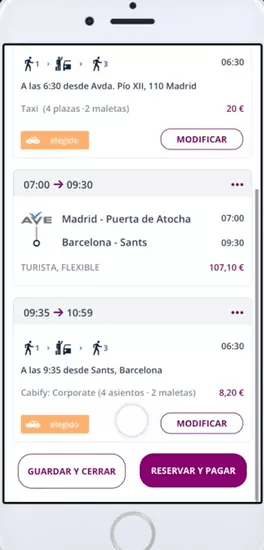
The iomob app platform illustrates how these integrations create a frictionless journey. By centralizing the booking and payment process, operators can access cross-platform data that reveals exactly where and when users switch modes, allowing for better-targeted promotions that maximize rides per user across the entire urban network.
What insights your data can deliver to maximize rides per user
TL;DR: To maximize rides per user in 2026, operators must leverage real-time data to influence trip frequency. With global ride-hailing users forecasted to reach 1.99 billion this year, success depends on converting occasional riders into daily commuters. In our experience, utilizing predictive analytics can shift user behavior for over 35% of trips, directly increasing lifetime value through personalized engagement and fleet optimization.
They say that knowledge is power, and in the 2026 mobility landscape, data is the primary currency. Hidden in the patterns of your app are the keys to maximize rides per user by understanding shifting consumer preferences. In fact, research continues to show how targeted data application enhances satisfaction and retention:
Transport Policy - "An app incorporated personalized rewards with predicted travel time and showed that users change both departure time and route for 35% of their trips... this helps mobility apps get positive feedback and gain more customers."
Now, many mobility operators already use customer data to manage their fleets, but the most profitable services in 2026 use it to aggressively optimize pricing and frequency.
Improved dynamic pricing to maximize rides per user
The more you know about your customers, the better your dynamic pricing will be. Market data indicates that the largest trip share in 2026 consists of short, high-frequency rides priced under $10. To maximize rides per user within these thin margins, operators are relying on efficiency-focused tech to manage high volumes. In our experience, implementing real-time surge and "quiet hor" discounts ensures full fleet utilization. You cannot achieve this without knowing exactly when demand spikes and the specific price ceilings your local customers will tolerate.
Personalized pricing strategies that lead to loyalty
In our experience, high-frequency services such as those scaling toward 15 million annual rides like Waymo succeed because they minimize friction for the power user. To maximize rides per user, many mobility operators now offer tiered subscription models. For instance, Lime’s model allows monthly subscribers to pay zero fees to unlock an e-scooter. This strategy feeds into the ‘Lucky Loyalty effect,’ which suggests that as a user's trip frequency increases, their expectation of "VIP" treatment grows. By meeting this expectation with data-backed rewards, you secure a larger share of the 1.99 billion global mobility users.
How StriveCloud helps mobility operators maximize rides per user with gamification
TL;DR: To maximize rides per user in 2026, operators must pivot from simple acquisition to behavioral habit-formation. With the global ride-hailing market reaching 1.99 billion users this year, the winners are those who use gamification to turn "one-off" trips into daily routines. In our experience, integrating real-time rewards and progress tracking directly into the app flow is the only way to sustain growth in a market defined by high-frequency, short-distance journeys.
If you want to maximize rides per user, your app experience must be the center of your retention strategy. It is where customers sign up, pay, and interact with your brand daily. StriveCloud helps mobility operators create a unique competitive advantage by introducing gamification and loyalty features that reward users for choosing your service over a competitor every single morning.
Our software makes it easy for you to add all types of features from points and badge reward systems to daily quizzes, lotteries, in-app currencies, and leaderboards. According to industry market forecasts, the 18.4% CAGR in the mobility sector means that user expectations for interactive, app-based experiences are at an all-time high. We provide over 20 powerful interactive features you can use to engage your customers at every touchpoint.
Michael Stewart @Forest - "What’s unique about StriveCloud compared to a regular loyalty program or customer marketing is that your customer’s experience is inside the app, at the moment they are using it."
So why does it work? Shared mobility is perfectly suited for gamification because reward systems align directly with your core business goal: maximizing rides per user. Furthermore, the modern mobility audience who often prioritize efficiency and tech-integration responds exceptionally well to the intrinsic motivation of "leveling up" their commuter status.
Our expertise in behavioral science allows us to create a strategy that fuels long-term engagement. By combining extrinsic motivation (discounts and perks) with intrinsic motivation (progress, achievement, and social status), we ensure your service becomes a "sticky" part of the user's life. In fact, our clients consistently see an average 300% increase in trips completed by their most active customer segments!
Don’t believe it? See for yourself! Find out how StriveCloud helps you maximize rides per user!
FAQs: How to maximize rides per user
TL;DR: To maximize rides per user in 2026, mobility operators must shift from simple acquisition to high-frequency retention. With the global user base reaching 1.99 billion this year, success depends on using real-time data to optimize for short-distance trips (under $10) and leveraging gamified loyalty programs that reward daily streaks and consistent usage.
How to maximize rides per user in shared mobility?
Gamification uses game-like elements to turn routine transportation into an engaging habit, which is essential to maximize rides per user. In our experience, shifting from generic discounts to milestone-based rewards creates intrinsic motivation. This strategy is reflected in the broader industry’s growth; for example, market leaders like Waymo reached 15 million annual rides by 2025 by ensuring high-frequency availability that encourages riders to use the service for multiple daily trips. By integrating public in-app leaderboards and "ride streak" challenges, operators can see a significant uptick in monthly active usage.
Why is the customer experience important for shared mobility?
Providing a frictionless customer experience is the most direct way to maximize rides per user in a crowded market. Recent McKinsey research highlights that reliability and vehicle availability are the top two factors driving consumer choice. In 2026, the majority of the market share consists of short-distance trips priced under $10. In our experience, if a vehicle isn't available within three minutes, users switch to a competitor. Ensuring a seamless booking flow and high vehicle density creates the "reliability trust" necessary to become a user’s primary mode of transport.
How can data insights help shared mobility apps understand consumer behavior?
Dynamic pricing and predictive demand modeling are vital data tools to maximize rides per user. By analyzing historical usage patterns, services can adjust pricing in real-time to fill "dead zones" and optimize fleet distribution. With the ride-hailing market maintaining an 18.4% CAGR through 2026, the competition for the forecasted 1.99 billion global users is fierce. In our experience, using data to automate customer service for low-margin, high-frequency trips allows operators to maintain the thin margins required for $10 rides while still delivering a responsive, high-quality user experience that keeps riders returning daily.
.avif)
Related Posts

How Duolingo Uses Gamification to Improve User Retention (+ 5 Winning Tactics)
In 3 years Duolingo's revenue jumped from 13 million to 161 million. How? They made learning fun! Duolingo's lead product managers all speak to the effect of gamification and how it increased their user retention metrics. With over 42 million active users, Duolingo is claiming the learning app throne. In this article, we break down how they keep learners engaged and motivated. Take a look!