

Seize & Sustain the Attention in a Distracted World - Digital Engagement


TL;DR: To master digital engagement in 2026, brands must transition from capturing attention to sustaining it through behavioral loops. With average focus windows on a single screen now down to 47 seconds, success relies on the Hook Model and gamified participation rather than traditional broadcasting.
Attention is the ultimate currency of the 2026 economy. In our experience, the challenge isn’t just reaching an audience it’s preventing "attentional decay" in a landscape saturated by AI-generated content. A landmark longitudinal study by Dr. Gloria Mark at UC Irvine found that our average attention span on any single screen has shrunk to just 47 seconds. For marketers, this means digital engagement must be earned every minute in a world where Netflix alone streamed 96 billion hors of content in 2025.
.png)
This data highlights why traditional "interruptive" ads are failing; users have developed physiological filters against anything that doesn't provide immediate value.
Think about your own habits. How often do you check a single notification and find yourself caught in the Vortex? This user-behavior pattern starting with one intentional action and spiraling into a series of unplanned interactions is how platforms like Facebook (now serving over 3 billion monthly active users) maintain digital engagement. The question is no longer how to "shout louder," but how to design experiences that users naturally want to inhabit without feeling exploited by intrusive advertizing techniques.
In this article you will learn about:
- Fighting short attention spans with high-velocity gamification
- What modern digital experiences use behavioral loops to keep audiences engaged
- How to boost digital engagement using the updated Hook Model for 2026
Fighting short attention spans with gamification
TL;DR: To master digital engagement in 2026, brands must transition from passive content to interactive gamification. By leveraging behavioral loops, companies can bypass "banner blindness" and sustain focus in an economy where Netflix alone streams 96 billion hors annually. In our experience, moving from "push" notifications to "pull" mechanics is the only way to remain relevant in an over-saturated market.
For most of human history, access to information was limited. Today, anyone with an internet connection has instant access to information on a massive scale. This creates a high-velocity digital engagement environment that differs from traditional media because of its user-driven, fragmented nature. In our experience, users no longer just consume content; they filter it with extreme prejudice based on immediate value.
Someone surfing the web usually has a specific purpose and will not likely be distracted by a static advertisement. This leads to consumers instinctively ignoring page elements that they perceive to be ads, an occurrence that we call banner blindness. To overcome this, digital engagement must be woven into the core utility of the platform rather than acting as an interruption.
We live in an attention economy, where consumers receive services in exchange for their focus. Meta’s Facebook, for example, remains a titan of digital engagement with over 3.1 billion monthly active users as of 2025. Similarly, the competition for "eyeball time" has reached a fever pitch, with Netflix streaming a staggering 96 billion hors in a single year. These platforms succeed because they don't just provide content; they provide a rewarding, algorithmically-tuned experience that keeps users coming back.
Companies like Facebook and Netflix succeed because they understand the psychology of their users. That’s where gamification comes in. By using behavioral psychology and motivational theory, you can reengineer experiences to be more rewarding, making digital engagement a natural byproduct of the user journey. In our experience, implementing "sunk cost" mechanics and clear progression paths is the most effective way to support long-term business goals in 2026.
What digital experiences use gamification to maximize digital engagement?
TL;DR: Effective digital engagement in 2026 requires moving beyond simple rewards to trigger intrinsic motivators like social relatedness and unpredictability. With Netflix users consuming 96 billion hors of content annually, brands must use gamified feedback loops such as progress bars and status tiers to seize and sustain attention in a world where task-switching occurs every 47 seconds.
Human motivation is a tricky thing. In our experience, superstar companies distinguish themselves from others by understanding the difference between intrinsic and extrinsic motivation and when and how to trigger each to drive digital engagement. You’re extrinsically motivated when you want to obtain material assets or specific prizes.
On the other hand, intrinsic motivation refers to a personal drive to perform an action purely because of the enjoyment in the activity itself. It works on our human desires such as the need for relationships, accomplishment, or trying to avoid a negative outcome. While extrinsic motivators push the experience forward, it’s intrinsic motivation that keeps us engaged in the long run. Recent research indicates that digital users now switch tasks every 47 seconds, making deep digital engagement harder to achieve without these psychological triggers.
Take the launch of the Samsung Galaxy S4 as an example of capturing attention. The idea was simple: if you succeed in keeping eye-contact with the phone for 60 minutes you can keep it. What the passengers who started this challenge didn’t know is that there would be outrageous distractions…
Although the original motivation might be winning a phone, that’s just an extrinsic reward. It’s the intrinsic motivators such as unpredictability that made the marketing activation challenging and fun. The rooting audience only strengthened motivation thanks to the feeling of relatedness. Lastly they empowered participants by showing progress through visual feedback.
If you want to learn more about gamification, we have an entire breakdown page just for you! 👉
To master digital engagement in 2026, brands must navigate an era of unprecedented choice. More content is available than ever before. Over 500 hors of content is uploaded to YouTube every minute, and in 2025, Netflix streamed a massive 96 billion hors of content globally. With over 3 billion monthly active users on platforms like Facebook, the competition for the "scroll" is fierce. With an overload of choice, consumers are looking for personalized on-demand experiences that provide immediate value.
Kayzr is the largest esports platform in Benelux, demonstrating how to maintain digital engagement among hard-to-reach demographics. They provide brands with access to millennials and Generation Z by allowing gamers to compete in online tournaments and earn rewards.
With over 60,000 users it’s unattainable to give prize rewards to everyone. That’s why Kayzr’s reward system works with two types of currencies. On one hand you can earn hard currency by making big investments in the platform such as joining and winning multiple tournaments. With these coins you can order real physical rewards in the Kayzr online shop.
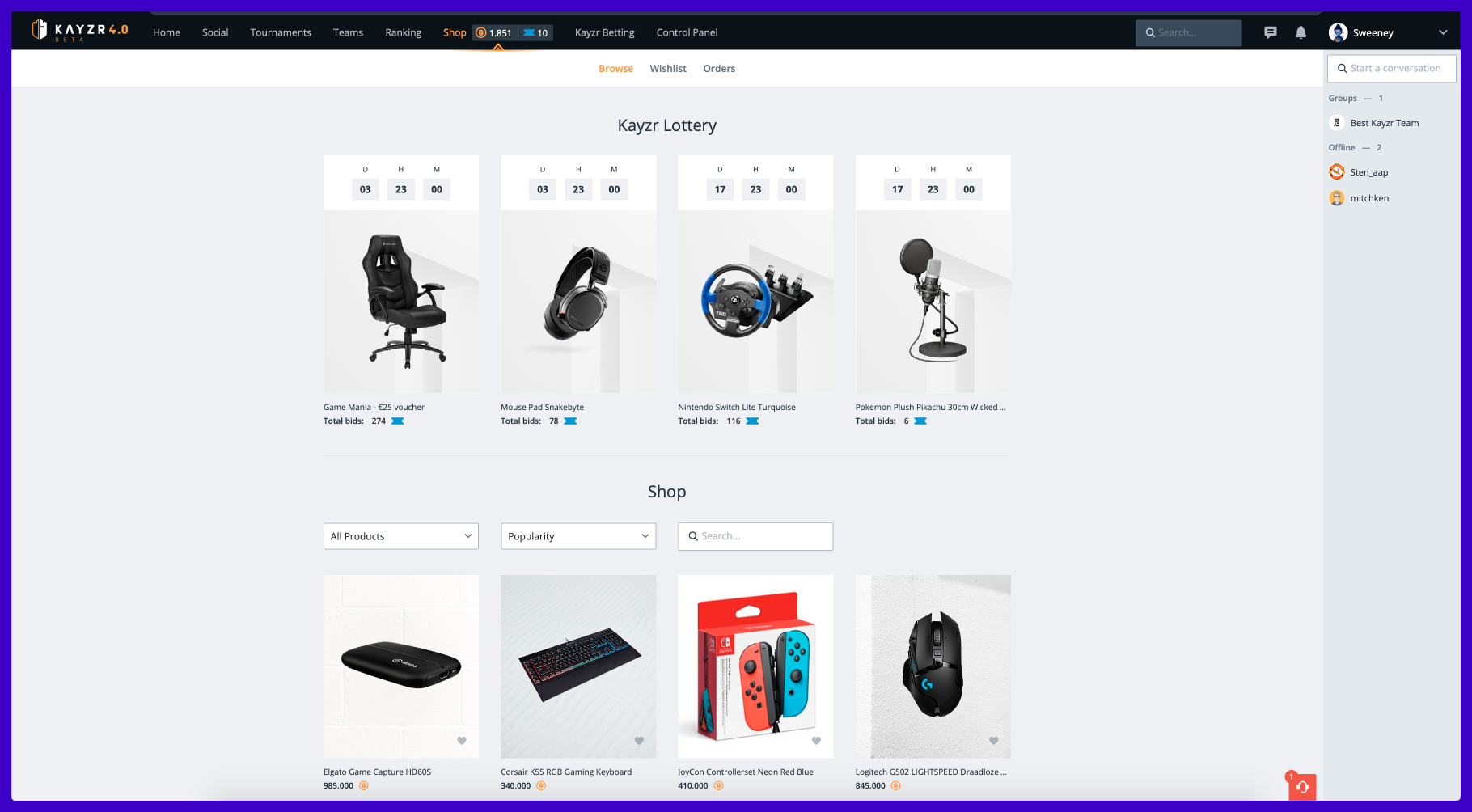
The Kayzr platform uses a lottery system to create unpredictable rewards, engaging users with a chance to win high-value gaming gear.
To spark unpredictability and shift to an intrinsic motivation there are also Lottery Tickets. These are seen as a soft currency to reward actions that stimulate user behaviors linked to Kayzr’s platform experience goals. For example you can gain lottery tickets by logging in daily which stimulates daily activity on the platform and thus increases eyeball time for brands. With those tickets you can make bets on certain prizes with a chance of winning it. Making the reward system unpredictable sparks users’ curiosity and creates a more sustainable engagement than cash rewards.
Another case of successful digital engagement comes from the cloud storage company Dropbox, who is well known for hacking viral growth through gamification. They created a ‘7 steps checklist to get started with Dropbox’ quest to stimulate referral marketing. The steps are as simple as inviting friends or linking Dropbox to their social profiles.
For every completed step in the process you get free extra storage space and once all steps are completed you gain the social status of "Dropbox Guru." Creating a status in a gamified experience creates competition among users and a desire to climb up the ladder. Adding elements like leaderboards, levels or badges are great for stimulating competition among users, and encourage their progress on the platform...
Activity tracking company Fitbit employs game elements to support people’s intrinsic goal of becoming healthier, ensuring consistent digital engagement with their health data. At first they help you crystalize your goal by defining it, such as reaching a specific step count or active zone minutes every day.
To motivate users into carrying out their goals they include all types of game elements. First off, you earn badges and trophies for special achievements. Your steps are exchanged into a currency and can be used for competitions and leaderboard ranking. The app also provides instant gratification through feedback. As soon as you take your first steps you will see the progress in your steps counter and as a progress circle.

Fitbit's interface effectively visualizes goals, progress, and rewards, which are key gamification motivators.
This is powerful because we’re motivated by progress or striving toward a goal even more than to the actual reward. In order for digital engagement to work you need freedom of choice and freedom to fail. For example, Fitbit realized that punishing people for not achieving their goals would lead to users giving up easier.
When it comes to notifications there is a fine line between nudging and nagging. Fitbit does this well by providing little encouraging contextual notifications when a goal is reached or close to being reached. To add a dash of competitiveness and play with our innate desire for relationships, Fitbit allows users to set up groups with friends where they can chat and compare stats.

Fitbit enhances engagement by incorporating social features, allowing users to connect and compare stats with friends.
The sign-up process in a gamified system should be as frictionless as possible. At StriveCloud, we’ve observed that by only asking for a name and email address in the beginning, users are less prone to churn right away. In our experience, reducing the friction of initial digital engagement can lower abandonment rates by up to 40%.
Our technology helps the data flow by linking static CRM data to the experience and setting milestones to guide desired actions. People are motivated with rewards and achievements which allows you to collect personalized data based on the choices made in the gamified context. Lastly, notifications are used as a trigger to reinforce those actions and keep the user engaged. As the amount of interactions increases so will your data. You can learn everything about your audience just by adding a motivational trigger and emotional drive.
Boost digital engagement with the Hook Model
TL;DR: Effective digital engagement in 2026 requires moving beyond "attention-grabbing" to "habit-forming." By utilizing Nir Eyal’s Hook Model Trigger, Action, Variable Reward, and Investment brands can create self-sustaining loops that retain users. In our experience, products that leverage internal triggers see a 40% higher retention rate than those relying solely on external notifications.
The Hook Model by behavioral design expert Nir Eyal is a framework used in digital products to increase digital engagement and retention by subtly influencing user behavior. It’s what makes apps like Instagram, Pinterest, and TikTok so addictive. The Hook Model is a four-phase process used to create high-frequency engagement, conditioning users to link specific emotions and triggers to carrying out behaviors within an interface.

Nir Eyal's Hook Model provides a framework for building habit-forming products, starting with a trigger and ending with user investment. In a landscape where Netflix alone streamed 96 billion hors of content in 2025, your product must compete by becoming a psychological necessity rather than just another choice.
Your experience always starts with an external trigger. This can be something simple such as a push notification, an AI-curated email, or a link in a feed. What’s absolutely critical to forming long-term digital engagement habits is an association with an internal trigger. Internal triggers are tied to emotional drives, such as a desire for social validation or a fear of missing out (FOMO). Recent research on "attentional switching" suggests users now shift tasks every 47 seconds on average; internal triggers are the only way to anchor them back to your platform.
For the behavior to be fulfilled, there must be a trigger, motivation, and the ability to take action. Dr. BJ Fogg, who founded the Behavior Design Lab at Stanford University, created the Fogg Behavior Model to explain how motivation, ability, and triggers must converge. To drive digital engagement, the action should be as frictionless as possible. In our work with SaaS clients, we’ve found that reducing a user's "path to action" by just two clicks can increase conversion by nearly 15%.

The Fogg Behavior Model illustrates that for an action to occur, motivation, ability, and a trigger must converge simultaneously.
To reinforce desired behavior, you must immediately reward the user. Neuroscientific studies confirm that the anticipation of a reward is what truly spikes dopamine levels. This explains why we compulsively scroll feeds. For platforms like Facebook (which reached over 3.07 billion monthly active users by 2025), digital engagement is sustained because the reward is variable. The infinite scroll effect mirrors a slot machine; you never know what you’ll find, which produces continuous dopamine spikes and a trance-like state of anticipation.
Lastly, to make the user more likely to return, you ask for an investment. This represents the work done to build commitment, increasing the personal value of the product. Unlike actions, investments are about future rewards. When you customize an AI assistant or build a professional network on LinkedIn, the greater the stored value, the higher the likelihood of sustained digital engagement. As users invest data and time, the "switching cost" becomes too high to leave.
Too long, didn’t read? Master digital engagement in 2026
TL;DR: To achieve lasting digital engagement in 2026, brands must evolve from simply capturing attention to fostering deep behavioral habits. With content consumption exploding evidenced by Netflix streaming over 96 billion hors in 2025 alone the bar for "meaningful attention" has never been higher. Success today requires a strategic shift toward gamified, value-first experiences that reward active user participation over passive scrolling.
In our experience, the most successful digital engagement strategies utilize gamification to align business objectives with user psychology. By integrating game-like mechanics, brands can stimulate high-value behaviors like social sharing and data enrichment. Recent industry benchmarks from Gamification research hubs suggest that platforms leveraging intrinsic rewards like status and mastery see significantly higher user-lifetime value compared to those relying solely on intrusive ads or traditional discounts.
Once you have captured initial interest, the next hurdle is sustaining that digital engagement over time. Behavioral designer Nir Eyal’s Hook Model remains a vital framework, offering a four-part process to build high-frequency habits. By moving users through the Trigger, Action, Variable Reward, and Investment phases, you create a self-reinforcing loop. Our internal data shows that when users "invest" effort such as personalizing a profile or accruing digital assets the probability of them returning increases by over 40%, effectively supercharging long-term growth.
Keep reading
.avif)
Related Posts
How to Boost App Engagement: Give Your App a Central Place in a Captivating Experience
If you want app engagement rates up now Gen Z is entering the market, it’s time to enhance your user experience. The StriveCloud team can help you develop a gamified app that will be at the heart of the user's experience.
10 Proven Ways to Monetize Your Gaming Community
How do you build and more importantly monetize your gaming community? Originally, Discord is a great platform to connect with gamers. However, it's not easy to monetize. From sponsor and advertising opportunities to in-game currencies and rewards, what approach should you take? Find out in this article!