

How gamification helps Streetcrowd fight the greatest challenge in shared mobility

How gamification helps Streetcrowd fight the greatest challenge in shared mobility
Streetcrowd's gamified mobile app is at the forefront of tackling efficiency problems within the shared mobility industry.
Today, 76% of people live in cities. That’s one billion more than in the year 2000! Given the rapid urbanization, transport needs are changing - and fast. To get ahead, shared mobility companies like Uber and Streetcrowd boast cutting-edge gamified apps. Take Uber, whose reward system focuses on customer loyalty and user retention. Likewise, Streetcrowd has managed to create loyal customers by using gamification features. They’re an excellent example of how to increase app retention.
Let’s see what makes the Streetcrowd app successful and how it built a dedicated community of active users that spans across 10 cities. In this article, we cover:
- Trending now: why you should learn how to increase app retention
- Gamification apps leading the way in shared mobility
- Streetcrowd boosts user retention with gamification features
- Recap
Trending now: why you should learn how to increase app retention
In 2020, app uninstall rates shot up by 70%. That’s a $57,000 loss for the app market every month! Product managers are leveraging game psychology and gamification features to increase app retention and eliminate churn. As a result, the gamification market is set to grow over 25% yearly.
Studies show that gamification features give a huge boost to app retention metrics! That’s because they drive engagement by triggering customer motivation and making the experience fun and rewarding.
Apps that engage with and motivate their customers in this way see a whopping 63% decrease in user churn. Besides, gamified reward systems generate customer loyalty. This is great because loyal customers spend more, and more often!
Want to know more about the ins and outs of gamification? Read our ‘What is Gamification?’ page!
In short, 1/5 of users check out a new app just once before uninstalling. Given this, only focusing on the acquisition side can lead to poor user retention metrics, and a wasted budget writes software enterprise Upland.
Shared mobility apps are no different. That’s why the industry is exploring gamification features to increase user retention and loyalty.
Gamified apps leading the way in shared mobility
On-demand mobility is a fairly new sector; it only dates back to around 2009. When smartphones became the norm, mobility apps with a focus on flexibility and customer empowerment quickly emerged. One of the first to do so was Uber in 2009. Now, a little over ten years later, Uber has 93 million active users.
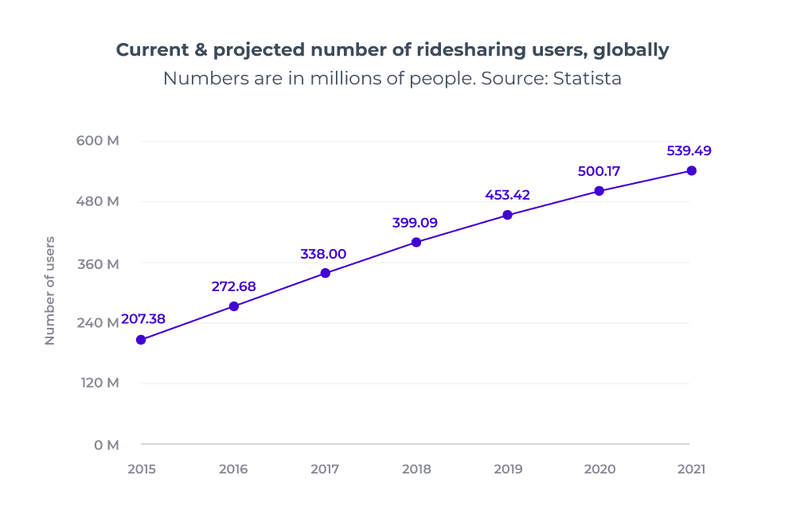
This graph illustrates the competitive landscape in the ridesharing market, showing shifting user loyalty between an established player and a rising challenger.
Uber is fighting to retain them from a fierce set of competitors. To illustrate, their userbase has declined by 7% in the past four years, while Lyft has seen an 11% rise. In response, Uber shifted its focus to user retention and created a reward system called Uber Rewards.
The story is similar across the mobility sector, given how fast the market grows. As an illustration, the world’s top 10 ridesharing apps were all founded after 2008!
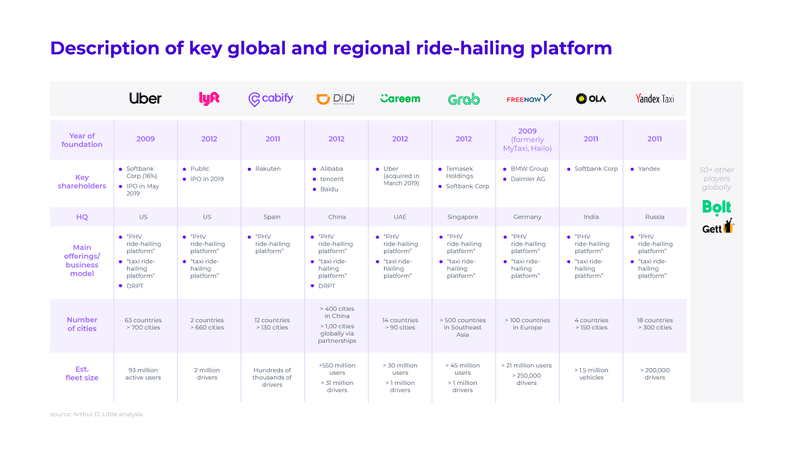
The table lists the top 10 ridesharing apps, highlighting the sector's rapid growth and recent emergence in the last decade.
To clarify, there is an explanation as to why “get big fast” is the motto of the mobility sector. It is due to the Network Effect, which means that the product grows in value as more people use it. Clearly, a mobility app is of little use to customers if there are no drivers, and there are no drivers without customers! This chicken and egg scenario means that companies need to grow extraordinarily quickly. One of these strategies means offering discounts and competitive pricing. However, that will not achieve user retention, nor will it improve the company’s wallet!
Under these circumstances, mobility apps need to find innovative ways to stay afloat and tackle the issue of how to increase app retention. In response, the shared mobility sector is emphasizing user retention and efficiency increases. In fact, operational efficiency is the greatest challenge facing the industry, notes consultancy firm Arthur D Little. To turn this threat into an opportunity, Streetcrowd is leading the way forward.
Want to drive meaningful retention on your app? Try our app gamification software!
Streetcrowd boosts user retention with gamification features
Streetcrowd is an app that supports mobility providers by making their operations more efficient. Its mission is customer experience optimization. Using gamification features, the app engages users through a reward system to do odd jobs, such as moving a parked car in the company’s 5,500 vehicles to a more desirable place.
In other words, where the car is more likely to meet customer demand, rather than sit idle. This maximizes profit! Clearly, it is needed: current car usage rates for mobility apps are a shockingly low 10%.
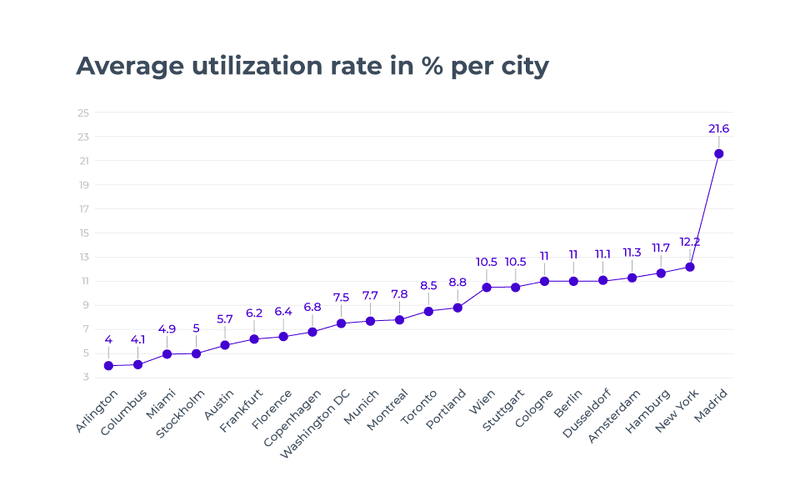
The chart highlights the low utilization rate of vehicles in mobility apps, a key operational challenge that Streetcrowd aims to solve.
To be sure, it is impossible to achieve a perfect 100% utilization rate, but there is obvious room for improvement. For customers, a higher car utilization rate means the car is easier to allocate because it’s closer to users. Benefits like these will drive customer loyalty and user retention much more than a discount. With this in mind, Streetcrowd sets out to increase rates by implementing a range of gamification features:
A reward system that motivates users to achieve goals
Streetcrowd incentivizes users through financial rewards, paying them for their time. This is an extrinsic motivator, meaning that it is a results-based driver. However, this reward system is most useful in the discovery phase. Behavioral research shows that user retention is instead achieved through intrinsic motivation.
Challenges that encourage users to complete tasks
This appeals to the user’s self-worth, an intrinsic motivator. In addition, challenges are fun! If users succeed, they will feel the reward (and the dopamine hit that comes with it). A possible challenge could be moving a certain number of vehicles in a fixed timeframe to get a bonus reward.
Empowerment through an interactive interface
Empowerment is a principle mechanic of app gamification. Users select which vehicles they want to move, and transparently see what is required. A visually pleasing map with greens, reds, and clearly mapped routes makes the task feel less like a job and more of a quest!
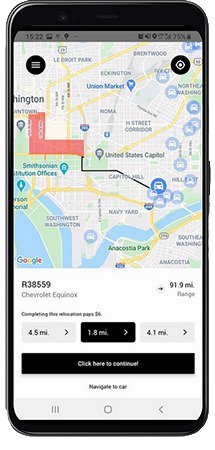
This screenshot of the Streetcrowd app displays its interactive map, which turns vehicle relocation into a quest-like experience for users.
Progress indicators and digital confetti give users instant gratification
When you are logging a vehicle, a progress indicator guides you during the wait for acceptance. This is a simple yet effective gamification feature. For one, it assures the user that the system is working. Additionally, scientific research shows that it minimizes cognitive load. In other words, instead of focusing on the wait, the progress indicator reduces the user’s perception of time by providing a visually stimulating experience.
Streetcrowd pairs this with digital confetti, showing a celebratory splash in the middle of the screen. This provides instant gratification, which contributes to creating customer loyalty! How so? It very clearly shows that their work has rewards.
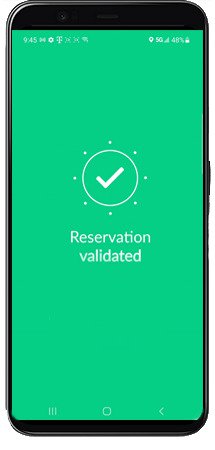
The app's reward screen uses digital confetti to provide instant gratification, reinforcing positive user behavior and building loyalty.
As a result of their gamified app, Streetcrowd has created customer loyalty in cities across the world. Users’ continued engagement and reward for participation create loyalty for the Streetcrowd brand. Streetcrowd has managed to leverage gamification to increase operational efficiency. The faster service and higher utilization rates give them a competitive edge over other bigger brands.

This call-to-action banner encourages readers to explore how gamification strategies can be applied to their own applications.
Recap
In 2020, app uninstall rates shot up by 70%. The on-demand mobility sector is growing rapidly, yet it is shifting, and companies are responding with gamification apps.
Market leaders like Uber are losing customers to challengers like Lyft. To combat this Uber installed gamification reward systems to improve user retention.
While tackling user retention, the largest challenge the sector is facing is a poor rate of operational efficiency. For example, the average utilization rate for a car in a mobility app’s fleet rests at just 10%! Streetcrowd is in the industry to change that.
Streetcrowd is an app that supports mobility providers by making their operations more efficient. Using gamification, the app engages users to do odd jobs such as moving a parked car to a more desirable location, where it is more likely to be used.
It uses a variety of gamification features to achieve this:
- A reward system that motivates users to achieve their goals. Using financial gain for completing tasks is a key result-based extrinsic motivator.
- Challenges that encourage users to complete tasks. This appeals to the user’s self-worth, and need for fun, both intrinsic motivators.
- Empowerment through an interactive interface. Users can choose tasks through a transparent and intuitive selection process.
- Progress indicators and digital confetti give users instant gratification. These enjoyable small touches provide encouragement to continue using the app.
As a result of their gamified app, Streetcrowd has created customer loyalty in 10 cities across the world, as well as making themselves indispensable to mobility app providers through their skill at tackling operational efficiency. Streetcrowd is showing the way forward by confronting the greatest challenge of the shared mobility sector.
This final banner rinforces the value proposition of using gamification to reduce user churn and improve retention metrics.
Related Posts
4 ways to introduce gamification features that improve the user experience
Games make up a staggering 72% of all app market revenue. Of course, your app doesn't need to be a game to be successful! With gamification features like a leaderboard, you can take inspiration from games to boost your app and meet your business strategy.
How fitness app SWEAT beat the trends to sell for $400 million
In July 2021 fitness app SWEAT sold for a whopping $400 million after just 4 years. How did two fitness influencers manage to do this? The SWEAT app is built to drive up user motivation to keep fitness fun and engaging. They leverage gamification tactics like leaderboards, trophies, and a progress tracker with a unique twist. Find out more inside the article!