

How to Improve Feature Discovery for SaaS Apps (and Why It’s Necessary)



TL;DR: Feature discovery is the strategic process of surfacing the right tools to users at the moment they need them most. In 2026, this is a survival requirement: 60% of SaaS clients are likely to churn if they do not receive personalized product experiences. By utilizing AI-driven nudges and gamified checklists, companies can bridge the gap between "installing" and "extracting value," ensuring long-term retention in a crowded market.
Feature discovery is an important contribution to how users perceive your product value. In other words, when you don’t show the value, users will eventually churn. Current industry reports show that 60% of clients are likely to churn without personalized experiences that highlight relevant tools. Despite this, feature discovery remains a massive blind spot: roughly 36% of SaaS companies still lack any form of in-app guidance to promote their offerings. In our experience, driving user engagement toward new and underused features via app gamification is the fastest way to stabilize MRR and improve adoption.
In this article, we’ll cover everything you need to know about feature discovery, including 12 examples from leading SaaS apps updated for 2026.
- What is feature discovery?
- Why feature discovery is vital for SaaS product adoption
- How to improve user engagement through feature discovery
- 12 top examples of how to promote feature adoption and discovery in 2026
- How to use feature discovery in your own product
- 3 quick wins to improve SaaS feature adoption
- How you can easily implement feature discovery with app gamification from StriveCloud
- FAQ
What is feature discovery?
TL;DR: Feature discovery is the strategic process of guiding users toward high-value functionality they haven't yet utilized. By bridging the gap between a product's capabilities and the user’s awareness, SaaS teams can significantly reduce churn and accelerate time-to-value.
In short, feature discovery is the process of building awareness around new or underused features. While users may stumble upon updates organically, relying on "accidental discovery" is increasingly risky in a saturated market. According to recent 2026 industry benchmarks, 36% of SaaS companies still lack any form of intentional in-app guidance, representing a massive missed opportunity for expansion. In our experience, the most successful product-led strategies don't just wait for users to explore; they use contextual nudges to educate users on relevant tools, which directly improves user engagement and long-term retention.
Why feature discovery is vital for SaaS product adoption
Feature discovery is the bridge between a user’s initial sign-up and their long-term loyalty. TL;DR: Without a proactive discovery strategy, users often miss the very tools they signed up for, leading to stagnation and churn. In our experience, SaaS platforms that prioritize feature discovery see significantly higher customer lifetime value because they guide users toward the "Aha! moment" repeatedly. In an era where 60% of clients are likely to churn without highly personalized experiences, ensuring users find the right features at the right time is a necessity for growth.
Ask yourself how can you make the most out of product-led growth if users are only scratching the surface of your capabilities? According to recent 2026 benchmarks from Email Vendor Selection, 36% of SaaS companies still lack any form of in-app guidance, meaning that mastering feature discovery provides a massive competitive advantage. By highlighting the right tools at the right time, you unlock several key business benefits:
Feature discovery is a surefire way to unlock SaaS growth in 2026! Get started with our ultimate product adoption guide.
How to improve user engagement through feature discovery
TL;DR: To improve feature discovery, SaaS teams must move beyond static tooltips toward personalized, context-aware "priming." In our experience, proactive guidance is the only way to prevent churn in a crowded market; current data shows that 60% of clients are likely to churn if they do not receive highly personalized product experiences. By triggering feature discovery at the point of need, you transform your product from a complex tool into a guided solution.
The way in which users encounter a feature will transform their perception of it. Behavioral scientists call this ‘priming’ a psychological effect where a specific stimulus compels a user to think or act in a certain way. You can use this effect to trigger a recurring loop of user engagement! This is increasingly critical as software complexity grows; for instance, research from Zylo indicates that 77% of IT leaders have discovered AI-powered features being used within their organizations without formal awareness. Without a managed feature discovery strategy, your users are likely missing your most valuable innovations.
In other words, by intentionally triggering feature discovery, you own the context in which a user perceives your platform's capabilities. As a result, the perceived value of your product increases because the user sees the feature as a relevant answer to their current problem rather than just another button in the UI.
12 top examples of how to promote feature adoption and discovery in 2026
TL;DR: Effective feature discovery is the bridge between user acquisition and long-term retention. In 2026, with 60% of users likely to churn without personalized experiences, SaaS leaders must move beyond static tooltips. By implementing gamified checklists, AI-aware announcements, and interactive walkthroughs, products can close the gap where 36% of competitors currently offer no in-app guidance at all.
#1 Gamified checklists incentivize feature discovery
In 2026, feature discovery is often the deciding factor in whether a trial converts. Recent data from Email Vendor Selection reveals that 56% of SaaS products have no onboarding checklists, representing a massive missed opportunity to spotlight key actions. Gamified checklists solve this by providing a structured path to value. Postfity, for instance, has historically used a progress-based system that rewards users for scheduling their first post.
In our experience, leveraging the ‘Zeigarnik effect’ where users feel a psychological need to complete a task already in progress can significantly boost completion rates. Above all, rewards don’t have to be financial; intrinsic value through badges or achievement systems is often more effective for long-term feature discovery.

This example of a gamified checklist shows how visual progress and incentives effectively guide new users toward valuable functionalities they might otherwise overlook.
How to maximize feature discovery with app gamification? Get your expert-led workshop & learn to craft your own gamified product!
#2 Interactive walkthroughs let users experience the value
To improve feature discovery, you must let users "play" with the product before they commit. With 36% of SaaS companies currently lacking any in-app guidance, providing a hands-on experience sets you apart. Demio, a webinar hosting service, allows new users to run a "fake" webinar with sample slides and simulated chat attendees. This interactive sandbox ensures that feature discovery happens through doing, not just reading.

Demio's interactive onboarding uses a simulated environment to demonstrate its core value proposition, making the feature discovery process engaging and risk-free.
#3 Segment feature updates
Personalization is no longer optional for feature discovery; it is a requirement for survival. According to SeoProfy, 60% of clients are likely to churn if they don't receive personalized experiences. Simple segmentation allows you to show the right feature to the right person. Beamer, for example, allows teams to personalize feature updates and push notifications based on whether the user is an admin, a newcomer, or a power user, ensuring relevant feature discovery every time.
#4 Tooltips can nudge customers to underused features
Even the best tools suffer from poor feature discovery if users are overwhelmed. Livestreaming platform Kumu famously addressed low adoption of their search bar using a simple spotlight nudge. This targeted intervention resulted in a 54% click-through rate. In our experience, these "micro-moments" of guidance are critical, especially considering that over a third of SaaS products currently leave users to navigate complex interfaces entirely on their own.

Kumu's use of a spotlight effectively drew user attention to an underutilized area, proving that feature discovery often just needs a visual cue to succeed.
#5 Celebrate customer success (and include tips on how to get more value)
Positive reinforcement is a powerful driver of feature discovery. Evernote masters this by congratulating users after they complete their first major action, such as sending an email to the app. By celebrating the "win" and immediately suggesting a related feature, they keep the discovery loop active. This strategy directly addresses the 60% churn risk by making the user feel seen and supported throughout their journey.
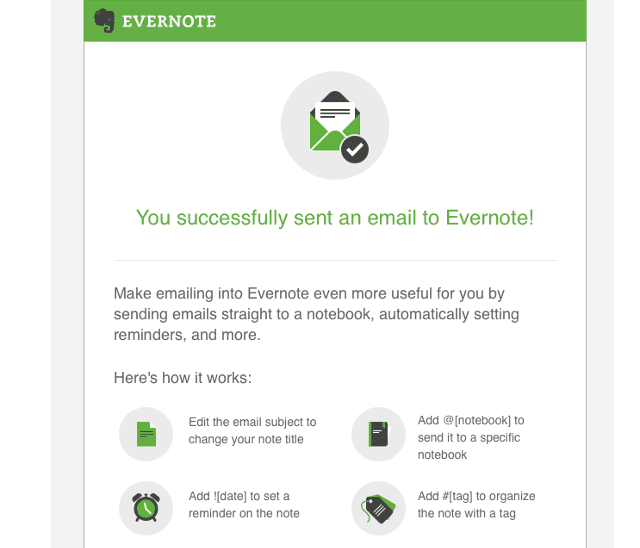
Evernote’s success emails demonstrate how to transform a single action into a broader feature discovery moment by providing timely, relevant tips.
#6 Promote new features with announcements
The rize of AI has made clear communication essential for feature discovery. Research from Zylo indicates that 77% of IT leaders have discovered AI-powered features operating in their stack without their prior awareness. Slack addresses this "shadow feature" problem by using slide-out modals and GIFs to announce updates. By clearly showing how a new AI or formatting tool works, they ensure feature discovery is intentional rather than accidental.
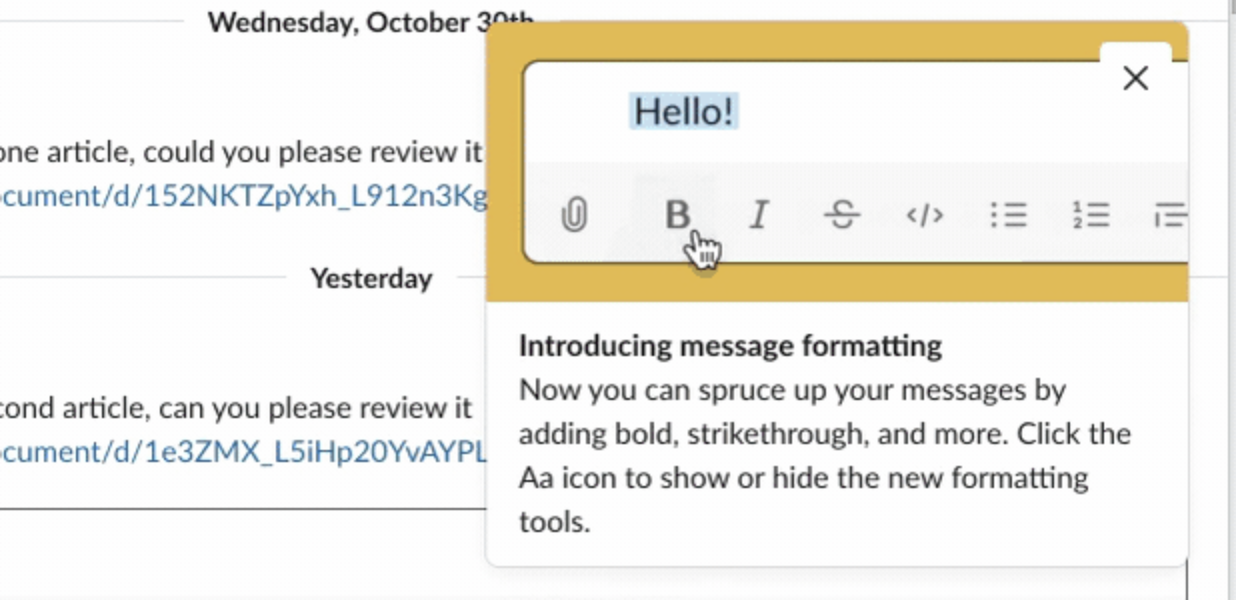
Slack's use of short, animated visuals ensures that feature discovery is instantaneous and the immediate benefit of the update is obvious to the user.
#7 Welcome emails can highlight the app’s key features
Your first email is a prime secondary channel for feature discovery. While standard marketing emails often see low engagement, welcome emails are over 75% more likely to be opened. Descript uses this opportunity to introduce its core functions. In our experience, including 2-3 "quick win" features in a welcome email significantly reduces the time-to-value for new users.

Descript's welcome email leverages high open rates to ensure feature discovery begins the moment a user signs up, even before they log back into the app.
#8 Let users provide feedback if feature discovery is skipped
When a user skips a tour, it’s an opportunity for feature discovery research. HubSpot implements a feedback loop when users exit an onboarding flow, asking why it wasn't helpful. This data is vital for combatting the 60% churn rate associated with non-personalized experiences. Understanding why a segment ignores certain features allows you to pivot your strategy and offer more relevant discovery paths later.

This HubSpot prompt is an excellent way to capture the "why" behind missed feature discovery, allowing for better iterative design in future updates.
#9 Highlight new features through design
Visual cues are the simplest form of feature discovery, yet they are often neglected. Statistics show that 70% of SaaS products lack progress bars or clear visual indicators in their onboarding. Asana avoids this pitfall by adding a vibrant "New!" tag to their navigation menu. This subtle design tweak triggers curiosity, leading users to engage with the product's latest additions without the need for intrusive pop-ups.

Asana demonstrates that feature discovery can be achieved through minimalist design that respects the user's workflow while still catching their eye.
#10 Create a dedicated in-app location for updates
Centralizing your updates creates a consistent hub for feature discovery. Revolut uses a modern, "stories" style format to showcase monthly updates to its most active users. By using a familiar social media UI, they make the discovery of new financial tools feel like entertainment rather than a chore. This dedicated space ensures that power users never miss a beat.

Revolut’s story-based updates provide a dedicated, high-engagement channel for feature discovery that feels native to the modern mobile experience.
#11 Discover when users are churning - and intervene
A proactive software adoption strategy is your best defense against churn. When users struggle with a complex tool, they don't always ask for help they often just leave. Productivity SaaS Groove used a personal email intervention to re-engage users who had stalled. In our experience, a simple, human-centric message can be more effective for feature discovery than any automated tutorial, directly addressing the 60% of users who feel a lack of personalization.

Groove’s intervention email proves that feature discovery can be reignited through empathy and timely support, turning a potential churn into a loyal user.
#12 Create a blog with valuable product tips
Finally, long-form content remains a staple for deep feature discovery. Educated users are high-value users because they understand the full breadth of your product. By sharing industry insights and technical "how-to" guides on your blog, you empower your brand champions to optimize their workflows. In 2026, where "shadow IT" and hidden AI features are common, a clear blog guide serves as a source of truth for your most innovative users.
How to use feature discovery in your own product
TL;DR: High-impact feature discovery prevents "momentum behavior" where users stick to inefficient habits by using contextual nudges and AI-driven personalization to surface tools at the exact moment of need. Without proactive discovery, users often fail to realize the full value of your platform, leading to stagnation and churn.
Your feature discovery strategy must be proactive because users are inherently task-oriented, not exploration-oriented. In our experience, even the most innovative tools remain untouched if they don't disrupt the user's autopilot mode. This "visibility gap" is more prevalent than ever; 2026 research from Zylo reveals that 77% of IT leaders discovered high-value AI features operating within their software stacks without any prior awareness of their existence. This confirms that simply shipping a feature is not enough to guarantee its use.
UX experts NN/g - "Momentum behavior happens when parts of the interface are not strong enough to call to users when they need them."
To maximize feature discovery and overcome the mental friction of switching to new workflows, the user experience experts at NN/g suggest four critical tactics:
- Analyze common user paths. If the most efficient route to a goal isn’t the most popular, use feature discovery prompts to redirect users toward the better path.
- Avoid "banner blindness" by ensuring new feature announcements don't look like advertisements; they should feel like a native, helpful part of the interface.
- Allow users to sync information across different platforms seamlessly, which significantly boosts user engagement by removing the hurdle of manual data entry.
- Ensure discovery elements are fully responsive; a feature that is easy to find on a desktop must be equally discoverable on mobile devices to prevent fragmented adoption.
With recent industry benchmarks showing that 36% of SaaS companies currently lack any in-app guidance, implementing these tactics provides a clear competitive edge. To track the health of your product-led growth, you must consistently monitor this metric:
feature adoption rate (%) = (new users of feature / total product users) x 100
Develop a gamified feature adoption strategy - Book your app gamification workshop & learn how to use psychology to drive user engagement!
3 quick wins to improve SaaS feature discovery and adoption
TL;DR: Effective feature discovery in 2026 requires moving beyond generic pop-ups toward personalized, behavior-driven nudges. By implementing gamified elements like progress bars and contextual educational triggers, SaaS companies can mitigate the 60% churn risk associated with unpersonalized experiences and ensure users find high-value tools, including "hidden" AI capabilities.
App gamification creates the motivation to act
App gamification remains a cornerstone of user engagement because it taps into fundamental human psychology. Success in this area relies on satisfying the need for competence and autonomy. However, many companies are missing this opportunity; 2026 research from Email Vendor Selection reveals that 70% of SaaS products still lack progress bars, and 56% do not utilize onboarding checklists. These visual milestones are essential for feature discovery, as they provide the psychological "nudge" required to explore deeper product functionality rather than just the basics.
Contextual notifications help users when THEY need it
The line between helpful guidance and intrusive noize is thin. In 2026, the standard for feature discovery has shifted toward hyper-personalization. In our experience, generic broadcasts are less effective than behavior-triggered tooltips that appear only when a user demonstrates specific intent. This is critical for retention, as data from SeoProfy indicates that 60% of clients are likely to churn if they do not receive a personalized experience. By segmenting your discovery flows, you ensure that power users aren't bothered by basic tutorials, while new users aren't overwhelmed by advanced configurations.
Promote your features through product marketing
Product marketing in 2026 is an internal growth engine focused on education and awareness. Despite its importance, 36% of SaaS companies still lack any form of in-app guidance, leaving users to find new tools by accident. This "discovery gap" is particularly visible with modern technology; according to Zylo, 77% of IT leaders found AI-powered features being used within their organizations without prior awareness. To bridge this gap, product marketers should leverage changelogs, empty states, and chatbots to turn passive feature discovery into an active, guided journey that highlights the ROI of every new update.
Bonus: Hypothesize, test, and tweak!
Effective feature discovery is never a "one and done" project. Use your product analytics to identify which segments are ignoring key updates, then hypothesize a solution. Does the user need a checklist, or a direct link to a video tutorial? In our experience, testing small variations in the timing of a feature spotlight can result in significant adoption lifts. By continuously tweaking these touchpoints based on real-world usage patterns, you create a self-optimizing product-led growth engine that drives long-term user loyalty.
How you can easily implement feature discovery with app gamification from StriveCloud
TL;DR: Successful feature discovery requires transforming passive exploration into a guided, reward-based journey. By leveraging app gamification to provide visual progress bars and milestone rewards, SaaS platforms can overcome the fact that 70% of products currently provide no visual cues for adoption, significantly reducing the 60% churn rate associated with poor user experiences.
Studies show clearly that app gamification can improve the user experience by increasing the perceived value of every interaction. In our experience, this is the most effective way to improve feature discovery in complex workflows. Current 2026 industry data highlights a massive opportunity gap: 70% of SaaS products lack progress bars and 56% offer no onboarding checklists (Email Vendor Selection). Without these nudges, users often fail to uncover deep-funnel tools, leading to the "hidden feature" problem. By gamifying the discovery process, you provide the structural motivation users need to move from basic utility to power-user status.
In fact, our app gamification solution allows you to easily add game-like features and contextual messaging throughout the user journey. This is essential for modern retention strategies, as 60% of clients are likely to churn if they do not receive a personalized, engaging experience that guides them to value (SeoProfy). Simply connect your data sources and create a custom adoption journey, from onboarding to power user. Start building your habit-forming product today!
Discover the possibilities of driving user engagement & adoption with our App Gamification Software!
Feature Discovery FAQ
What is feature discovery?
TL;DR: Feature discovery is the intentional process of guiding users to find, understand, and adopt specific functionalities within your application to drive maximum value. While some users may find tools organically, a data-driven feature discovery strategy uses in-app cues to remove friction and highlight relevant tools. This is more critical than ever, as research from Email Vendor Selection shows that 36% of SaaS companies currently lack any in-app guidance, leaving users to navigate complex interfaces entirely on their own.
Why is feature discovery important for SaaS?
To improve feature discovery is to directly impact your bottom line through better retention. In our experience, "feature blindness" is a leading cause of churn; if a user doesn't know a solution exists within your app, they will look for it elsewhere. Current 2025-2026 industry trends from SeoProfy suggest that 60% of clients are likely to churn without personalized experiences that surface relevant features. Additionally, with the rapid rize of automation, Zylo reports that 77% of IT leaders have discovered AI-powered features operating without their awareness, highlighting a desperate need for better communication and guided discovery to manage "shadow" feature usage.
How to use feature discovery to improve user engagement?
The most effective way to drive engagement is through "priming" a behavioral science technique where subtle stimuli prepare a user for a specific action. You can implement this by using structured onboarding elements, yet 56% of SaaS products currently have no onboarding checklists, and 70% lack progress bars to motivate users. By utilizing these nudges, you can create a recurring loop of feature discovery that rewards users for exploring your product. In our experience, moving away from generic tours and toward personalized, milestone-based discovery significantly increases long-term product depth and user satisfaction.
.avif)
Related Posts

How to Build a Loyalty Program Strategy on Your Mobility App
How do you create a loyalty program strategy for your mobility app? As the shared mobility market keeps growing, building brand loyalty becomes a crucial way to drive growth. Not only do loyal customers spend more, and more often, but they are also more likely to refer friends! Find out everything you need to build your own bullet-proof strategy here!

The Truth About Consumer Decisions and How to Influence Them
Consumers shop differently in the 21st century. That's not a surprise, since there has never been more information available to base decisions on. Think With Google, the marketing insights institute from Google, carried out over 300,000 purchase simulations to to map out this decision-making journey. We'll take it a step further and show you how to guide the consumer journey, or as Google calls it "the messy middle" forward using gamification.