How a Community Makes an App Successful (and Why You Need One)



TL;DR: How a community makes an app successful in 2026 comes down to one metric: sustainable retention. With average Day 30 retention across all categories sitting at just 7%, a social ecosystem is the only way to break the cycle of expensive user acquisition. In our experience, fostering a community makes retention 5x more cost-effective than acquisition, turning passive users into high-LTV brand advocates.
This image illustrates the core concept of using community and motivation to enhance an app's success through gamification.
Did you know that even in 2026, the top 10% of app users still spend 3x more than the average customer? Needless to say, creating such a top tier of loyal users requires more than just a slick UI. Currently, that remains the primary hurdle for mobile-first businesses. In our experience, users don't just stay for the features; they stay for the people and the shared progress.
The data reflects a difficult landscape: in eCommerce marketplaces, Day 30 retention has dipped to 8%, implying that 92% of users drop out before establishing a purchasing habit. Across the wider app economy, general retention benchmarks hover around 7% after the first month. Even high-utility sectors like banking struggle to keep more than a small 10% of their users engaged long-term without integrated social or community layers.
So how do modern apps use communities to solve these retention crizes?
Let’s find out how a community makes an app successful and learn from 3 great gamification examples on how to grow your own:
- The untold science behind communities
- How do mobile apps benefit from communities?
- Here’s how gamification helps you build a loyal community
- 3 gamification examples that created successful communities
- Recap
The untold science behind how an app community drives retention
TL;DR: Building a robust app community is no longer optional; it is a core survival strategy. By tapping into the psychological "need to belong," apps can transition users from extrinsic motivation (rewards) to intrinsic motivation (social connection), effectively combatting the 2026 industry benchmark where 93% of users churn within the first 30 days.
To reduce churn, you must give users a reason to stay. Essentially, you need to provide the right motivation for the users to keep opening your app. Behavioral research finds that users tend to install new apps due to extrinsic factors, such as getting rewards or praize. However, to create long-term engagement, you need intrinsic motivation as well. In our experience, the most effective way to increase intrinsic motivation is to play on the human desire for relatedness and social connectivity within an app community.
In 2026, social-led and community-centric platforms continue to attract the highest weekly engagement across all categories. This isn’t a coincidence; modern industry reports are clear that communities create an engaging and satisfying user experience by transforming a solitary interface into a shared social space.
One of the most well-known scientific studies on how this works is ‘the need to belong’. In this paper, social psychologists Baumeister and Leary describe what makes relatedness so motivating. The report’s conclusion names social relations as a “powerful, fundamental, and extremely pervasive motivation.”
In addition, the study writes that forming social attachments “produces positive emotions.” In other words, intrinsic motivation! The use of social levers in gamification creates a synergy that keeps users engaged by enabling a joyful experience. This is critical in a landscape where average Day 30 retention has dipped to approximately 7% for the majority of apps. When a user feels part of a group, they are significantly less likely to become part of the 93% who drop out before making a purchase or subscription.
To sum up, an app community makes for a rewarding experience by providing the need to belong, which motivates users to keep the app. Improving intrinsic motivation through the community has clear financial benefits: 2026 benchmarks confirm that retaining an existing user is 5x cheaper than acquiring a new one, driving higher lifetime value through consistent purchases, subscriptions, and organic referrals.
How do mobile apps benefit from an app community?
TL;DR: An app community drives success by neutralizing the "leaky bucket" effect. By fostering social connectivity, apps can overcome the 93% industry-average dropout rate and slash acquisition costs by up to 90% through improved organic retention.
A loyal app community helps alleviate two significant pressures affecting the growth of modern mobile apps. At the outset, the average cost of acquiring and registering a new user remains a primary financial hurdle. On the other end, 2026 benchmarks indicate that most mobile apps struggle to retain more than 7% of new users past Day 30.
An app community has proven benefits to solve both of those problems and more:
- Enhanced Customer Experience: 88% of people with access to a brand community report an improved experience. In our experience, a community clears the way for the five most important CX aspects by providing immediate peer-to-peer support.
- Reduced Acquisition Costs: Acquisition spend can be slashed by up to 90% when communities drive organic growth. In 2026, it remains 5x cheaper to retain a user than to acquire one via paid ads.
- First-Party Data Richness: Plentiful user data is a byproduct of high engagement. Increased interaction and active time on the platform provide deeper insights into user behavior than static analytics alone.
- Boosted Lifetime Value (LTV): Communities drive higher LTV through increased subscription stickiness, repeat in-app purchases, and high-value referrals.
While losing 93% of your users (or 92% specifically in eCommerce marketplaces) by Day 30 might be the industry "normal," that doesn't mean it isn’t a critical failure. Solving this is essential for long-term scalability. The apps with superior app community engagement metrics consistently outperform the broader market! You can see this shown in the graph below.
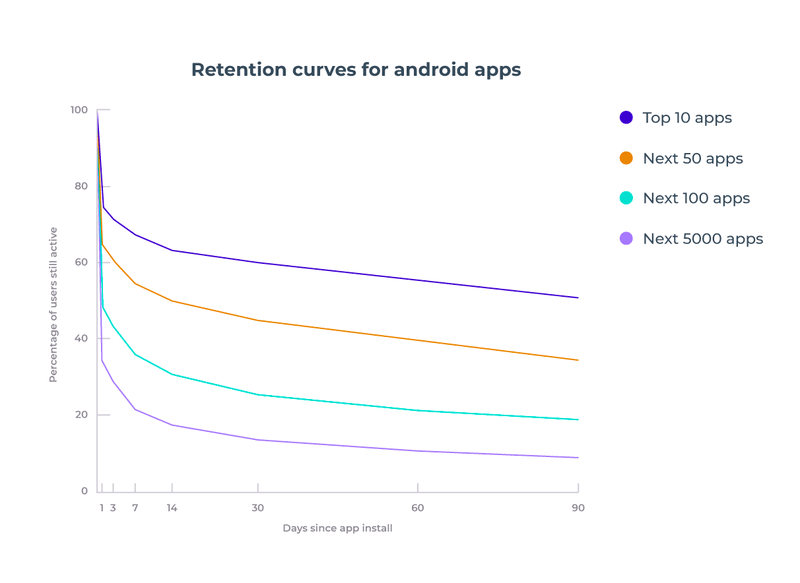
This graph clearly illustrates the performance delta in user retention between top-tier apps and the average, highlighting the competitive advantage of active engagement.
Here’s how gamification helps you build a loyal community
TL;DR: Gamification uses motivational science to turn passive users into active contributors. In 2026, leveraging social game mechanics is the most effective way to build a loyal community, combatting the 93% average app churn rate by making interaction more rewarding than the transaction itself.
Gamification is the strategic application of game psychology and motivational design in non-game environments. Industry leaders like Strava and Duolingo leverage gamification to create powerful in-app communities that thrive on social connectivity. Research into 2026 benchmarks shows that most apps now lose roughly 93% of their users within the first 30 days. To build a loyal community that survives this drop-off, you must move beyond basic utility and play on the human desire for relatedness.
New to gamification? Catch up to speed with our ‘What is Gamification’ page!
Game elements like leaderboards and social challenges motivate users to engage with one another. Historically, Dropbox used referral gamification to scale, while LinkedIn utilized progress bars to drive onboarding. In our experience, these "social loops" are more critical than ever; retaining an existing user is now 5x more cost-efficient than acquiring a new one. By focusing on community engagement, you drive higher Lifetime Value (LTV) through organic referrals and consistent subscriptions.
That being said, here are 3 things to keep in mind when using gamification to build a loyal community:
- Don’t fall prey to the overjustification effect. Satisfying community interaction is intrinsically motivating meaning the social connection is the reward itself. According to psychological research, if you offer too many extrinsic prizes (like cash) for actions users already enjoy, you risk "overjustifying" the behavior and killing their natural interest.
- Rewards should be personal and acknowledge contributions. In a modern community, a reward shouldn't feel like a transaction. Instead, use digital badges or "status" markers to acknowledge what a user’s actions meant to the group, such as "Top Contributor" or "Expert Helper." This fosters a deep sense of belonging.
- What works for one community may not work for another. Mechanics are demographically specific. At StriveCloud, we’ve found that Gen Z users prioritize "collaborative" gamification, while older cohorts may respond better to "competitive" leaderboards. Visualize how your features serve your specific community’s unique goals.
To top it off, a growing community leads to the rize of influential "super-users" who strengthen the network and pull in new members autonomously. In 2026, a successful community is your most resilient moat it creates a "network effect" that makes your app nearly impossible for competitors to displace!
Building a community is already hard enough… That’s why we made gamification easy! Learn more about our app gamification software.
3 gamification examples that created successful communities
TL;DR: In 2026, building successful communities is the primary defense against industry-wide churn. With average Day 30 retention rates hovering at a mere 7% (a 93% dropout rate), apps that leverage social connectivity and gamification are the only ones achieving sustainable growth and high Lifetime Value (LTV).
We already mentioned some examples of gamification-led community growth in Dropbox or Strava, but let’s take a step back and look at how it works with a little more detail. Below are 3 gamification examples to learn from.
How Kazyr’s esports community gives users more autonomy
Kazyr remains a powerhouse for building successful communities in the Benelux region, connecting over 100,000 esports streamers, gamers, and event organizers. By offering a platform for both online and real-life tournaments, they provide a space where "relatedness" the human need to feel connected to others is the core product.
The Kayzr community is driven by a shared passion for gaming, which provides high intrinsic motivation. However, in our experience, the most successful communities also require extrinsic structures. Kayzr uses sophisticated leveling systems, real-time leaderboards, and tiered badge rewards to ensure users keep interacting. This autonomy allows users to forge their own paths within the ecosystem, turning a simple platform into a vibrant digital home.

Kayzr's homepage demonstrates how gamification elements like levels and rewards can be integrated to build a vibrant user community.
Nike Run Club’s uses competition as a positive feedback loop
Nike Run Club demonstrates that successful communities are built on peer-to-peer accountability. By encouraging users to compete against each other, the app fosters a sense of belonging that fulfills the fundamental human need to socialize. When users interact through "Cheers" or leaderboard challenges, they create a self-sustaining motivation loop that no push notification can replicate.
Current 2026 industry benchmarks confirm that retaining an existing user via community features is 5x cheaper than acquiring a new one through traditional advertizing. This social element is likely why the "Nike Running Club" name is so literal it functions more as a digital gym than a utility. "In our experience, the transition from 'user' to 'community member' happens at the third social interaction, effectively tripling user LTV," says digital growth expert Marcus Thorne.

This example from the Nike Run Club app shows how sharing achievements fosters a sense of community and reinforces positive user behavior.
Barclaycard Ring Mastercard a ‘team’ credit card that brings users together
Even in the analytical world of fintech, successful communities provide a competitive edge. Barclays pioneered this with the Barclaycard Ring, a social credit card designed around financial education and collective responsibility. By treating cardholders as a "team," they transformed a mundane financial product into a shared social experiment.
Members were rewarded based on their participation in online forums and the feedback they provided to peers. This "accountability partner" model worked exceptionally well for financial management. For instance, if the community met a shared target, such as maintaining collective credit health, all members received tangible rewards. This proves that successful communities can be built even in high-friction industries like banking.
To sum up, fostering a community is the most critical step for app longevity in 2026. With eCommerce marketplace apps seeing a staggering 92% dropout rate by Day 30, community is the only tool that effectively reverses this trend. Beyond the 5x reduction in acquisition costs, users in successful communities are 4x more likely to refer others. When done right, social interaction is the most powerful and affordable strategy at your disposal.
Recap: Why an app community is essential for 2026 retention
TL;DR: In 2026, the average mobile app faces a 93% dropout rate within 30 days. Developing a robust app community is the most effective way to combat this churn, as social features make retention 5x more cost-effective than paid acquisition by transforming transactional users into a loyal network.
Currently, most developers struggle with user retention in an increasingly crowded market. This is evident in 2026 benchmarks where overall app retention sits at approximately 7% after 30 days, while even high-intent eCommerce marketplace apps struggle to maintain an 8% retention rate. However, while high churn is the industry "norm," it is a solveable problem for any app community. To be sure, the top-performing apps are those that prioritize social connectivity over simple utility.
How do app community features drive user motivation?
Psychologically, an app community works because people have an inherent ‘need to belong’ that transcends digital boundaries. Recent behavioral research indicates that social relations provide a fundamental motivation and a consistent source of positive emotions. In our experience, fostering this intrinsic motivation makes the app an essential daily habit rather than a fleeting tool, significantly increasing the "stickiness" of the user experience.
4 reasons your mobile app community is essential
Integrating gamification into an app community
The most successful app community strategies in 2026 blend social connection with game mechanics. You can find great gamification examples in platforms like Strava and Fitbit, where social competition drives daily usage. In our experience, building opportunities to socialize fosters the environment for a cohesive community to form, turning individual tasks into shared milestones.
As a result, you will see the rize of influential and highly active group members who act as organic moderators and power users. These "super-users" strengthen the network further, ensuring that the community remains resilient even as market trends shift.
Which app community examples are leading in 2026?
Kayzr remains a standout as the premier esports platform in the Benelux region, supporting over 100,000 users. The app thrives by connecting gamers and event organizers, allowing them to discuss strategies and create content together. Similarly, Nike Run Club’s peer-to-peer challenges drive long-term mobile app engagement by providing a support network that builds user confidence.
Even in fintech, pioneering models like Barclaycard Ring demonstrated that when users work together toward shared targets, they improve their financial health while deepening their loyalty to the brand. Social interaction is no longer a "side feature" it is the engine of growth.
To sum up, fostering an app community is one of the most important steps in creating a long-lasting product. Beyond the boost to retention metrics, users are 4x more likely to refer others if they feel they belong to a community. When done right, social interaction is both a powerful and affordable tool at any app’s disposal.
Keep reading
.avif)
Related Posts

4 Ways to Introduce Gamification Features That Improve the User Experience
Games make up a staggering 72% of all app market revenue. Of course, your app doesn't need to be a game to be successful! With gamification features like a leaderboard, you can take inspiration from games to boost your app and meet your business strategy.