
Dive into top reads
SaaS User Activation | The Complete Guide
User activation is crucial for SaaS. Unfortunately, only 25% of trial users eventually go premium. To help you get started we created the ultimate SaaS growth guide for user activation! Discover everything you need to know about drive activation during onboarding & after!
SaaS User Activation | The Complete Guide
This guide provides a comprehensive overview of SaaS user activation, explaining its importance and how to measure it effectively.
What is user activation? How can you measure it? In what ways does it drive growth for SaaS? How do I increase user activation? Without a doubt, getting users from trial to paid is a challenge all SaaS companies face. So, how can you get users to reach their ‘AHA-moment’ faster? Should you try gamified user onboarding?
To help you get started we created a complete guide on user activation for SaaS companies! In this guide, you’ll discover what user activation actually means, how you can measure it & how it drives growth! You’ll get 15 actionable tactics you can use to (re-)engage both new users, existing users & lapsing users.
This is StriveCloud’s ultimate guide to SaaS user activation:
- User activation fundamentals
- What is the activation funnel?
- How do I increase user activation?
- 15 ways to increase user activation for your SaaS product
- The bottom line of user activation in SaaS
- FAQ
User activation fundamentals
What is user activation in SaaS?
User activation is a metric that indicates how a user engages with a product. Usually, it refers to a certain series of tasks or actions during onboarding that indicates an initial level of user engagement. In SaaS, user activation focuses on the conversion from trial to paid user. However, less than 25% of free trial users eventually go premium.
How to measure user activation in SaaS?
To measure user activation you need to first define the goals, steps, or actions you want your user to complete. In SaaS, this could be upgrading to premium, or simply completing the user onboarding process. You can calculate the user activation rate by dividing the number of activated users by the total number of registered users and then multiplying it by 100.
What is user activation rate?
Activation rate = Activated users / Total registered users * 100
To be sure, user activation is a powerful metric to indicate how healthy your business is. Higher activation means higher customer lifetime value! But where do you draw the line - at what point is a user considered activated?
How to effectively map user activation events? (The 3 key milestones)
When user activation takes place varies from product to product, but activation events are generally linked to your software’s key tasks. In reality, this is useful, trackable data such as how many users complete profile set-up or perform a certain important task.
However, while your map of activation events is unique to you, it will always follow the three key milestones on the customer journey to user activation:
#1 The Aha moment (or perception of product value)
Before users can personally feel your product value, they first need to know what that value is! In psychological terms, this is called priming, which is when one stimulus influences the reaction to another. In short, show off your value during user onboarding, and users will stay loyal for longer!
#2 Finding gold (experiencing the product value)
The first thing new users do is learn how your product works. Your job here is to provide a great and valuable experience because after this step users will subconsciously evaluate whether their expectations were met. This is a make-or-break moment for continued user engagement!
#3 And finally, adopting the product
This is where you hook your users! When users come this far, you know they are more likely to respond to your engagement strategies. For example, a gamified SaaS might use points or challenges to introduce already engaged users to new features.
What is the impact of user activation on product growth?
Activation is the prerequisite for all user engagement! Show users your product value early, and you will activate them before they can churn. In short, that means growth! Indeed, a 25% rise in user activation results in a 34% jump in monthly revenue.
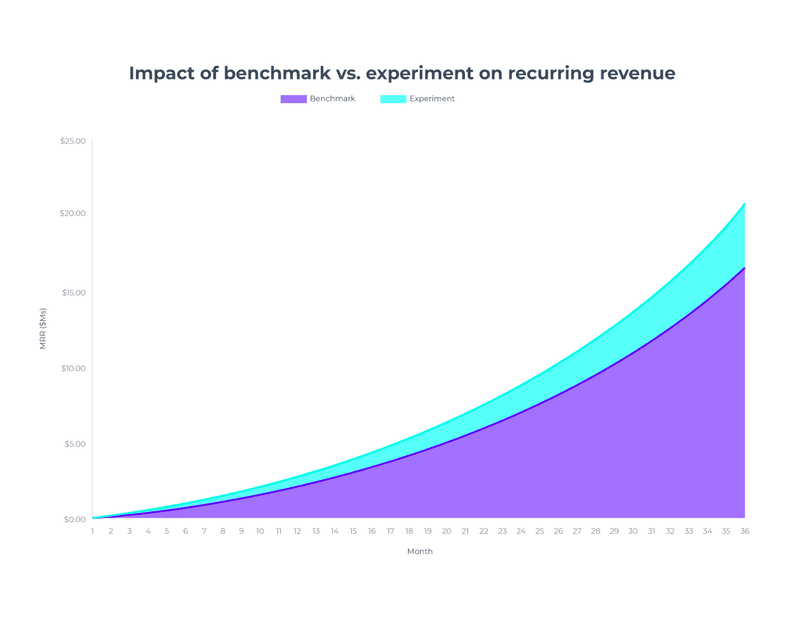
This graph illustrates the direct correlation between increased user activation and a significant rise in Monthly Recurring Revenue (MRR).
What is the activation funnel?
User lifecycle funnels are a helpful way to visualize your strategy. The framework guides you by identifying key milestones along the customer journey both from the business and the user perspective. In short, it reflects your vision of how to turn new customers into activated users!
What is the activation stage?
The activation stage comes directly after acquisition. You must show new users how you will solve their problems - in short, keeping the promises made during acquisition! For a typical Saas business, the activation stage follows some measurable and important steps:
- Requested a demo
- Received a demo
- Started free trial
- Converted to a paid customer
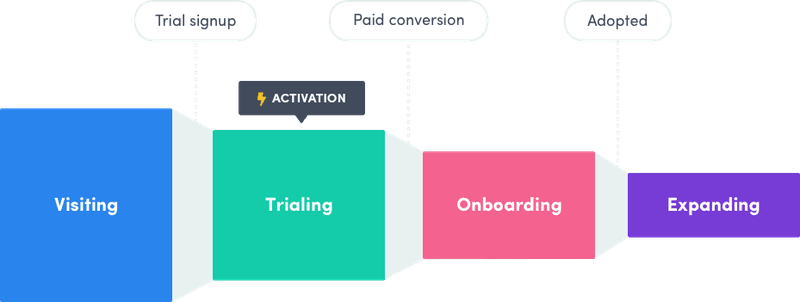
The activation and onboarding funnel visually breaks down the user journey from initial signup to becoming a fully engaged customer.
User activation for growth marketers
How do I increase user activation? For growth marketers, the activation stage represents two challenges. Firstly, how to successfully scale user onboarding. And secondly, how to activate abandoners and disengaged users. However, both cases require their own strategy!
Growth marketers optimizing for activation should know which early customer touchpoints to leverage. A gamified SaaS for instance might use a badge reward system or personalized push notifications. Experiment with these user interactions, and you can impact conversion rates - directly increasing user activation and growth.
How do I increase user activation?
Achieving higher levels of user activation takes more than effort - you need a strategy. Here the activation funnel becomes incredibly useful. Of course, having a plan that defines when and how to engage users is the difference between user engagement and churn!
Set clear goals for your activation strategy in 5 steps
Certainly, one of the tricks of an activation strategy is to facilitate - not force - a genuine and organic Aha moment that the user feels they reached on their own. To achieve that, you need a clear user onboarding process.
Think about:
- User personas. Who your users are will define their journey.
- A journey map. What does your average lead do, feel, and think at each stage?
- User engagement strategy. Time to pick your tactics, based on informed data. Choose where to implement gamified SaaS features, and how to make them unique!
- The key metrics. Know your activation, churn, and cost-per-acquisition rates.
- Push for premium. For SaaS, a conversion may mean a one-to-one meeting. To succeed, personalize and come prepared with the user’s pains and gains!
What is a good activation rate benchmark?
Currently, the top product-led growth SaaS companies enjoy a respectable activation rate of 40% for free trial users. Still, that means 6 in 10 users churn! For the moment, however, this benchmark is the one to beat. How can you increase user activation to match this?
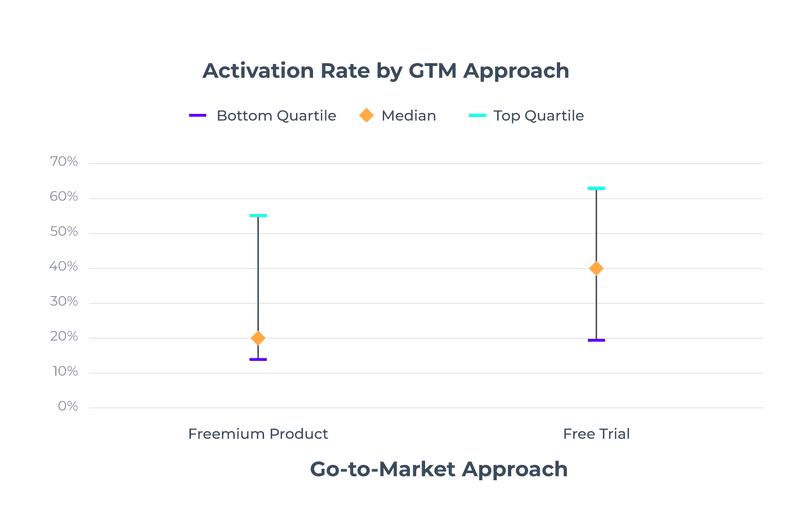
This graph shows the activation rate benchmark for top SaaS companies, highlighting the goal that growing companies should aim for.
15 ways to increase user activation for your SaaS product
Top 5 activation techniques for new users
#1 Welcome emails can create the Aha moment
When you send a welcome email with the user’s name, you personalize the user journey. This gives the customer an instant sense of ownership over the product! Moreover, welcome emails are another chance to promote your customer value. Don’t waste it!
Take SurveyMonkey for instance! They jumped straight into their customer value. Instead of a standard boring ‘Welcome to’ message, their first email asks “ready to get answers to your questions?” After all, that’s why users sign up, right?

SurveyMonkey's welcome email is a great example of personalizing the onboarding experience to immediately demonstrate product value.
#2 Improve user onboarding through progress bars
A gamified SaaS might incentivize people who complete user onboarding with a progress bar. As the bar fills up, users receive both instant feedback and an indication of how long is left. This is crucial to avoid user frustration & boredom- a perceived longer onboarding means higher churn!
To see how to implement a progress bar like a pro, look no further than the productivity software Trello. Trello links the progress bar with unfinished tasks, thus leveraging the ‘Zeigarnik effect’. This effect says that incomplete tasks are more memorable than completed ones. In doing this, Trello makes completing onboarding irresistible!
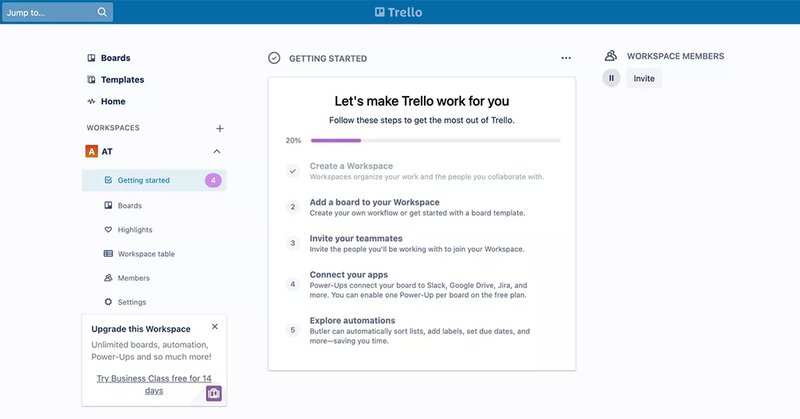
This screenshot of Trello shows how a well-designed progress bar can gamify user onboarding and encourage task completion.
Create a gamified experience to drive user activation? Build your own gamification strategy during a tried & tested workshop!
#3 Personalize the onboarding user experience
Take advantage of the user personas you’ve developed and personalize your user onboarding. When you segment your users, you can customize the onboarding to fulfill their unique expectations - as well as provide that crucial glimpse of your product value.
Let’s look at HubSpot for example. Even though they have a complex product their onboarding begins with a quick survey asking users about their specific needs and industry. These short, simple questions - none of them personal - can form the basis of your personalization strategy.
#4 Delay asking for user registration
Pushing for a full registration before the customer explores your platform is sure to lower user activation. Until you activate your newly acquired user, they are just a visitor! So let them discover your platform before you request they register.
There’s no clear answer on when to ask - that’s why you need to experiment and see what works best for you. Graphics creation software Snappa for instance found out that simply delaying email confirmations resulted in 20% monthly revenue growth!
#5 Tooltips, not tutorials
Optimize onboarding by skipping tutorials and product tours. Instead, show sporadic tooltips with quick hints at the exact time that the user needs them. Now that’s customer value! Tooltips are an easy way to create a platform that is responsive and personalized.
Take inspiration from business messaging software Respond. Their tooltips nudge new users to add their first channel. First, they show how the platform works. Then, they specifically explain how the platform can benefit them. As a result, users immediately get to the AHA moment for their specific use case.

Respond.io uses contextual tooltips to guide new users, demonstrating a key method for seamless, gamified onboarding.
Top 5 activation techniques for existing users
#1 Send emails to introduce new features
Once you learn a platform, it’s easy to settle into a routine. Keep that routine fresh by sending emails about new features, getting users excited again to discover your increasing product’s value.
Video hosting platform Wistia for instance showed off their new video player with a clear call to action that takes people to explore the new feature. Simple and frictionless!

This email from Wistia effectively announces a new feature, providing a clear call-to-action to re-engage existing users.
#2 Give users the chance to extend their free trial
Activate your existing trial users with this simple feature! Offering a free trial extension highlights your most engaged users, allowing you to better target your marketing. This can boost your cost-per-acquisition rates and make user activation more effective.
Improve things further with a gamified approach! Management software Prodpad rewards users with extensions by asking them to complete tasks, such as setting up their profile or even referring another user. With this feature, Prodpad tripled its conversion rate!

Prodpad’s strategy of offering trial extensions for completing tasks is a powerful example of gamified onboarding in SaaS.
#3 Timed challenges and digital rewards can increase user engagement
Gamified features incentivize user engagement, edging them closer to activation. Take timed challenges and digital rewards for instance! They are both fun and provide an intrinsically motivating reason to use your platform. What is intrinsic motivation? Essentially, users will engage because they enjoy it!
Salesforce gave their users bronze, silver, and gold 10-12 week challenges to incentivize learning the product’s features. Additionally, to reward engaged users, they received badges and levels. This gamified approach led to an increase in user logins of over 34%!

This example from Salesforce illustrates how timed challenges and badges can be used to drive gamified activation and feature adoption.
Building a gamified experience has never been easier - Check out our gamification software & find everything you need in 1 solution!
#4 Start an in-app community
Social relatedness is consistently one of the most powerful motivations available. A community can by themselves create support networks like those on forums where questions get answered, or even just a place for users to brag about their achievements. Additionally, we’ve seen many gamification examples that leverage their community to drive engagement.
Support software Freshdesk for instance gamified its community with a leaderboard. It creates competition and fosters interpersonal relationships between colleagues. Also, it makes user engagement worthwhile!

The Freshdesk leaderboard is a prime example of using gamification and community features to boost engagement within a SaaS product.
#5 Leverage the network effect and create sustainable growth
SaaS companies are uniquely scalable. Combine this with the ‘network effect’ and you’ll unlock sustainable growth! In brief, the network effect says that a product becomes more useful the more users sign up. To achieve this, incentivize referrals and implement social features.
Messaging software Slack went from $0 to $7 billion in under five years by doing this! Right away, Slack asks new users to invite team members, and they facilitate this with one-click links and unique user URLs that can be shared anywhere. These types of viral growth hacks are also seen in lots of gamification examples where they add fuel to the fire with rewards like badges, experience points or milestone unlocks!

Slack effectively leverages the network effect by prompting users to invite their team, a key strategy for viral growth and gamified onboarding.
Top 5 activation techniques for unengaged users
#1 Retargeting emails with social proof go a long way
Adding social proof to your re-engagement campaign is a clever user activation technique. In essence, testimonials work so well because peer reviews build trust and credibility. Social proof can be gathered from user feedback and even personalized to the user’s segment!
#2 Give users an incentive to return
Try offering disengaged users a free week of premium. This encourages them to give your platform a second chance. Targeting lapsed users is in fact one of the best growth strategies - reengaged users spend 37% more often than new users!
For example, Flow lets users experience their project management tools by making it easy to extend the free trial, and they do it with a personable copy to boot.

This image demonstrates how offering a trial extension can be a simple yet powerful way to increase user activation and re-engage lapsed users.
#3 Live chats can stop users from quitting
Only 14% of SaaS products offer a live chat. That’s a huge problem! Live chats keep users in-app and satisfied, driving user activation and not frustration. In fact, live chats have the highest customer satisfaction rate of 82%, more than any other channel. What’s your excuse?
#4 Catch lapsing users with social media
While some users might be disengaging with your product, nearly 7 out of 10 minutes on mobile are spent on social media! Take advantage of this by reengaging lapsed users on social media, where you are most likely to reach them.
#5 A gamified loyalty system promotes user retention
Stop users from churning in the first place with a gamified loyalty system. Users today expect to be rewarded for their loyalty - the so-called Lucky Loyalty Effect - and actually feel more entitled to prizes and gifts than customers who are not loyal.
To be sure, a lapsed user has less reason to churn for good if they have built up perks & invested lots of time in setting up their profile. It creates a sense of loss prevention which will make users less likely to switch.
The bottom line of user activation in SaaS
Optimizing user activation has been shown to give you the biggest bang for your buck. Even more than retention or loyalty, activation is the most essential step in the customer journey. Without being activated, users will churn before they can even engage!
To sum up activation, you need to get users from acquisition to learning about your product value, experiencing it, and finally turn it into a habit. Certainly, it is an enormous task - and it is the SaaS companies with the ambition to experiment who will discover the next best way to increase user activation! Will it be you?
Kickstart your own activation strategy with a custom workshop & go home with an actionable roadmap!
FAQ - How do I increase user activation?
What is user activation in SaaS?
User activation is a metric that indicates how a user engages with a product. Usually, it refers to a certain series of tasks or actions during onboarding that indicates an initial level of user engagement. In SaaS, user activation focuses on the conversion from trial to paid user. However, less than 25% of free trial users eventually go premium.
How does user activation create product growth?
User activation is the prerequisite for all user engagement! Show users your product value early, and you will keep them engaged for longer. In short, that means growth! Indeed, a 25% rise in activation results in a 34% jump in monthly revenue.
What is user activation rate?
User activation rate is a metric that indicates what percentage of users actually activate. You can calculate this by dividing the number of activated users by those who signed up and then multiplying it by 100.
How to create a user activation strategy?
There are five steps to building a user activation strategy. Firstly, you need user personas. Those will define the customer journey. Then you develop a user engagement strategy, supported by metrics like activation & user engagement rate. Finally, you experiment with tactics like gamified user onboarding to drive users from trial to premium!
Top 25 user growth experiments designed to boost SaaS user activation rate
Want to boost activation? Get started with these 25 growth experiments! Discover how user activation can boost onboarding, feature adoption & trial to paid conversion for your own SaaS!
Top 25 user growth experiments designed to boost SaaS user activation rate

This introductory image sets the stage for a deep dive into user growth experiments aimed at improving SaaS activation.
Building a sticky product is the dream of every SaaS, but it’s not easy. It requires you to always be tweaking and improving your strategy to activate new users and turn them into loyal ones. Some have suggested gamified onboarding, others recommend personalized notifications or tooltips. However, the right strategy depends entirely on your situation! With this in mind, we at StriveCloud have collected 25 user growth experiments to lift up your user activation rate and boost user engagement!
- How to define the activation point for your SaaS product
- 25 user growth experiments to start optimizing
- 7 user growth experiments for new user onboarding
- 6 user growth experiments to improve feature adoption
- 6 user growth experiments that boost trial to paid conversions
- 5 user growth experiments to enhance personalization
- FAQ
Track user activation rate by defining your AHA-moment
In reality, there is no one activation event. However, activation takes 3 steps. Firstly, the perception of value. Then, the experience of value. And finally full product adoption. But what facilitates those activation points are defined by your product's key tasks.
Take a project management SaaS for instance. Their activation point might be when a user creates a new project. However, after doing some user growth experiments, you might find what other actions drive the user activation rate.
User activation rate = Activated users / Total registered users * 100
In short, experiments will help you reveal the tipping points with the highest user activation rate. In other words, you can motivate the behaviors that lead to more user engagement and higher customer lifetime value!
What’s a good user activation rate? Check out our ultimate SaaS user activation guide & start optimizing!
25 user growth experiments to start optimizing
Through research, we have determined 25 user growth experiments to lift up your user activation rate today! Moreover, each experiment comes with an ICE prioritization score which will help you find the best tests for your goals.
7 User growth experiments for new user onboarding
#1 Tweak the onboarding copy
A good piece of copy can make a new user like your product. But to succeed, you need 2 things: clarity and personality. For example, Acme Widgets overhauled their copy and achieved a 5% increase in conversions!
Our score:
- Impact - 7
- Confidence - 7
- Ease - 9
- ICE score - 77%
Want to calculate your own ICE score? Get our Free Growth Experiment Planning Tool!

This example of onboarding copy demonstrates how clear and concise messaging can guide new users effectively.
#2 Celebrate quick wins during onboarding with gamification
Onboarding shouldn’t be boring! So how can you make it fun while still expressing value? With a gamified approach, you can keep users in an engagement loop of action & rewards. You can celebrate wins through confetti screens, badge achievements, or even personalized notifications. AddThis for instance sends users an email when their traffic spikes thanks to them!
Our score:
- Impact - 8
- Confidence - 8
- Ease - 8
- ICE score - 80%
Want to calculate your own ICE score? Get our Free Growth Experiment Planning Tool!
#3 Personalize onboarding to your user personas
Take advantage of user personas and match onboarding to complement each profile. When you segment users, you can customize onboarding for their unique roles & perspectives. Definitely, a personalized experience will lead to more app engagement.
Our score:
- Impact - 7
- Confidence - 8
- Ease - 7
- ICE score - 73%
Want to calculate your own ICE score? Get our Free Growth Experiment Planning Tool!
#4 Feature video product tours to create the AHA Moment
Video can massively impact your user activation rate! In fact, 65% of people say video is their preferred way of getting to know a new product or service. Besides, it helps to scale time on both sales and customer success teams! Basecamp for instance has a 2-minute instructional video explaining the basics of their product.
Our score:
- Impact - 7
- Confidence - 4
- Ease - 4
- ICE score - 50%
Want to calculate your own ICE score? Get our Free Growth Experiment Planning Tool!

The LifeWorks app onboarding shows how a guided experience can improve user engagement from the very first session.
#5 Customize your user interface based on product goals
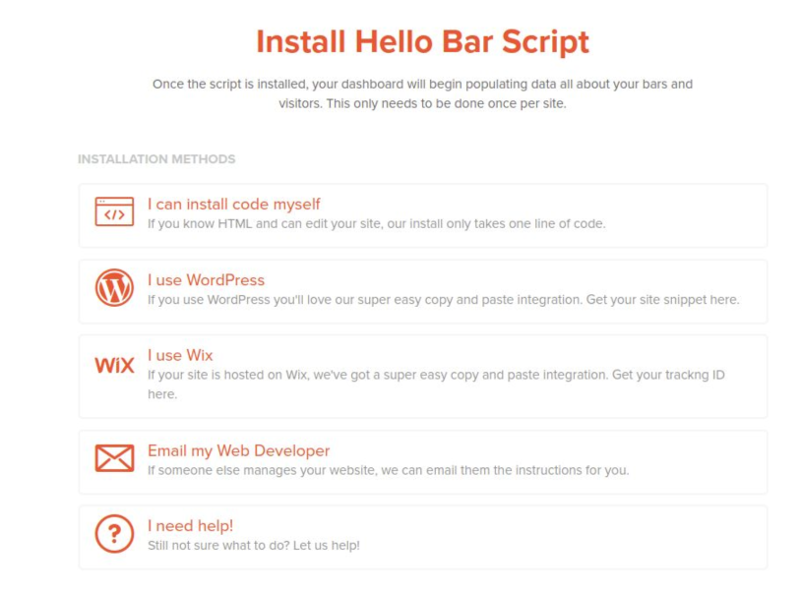
Especially when you have a multifunctional product, it’s important to find the focus of your user during onboarding. The pop-up tool Hellobar for instance lets you customize its interface by selecting your goals and pop-up types. They even give you tailored instructions on integrations depending on your level of coding skills!
Our score:
- Impact - 7
- Confidence - 8
- Ease - 1
- ICE score - 53%
Want to calculate your own ICE score? Get our Free Growth Experiment Planning Tool!
#6 Create gamified progress bars to improve onboarding completion
As a progress bar fills up, users receive both instant feedback and an indication of how long is left. This is crucial to avoid user frustration and boredom - a perceived longer onboarding means higher churn. LinkedIn is a classic gamified onboarding example; this feature alone boosted profile set-up completion rates by 55%!
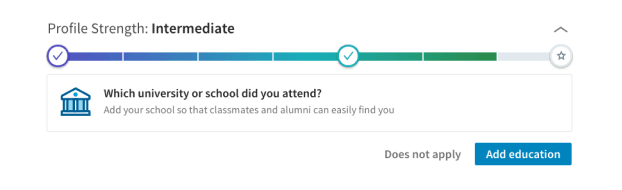
LinkedIn's profile completion bar is a classic example of using gamified progress to motivate users to provide more information.
Our score:
- Impact - 7
- Confidence - 7
- Ease - 8
- ICE score - 83%
Want to calculate your own ICE score? Get our Free Growth Experiment Planning Tool!
#7 Add a sense of endowed progress to boost user motivation
When you give your users instructions such as 5 steps to complete, try to already cross out the first two. Giving users a headstart motivates them to complete the challenge by making it easier. Take Userguiding’s gamified onboarding checklist for instance. This tactic helps to increase your user activation rate & onboarding completions by upwards of 10%!
Our score:
- Impact - 7
- Confidence - 8
- Ease - 10
- ICE score - 83%
Want to calculate your own ICE score? Get our Free Growth Experiment Planning Tool!
6 User growth experiments to improve feature adoption
#8 Nudge users with subtle tooltips
Pushing users too hard to try new things can provoke the 'Reactance Effect', where users do the opposite of your goal! Instead, go for closeable tooltips that show up exactly when the user needs them.
Our score:
- Impact - 8
- Confidence - 8
- Ease - 7
- ICE score - 77%
Want to calculate your own ICE score? Get our Free Growth Experiment Planning Tool!
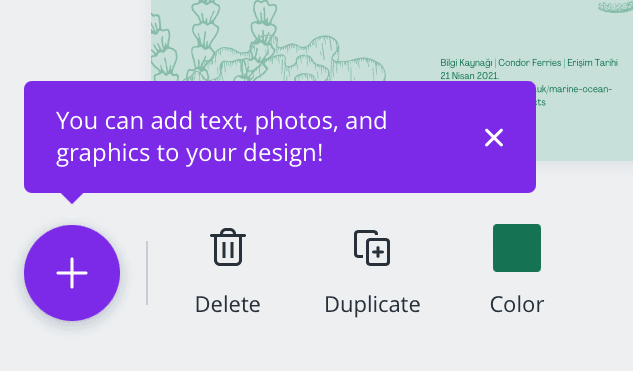
Subtle tooltips, as shown here, can guide users towards new features without disrupting their workflow, boosting app engagement.
#9 Add gamified challenges to boost new feature adoption
Leverage gamified features like challenges & rewards to boost app engagement on new features. Gamification is a great way to spark the original motivation and to keep users coming back. Alert users about new features and reward them for trying them out.
Our score:
- Impact - 8
- Confidence - 7
- Ease - 7
- ICE score - 73%
Want to calculate your own ICE score? Get our Free Growth Experiment Planning Tool!
Building a gamified experience has never been easier – Add, track & tweak your gamification strategy with 1 solution!
#10 “Getting started” emails can hype up certain features
A series of emails introducing your product's key features help to inspire that all-important 'AHA Moment'. Certainly, giving users an overview of what’s possible with your software makes onboarding easier which can lead to more app engagement.
Our score:
- Impact - 7
- Confidence - 7
- Ease - 10
- ICE score - 80%
Want to calculate your own ICE score? Get our Free Growth Experiment Planning Tool!
#11 Create interactive walkthroughs
As opposed to tooltips, walkthroughs mix user actions with instructions. Take CRM software Salesflare for instance. Their instructions not only show how their platform works, but it re-expresses value towards their users. Doing this can nearly double the user activation rate! And, you guessed it, a gamified rewards system can boost it even more!
Our score:
- Impact - 8
- Confidence - 8
- Ease - 3
- ICE score - 63%
Want to calculate your own ICE score? Get our Free Growth Experiment Planning Tool!
#12 Introduce rewards to encourage feature adoption
Sometimes users just need a reward! Work management platform Asana rewards users with a flying unicorn that celebrates task completion. What’s more, Asana incentivized app engagement further by rewarding the first user who screenshotted the unicorn with a $500 gift card!
Our score:
- Impact - 9
- Confidence - 8
- Ease - 7
- ICE score - 80%
Want to calculate your own ICE score? Get our Free Growth Experiment Planning Tool!

Asana's celebratory unicorn is a perfect illustration of how a simple, fun reward can increase task completion and overall app engagement.
#13 Use in-app communities to promote new features
An in-app community allows you to communicate closely with users. Not only can you give advice on how to use new features, but you can also collect feedback & find product ambassadors! The Interconnected forum by Intercom for instance not allows you to ask questions, join groups & find the latest product updates & resources. It’s built to help users succeed by sharing their lessons. To promote user-generated responses they also feature a leaderboard of the top connectors!
Our score:
- Impact - 9
- Confidence - 8
- Ease - 4
- ICE score - 70%
Want to calculate your own ICE score? Get our Free Growth Experiment Planning Tool!
Get activating with gamification! Book a custom workshop & go home with an actionable roadmap!
6 User growth experiments that boost trial to paid conversions
#14 Leverage “stored value” to keep users coming back
Some SaaS platforms become more valuable as a user spends more time on them. Take Salesforce for instance. The more someone uses it to store data, the more valuable it becomes. Not only does it lead to a more complete experience, but it also introduces the hassle of switching costs. Thus, think about what your user investment hook looks like!
Our score:
- Impact - 8
- Confidence - 8
- Ease - 4
- ICE score - 67%
Want to calculate your own ICE score? Get our Free Growth Experiment Planning Tool!
#15 Offer the opportunity to extend free trials
Of course, trial extensions are better than losing users forever. However, the danger is covering users that never intended to pay! Experiment with this issue by offering extensions to specific user segments or through gamified trial extensions that reward user engagement. Navexa, for instance, gave users the ability to extend their free trial by completing their profile.
Our score:
- Impact - 8
- Confidence - 9
- Ease - 7
- ICE score - 80%
Want to calculate your own ICE score? Get our Free Growth Experiment Planning Tool!

This example from Navexa shows how offering a trial extension in exchange for profile completion is a smart, gamified growth experiment.
#16 Use social proof to build credibility
Did you know that 88% of consumers trust user reviews as much as personal recommendations? Nudge your users to convert to paid by connecting them with relevant industry testimonials, using an authority figure in their market, or sending targeted case studies.
Our score:
- Impact - 7
- Confidence - 9
- Ease - 8
- ICE score - 80%
Want to calculate your own ICE score? Get our Free Growth Experiment Planning Tool!
#17 Keep some features locked during trial
Try a user growth experiment around feature access. Too many features can lead to cognitive overload & churn. However, too few features might not give enough value. Instead, try out a gamified approach where users can unlock new features for carrying out specific actions, or simply add a premium button to have users upgrade right away!
Our score:
- Impact - 9
- Confidence - 7
- Ease - 6
- ICE score - 73%
Want to calculate your own ICE score? Get our Free Growth Experiment Planning Tool!
#18 Trigger a sense of urgency by sending follow up emails
Don’t let the deadline pass without your user knowing it! A sense of urgency sparks the fear of missing out. Maybe your user hasn’t spent enough time on their trial? Or maybe they had just forgotten about it? Track user engagement & follow up accordingly. You could even consider offering a trial extension.
Our score:
- Impact - 5
- Confidence - 8
- Ease - 9
- ICE score - 73%
Want to calculate your own ICE score? Get our Free Growth Experiment Planning Tool!
#19 Use scarcity & exclusivity to power up demand
Scarcity is guaranteed to boost your user activation rate. People are more motivated by loss avoidance than actual rewards. Take the email software Superhuman for instance! They built a waiting list of over 250,000 people. However, if you get an exclusive invite by an existing user you get to skip the line!
Our score:
- Impact - 8
- Confidence - 8
- Ease - 3
- ICE score - 63%
Want to calculate your own ICE score? Get our Free Growth Experiment Planning Tool!
6 user growth experiments to enhance personalization
#20 Personalized notifications provide unparalleled customer value
Empower your users and give them value with notifications designed for them. This level of personalization requires effective user segmentation - whether it be along the lines of user personas, behavior, or lifecycle stage.
Our score:
- Impact - 10
- Confidence - 9
- Ease - 6
- ICE score - 83%
Want to calculate your own ICE score? Get our Free Growth Experiment Planning Tool!
#21 Greet existing customers with a personalized message
Say ‘welcome back’ like payroll company Gusto and you’ll build a great customer relationship! In conclusion, reserve your general sales-oriented copy for new users.
Our score:
- Impact - 4
- Confidence - 4
- Ease - 10
- ICE score - 30%
Want to calculate your own ICE score? Get our Free Growth Experiment Planning Tool!
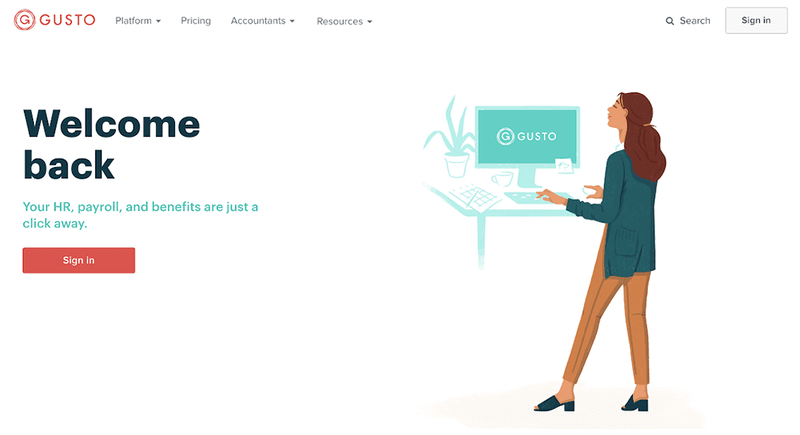
Gusto's personalized greeting is a simple yet effective personalization technique that helps build a stronger customer relationship.
#22 Retargeting campaigns can catch lapsing users
Retargeting ads receive 76% more clicks than a standard ad! Lift up app engagement by remarketing to lapsed users through personalized ads with information gathered during onboarding and from prior user engagement.
Our score:
- Impact - 7
- Confidence - 9
- Ease - 7
- ICE score - 77%
Want to calculate your own ICE score? Get our Free Growth Experiment Planning Tool!
#23 Give product recommendations based on user activity
What better way is there to incentivize repeated user engagement than by making your experience even more personal? Help users discover new relevant features or use cases based on their previous interactions. You can do this through banners, notifications, emails,... As long as the feature you recommend is relevant & useful it will drive app engagement & retention!
Our score:
- Impact - 9
- Confidence - 10
- Ease - 6
- ICE score - 83%
Want to calculate your own ICE score? Get our Free Growth Experiment Planning Tool!
#24 Leverage user engagement for progressive profiling
This approach will help you collect more user data with every interaction. Instead of overstimulating new users by asking them a ton of questions at the start, progressive profiling steadily collects more information over time to improve conversion in every stage by as much as 20%.
Our score:
- Impact - 9
- Confidence - 10
- Ease - 6
- ICE score - 83%
Want to calculate your own ICE score? Get our Free Growth Experiment Planning Tool!
#25 Webinars can answer a customer’s burning questions
It helps to have a friendly face when you want to ask the questions on your mind. Webinars are perfect for this, as the topic of them can even be personalized to provide the answers that a specific group of users is clamoring for. It’s certainly a great way to increase user activation rate in B2B SaaS.
Our score:
- Impact - 9
- Confidence - 7
- Ease - 7
- ICE score - 77%
Want to calculate your own ICE score? Get our Free Growth Experiment Planning Tool!
FAQ
How to define the activation point?
In reality, the ultimate activation point for your SaaS product is the one with the highest user activation rate! Learning which event this is for your platform requires enacting a range of user growth experiments based on different activation points.
What is user activation rate?
You can work out the user activation rate by dividing the number of activated users by the total of registered users, then multiplying by 100. This gives you a clear, easy-to-measure percentage.
Why do I need to do user growth experiments?
Achieving sustainable growth is a constant challenge. It requires that you are always tweaking and improving the activation strategy that turns new users into loyal ones. User growth experiments are simply ways to discover your best activation strategy!
How can gamification drive user growth for SaaS?
Gamification incentivizes repeated user engagement by making your product enjoyable to use! Higher levels of engagement mean more data for personalization and marketing efforts, as well as a product more likely to get users hooked.

Follow these 8 simple steps to create a successful gamified app
How gamification is used in apps varies, but one thing remains the same - done right, app gamification can augment your UX and inspire a powerful sense of user motivation! Read on and discover the 8 step plan to creating a successful gamified app of your very own.
Follow these 8 simple steps to create a successful gamified app

This guide will walk you through the essential steps for incorporating gamification into your application effectively and outlines what a truly gamified experience looks like.
It goes without saying that growth teams want to maximize their app retention and user engagement. But how you go about achieving that is what makes your user experience special! To inspire your own app gamification journey, let’s discover how gamification is used in apps & what a gamified experience looks like. Finally, we’ll give you 8 simple steps to build your own gamified app.
- The idea behind app gamification
- What is a gamified experience?
- 3 ways to get users hooked with app gamification (with real-life examples!)
- 8 steps of implementing app gamification
- Top 3 gamified app examples
- FAQ
The idea behind app gamification
Gamification introduces game-like elements like badges, points, and levels to create a more motivating user experience. Far from turning your app into an outright game, app gamification augments your existing UX by incentivizing desired user activity and inspiring a powerful intrinsic motivation.
Simply put, intrinsic motivators are complex concepts like the need for personal growth, purpose, and fun. Altogether, these factors make your app naturally fun and satisfying to use, in turn boosting engagement!
Mauro Cherubini - "The greater the intrinsic motivation, the more likely an individual is to engage in a behavior over the long-term."
In fact, the benefits of intrinsic motivation are one of the most compelling arguments for why apps should choose to gamify. Research has shown that gamification has a positive effect on intrinsic motivation and this makes it an indispensable tool for those looking to motivate their users and push up their metrics.
Slash churn and supercharge user engagement! Check out our definitive guide to app engagement & retention.
What is a gamified experience?
A gamified experience emphasizes personal progression, intersocial competition, and rewards. In short, a goal tailored to the individual, a fun way to achieve it, and rewards to make the journey worthwhile. Consciously or not, every app can fit into this model!
Take health & fitness apps for example, where many users sign up to get fit. Already, that’s the ideal base for a gamified journey! Or look at fintech, where new users open an account to save money or simply to be rewarded. In fact, finance consumers say that rewards are one of the most attractive pull factors when picking a digital bank.
As you can see, with just the most basic motivation you have fertile ground to build a gamified experience that maximizes those emotions.
To put a gamified experience in concrete terms, these 5 mechanics are essential:
- Relationships. People are naturally social. Features like leaderboards or group challenges can put this into motion, and motivate your users.
- Accomplishment. If winning doesn’t feel like winning, then what’s the point? Make sure to celebrate user progress with levels, badges, and points.
- Empowerment. Just as users have their own end goals, the journey to achieve them is also personal. To meet this need, empower users with customization.
- Unpredictability. Keep your UX feeling new and worth coming back to. Challenges, wagers, and hotzones can add much-needed depth to your UX.
- Constraint. Teens might call this FOMO or the ‘fear of missing out’. In short, people are highly motivated to avoid negative outcomes or constraints!
Build the ultimate gamified app with a custom gamification workshop! Bring your goals, we’ll bring the expertise!
3 ways to get users hooked with app gamification (with real-life examples!)
The greatest strength of a gamified app lies in its power to boost user engagement and retention. When you make the UX fun, users get hooked on your product! And in a world of product-led growth, this has never been more important.
But let’s get to the heart of it, how is gamification used in apps? Primarily, app gamification can be used to achieve 3 goals:
#1 Evoke customer emotion
Right from the beginning, app gamification is designed to elicit positive emotions in the user. For example, users get satisfying and motivating dopamine hits from receiving badge rewards or simple positive reinforcement. Indeed, studies show that gamified rewards increase cognitive user engagement.
#2 Build customer habits
Habit-forming is crucial. To incentivize your users to engage, use gamification features like streaks and challenges. Indeed, regular engagement works wonders: 90% of new users who engage weekly are retained on Day 30, compared to 23% for those who don’t.

This chart clearly illustrates the strong correlation between weekly user engagement and higher retention rates over a 30-day period.
#3 Drive repeat engagement
A boost in repeat engagement reaps other rewards in addition to retention. More user engagement means more data, and that data allows you to better personalize and contextualize your UX and marketing offers.
In short, when you look at how gamification is used in other apps, you should look out for how they make every interaction matter! While a gamified app can leverage many tools to meet these aims, knowing why it is done is the first step in implementing gamification yourself.
8 steps of implementing app gamification
Introducing app gamification means making a plan. Without a solid base, you risk creating an inconsistent UX that pushes users away, rather than hooking them in. In fact, if you’re looking to enact your holistic gamification strategy, a great way of doing so is with a flexible and scalable building blocks gamification software.
Everything you need to gamify your app in 1 solution – check out how our app gamification software can help you!
But before implementing gamification, you need a plan! Luckily for you, you can follow these 8 simple steps designed to be personalized to your unique situation:
- What are your growth goals? Start your journey by imagining its end. After that, list the obstacles blocking your path. This will help frame your plan.
- Explore your app! Make a general assessment of your app’s functionality. What service does it actually offer to users?
- Identify a target audience. Learn not just who your users are and what they like, but find out what motivates them. This is your key to engagement!
- Find the user interactions. Speaking of user engagement, what is your ideal user interaction? Is the route to interaction simple, or complicated?
- Learn from the best (and worst). Study how competitors leverage gamification, from great examples to not-so-great examples.
- Select your strategy. Based on the information you’ve gathered and what goals you want to achieve, now is the time to pave the way forward. This strategy should leave room for growth - in short, ensure it is scalable.
- Develop gamification features. It’s here that your gamified app takes shape! Leverage user data to develop challenges and rewards that will motivate users.
- Evaluate and optimize the gamification features. Test, test, test! Measure your success using key KPIs such as daily/weekly user engagement and other feedback methods. Use this to inform your optimization strategy, which will keep your app fresh and relevant.
Build the ultimate gamified app with a custom gamification workshop! Bring your goals, we’ll bring the expertise!
Top 3 gamified app examples
Navexa uses free trial rewards to lock in engagement early
How is gamification used in apps to increase user engagement during onboarding? To be sure, this is a serious challenge. In 2019, average app user retention by Day 14 was just 5.8%. In contrast, Navexa boasts a 50% conversion rate from trial to a paid subscription in 14 days. Now that’s a success!
Navexa solved this problem with one clever gamification feature. To reward free trial users with the highest engagement, every step of onboarding that is completed earns users an extra free trial day! In essence, Navexa is incentivizing users to learn the value of the product, as well as giving them double the time to experience that value.

Navexa's gamified onboarding successfully incentivizes users to explore the platform by rewarding them with extended trial days for completing key actions.
Badges help Fitocracy user hit their fitness goals (as well as help Fitocracy reach their goals)
Is the aim of your users to get fit? Whatever it is, badges can help them get there. Not only that, Fitocracy’s clever use of badge rewards aligns with what they want to see from their users. For instance, badges are given to users who post on the in-app community. This can push users to socialize and become a part of the community, a hugely powerful motivation to be sure. That will keep users engaged, exercising, and reaching their goal!
Indeed, Fitocracy’s badges have been noted by a study as ‘incentivizing continued use to earn them all’. In other words, that means higher engagement and longer retention!
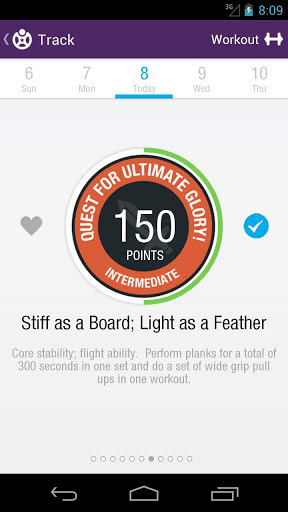
Fitocracy uses a badge system to celebrate user achievements, encouraging consistent use and fostering a sense of accomplishment.
Mobility app Ciclogreen challenges Spain to travel green
Issuing a group challenge is one of the best ways to clearly communicate your brand values. Not only does it entice users to test their ability, but the competition inherent in a group challenge motivates users to be the best. It’s for this reason that Spanish mobility app Ciclogreen ran a public leaderboard on their ‘30 days by bike’ challenge.
In totting up the distance traveled sustainably by employees and university students, Ciclogreen inspired a powerful sense of motivation. Or as a recent study put it:
Gamification through leaderboards, 2019 - "When [users] share the same score in leaderboards, all users appear at the same position, fostering relatedness. They feel they are part of a group and can discuss results with their peers."
The challenge and its leaderboard worked - Ciclogreen engaged over 44 organizations and nearly 13,300 users! All in all, over 101,000 kilometers were traveled sustainably. And to sweeten the deal, the most active individual users won prizes like backpacks and bike helmets. To be sure, those users won’t forget the challenge anytime soon!

Ciclogreen's leaderboard for their '30 days by bike' challenge demonstrates how competition can drive massive engagement and promote brand values.
FAQ
What is the idea behind app gamification?
Gamification introduces game-like elements like badges, points, and levels to create a more motivating user experience. Far from turning your app into an outright game, app gamification augments your existing UX by incentivizing desired user activity and inspiring a powerful intrinsic motivation.
What is a gamified experience?
A gamified app experience emphasizes personal progression, intersocial competition, and rewards. In short, a goal tailored to the individual, a fun way to achieve it, and rewards to make the journey worthwhile. Consciously or not, every app can fit into this model!
How is gamification used in apps?
App gamification is used to achieve 3 important goals. Firstly, to evoke customer emotion, with things like rewards and positive reinforcement. Secondly, to build customer habits, and lastly to drive repeat user engagement, both achieved by creating a fun, sticky user experience.

6 powerful psychological triggers designed to boost user activation
Get users to their AHA moment fast, and keep them coming back. What can SaaS companies do to drive user activation? Well, start with human psychology in mind. Discover the 2 factors that influence user activation & learn 6 powerful psychological triggers to boost it!
6 powerful psychological triggers designed to boost user activation

Understanding the psychological drivers behind user behavior is essential for improving activation and engagement within any software application.
- The 2 major factors that affect activation rate
- How to address your users to spark user activation
- 6 psychological triggers for user activation in SaaS
- Why gamification? - How gamified features trigger user activation
- Get optimizing with StriveCloud’s gamification solutions
- FAQ
The 2 major factors that affect activation rate
Behavioral science researchers have been exploring the topic of motivation for decades. One of those researchers is Dr. BJ Fogg, a social scientist from Stanford University. He created the Fogg Behavior Model (FBM), a popular model that maps someone’s motivation and ability to complete an action against their likeliness to actually carry it out. For a user to take action, these 2 major factors have to be in place.
Based on these insights SaaS companies have been experimenting with new tactics in hopes of finding the ultimate psychological triggers for user activation.
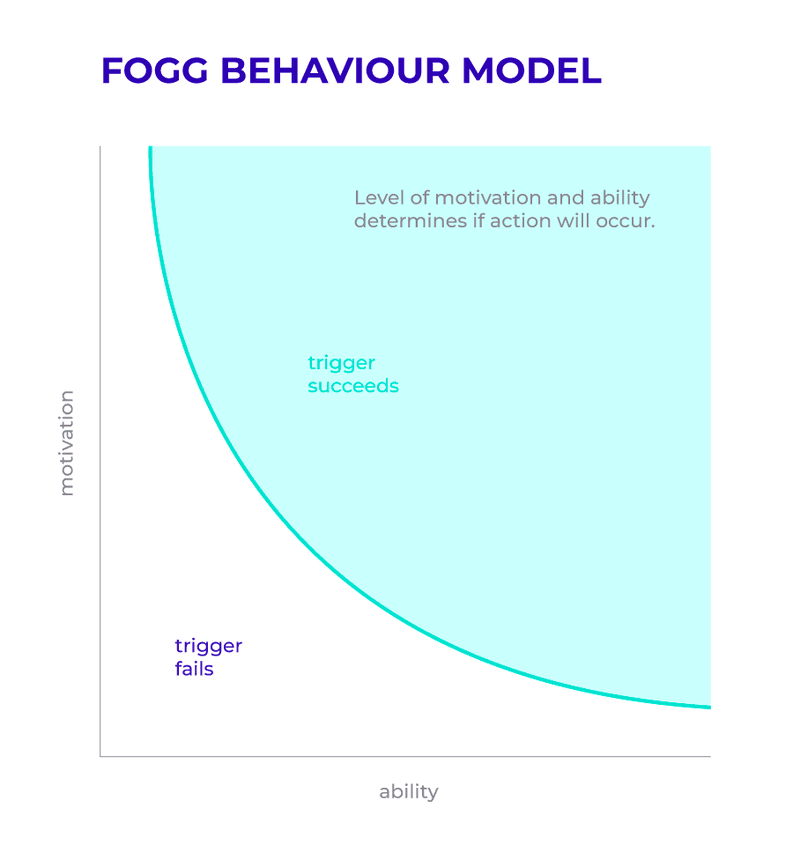
The Fogg Behavior Model shows that for an action to happen, a user needs sufficient motivation, ability, and an effective prompt to trigger the behavior.
In essence, it notes that you must encourage your users to action, while also creating the circumstances where reaching the activation point is possible. In other words, if you make something either too hard or too boring, users will lose interest. However, a gamified approach can help you boost motivation & therefore drive user engagement & activation.
Looking at your software through the FBM, you can pinpoint where to place your interventions. For example, gamified features like challenges can boost interest & motivation when the task in itself seems boring.
In conclusion, there are two ways to go about this. To start, keep your user interactions easy. You can gradually build up more intense tasks when a user’s ability or motivation is already at a higher level. Secondly, boost motivation with a gamified strategy. Read on to learn how you can get started!
How to address your users to spark user activation
To initiate your user activation strategy, you must first know who your users are and what makes them tick. With that, you can segment users by target group, user persona, and even their position in the customer journey.
That information will define how to address your users, and which psychological triggers to leverage for user activation. Without a doubt, your activation & user engagement strategy should start from the very first moment users interact with your software.
Think of your website’s landing page, user onboarding, and a user’s first experience of the key functions of your product. Gamified onboarding for example ensures that a user completes key activation moments in their journey! You can use different tools here. From push notifications to emails, or a cleverly timed tooltip. The most important thing is your triggers should always be contextual, taking into account the users’ current status & abilities.
What is your AHA moment? Check out our ultimate SaaS user activation guide & start optimizing!
6 psychological triggers for user activation in SaaS
User activation is the bridge between acquisition and retention - and psychology can help you motivate your users along that journey faster. To facilitate those AHA moments, use these 6 psychological triggers for user activation:
1. Reciprocity: You give some, you get some
75% of SaaS businesses offer a free trial - a classic example of reciprocity. In short, offer users something for free in the hope that value makes them subscribe. Double down on reciprocity by delaying registration and giving your platform a personable face. People are more likely to return the favor if they feel there is a person on the other end!
Let’s look at Bench for instance. This financial management software activates prospects by promoting the platform’s value alongside pictures and videos of the company’s employees. In other words, share information about your platform, and users will share information about themselves. This builds the foundation of a great customer relationship!

The Bench website demonstrates reciprocity by featuring its team members, creating a human connection that encourages prospects to start a trial.
2. Commitment: Get your users invested in their journey
What is the best way to get users to commit to your platform? Well, start off easy by having the user commit to something small. This could be completing their profile, or setting up an integration. Of course, it all depends on what your AHA moment is!
Then, steadily drive up user engagement with a gamified experience. Reward users for investing time and effort in your platform. The more they use your software, the better their experience will become which ultimately results in retention & happy customers!
Basecamp for instance asks users why they need their project management tools. It shows users that Basecamp is as committed to your goals as you are.

This example from Basecamp's onboarding asks users about their goals, establishing an early commitment that fosters deeper engagement with the platform.
Build your gamified strategy on human psychology. Book an expert-led workshop & learn how to drive user activation with gamification!
3. Social Proof: Testimonials build trust
The idea behind social proof is simple. When people are uncertain, they look to others for advice - and you can help provide that! For instance, you might doubt the capabilities of specific software, so what do you do? Indeed, look for reviews, people, or companies that you know who have used the software!
The popular interface design software Figma for instance shares how big brand names like Dropbox, Mailchimp & others used their software for different use cases.

Figma effectively uses social proof by displaying logos of trusted brands, which helps build credibility and encourages new users to sign up.
4. Liking: Be fun and personable!
We are more easily persuaded by someone we like. Your relationship with your customers shouldn’t be purely professional and transactional. Fun is contagious. That’s why sales or customer success people (try to) smile on the phone! You could do the same for your SaaS!
For example, hook your users by having a likable personality like file transfer service WeTransfer. Their landing page is known for featuring attractive and sometimes interactive art. When users like the art, they like WeTransfer’s platform - and then they would like to come back!

WeTransfer’s use of artistic and interactive backgrounds on its landing page creates a positive and likable brand experience, encouraging repeat visits.
5. Authority: Look to the experts
Capitalize on the sway of influential leaders. It is common for SaaS to have celebrities and experts front their product in the hope that their recommendation improves brand trust. Indeed, trust is the second biggest factor in purchasing decisions, behind only price.
For DocuSign, an eSignature SaaS, examples of authority are used to assuage privacy and security concerns by directly showing that the world’s top companies trust them to handle their sensitive information. If they trust us, why shouldn’t you?
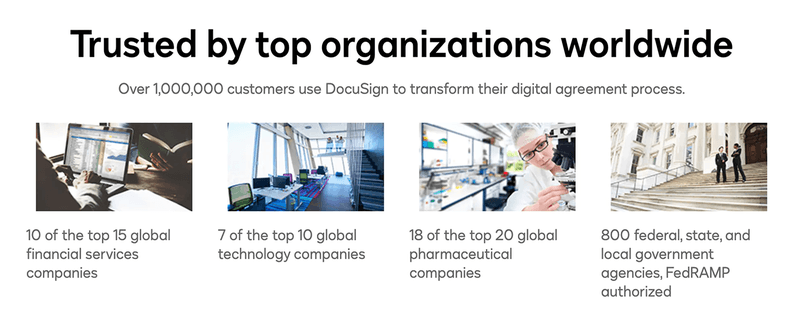
DocuSign establishes authority by showcasing the top companies that trust its services, effectively easing security concerns for potential customers.
6. Scarcity: Take action while you still can!
People want the things they can’t have the most. That’s why we like ‘limited edition’ or ‘exclusive access’. This stems from an internal fear of missing out. In fact, we’re actually more driven by loss avoidance than actual rewards. Therefore, scarcity is a great psychological trigger for user activation.
Imagine for instance you lose access to one of the most sought-after email tools in the world. Enter Superhuman! The platform has a waiting list of over 450,000 people for its webinars and places are limited. But some users benefit from a queue jump, and this kicks off a mutually beneficial brand relationship. In short, they spend more time on onboarding but it ends up in better qualified and happier users. Win-win!

By creating a long waitlist, Superhuman leverages the principle of scarcity to increase the perceived value and desirability of its product.
Looking to drive user activation? Gamify! Build your own gamification strategy during our tried & tested workshops!
Why gamification? How gamified features trigger user activation.
Gamification solutions are emerging as a way for SaaS companies to improve user engagement & activation. Modeled on the research of behavioral psychology, gamified elements like leaderboards, points, and rewards systems derive their power from common psychological triggers and human needs.
Gabe Zichermann, gamification expert - "Gamification is 75% psychology and 25% technology."
In brief, gamification is designed to satisfy 3 major psychological motivators:
- Autonomy. People like being empowered with a choice - and this motivates them to stick to their goals. Personalization and custom rewards achieve this.
- Value. Show the user your value to them and their value to you! Reward them with badges and points, and let them socialize to buff up their social status.
- Competence. The need for personal growth is a powerful motivator. Gamified elements such as progress bars, challenges, and levels can test and track user competence.
Ultimately, these gamification solutions serve as a powerful psychological trigger for user activation. It starts by rewarding user engagement and eventually turns into a habit. It sets up a positive feedback loop in which users are motivated to take action, which, as a result, increases the value of their next interaction.
Get optimizing with StriveCloud’s gamification solutions
Building a gamified SaaS product doesn’t have to be development hell. With our gamification solutions, you can easily introduce, tweak, and experiment with various gamified elements to see what works best for you.
Pieter Verheye, Community Manager @Kayzr - "By gamifying the user experience, StriveCloud helped us grow our user base by 350%."
Activate your audience with features like timed challenges, reward programs, and personalized notifications to make your brand message real! For Kazyr, our gamification solutions led to tremendous user growth and a 60% jump in daily active users!
Building a gamified experience has never been easier - Discover our gamification solutions & start driving user engagement!
FAQ
What factors affect user activation rate?
Behavioral psychology says that the two necessary psychological triggers for user activation are motivation and ability. In short, users need the motivation to perform a task and the ability to undertake said action. It’s your job to ensure they have both!
How to address users to spark user activation?
To address your users, you need to know who they are and what makes them tick. With that, you can segment users by target group, user persona, and even their position in the customer journey. All this will inform your strategy.
What are psychological triggers for user activation?
There are six major psychological triggers for user activation. Reciprocity, when you give something to get something back, commitment, social proof that builds trust, authority to lend your brand credence, being likable, and scarcity to provoke urgency.
How do gamified features inspire user activation?
Gamified features inspire user activation through empowerment. People like autonomy and it gives them ownership over their journey. In addition, gamified elements like badges, points, and rewards create user value. Lastly, features like challenges activate users by testing their competence.

How to increase product engagement for SaaS like a Pro: Part 2 - 17 Strategies!
The future of SaaS is product-led. That means increasing product engagement is your route to growth. Given this, let's discover 17 actionable product engagement strategies & examples used to fuel retention & growth!
How to increase product engagement for SaaS like a Pro: Part 2 - 17 Strategies!

This article explores proven strategies to enhance product engagement, a critical factor for SaaS success.
In part 1 we established user engagement as the fundamental growth driver for SaaS. In short, more engagement means increased retention & lifetime value! So what can you do? In this article, we gathered 17 actional product engagement strategies for SaaS! Discover how tactics like gamified onboarding & personalized notifications can boost your engagement!
- Why increasing product engagement is a must for SaaS success
- Customer engagement vs product engagement
- The difference between users & customers
- User engagement - Essential to improving the product adoption rate
- How to develop the best product engagement strategies in 2022
- 17 actionable strategies to increase user engagement
- FAQ
Why increasing product engagement is a must for SaaS success
The lower your user engagement, the higher your churn. And churn is fatal to SaaS! According to Katie Pierce, retaining customers proves more cost-effective than acquiring new ones, given the notably higher costs associated with acquisition. Additionally, engaged users have a higher lifetime value, as they buy and refer more!
Product engagement vs Customer engagement
While customer engagement is more about driving metrics like session frequency and duration, product engagement goes deeper into usage with metrics like feature adoption & stickiness. Amazingly, both metrics contribute to one another. In other words, you need both customer and product engagement strategies to succeed.
The difference between users & customers
In SaaS, the customer and user are often two different people. First, you have users, these are the people that interact with your product. Then, you have customers, the people who are actually paying for your software. Of course, your definition might differ depending on your strategy, as some use premium models, while others rely on enterprise customers.
User engagement - Essential to improving the product adoption rate
Improving user engagement is the best way to stimulate product adoption. For one, engaged users tend to spend more time exploring your platform. You can use that behavioral data to make the experience more relevant for them! That will ensure they reach the magical AHA moment where your value becomes clear!
Power up your product engagement! Start reading our ultimate SaaS growth guide for User Activation.
How to increase product engagement in 2022
A plurality of business professionals will tell you that their top priority is the customer experience. Why? Because top experiences lead to happy customers and eventually growth! The right product engagement strategies will lead users to engage and let your CX work its magic.
With that in mind, let’s discover 17 of the best product engagement strategies out there today.
17 actionable strategies to increase product engagement
#1 Optimize onboarding with fewer screens
According to research by the product success tool Chameleon, the optimal onboarding length has 3 screens. As you add steps, completion rates fall from 72% to as low as 45%. That’s over half of new users churning before they can even try out your product! DeepFit for instance lets you set up a personalized profile in just 3 screens.
#2 Drive user engagement with a clear CTA
Friction can prevent initial product engagement. Are your users dropped onto a page with no clear purpose, or trialing features with no end goal in mind? Frame your user’s first steps with a powerful CTA that primes them for the AHA moment!
Take Box, for instance. Their CTA is a straightforward “get started”, accompanied by the line “simplify how you work” which makes the benefits of using Box crystal clear.
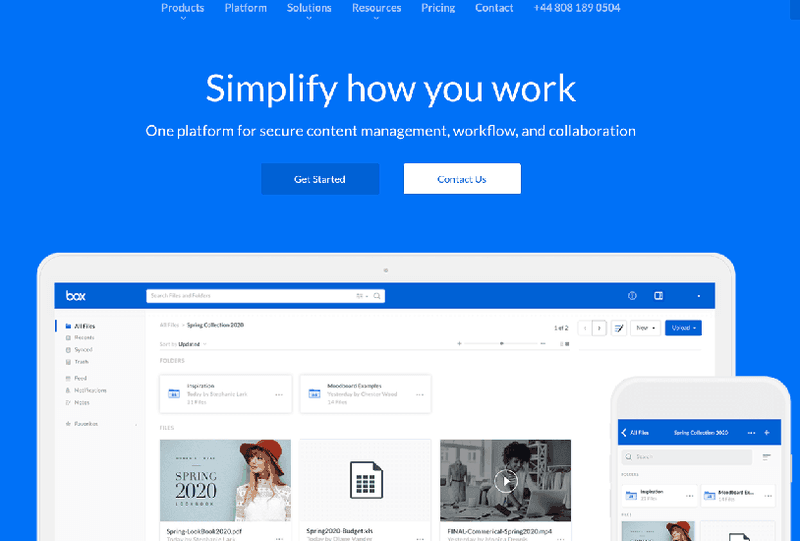
This example from Box shows how a simple but powerful call-to-action can guide new users and effectively drive product engagement from the start.
#3 Personalize your UI with templates
Typeform is a form-builder. Their onboarding starts by asking a few questions about your goals & uses for the product. Then, they provide a tailored interface with templates that you might find interesting. It’s a great way to get your users started faster, and have them see the value immediately.
#4 Reinforce user engagement with triggered messaging
This product engagement tactic relies on the psychology of positive reinforcement. When your user is making progress or getting results, let them know! The social media app Buffer for instance notifies users when one of their posts is doing well.
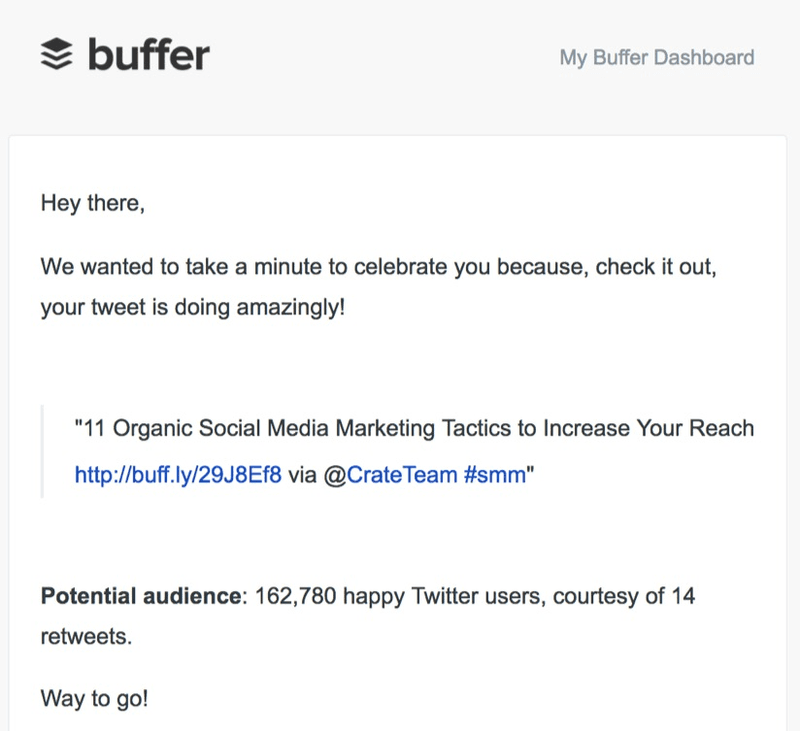
Buffer's timely notifications serve as positive reinforcement, encouraging users to continue interacting with the platform to achieve similar results.
#5 Skip tutorials and pick tooltips & hotspots
Sometimes tutorials can be overwhelming. Instead, try using tooltips to recommend or explain features as Slack does! What’s great about this approach is that you’re not overwhelming users from the start but incrementally adding information to increase product engagement.
#6 Turn tutorials into gamified “quests”
Not all users like tutorials. As a result, lots of users end up skipping them and sometimes missing critical information for their success. Instead, you can make your tutorials on-demand and more fun! Support software Freshdesk for example has these quick gamified missions that allow you to earn badges & points to rank on their company leaderboard. User interaction is a great way to increase product engagement.
#7 Use gamified checklists to trigger user engagement
You can use these checklists for onboarding, but also for in-app tutorials or to trigger certain actions. Content marketing solution StoryChief for example uses an onboarding checklist that also drives referrals. This gamified checklist fits all the best practices. First, they create a sense of “endowed progress” by already completing the first step. Additionally, they visualize progression with a progress bar.
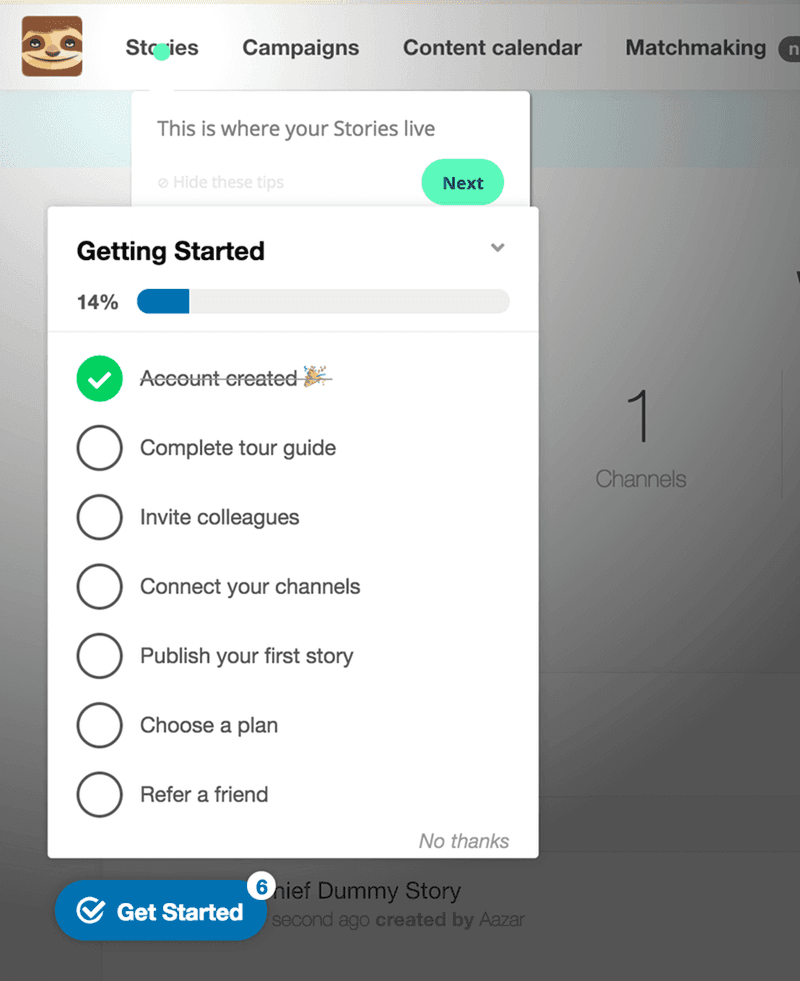
This gamified checklist from StoryChief effectively uses psychological principles like endowed progress to motivate users to complete the onboarding process.
Put your product engagement strategies to work with app gamification! Book and secure your expert-led workshop & learn how to make a sticky gamified platform.
#8 Prompt users to customize their own experience
LinkedIn for instance encourages user customization and boosts product engagement by strategically employing pop-up reminders. These reminders motivate users to personalize their feed with relevant hashtags. When users decide to do so, LinkedIn already suggests a few hashtags that might be relevant to them. This personalized customer experience is a fantastic means for cultivating loyal users.
#9 Tease the value of going premium
Another nudging example from LinkedIn is its nudge towards its premium solutions. They do this by teasing some of the available information to showcase the value of upgrading. It doesn’t feel intrusive and relies on our natural curiosity to explore. A great way to introduce users to the extended capabilities of your SaaS!
#10 Give your software personality with friendly faces
Reciprocity is a powerful psychological trigger. Essentially, you give some, you get some, like a free trial for instance. But an often-overlooked element of reciprocity is a friendly face! Content management tool Kontentino did this amazingly by using “Hana”, the head of customer success as an avatar. After linking your first account, Hana’s there to thank you with a funny GIF!

Kontentino's use of a friendly avatar and celebratory GIFs personalizes the user experience, making interactions more memorable and engaging.
#11 Use integrations to increase your value
The popular CRM Salesflare for instance does this by suggesting to connect your email contacts automatically. This of course immediately adds a ton of value to their platform. Not only does it make Salesflare more compelling to use, but it also makes it harder to churn. Additionally, you can even connect your calendar to never miss a meeting.
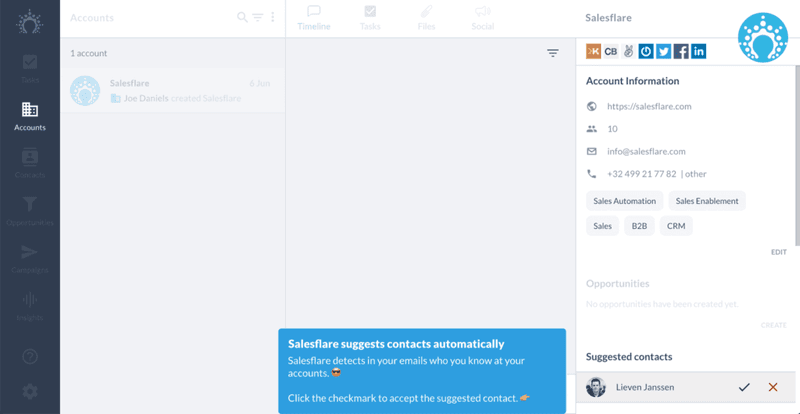
By prompting users to integrate their existing tools like email, Salesflare immediately enhances the platform's value and user stickiness.
#12 Send regular re-engagement emails
Grammarly for instance sends a weekly re-engagement email in which they use gamified elements like achievements and competition. For example, it features a writing streak coupled with achievements and a leaderboard that compares productivity, accuracy & vocabulary against other Grammarly users.
#13 Provide instant support through live chat
In 2022 users want assistance exactly when they need it. Having them wait can lead to frustrations and eventually churn. Website operation platform Pantheon for example improved its average response time from 30 minutes to under two minutes by adding a live chat feature.
#14 Foster user engagement through community
The influence of social relatedness can be fostered in many ways. In fact, this is one of the most powerful product engagement strategies. Amity states that active in-app communities boost user retention rates by 40%! The “Refresh” community by Freshdesk for instance includes support content, upcoming events & a community feed. Additionally, their community pages feature a gamified leaderboard where users can rank based on points they’ve earned by answering questions in the community.
The easiest way to create an amazing reward system? Gamify your app with our app gamification software & user engagement by +50%!
#15 Ensure feature discovery with highlights
Feature discovery is essential to keep user engagement. You should look at every feature launch as a new micro-onboarding. It can as simple as adding “NEW” right next to it as Asana did for its reporting feature. Alternatively, you could use things like pop-ups, in-app messaging, or even targeted e-mail to promote new features.
#16 Leverage ‘stored value’ to install user habits
Some SaaS platforms become more valuable the longer that a user spends on them. For example, cloud storage software like Dropbox uses this to its advantage. Every user starts out with free storage space. You can even partake in gamified challenges to get more free space! However, once you finally pass that space you’re more likely to pay rather than to transfer all your files to a new service.
#17 Retargeting ads catch those most likely to engage
Don’t give up on lapsing users - they are your most valuable target group. In fact, reengaged users have a 152% higher user engagement rate than new acquisitions! We recommend personalizing your ads towards existing users with low engagement. For example, show them what they are missing out on, or offer live support or training content,...
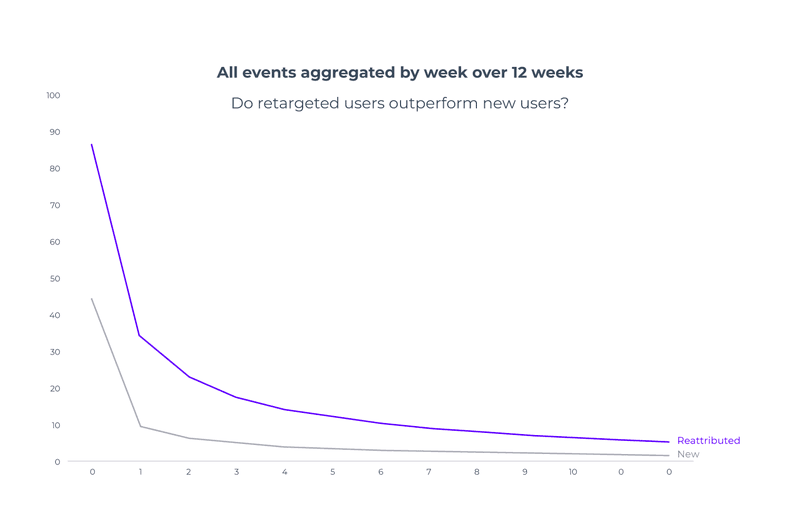
This graph illustrates the high engagement rate of re-engaged users, underscoring the value of retargeting campaigns for SaaS growth.
FAQ
Why does SaaS need to increase product engagement?
The lower your user engagement, the higher your churn - and churn is fatal to SaaS! According to User Pilot, retaining customers proves more cost-effective than acquiring new ones. Additionally, engaged users have a higher lifetime value, as they buy and refer more!
What is the difference between users and customers?
First, you have users, these are the people who interact with your product. Then, you have customers, the people who are actually paying for your software. Of course, your definition might differ depending on your strategy, as some use premium models, while others rely on enterprise customers.
Are customer engagement and product engagement the same thing?
While customer engagement is more about driving metrics like session frequency and duration, product engagement goes deeper into usage with metrics like feature adoption & stickiness. Most importantly, both metrics contribute to one another. So, you need both customer and product engagement strategies to succeed.
48 best user onboarding experiences (plus a free checklist to boost your SaaS)
Poor onboarding is the largest contributor to user churn! So what do the best onboarding experiences have in common? Check out these 8 UX patterns with 48 examples of leading SaaS companies. Get started yourself with our free user onboarding checklist!
48 best user onboarding experiences (plus a free checklist to boost your SaaS)

This lead image sets the stage for the article's exploration of top-tier user onboarding experiences and resources.
In reality, poor onboarding is the main reason users churn. However, the best user onboarding experiences know how to overcome that challenge! Want to do the same? Get started with our free user onboarding checklist designed to drive product adoption.
In this article, let’s review why onboarding is so important, and detail 8 great onboarding UX patterns with 48 top examples from SaaS apps.
- What is user onboarding?
- Why you should focus on onboarding
- Lesson 101: the basics behind the best user onboarding experiences
- How do you design a great onboarding experience? Top tips to learn from
- 8 great user onboarding UX and UI patterns from leading SaaS companies (With 48 examples!)
- #1 Leverage social proof using data, testimonials, and conversion rates
- #2 Email verification walls are conversion killers
- #3 Unnecessary steps discourage users from completing onboarding
- #4 Product tours should be action-focused, not informational
- #5 Segmenting users increases their likelihood to finish onboarding with success
- #6 Make onboarding motivating by emphasizing “what”, not “why”
- #7 Show helpful empty states that facilitate further user engagement
- #8 Behavior-based emails encourage new users to re-enter the product
- What are the key elements that define an excellent onboarding experience?
- Best user onboarding experiences - FAQ
What is user onboarding?
Onboarding is the process of getting users acquainted with your product and leading them to value as fast as possible! Indeed, that first impression is a crucial stage in all the best user onboarding experiences! Essentially, onboarding is where the user learns the ins and outs of your product. This can happen either manually or automated.
👉 Download our Free User Onboarding Checklist here!
Why you should focus on onboarding
The best user onboarding experiences lead to increased retention. For the average SaaS startup, it takes users 11 whole months to return their acquisition cost. That’s nearly a year before you see any profit! Losing a customer due to not conveying value clearly is a big bummer.
In reality, poor onboarding is the main reason users churn. However, the best user onboarding experiences know how to overcome that challenge! Want to do the same? Get started with our free user onboarding checklist designed to drive product adoption.
In this article, let’s review why onboarding is so important, and detail 8 great onboarding UX patterns with 48 top examples from SaaS apps.
- What is user onboarding?
- Why you should focus on onboarding
- Lesson 101: the basics behind the best user onboarding experiences
- How do you design a great onboarding experience? Top tips to learn from
- 8 great user onboarding UX and UI patterns from leading SaaS companies (With 48 examples!)
- #1 Leverage social proof using data, testimonials, and conversion rates
- #2 Email verification walls are conversion killers
- #3 Unnecessary steps discourage users from completing onboarding
- #4 Product tours should be action-focused, not informational
- #5 Segmenting users increases their likelihood to finish onboarding with success
- #6 Make onboarding motivating by emphasizing “what”, not “why”
- #7 Show helpful empty states that facilitate further user engagement
- #8 Behavior-based emails encourage new users to re-enter the product
- What are the key elements that define an excellent onboarding experience?
- Best user onboarding experiences – FAQ
What is user onboarding?
Onboarding is the process of getting users acquainted with your product and leading them to value as fast as possible! Indeed, that first impression is a crucial stage in all the best user onboarding experiences! Essentially, onboarding is where the user learns the ins and outs of your product. This can happen either manually or automated.
👉 Download our Free User Onboarding Checklist here!
Why you should focus on onboarding
The best user onboarding experiences lead to increased retention. For the average SaaS startup, it takes users 11 whole months to return their acquisition cost. That’s nearly a year before you see any profit! Losing a customer due to not conveying value clearly is a big bummer.
Lesson 101: the basics behind the best user onboarding experiences
These 3 things need to be on your user onboarding checklist:
- Useful - Do users get value from the experience?
- Easy to use - Can users get to value intuitively?
- Fun - Do users enjoy engaging in the experience?
But this is merely the background to the ultimate goal of onboarding: to acquaint users with your value! A shorter time to value will also help users reach the AHA moment faster, an important stage in user activation.
How do you design a great onboarding experience? Top tips to learn from.
To discover what constitutes the best user onboarding experiences, learn from the ones already out there! For example, how did French fintech Shine achieve an amazing 80% onboarding conversion rate? These are some tips from growth engineer Arnaud Babol:
Arnaud Babol - "Keep it simple: one screen, one action."
New customers can very easily be overloaded by your user interface. Therefore, it’s wise to segment each action with different screens. This makes it especially clear what you’re asking for!

Shine's onboarding flow exemplifies the 'one screen, one action' principle, breaking down the process into simple, manageable steps.
Arnaud Babol - "Make your onboarding experience unique with motion design."
Arnaud Babol writes that the best user onboarding experiences quickly cement their brand identity in the user’s head. One way to do that is with a unique motion design.
Arnaud Babol - "Never leave your user alone."
If your user is lost, that’s a missed opportunity! Instead, guide them with tooltips and checklists that lead them to their next action so they can still discover your true value.

Here, tooltips in Shine's UI guide the user, ensuring they are never left without direction during the onboarding process.
8 great user onboarding UX and UI patterns from leading SaaS companies (With 48 examples!)
#1 Leverage social proof using data, testimonials, and conversion rates
In times of uncertainty, we always look to take guidance from others. Behavioral scientists call this ‘social proof’ - and the best user onboarding experiences leverage it to powerful effect!
Insight Timer creates a global sense of community through social proof
To make users feel a part of a community, the wellness app Insight Timer shows on its dashboard how many users are meditating at that very moment. Not only does this validate the platform’s quality, but it also makes users feel they belong to a community!
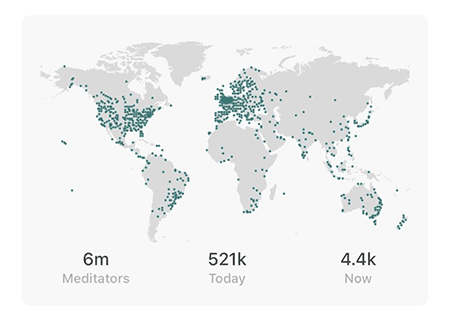
Insight Timer's live map demonstrates social proof by showing a global community of users meditating simultaneously, which enhances the sense of belonging.
How Kajabi uses longevity to position as an authority
Touting how long you have been in business hints at a history of success. For example, online course creator Kajabi boasts in a bold blue “10+ years as the industry leader”. It makes them stand out as authority figures in their industry.
Proof leverages expert testimonials to build brand trust
In a way, experts are influencers. Their clout can be used to give your brand credibility, and it is a particularly powerful influence. Personalization tool Proof has perhaps the best example - with a quote from Steve Jobs talking about how “personalization works”. Of course from him, that builds trust!
PiggyVest elevates brand champions
Easily accessible on their website, Nigerian fintech PiggyVest shares the story of hundreds of their ‘happy savers’. To be sure, the feature inspires success! In 2021, PiggyVest saved users over $585 million!

PiggyVest showcases success stories from their users, inspiring confidence and demonstrating the tangible benefits of their fintech platform.
Use conversion data to boost your credibility like Proof
Proof found a way to instantly communicate their value offer of boosting your conversions. How did they do it? Easy, with a counter on their landing page that says:
"1594 people requested a demo in the last 30 days."
Boast.io uses testimonials for proof-based marketing
Many users identified in the product adoption curve are risk-averse. But when you post testimonials on your landing page, you help reduce your prospect’s fear of change by making the switch less intimidating. Boast.io is a video testimonial tool practicing what they preach!
Invision builds brand trust through recognizable logos
If a trusted company is your client, then customers will see you as trustworthy too! To benefit from that trust, follow the example of Invision and place the most recognizable logos of your business customers on your website. Research shows it can increase conversions by 400%!
ShipBob uses testimonials, reviews, and data to boost social proof!
This E-commerce platform guarantees success with multiple types of social proof. Besides a testimonial and a few world-class logos, it also features raw data such as:
- Trusted by 7000+ brands
- 99,96% of orders ship on time
- 99,95% accuracy rate
- 30+ fulfillment centers
- #1 fulfillment technology
👉 Download our Free User Onboarding Checklist here!
#2 Email verification walls are conversion killers
Email verification walls are common - but they’re also a big reason for churn. Make sure to take these insights with you on your user onboarding checklist!
Snappa delays verification requests to turn churn into growth
Graphic design tool Snappa discovered that 27% of all signups never activated their email. But when Snappa removed the request, monthly revenue quickly rose by 20%!

This graph illustrates the significant revenue growth Snappa experienced after removing the email verification wall, a key lesson in reducing user friction.
Ensure email deliverability in-app like Monday.com
Of course, you want the user’s email, but you also want them to stay in-app, or else they might churn. Solve this problem like work management software Monday! Monday lets users experience the value straight away and only alerts users if their email bounces.
Simply don’t ask for registration like Jotform
Incredibly, form builder Jotform doesn’t ask new users to register. In fact, they allow customers to test the app’s full functionality! Actually, users only need to register when they wish to send out forms. This method must work to increase product adoption - in 2022 Jotform achieved 1 billion form submissions!
👉 Download our Free User Onboarding Checklist here!
#3 Unnecessary steps discourage users from completing onboarding
Industry wisdom states that each onboarding step results in a 20% increase in user churn – so keep it short and sweet!
Behavioral scientists will tell you that unnecessary steps and choices can accumulate to a dangerous degree. In detail, there are 2 major effects that you want to avoid triggering:
The paradox of Choice. The more choices you give a user, the less likely they are to choose!
Hick's Law. Basically, where decision time increases with every additional choice.
Don’t waste time stating the obvious. In fact, studies show that the optimal onboarding length is 3 screens! With extra steps, conversions can fall from 72% to as low as 45%.
Shopify split onboarding on multiple screens
If you still need more information to make your product valuable, then look at Shopify! The first page focuses on your use case for the platform. Then, you complete your personal details and get started!
WaveHQ does the styling for you
Instead of letting you customize your workspace to your own brand Wave simply asks you to add your logo and does the rest for you. Some might think this is still an extra step, however, it seems to fuel motivation and user engagement.
Zakeke uses hotspots to avoid information overload
First, ask yourself what is necessary for onboarding. Then ask “when is it necessary?” Hotspots like Zakeke guide the user in real-time. As a result, they eliminate the need for extra steps and thus user churn.
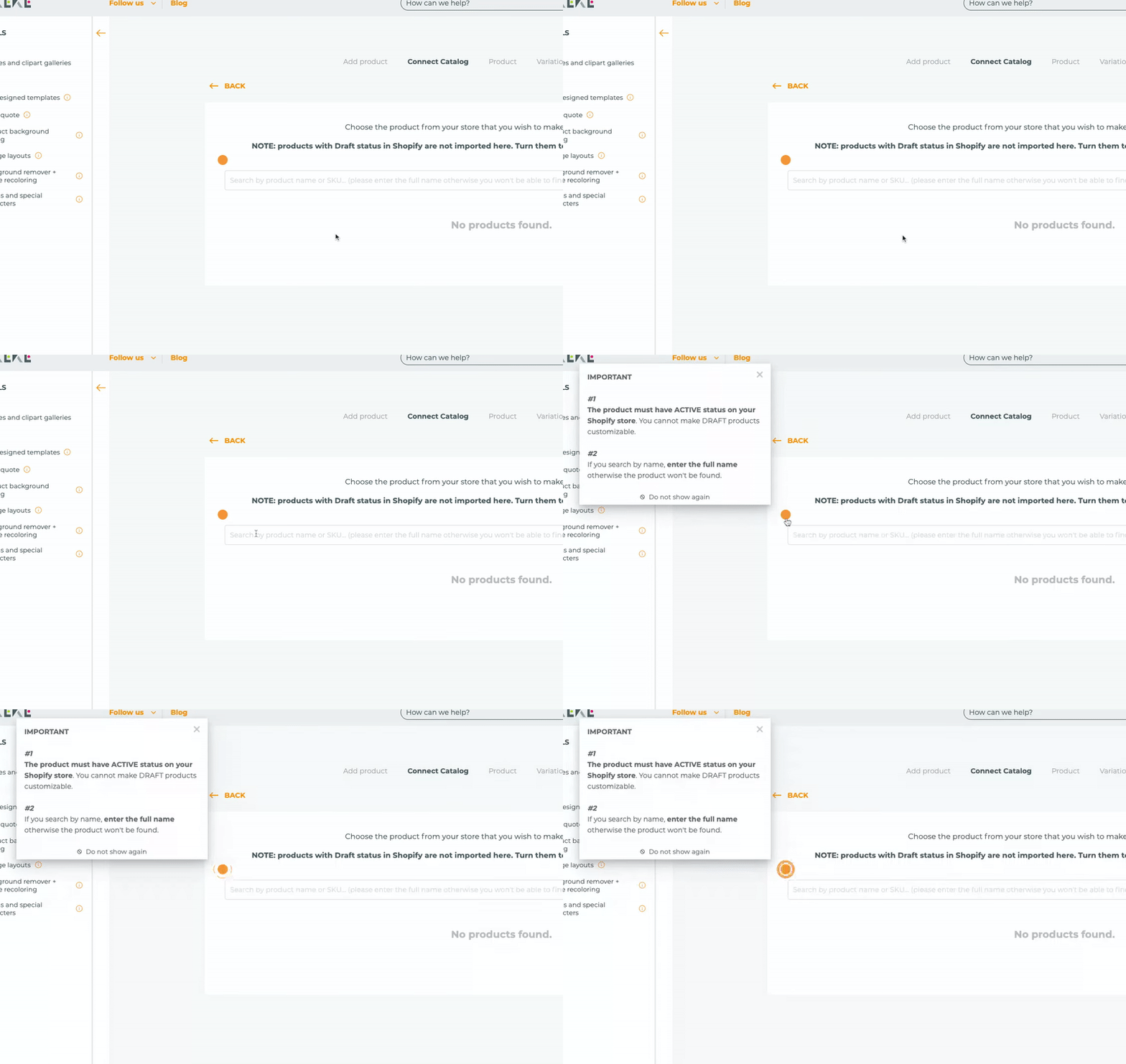
Zakeke uses hotspot tooltips to provide contextual information just-in-time, preventing information overload and keeping the onboarding flow clean.
Let users skip profile set-up like Substack
Should new users need to set up their profile photo and bio, before they have even trialed the product? Well, that used to be how it was for Substack. Today, however, Substack lets users “skip for now” - removing a big barrier to initial user engagement.
Avo keeps a quick and clean UI with a singular focus
Analytics tool Avo keeps each onboarding screen as simple as possible, asking questions like “what are the sources of your data?”, alongside clear, clickable options that move users on to the next stage in their journey.
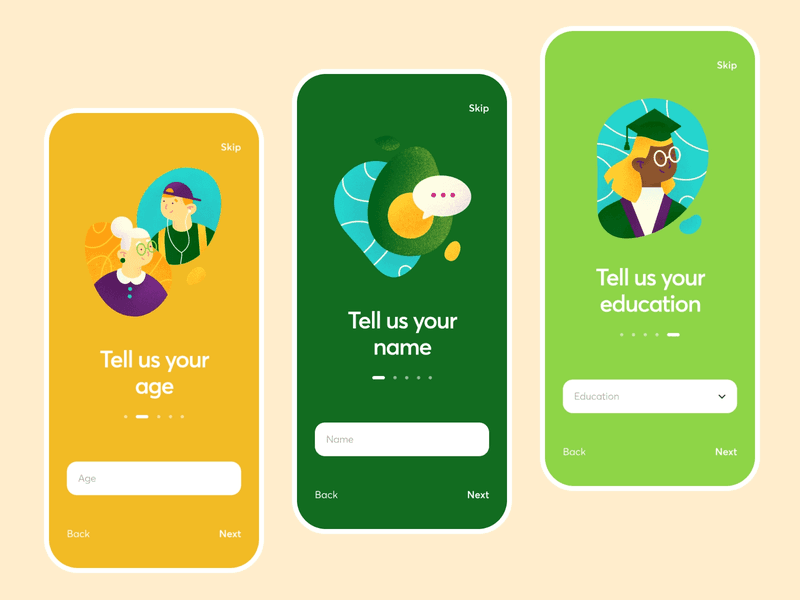
Avo's onboarding screen maintains a singular focus, asking a clear question with simple options to guide the user smoothly through setup.
Speed up time to value with suggestions like Reclaim
Time blocking tool Reclaim for instance asks during onboarding if you want to block out time for lunch. Not only does this immediately display their unique value, but it also introduces users to a new way of planning!
#4 Product tours should be action-focused, not informational
In reality, we as humans are overloaded with information every day. And often, we don’t know what to do with any of it! To avoid this, create an action-focused UX. In essence, if users start with action in their minds, they are more likely to take the next steps!
For example, a gamified user onboarding checklist states the next steps to take along with potential rewards.
Mint has a clear CTA on each screen to prompt user engagement
Mint’s headline is a rousing CTA: “See all your money in one number”.

Mint's onboarding screen features a powerful and direct call-to-action, encouraging users to engage immediately by seeing all their finances in one place.
Gamified checklists motivate users to finish onboarding on Quora
A gamified user onboarding checklist provokes the ‘endowed progress effect’. This principle notes that people are more likely to finish something if they think they are close to completion. To lock in this effect, reward users for completing ‘dummy’ tasks like ‘signed up’. Quora users already have 1-3 out of their items crossed after signing up.
How to increase product adoption with a gamified product? Get your expert-led workshop & learn how to use behavioral psychology to your advantage!
Improve product discovery with interactive paths like Xero
When customers sign up to Xero to improve their accounting, their greatest dread is probably a wall of confusing numbers! But the Xero dashboard is like a simple choose-your-own-adventure game.
Not only is this fun to use, but Xero’s UX empowers users with the choice of product tour, letting them discover what is most valuable to them faster!

Xero's interactive, 'choose-your-own-adventure' product tour empowers users to discover the features most relevant to their needs first.
Why Xero frames tasks as win-based actions
Framing tasks as a win will remind users of why they’re completing the product tour. Take Xero again. For each task on their product tour, win-based copy triggers users to action: “Get paid faster”, “Track your money”, and “Stay on top of your taxes”.
Hypercontext uses modals to highlight the key tasks
Hypercontext is a collaborative meeting SaaS that promises to make meetings more productive. To convey this value quickly, modals highlight the app’s key tasks: “Create your first agenda”.

Hypercontext effectively uses a modal window to highlight the primary action, "Create your first agenda," guiding new users towards their 'Aha!' moment.
How Headspace fuels healthy habits with streaks and badges
Wellness app Headspace has 2,100 corporate customers - and they manage this because their app encourages habit formation. With gamified streaks and badges that celebrate early successes, users are intrinsically motivated to use the platform and earn more.
👉 Download our Free User Onboarding Checklist here!
#5 Segmenting users increases their likelihood to finish onboarding with success
When you segment users, you understand their needs on a deeper level. This knowledge can be used to personalize onboarding and create more value!
Customize product samples like Genially
Genially is an animated content platform to create infographics, presentations, and e-learning materials. During onboarding Genially asks a few questions like what industry you work in. Then, they display a customized design sample based on your preferences.
Lumen5 motivates users with custom goals
Letting users set their own goals should be on your user onboarding checklist. For users, it provides a clear purpose. For you, it allows you to personalize the user experience! Video maker Lumen5 wastes no time in doing this. In fact, they devote their second onboarding screen to asking new users about their goals.

During onboarding, Lumen5 asks users to define their goals, which allows for a personalized experience and provides a clear purpose from the start.
Ticketmaster uses geolocation to customize your feed
For many apps, what you offer varies wildly depending on where the user lives. For Ticketmaster, geolocation data is crucial to personalizing offers like upcoming concerts that might interest the user. Equally, to discover what a user likes, onboarding fields that simply ask users their favorite artists are a great way to personalize offers.
Segment users on NPS score like Qualtrics
Not all users want the same. So why not segment them based on customer satisfaction? One way to do so is through a Net Promoter Survey such as Qualtrics. Besides defining the key drivers for different segments, you’ll also learn where to prioritize support!
Evernote enhances personalization during onboarding
When starting off with Evernote you’ll be asked to order your main use cases for the product. As a result, you’ll get a customized template library and interface to start. This way you get a product experience relevant to you.
Dropbox targets account expansion through segmentation
Dropbox doesn’t try to sell its premium product to barely engaged users. Instead, they segment the most engaged users expected to reach their storage limit. What’s that saying about marketing again? Right place, right time?
👉 Download our Free User Onboarding Checklist here!
#6 Make onboarding motivating by emphasizing “what”, not just “why”
Simplicity is key. That’s why focusing on the concrete ‘what’ instead of a more abstract ‘why’. There is a famous quote that should sum up your attitude towards user experiences:
“A designer knows they have achieved perfection not when there is nothing left to add, but when there is nothing left to take away.”
Calendly uses copy that gets straight to the point
Essentially, your copy should stick to the task at hand! Otherwise, you run the risk of being ignored. Calendly avoids this with a simple headline based on ‘what’ they offer.
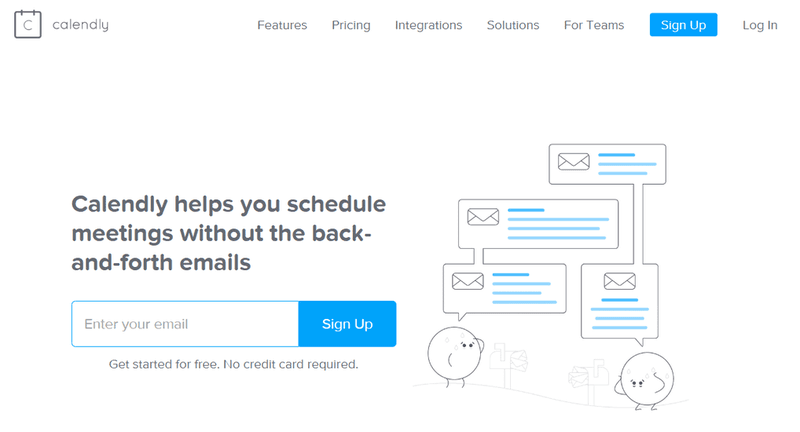
Calendly's landing page copy is a prime example of simplicity, getting straight to the point to communicate the product's core value instantly.
Sprig emphasizes feature benefits to increase feature adoption
User research tool Sprig is clear on its benefits as users create a survey - and that’s good! Alongside a preview of the final result, a text bubble reads “we’ll automatically customize your company name to increase response rates”.
Let users complete micro-commitments like Grammarly
Handing new users small tasks is a fast way to get them invested and learn why your product is great. Moreover, users will feel like they earn their reward! For instance, Grammarly asks demo users to correct problems in a sample document. As a result, it instantly conveys the core value of their product.
Togglr uses gamified rewards to reinforce user action
Gamified rewards provide users with an intrinsic satisfaction that facilitates repeated user engagement. For example, when Togglr users successfully complete a task for the first time, the app celebrates their success with a clapping emoji. This positive reinforcement gives users a reason ‘why’ they should complete the task again!

Toggl demonstrates positive reinforcement by using a simple clapping emoji to celebrate a user's first completed task, encouraging repeat engagement.
Sprout explains what they’ll do with your data (and why they need it!)
For many apps, onboarding means asking users for access to their personal data. That can be a thorny subject - so it pays to tell users exactly why users should accept:
Sprout Social - "It’s okay to click ‘Okay’! We need your permission to deliver and report on the messages you post."
Moosend’s progress bars remind users of their goal (and how far they’ve come)
Aside from showing users their past personal progress, progress bars remind users of their goals. Email marketing software Moosend has a great gamified progress bar that fills after each onboarding step, culminating in the ultimate goal: “send a campaign”.
Drive product-led growth with an in-app gamified experience! Simply link to our modular gamification software & start testing!
#7 Show helpful empty states that facilitate further user engagement
While only an estimated 5% of users ever see an empty state, they’re still a great opportunity to drive user engagement. How? By balancing the principles of all the best user onboarding experiences that include education, motivation, and direction.
Todoist makes empty states the end goal
We all love the feeling of completing our to-do list. So what better example than Todoist using empty states to celebrate user success? In addition, they prompt users to share their success with a hashtag and social media buttons.
Todoist - "Enjoy your afternoon. Today you completed 8 tasks and reached #TodoistZero!"
Buffer gets you connected with 1 click
Buffer is a social media publishing and analytics tool, so it doesn’t have much value without linking your channels. That’s why their empty states suggest “connect your first channel”.
How Superhuman charms users with feel-good nature scenes
Believe it or not, empty states can actually make users more productive! This effect is called ‘biophilia’ and has even been shown to improve moods. Taking advantage of this, email SaaS Superhuman shows users landscapes when they reach inbox zero!

Superhuman uses beautiful, serene landscapes as a reward for reaching 'inbox zero,' leveraging biophilia to create a positive and calming user experience.
Guide users to their next step like Jobpal
Jobpal is an automated recruitment solution that saves both recruiters and candidates a ton of time. As a recruiter, the empty state makes it very clear which next steps to take. This way you never get stuck, or bored with endless onboarding tours!
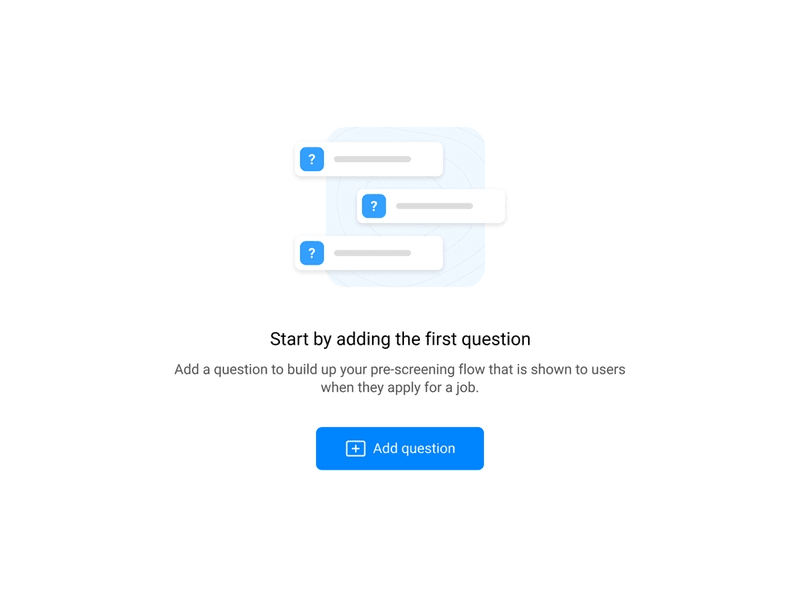
Jobpal's empty state clearly outlines the next steps a recruiter should take, preventing confusion and guiding them towards productive use of the platform.
Use empty states to inspire users like Notion
When you create a new page on Notion its default state is empty. However, Notion adds demo content which is also educational and instructive. For instance, they include a get started checklist explaining their features and the copy: “Press enter to continue with an empty page or pick a template.”.
Copper turns empty completion pages into conversion machines
Onboarding should be more than creating a personal profile. Follow the lead of CRM app Copper, which promotes their Chrome extension. As a result, 25% of new users install their Chrome extension directly from this screen!

After profile completion, Copper uses this success state to promote its Chrome extension, successfully converting a significant percentage of new users.
Salesflare locks you in with a simple suggestion
When users hit an empty state on CRM tool Salesflare, the dashboard suggests that users automatically connect their email contacts. That’s instant value and makes churn less likely!
👉 Download our Free User Onboarding Checklist here!
#8 Behavior-based emails encourage new users to re-enter the product
Every user onboarding checklist should include behavioral emails or messaging. Not only does it improve user onboarding, but it also brings back potential drop-offs!
While most emails get put straight in spam, recipients are over 75% more likely to open welcome emails than other marketing emails. Take advantage of that open rate to drive the behavior that you know will lead to product adoption.
Kick-off onboarding with reaffirming CTA’s like Hotjar
The best user onboarding experiences make their emails action-focused. In other words, they clearly describe the benefits next to concrete action. Take Hotjar’s ‘get started’ email for instance!
Hotjar - "Ready to see what’s really stopping your visitors from converting? You’re only minutes away from seeing your site through your users eyes!"
Databox helps you become a data-driven professional
Don’t give up on users who are already halfway through the process! Databox for instance encourages you to complete the final step to becoming a data-driven professional. Strong copy like ‘What are you waiting for?!’ and ‘Complete stage 1’ skyrocket completion.
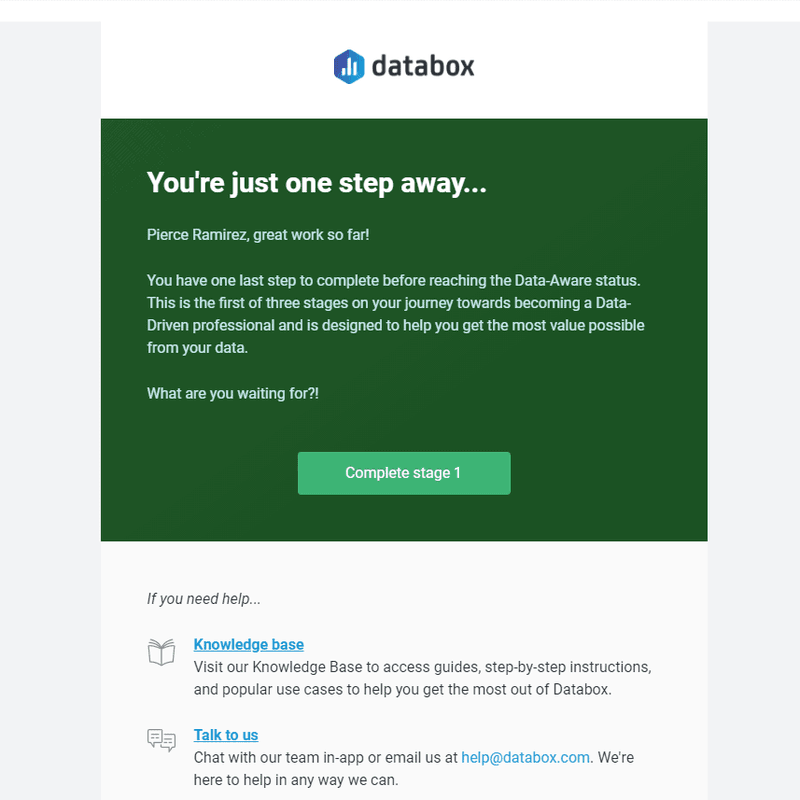
This behavioral email from Databox uses encouraging and urgent copy to re-engage users who are partway through the setup process.
Celebrate success and build upon it like Soapbox
Soapbox rewards users with a fun rockstar gif for uploading their first video - which already highlights the product’s value. Then, they encourage users to complete the next steps of editing or improving their video. Besides being helpful, it clearly demonstrates the product value at the right moment!
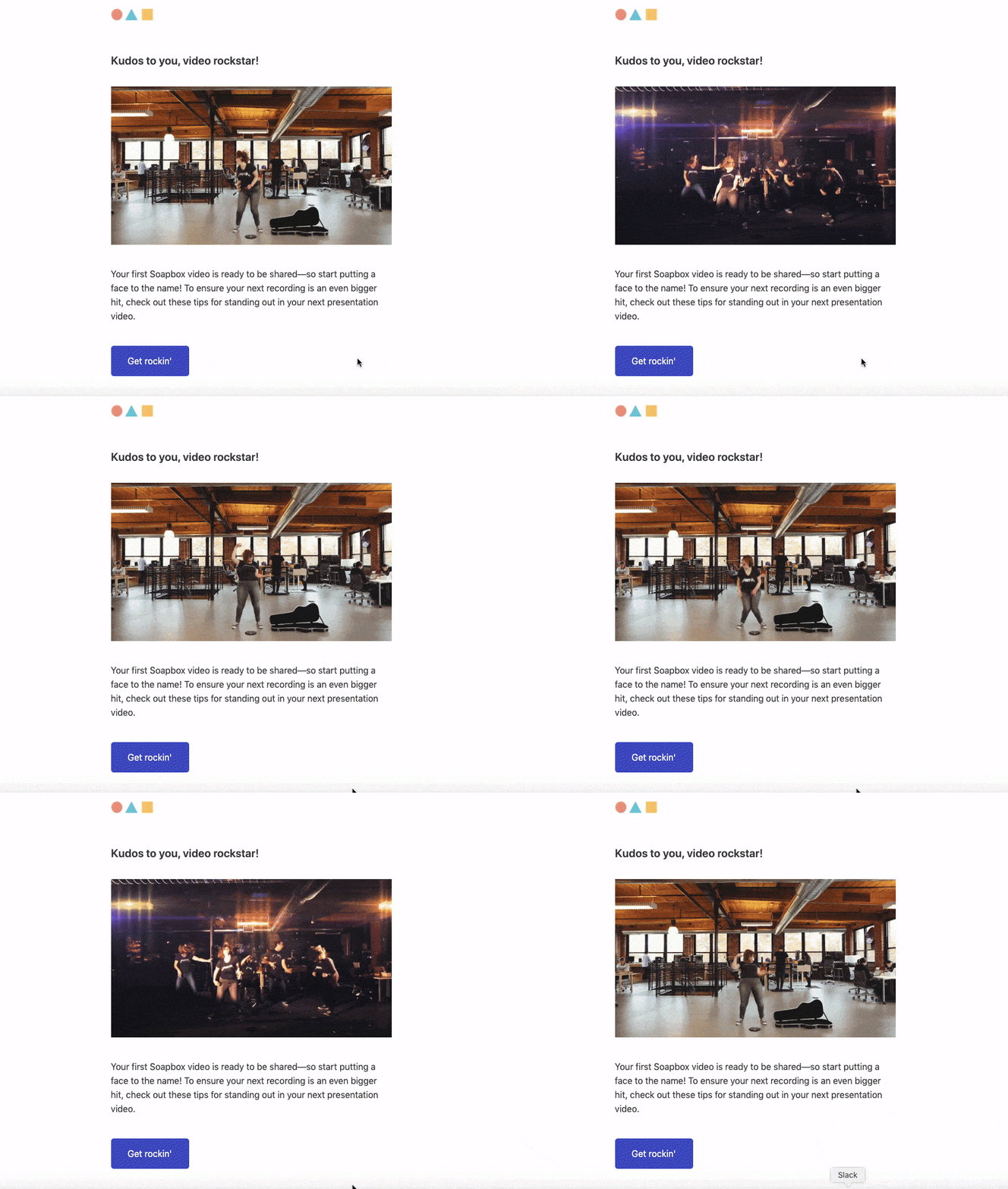
Soapbox celebrates a user's first video upload with a fun GIF and immediately suggests the next steps, building momentum and demonstrating further value.
Learn to drive user engagement like Asana
Asana has the mission of making its users more productive, so what better way to act on this than by sending an action-packed email? If you’re new to their product it might feel overwhelming. However, by giving clear step-by-step instructions Asana gets you started in no time!
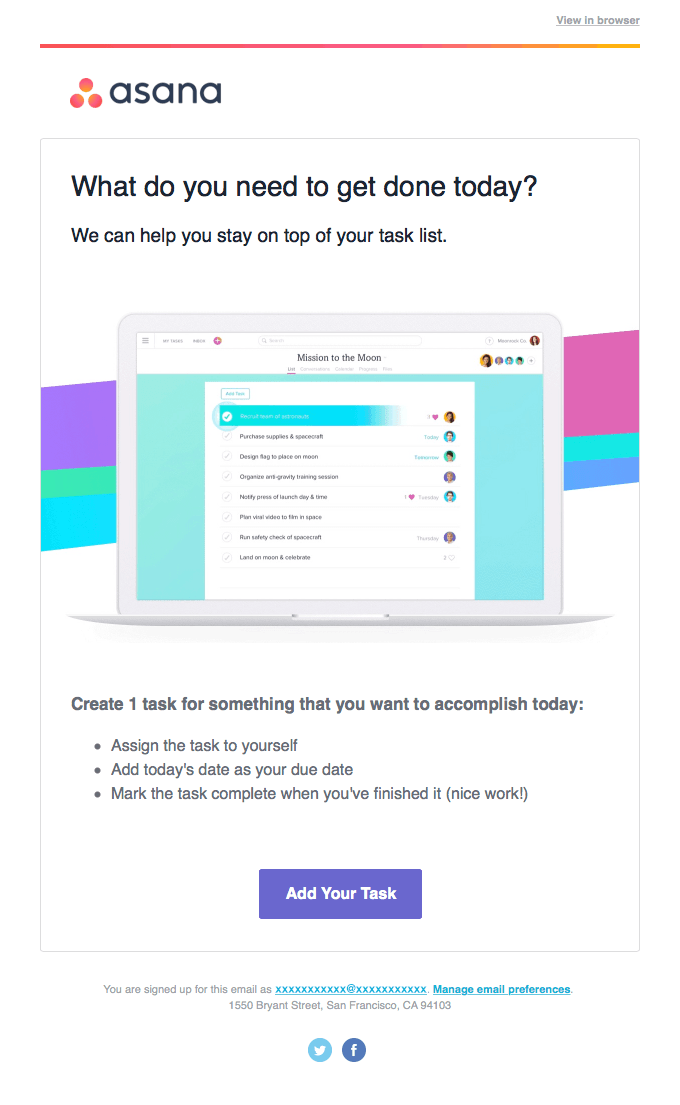
Asana's welcome email provides clear, step-by-step instructions to help new users overcome the initial learning curve and start organizing tasks effectively.
Monday’s custom tours designed to suit the user’s behavior
Everyone behaves differently - and that extends to the best user onboarding experiences. Look at workflow SaaS Monday for instance. Its welcome email empowers users with the choice of a video or text product tour. This extra autonomy makes users more likely to engage with their preferred style, leading to increased engagement and onboarding success!
Groove steps in before you can say churn 3 times!
Your user onboarding checklist should be as churn-proof as possible. Take productivity platform Groove, which intervened when users had issues setting up email forwarding. As a result of their supportive email, Groove achieved a 30% retention rate in just 30 days!

Groove's proactive support email intervenes at a common friction point, helping users set up email forwarding and drastically improving retention rates.
Keep users engaged with gamified performance reports like Grammarly
Nobody buys software. They buy outcomes! With this in mind, gamified reports can increase motivation enough to keep users going! Take Grammarly for example. In its weekly writing update, you can see your streak, activity-based achievements & how productive and unique you are compared to other Grammarly users.
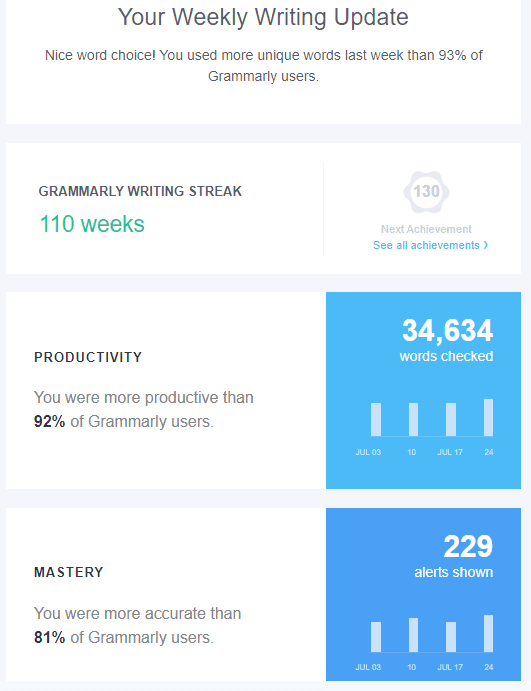
Grammarly's gamified weekly writing report keeps users engaged by showing their streaks, achievements, and comparisons with other users, reinforcing the value of the tool.
So.. What are the key elements that define an excellent onboarding experience?
We analyzed the 48 examples and made a practical checklist to follow. Download the free checklist here.
Best user onboarding experiences - FAQ
What is user onboarding?
Onboarding is the process of getting users acquainted with your product and leading them to value as fast as possible! Indeed, that first impression is a crucial stage in all the best user onboarding experiences! Essentially, onboarding is where the user learns the ins and outs of your product. This can happen either manually or automated.
Why should you focus on onboarding?
The best user onboarding experiences lead to increased retention. For the average SaaS startup, it takes users 11 whole months to return their acquisition cost. That’s nearly a year before you see any profit! Losing a customer due to not conveying value clearly is a big bummer.
What are the basics of great user onboarding?
Your user onboarding checklist should include 3 things: to make your product useful, as well as fun, and easy to use. But this is merely the background to the ultimate goal of onboarding: to acquaint users with your value!
What are the 4 steps of a SaaS user onboarding checklist?
Start off by inspiring action. Sometimes copywriting can be enough, however, in-app prompts can also help. Then, reward users for taking action to keep them coming back. Afterward, you can drive repeat usage with personalized messaging and gamification. Finally, expand usage through education and build power users!
How to increase product engagement for SaaS like a Pro: Part 1
Over the last decade, SaaS grew at twice the rate of the overall market, yet profitability fell by half! In short, competition is stiffer - and this means you need to learn how to increase product engagement like a Pro. Get started with Part I of our definitive guide.
How to increase product engagement for SaaS like a Pro: Part 1
This article defines product engagement, explores its importance for SaaS, and outlines how to measure it effectively for growth.
What is product engagement and how do you increase it? Product engagement is a lagging indicator that gives insight into how users interact with your product. It measures things like user or app engagement, retention, feature engagement & active users.
This is part 1 of a two-article series where we discuss how to increase product engagement. In this article, you’ll learn what product engagement is, how to measure it & what metrics are most important!
- What is product engagement?
- SaaS and the role of product engagement
- What makes a product engaging?
- Why is product engagement analysis important?
- How to measure product engagement like a Pro
- The key product engagement metrics you need to know
- How to increase product engagement for your SaaS platform
- FAQ
What is product engagement?
Product engagement is a way of measuring how users interact with your product. Usually, this happens on 3 axes: depth (app engagement & retention), breadth (feature adoption) & frequency (stickiness & active usage). Once you understand the leading indicators for this behavior you’ll know how to increase product engagement.
SaaS and the role of product engagement
Product engagement is an indispensable metric for SaaS companies. This 1 metric shows you everything you need to know about app engagement, retention & product adoption. Understanding this user behavior can help you build better roadmaps, shape more personalized experiences, and ultimately increase customer lifetime value!
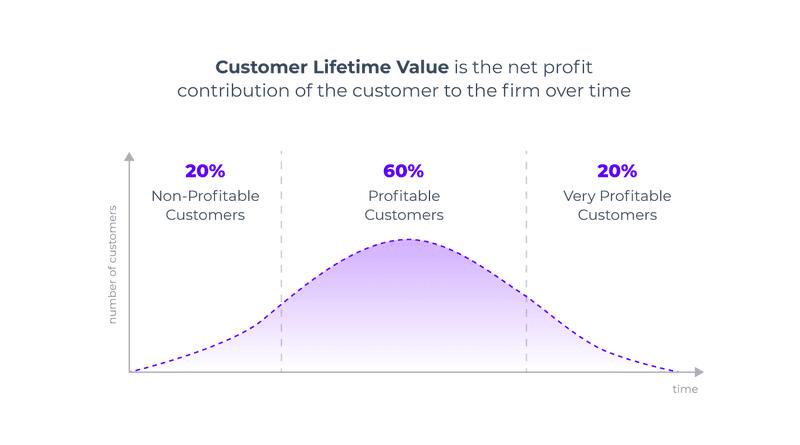
The chart visualizes how gamified elements can positively impact user engagement metrics over time, leading to healthier product adoption.
The goal is not to have a bunch of unused features or churning customers. On the contrary, you want to drive user engagement to increase the number of interactions, get more data & build a more sticky experience based on that. Once you understand product health, you can test with gamified tactics to boost product growth!
How to increase product engagement? Start with our ultimate SaaS growth guide for User Activation!
What makes a product engaging?
Simply put, a great product will keep users coming back. A good user experience can increase conversion rates by 400%. When users are motivated to use your product it’s probably because you solve a key problem in a better way. That’s why user engagement usually has a big impact on user retention or churn.
To create a UX that fosters user engagement, you can leverage psychological triggers. Fulfilling basic human desires such as autonomy, value, and competence can drastically improve app engagement and retention. Additionally, a gamified approach can boost user motivation and make seemingly mundane tasks into an enjoyable experience!
How to increase product engagement with a gamified product? Get your expert-led workshop & learn how to use behavioral psychology to your advantage!
Why is product engagement analysis important?
Great products don’t just build new features. Instead, they study user behavior and build features to support their users’ goals and needs. Analyzing product engagement can help you identify in what areas you could still improve app engagement.
With this data, you can answer questions such as:
- Do they use it frequently or not? How often?
- How much time are users spending on your platform?
- Are they utilizing the full product or just a few features?
- What are the most popular features?
- Do they keep coming back or do they churn?
Besides evaluating just the efficacy of your product and its features, you also need to analyze your users. Which users are about to churn? Who can you upsell to? Comprehensive analysis like this will inform your feature tweaks and can help boost motivation through gamified tactics.
How to measure product engagement like a Pro
Before you learn how to increase product engagement, you need to have the right tracking in place. So how do you measure product engagement?
First of all, there are many leading indicators going into your product engagement score. That’s why you’ll need to track all product interactions to measure things like user engagement, adoption & stickiness.
Here’s a 5 step plan to get you started right away!
Step 1: Set up product analytics
Success isn’t built on guesswork! Before you can even think about learning how to increase product engagement, you need a product analytics tool that can equip you with the best, most up-to-date data. This data will form the bedrock of your strategy.
Step 2: Identify the problem your product solves
To measure user engagement, it pays to know why your users engage in the first place. Knowing the problem that your product solves for users will highlight which tasks you can leverage, as well as those with the maximum impact on activation.
Step 3: How frequent is this problem?
Of course, if you want to increase efficiency, (gifting you more money to spend elsewhere), it makes sense to optimize the most common user pains. In practice, solving a user’s most persistent problems leads to organic and long-term user engagement.
Step 4: Create and test your hypothesis
Identifying the problem is one thing, but formulating solutions is harder. Eventually, you will need to draw a conclusion from the data mined from existing user engagement. Following that, your next step should involve developing and testing a hypothesis.
Generally, a hypothesis is a 3 step document:
- We believe that this new feature/tweak...
- Will result in this outcome...
- And its success will be defined by the occurrence of X measurable change.
For example: “we believe that a gamified challenge will result in a boost to user engagement, and success will be defined by a 5% rise in average session duration”.
Step 5: Measure the results!
So you’ve tested a new feature and received buckets of user engagement data in return. That’s great! But you need a way to make sense of the numbers. One of the preferred methods to measure differences in product engagement is through Cohort Analysis.
In brief, a Cohort Analysis chart organizes your data by date of user acquisition, allowing you to compare any tweaks and experiments by comparing their effect on new users compared to existing ‘cohorts’.

This cohort analysis chart is a powerful tool for measuring how changes to a product affect user engagement across different user groups.
The key product engagement metrics
When talking about product & user engagement, these 5 metrics give you a general overview on how your product is performing. It shows you how engaging your product is, and also where there’s still room for improvement.
Finally, you can test with gamified tactics to increase user activation, engagement & retention! That said, here are 5 key product engagement metrics to look after:
Daily/Monthly Active Users (DAU/MAU rate)
Daily Active Users / Monthly Active Users = DAU/MAU Rate
Comparing your daily (DAU) and monthly active users (MAU) gives you an indication of how sticky your product is. For example, if you have 100 daily active users, and 1000 monthly active users, your DAU/MAU rate is 0.1. In other words, 1 in 10 monthly active users also engage on a daily basis.
Stickiness Ratio
DAU/MAU rate * 100 = %
Take the DAU/MAU Ratio one step further by formulating it as a percentage. The stickiness ratio also reveals how much repeated user engagement you generate. Currently, the median score for SaaS is 9.4%, which equals under 3 days of monthly engagement! Contrast that with the top performers in SaaS, who have a stickiness rate of 28.7%!
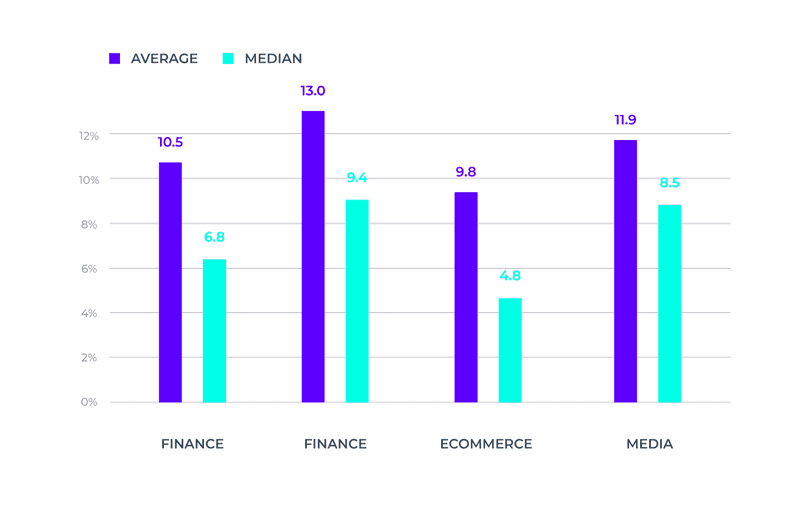
This graph illustrates the concept of product stickiness, showing how gamification can lead to more frequent and consistent user interaction.
Our top tip for developing a sticky product? Easily build a gamified experience & increase active usage by +50%!
Average Session Duration
Duration of All Sessions / Number of Sessions = Average Session Duration
The average B2B SaaS boasts an Average Session Duration of 4 minutes and 26 seconds. In essence, that time encompasses the length of time from the user’s first click on your platform up till their last. This metric is one you definitely want to improve. Why? Because increasing Average Session Duration correlates directly with higher conversion rates!
Retention Rate
(Users at end of time period / Total number of paying customers at beginning of period) * 100 = %
The Retention Rate reveals how many loyal customers you have. One great way to track this data is with the Cohort Analysis chart we mentioned earlier. In short, retention is an important sign of good business health and customer satisfaction. For SaaS, lower Monthly Retention Rates start at 35%, compared to the highs of 93%.
Churn Rate
(Customers who left / Total number of customers) * 100 = %
Churn measures what percentage of customers leave your app within a set timeframe. In contrast to the Retention Rate, it shows how many users you lost over a week, month, or quarter,... Churn is a real dealbreaker in SaaS. Not only does it lead to lower revenue, but it also impacts the customer acquisition cost & customer lifetime value! It’s usually an effect of low app engagement or an unsatisfying experience.
How to increase product engagement for your SaaS platform
According to the data team of Sequoia Capital, the leading venture capital fund that has invested in companies like Apple, Zoom & Doordash just to name a few, user engagement is the fundamental growth driver. It’s what ultimately leads to stickiness, retention & growth.
There are many things you could do to boost engagement. Think of gamified onboarding, personalized notifications, rewards programs,... However, measuring product engagement is the first crucial step. Once you understand which product levers can increase user motivation, you’ll know how to increase product engagement. It’s just a matter of experimenting with the right tactics to boost your growth.
Keep reading the StriveCloud blog for Part II and discover 17 actionable strategies on how to increase product engagement in 2022.
FAQ
What is product engagement?
Product engagement is a way of measuring how users interact with your product. Usually, this happens on 3 levels: depth (app engagement & retention), breadth (feature adoption) & frequency (stickiness & active usage). Once you understand the leading indicators for this behavior you’ll know how to increase product engagement.
What makes a product engaging?
People are motivated by great experiences, and you can use highly persuasive psychological triggers to build a great user experience. A gamified approach, for instance, can fulfill human desires such as autonomy, value, and competence to drive user engagement!
Why is product engagement analysis important?
Don't work in the dark - analyzing product & user engagement data can inform and shape your strategy. Hence, it can shape your roadmap & product strategy. Additionally, it can help you identify users that are about to churn or ready to upsell!
What is cohort analysis?
Cohort analysis organizes app engagement data by date of user acquisition, allowing you to compare the effect of feature experiments on users. Simply test new features on a ‘cohort’ of users and see if engagement rates rise compared to prior cohorts.
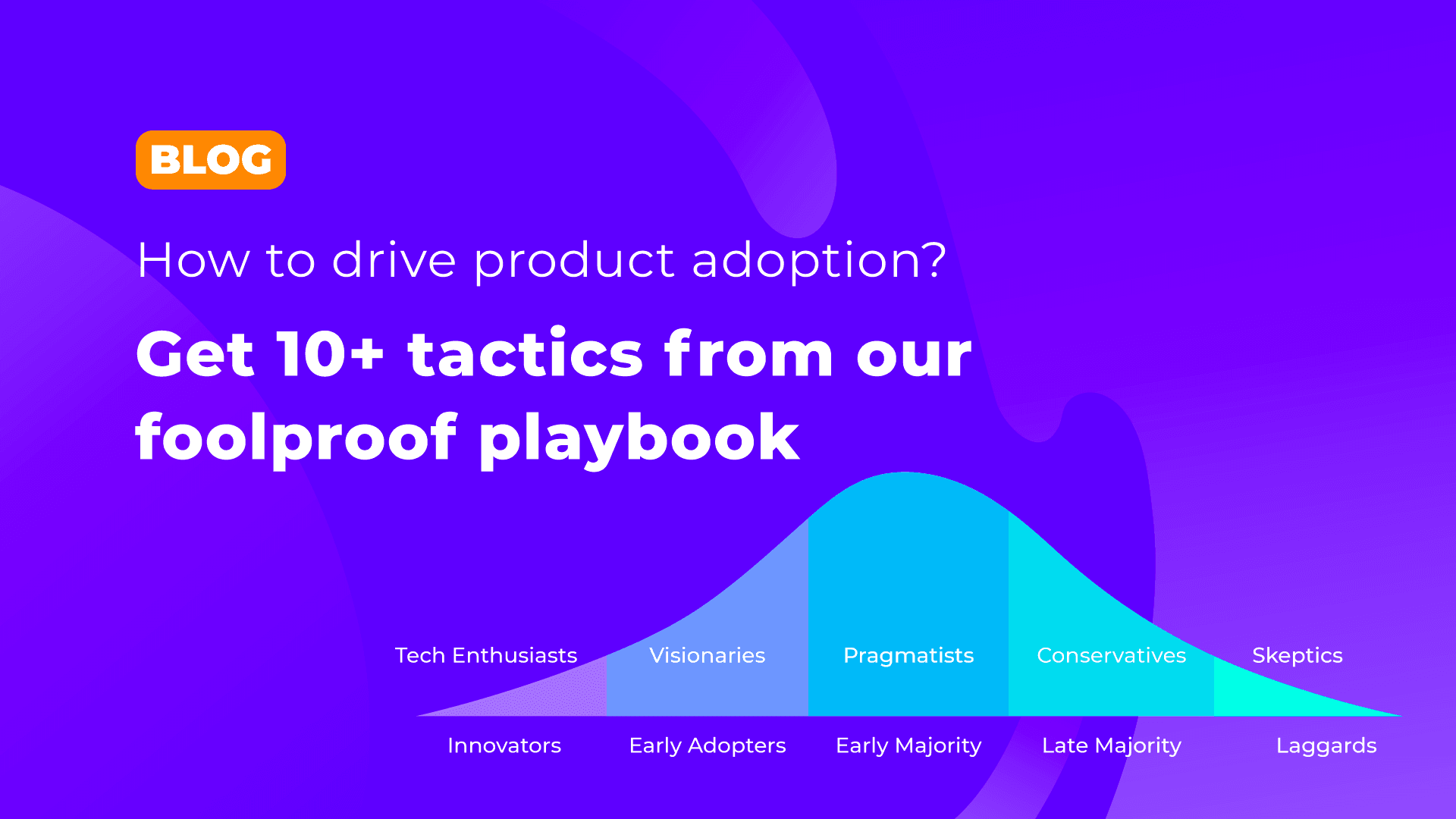
How to drive product adoption? Get 10+ tactics from our foolproof playbook
What is product adoption and why is it important? After user acquisition & activation it's your job to get users to fully adopt or embrace your product! How can you accelerate this? With a great user experience! Find out the metrics, stages & tactics in our ultimate guide to drive product adoption!
How to drive product adoption? Get 10+ tactics from our foolproof playbook
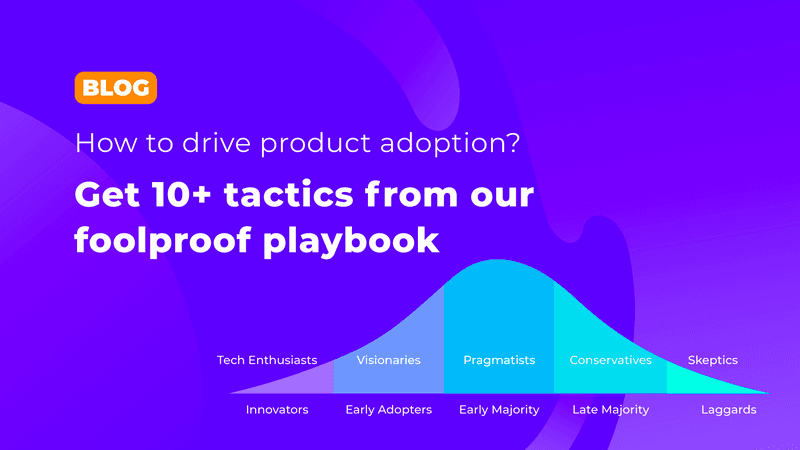
This guide provides a comprehensive playbook for SaaS companies looking to improve how users discover and embrace their products.
What is product adoption and why is it important? Product adoption is the process of users discovering and then fully embracing your product. Great software products can accelerate this through an even better user experience. In fact, it’s why 75% of SaaS companies offer a free trial. So what are the steps & stages to go through? Fortunately for you, we gathered everything you need to drive product adoption in 1 guide! Read on to find out the best-gamified user engagement strategies & real-life case studies
- What is product adoption?
- Why Saas needs to drive product adoption
- What is the product adoption curve?
- 6 stages of every product adoption journey
- What drives product adoption? 4 of the biggest factors
- How do you measure product adoption?
- How to drive product adoption like a pro
- Here's how a gamified UX fueled product adoption for Kayzr
- Build your own gamified user journey with StriveCloud
- FAQ
What is product adoption?
Product adoption is a metric to describe how engaged users are with your product. It describes the lifecycle, depth & breadth of usage according to a set of desired actions. Therefore, product adoption is intertwined with user engagement. In other words, to drive product adoption, you need to move your user from unaware to product fan!
Why Saas needs to drive product adoption
Today 68.8% of SaaS businesses run on a subscription model, the most common monetization method. However, this adds pressure on you to create user value. Indeed, when customers receive a regular bill, you need to justify that spending with your value!
In short, the important thing to remember for SaaS is to drive product adoption to a level that the customer’s expense is outweighed by the value you provide.
What is the product adoption curve?
The product adoption curve identifies user segments based on their place in the market. Ask yourself, who is your product for? If you’re selling a niche software in a new or emerging market, then your audience is likely tech enthusiasts, not pragmatists.
Knowing this also makes it easier to define your marketing and product adoption strategies. Additionally, the product adoption curve visualizes a framework for your future growth!
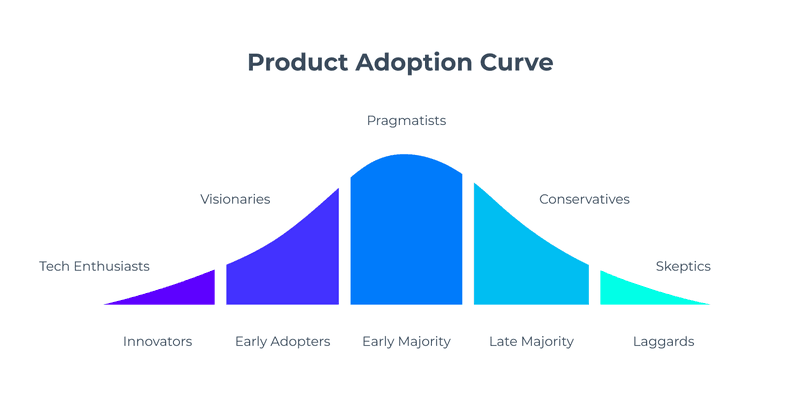
This product adoption curve visualizes the five key user segments based on their willingness to try new technology, from innovators to laggards.
6 stages of every product adoption journey
All customers undergo a 6 step journey before purchase. If you’re aiming to drive product adoption - as you should be! - you must adjust your strategy accordingly to fit this customer journey:
#1 Awareness. Users need to find you somewhere!
#2 Interest. Create that AHA moment and let users realize what your value is.
#3 Evaluation. Here, it’s common that users are still skeptical. Persuade them with strong use cases, social proof, and feature highlights that emphasize their benefits.
#4 Trial. The user decides to sample your product and see if it fits their needs.
#5 Activation. While using your software, the user experiences product value for themselves.
#6 Adoption. Once users are convinced of your platform, they’re ready to subscribe!
How to increase product adoption? Start with our ultimate SaaS growth guide for User Activation!
What drives product adoption? 4 of the biggest factors
Before users even go looking for a new product, they need a trigger. For instance, this could be that their current platform just isn’t working. This is called a push factor. Conversely, a pull factor is something attracting users to change. And that’s where your strategy to drive product adoption truly comes in!
You can create and leverage pull factors that get users aware and interested in your SaaS product. To succeed, there are 4 crucial factors that impact your pull force:
- Ease of use. A user experience that is more intuitive will beat out the competition by reducing friction and shortening the time to value. Things such as gamified onboarding can help by giving users a clear and easy to strive for purpose.
- Product visibility. Needless to say, how can you pull users in if they can’t find you? Up your SEO and find the right channels or directories to promote your product you’ll pull more people in.
- Pricing. Price will always be a sensitive topic, but settling at a perceived ‘fair’ price is critical to success. Indeed, research from McKinsey shows that an effective pricing strategy can deliver a 2-7% increase in sales!
- Product quality. Of course, before anything else, you need a good product! In effect, this means solving your user’s problems better than the competition.
How do you measure product adoption?
Your effort to drive product adoption must work on 3 axes: breadth, depth, and frequency. To clarify, breadth means that users adopt a wide range of features, whereas frequency measures app usage and stickiness. Finally, depth measures engagement and retention.
The essential product adoption metrics
To track your success, you need to know the right metrics that make sense of your data:
Time to value
How long does it take to get a user from starting a trial to the activation event? The shorter, the better!
Product qualified leads (PQLs)
As opposed to a marketing qualified lead, a PQL is a user who has experienced your value by directly interacting with your software. This metric is expressed as a simple number. For instance, you may have 1000 PQLs. Keeping an eye on this metric will highlight the users most ready for activation.
Activation rate
Activation rate = Activated users / Total registered users * 100
Because PQLs only represent the total number of activated users, the metric doesn’t take user churn into account! To discover if you’re activating efficiently, track the activation rate. Basically, it calculates how many new users reach your chosen activation event.
Feature adoption rate
Feature adoption rate = Feature monthly active users / Total monthly logins * 100
Your user engagement needs breadth - that is to say that users are engaging with multiple features. Certainly, a high rate of feature adoption is a good indicator that users are getting value from your product. On the other hand, paying for unused features lowers the perceived customer value!
Customer lifetime value (CLV)
CLV = (Annual user revenue * Duration of user relationship in years) – Total costs of acquiring and serving the customer
This one is simple but important! The more users that adopt, the fewer churn. And that means getting more bang for your buck from each customer. As an added bonus, this also means reduced customer acquisition costs.
Customer engagement score (CES)
CES = Total event value #1 + Total event value #2 + total event value #3...
This is a more complex metric that relies on a host of different user data, ranging from weekly logins and session frequency to the referral of other users.
To calculate the value of these events, first, identify which activities have the biggest impact on user engagement and retention. Once you identify the key moments, ascribe each a score between 1 and 10 depending on how important they are.
Following that, add your scores and view them on a scale of 100. The higher the score, the better your user engagement! Ideally, highly engaged users sit in the 70-100 range. On the contrary, disengaged users languish below 40, a sign of potential churn!
Learn to manage churn with Retention Analysis
There is a way to predict and manage churn, instead of just falling prey to it! The answer is Retention Analysis. When you analyze your churn as comprehensively as this, you will notice trends in product/feature satisfaction. For example, does a certain segment have a higher churn rate than other groups?
In detail, Retention Analysis segments users based on demographic data and dates of acquisition. This can then be applied to steps in the customer journey, especially user onboarding where the need to drive product adoption is acutely important.
As a result, Retention Analysis delivers insights on what is impacting user engagement, including the reasons why users decide to adopt your product - or why they don’t.

This graph illustrates how retention analysis can track user cohorts over time, identifying drop-off points in the onboarding process.
How to drive product adoption like a pro
Now for the bit, you’ve been waiting for - how do you drive product adoption like a pro? When you look at the top SaaS companies on the market, you’ll see them utilize a whole range of tactics from gamified checklists to re-engagement campaigns.
Here are some of the best lessons you can learn from SaaS market leaders:
Learn to identify the segment of your top customers
SaaS products with high user engagement and profitability know who their most valuable customers are, and you should too. This is when Retention Analysis and Cohort Analysis become especially useful. Top product managers double-down on the channels and campaigns proven to achieve conversion!
Make user engagement and retargeting campaigns a major priority
Retargeted users are an untapped goldmine for your business. If you want to drive product adoption, they are invaluable. Retargeting typically involves campaigns, offers for lapsed users, and upselling to existing users.
Research shows the advantages of these tactics:
- Retargeted users spend 37% more often than new users
- Their retention is consistently 5% higher than organic acquisitions
- And by Day 30, retargeted users have a 152% higher user engagement rate!
Top tips on improving your onboarding experience
Develop a frictionless signup flow with Retention Analysis
With Retention Analysis, you can discover the exact steps where your users are churning. In general, sudden peaks in churn indicate a point of friction or frustration. To solve this, optimize drop-off events by testing tweaks that streamline the customer journey.
A gamified user experience boosts user motivation to drive product adoption
Gamified onboarding takes full advantage of the power of psychology. These psychological triggers are powerful and pervasive, as they are common to all of us! For a great example, check out how Databox adds 3 levels to its gamified onboarding:
#1 Gamified checklists
Checklists with incomplete items are a clear winning condition for the ‘game’. It is also an example of the powerful ‘Zeigarnik effect’. This psychological phenomenon says that incomplete tasks are more memorable than completed ones!
#2 Progress bars
Progress bars fill as the user advances, which creates the ‘endowed progress effect’. This says that users are more likely to complete tasks they begin.
#3 Tiered levels
A tiered leveling system rewards user engagement and gives them a higher social status. This idea is actually called the ‘lucky loyalty effect’, where engaged customers feel more entitled to prizes and gifts than customers who are not as engaged or as loyal.
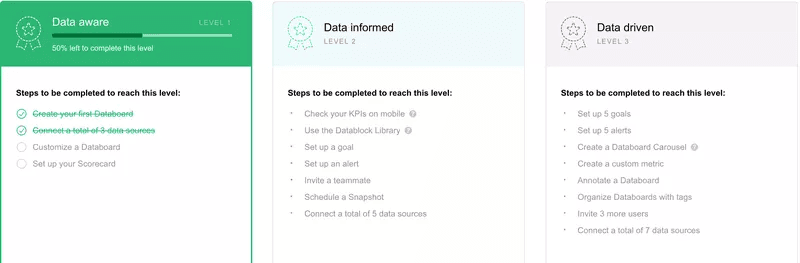
Databox's onboarding process effectively uses gamification elements like checklists and progress bars to guide new users toward activation.
Learn how a gamified user experience can drive product adoption! Learn how to use behavioral psychology to your advantage in our expert-led workshop!
The key to providing better product support
Balance forums and FAQs with live chat tools
Not every issue needs a support agent to solve it. Give users self-service resources such as FAQs, help sections, and user forums that let users find their answers fast and independently. Failing that, ensure that you offer real-time human support! In this regard, live chats have the highest customer satisfaction rate of an impressive 82%.
Track the behaviors that indicate churn and prioritize support for those users
To be the most efficient and effective business you can be, learn which behaviors precede churn. For example, low session duration could hint at dissatisfaction. In short, discover which users are flagging, and prioritize them to optimize your product adoption rates!
How to use data to improve your product
Data can be overwhelming to process. To make sense of it all, follow these 4 steps:
- Analyze data using the key metrics, highlighting areas that need improvement
- Develop a hypothesis for how to drive product adoption
- Tweak or update the product accordingly, for example with A/B testing
- Validate your results! A Retention Analysis comparison is helpful here
Top tools from your stack made to drive product adoption
Improving product adoption rates requires a holistic approach - and that means you need a handy stack of tools! Don’t be caught without these great products:
StriveCloud
Gamification is one of the most versatile and powerful tools looking to create an engaging user experience. Our modular gamification software is easy and flexible to use - simply connect it to your SaaS and customize it to your needs!
We solve the user motivation challenge with a sticky reward system & tons of gamified features to keep users engaged. Build your own gamified user journey from activation to product adoption, with ease!
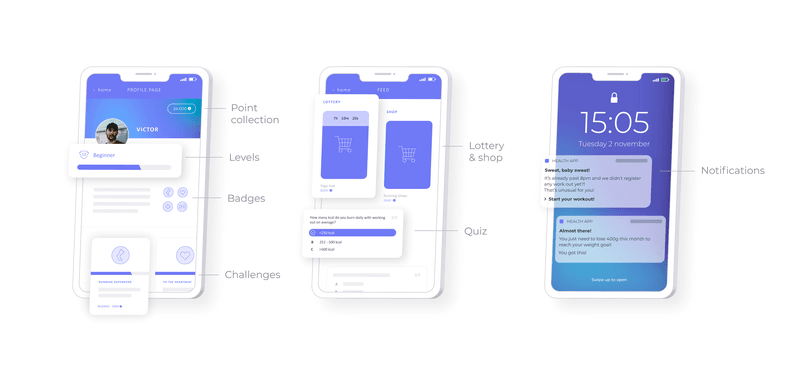
The StriveCloud user interface provides modular building blocks for creating a customized and gamified user journey to increase engagement.
How to build a gamified UX in no time? Build, measure & learn with our modular gamification building blocks!
WalkMe
Identify the gaps in your customer journey with WalkMe. Their software analyzes real-time user journeys in a clean user interface, allowing you to understand your users better and make data-driven decisions. For example, you can gain insights into any friction preventing new users from long-term product adoption.
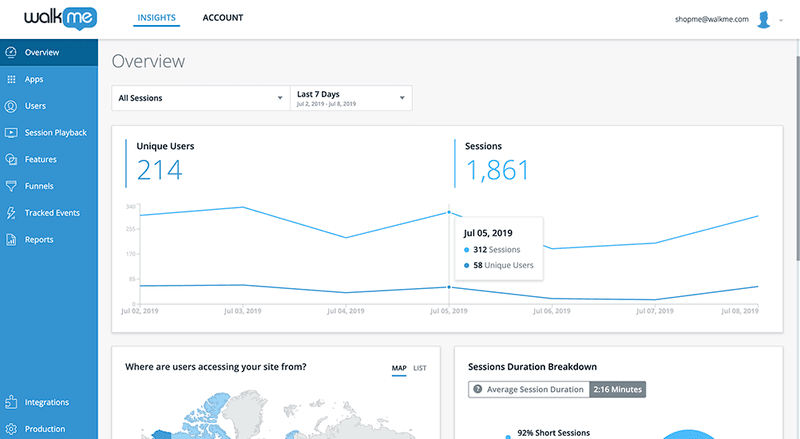
WalkMe's analytics dashboard helps teams visualize the user journey and identify points of friction that might be hindering product adoption.
Social Intents
Remember that live chats are incredibly successful? You can create that success with Social Intents. As a live chat tool, this software improves the responsiveness of your customer service by facilitating easier and faster discussion. Not to mention, their live chat lets you share those all-important FAQs for when an agent isn’t really needed.
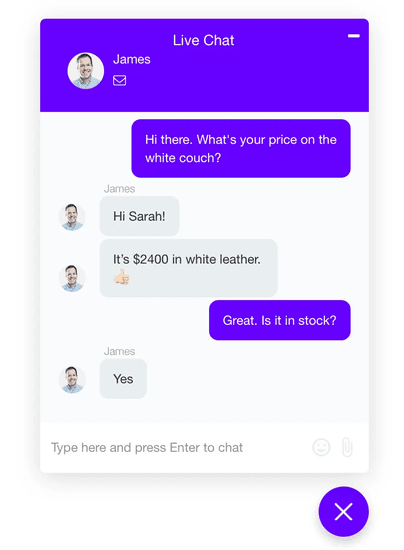
This example shows how a live chat widget, like the one from Social Intents, can be integrated to provide immediate customer support and improve user satisfaction.
Here’s how a gamified UX fueled Kayzr’s product adoption rates
The whole SaaS industry wants to drive product adoption. This was the case for gaming community platform Kazyr when they came to StriveCloud looking to supercharge user engagement & retention, without massively increasing the costs to scale. The answer? A platform powered by gamification that rewards and empowers users!
The results were incredible:
📈 350% more users since StriveCloud’s involvement
💪 60% more daily active users
👉 1 year of 24/7 eyeball time in a day
🕒 1.5h average session time per user per day
So how was this success achieved? Firstly, we implemented a tournament system independent of Kazyr moderators. This meant that competitions could run 24/7, opening up the platform for longer and deeper user engagement!
Additionally, we decided to cap prize rewards and introduce an intrinsic rewards system that sparks gamers’ motivation. That means badges, achievements, and points instead of extrinsic rewards such as cash prizes. In fact, research shows that intrinsic motivators are preferred for some important reasons:
- Intrinsic rewards are self-determined
- They don’t rely on reinforcement/environmental factors
- Self-motivation means stronger and longer-lasting engagement!
Build your own gamified user journey with StriveCloud
Kayzr selected StriveCloud because we offer a uniquely sticky and scalable reward system. As your reliable business partner, we always endeavor to drive product adoption in a sustainable and efficient way. More than that, in a way that is completely customized to your needs.
Our modular gamification software achieves success on behalf of our clients:
👉 58% increase in Daily Active Users on average across all our customers
👉 23% decrease in churn rates (making business more efficient!)
To start your journey today, get in touch with our expert team. There’s no better time than now to optimize your platform and make it the best it can be!
FAQ
What is product adoption?
Product adoption is a metric to describe how engaged users are with your product. It describes the lifecycle, depth & breadth of usage according to a set of desired actions. Therefore, product adoption is intertwined with user engagement. In other words, to drive product adoption, you need to move your user from unaware to product fan!
Why SaaS needs to drive product adoption
Today 68.8% of SaaS businesses run on a subscription model, the most common monetization method. However, this adds pressure on you to create user value. In other words, when customers receive a regular bill, you need to justify that spending with your value!
What is the product adoption curve?
The product adoption curve identifies user segments based on their place in the market. Ask yourself, who is your product for? If you’re selling a niche software in a new or emerging market, then your audience are likely tech enthusiasts, not pragmatists.
How do you measure product adoption?
Your effort to drive product adoption must work on 3 axes: breadth, depth, and frequency. To clarify, breadth means that users adopt a wide range of features, whereas the frequency scale measures app usage and stickiness. Finally, depth measures engagement and retention.

How to boost SaaS product adoption? The science you need to know.
Top product-led SaaS companies are using behavioral psychology to make their product experiences better and stickier. So how can it help to increase SaaS product adoption? Get started with 12 psychological phenomenons to improve your product!
How to boost SaaS product adoption? The science you need to know.
This article delves into how leading SaaS companies are using behavioral science to drive product adoption and increase user engagement.
Some of the leading product-led companies are using behavioral psychology to make their product experiences better and stickier. In other words, they are looking to drive user engagement to increase SaaS product adoption. Right now, around 91% of SaaS businesses are developing strategies like gamified onboarding to leverage product-led growth. If PLG* isn’t your priority, the simple fact is that you’re at a competitive disadvantage.
In this article, we’ve gathered 12 SaaS product adoption tactics to boost product-led growth backed by our expertise in motivational theory & behavioral science!
- The basics: what is SaaS product adoption?
- Why is user adoption so important?
- When does onboarding end and product adoption begin?
- How do you track SaaS product adoption?
- What really influences a customer’s decisions: Behavioral Science 101
- The questions you must answer to improve SaaS product adoption
- 12 top product adoption strategies for SaaS that use behavioral science
- FAQ - SaaS Product Adoption
The basics: what is SaaS product adoption?
SaaS product adoption happens when customers show repeating patterns of user engagement. Basically, they’ve started to adopt your product into their workflow, routine, and habits. You can measure product adoption based on breadth, depth, and frequency of usage.
Why is user adoption so important?
It’s simple - a better adoption process ensures users experience the full value of your product. As a result, you drive sustainable user engagement and retention. And this is crucial - 70% of SaaS companies report that revenue from existing customers increases by up to 40% in the first year! Clearly, that beats losing customers to churn and even the cost of acquiring new users!
The ultimate guide to SaaS Product Adoption: Get everything you need to drive product-led growth in 2022!
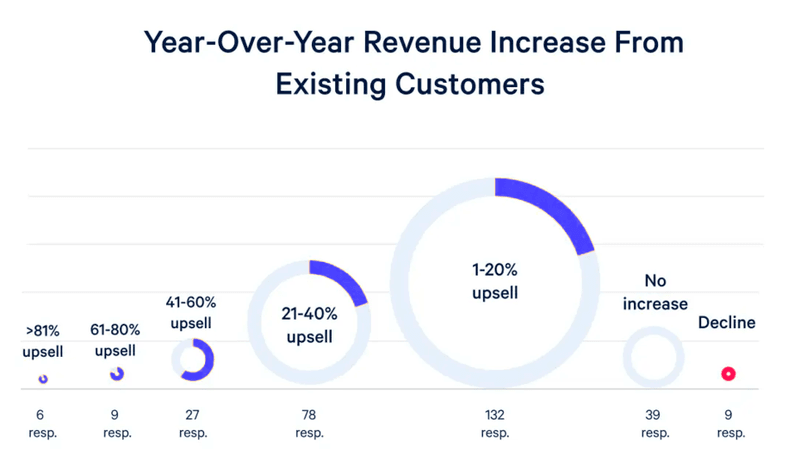
This graph illustrates the significant benefits of high user engagement on SaaS growth and customer retention.
When does onboarding end and adoption begin?
In general, a user is considered ‘onboarded’ after they demonstrate a certain level of commitment to your platform. In terms of SaaS product adoption, this can be seen as increased user engagement on your platform.
To track the transition, consider these 4 factors:
- Have they completed the full onboarding process?
- Does the user engage often, and with a wide range of features?
- Can they see and understand your value clearly?
- Does the user upgrade to paid or become a loyal user?
The more the answer is yes, the closer your user is to product adoption!
How do you track SaaS product adoption?
While the line between onboarding and SaaS product adoption is blurry, there are various metrics you can use to make sense of it. For example, a user’s time to value is important, as well as the product activation rate, stickiness rate, and user engagement.
However, every SaaS has different ways of measuring product success. Basically, you need to ask yourself which behaviors lead to both product growth and customer success?
If you’re a to-do app, for instance, you’ll want your users to:
- Create a to-do list
- Add 3-5 items to their list
- Complete to-do’s
Then, it’s about repeating and expanding on those behaviors. Your user might connect his calendar app to get even more value or use additional features that improve their experience.
What really influences a customer’s decisions: Behavioral Science 101
The power of behavioral science is transformative. Today, an increasing number of growth marketers are building their user experience around the principles of behavioral psychology. As a result, they want to increase SaaS product adoption.
Here are just a few psychological triggers that strongly influence customer decisions:
Loss Avoidance
First coined in 1979, this theory explains that humans are more motivated by avoiding loss than by making gains. Famously, marketing efforts focused on scarcity, like time-limited offers, activate loss avoidance to encourage user engagement.
Premium email software Superhuman for instance created an invite-only software and managed to build a waiting list of currently over 450,000 people! Want to skip the wait? Get referred! In return, you get a VIP onboarding to truly help you get to inbox zero.
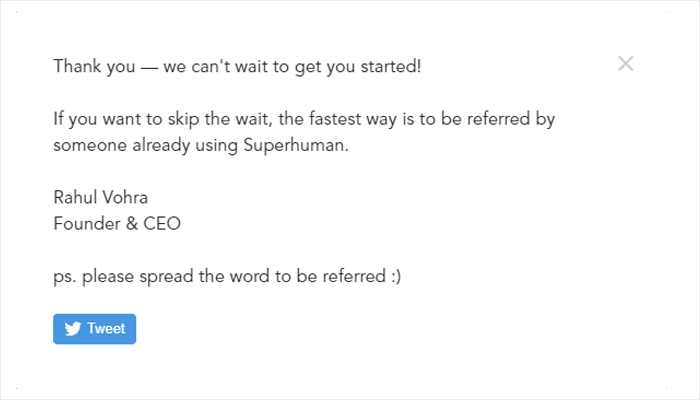
Superhuman's invite-only strategy is a prime example of using scarcity and loss avoidance to create high demand and engagement.
Narrative Bias
People love to look for patterns and stories. In fact, when presented with new ideas we tend to compare them to relatable situations and contexts to better understand the possible value. Basically, we focus on the information we already know and interpret things to support our own worldview. This is also called confirmation bias.
A similar thing happens in survivorship bias. Here, we look at successful examples in hopes of achieving the same results. For example “Steve Jobs, Bill Gates, and Mark Zuckerberg all dropped out of college, so if I do the same!” Additionally, high achievers like athletes often look for patterns to explain their own success. That’s why some claim some crazy rituals or foods to be the secret to their victories.
In de the end, it all comes down to knowing your target audience and creating a narrative they would subscribe to. What facts do they already know of? How can you position yourself within their reality? Finally, measure the success of your narrative by tracking user engagement and time on page.
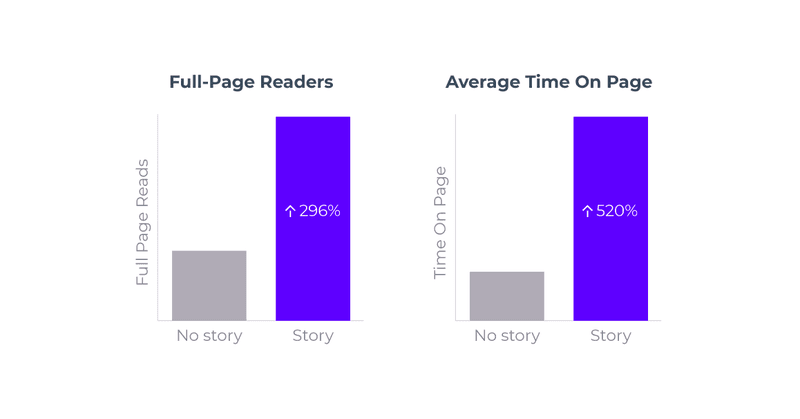
This visualization demonstrates how building a compelling narrative influences user engagement and reinforces marketing messages.
Social Proof
As humans, we make decisions by looking at what other people are doing. Think of your peers, or even better: experts & authorities in the field! Drift for example leverages big, recognizable client names like Gong to win over new customers!

Drift effectively uses social proof by showcasing well-known clients like Gong to build trust and credibility with new customers.
The questions you must answer to improve SaaS product adoption
Improving SaaS product adoption requires a clear strategy. However, you should know a few things about your user, your business goals & product vision. Therefore, we’ve listed the main questions you should ask to drive user engagement and product-led growth.
Who?
- Who are your most/least engaged users?
- What behaviors do they have in common?
In short, these ‘who’ questions will reveal the kind of user most likely to complete your adoption process. Evidently, this data will make you more effective at product adoption!
When?
- How long until a user reaches their AHA moment?
- When is a user considered fully adopted?
- When does it become clear a customer won’t fully adopt?
After learning who your ideal users are, next up is to identify them fast and reliably.
What?
- What issue are they solving by using your product?
- Which features do fully adopted users engage with the most?
- What steps did those users take to get there?
Through analysis, you can reveal which features generate the highest user engagement amongst fully adopted users. Following that, you can double down on them!
How?
- How long does it take your users to become fully adopted?
- At what frequency do users engage with specific features?
- How much customer support did fully adopted users need? And what did they need assistance with?
- How do users reach SaaS product adoption?
It’s up to you to figure out the best way to answer these questions. From direct customer feedback, surveys, or any other analytics tool, you will discover your preferred method.
12 SaaS product adoption strategies based on behavioral science
#1 Progress bars fulfill a user’s need for advancement
Intrinsically, all users want you to help them grow! A simple way to meet this need during onboarding is with a gamified progress bar. Not only does it tell users the length of your onboarding, (reducing frustration), but progress bars also provide instant feedback. And that’s what customers crave!
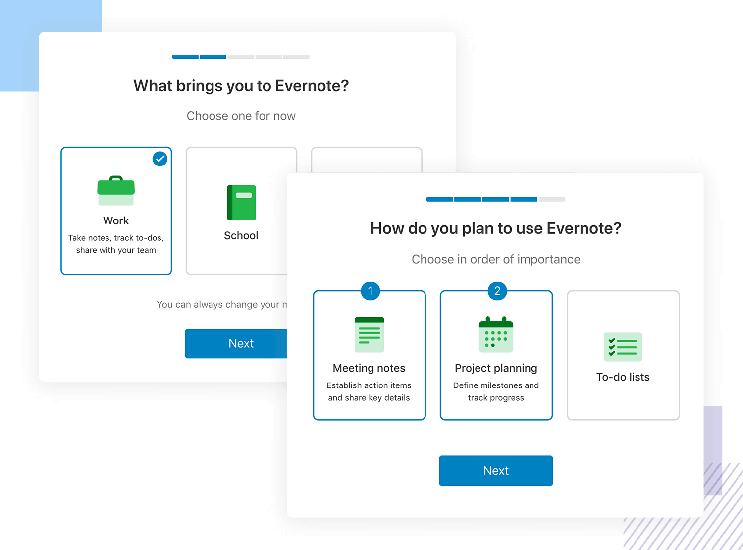
Evernote's onboarding progress bar perfectly illustrates how visualizing advancement satisfies a user's need to see they are making headway.
Leverage Human Psychology Today: Craft your own gamified SaaS Product Adoption Strategy in a custom workshop!
#2 Personalized onboarding empowers future user engagement
To make onboarding more valuable, personalize the experience. Evernote does this by asking why users want to take notes. Then, they show a personalized template feed based on your preferences. In short, personalization gives users faith that you are looking after their needs.
#3 Scarcity triggers user action
MeetEdgar’s product launch used scarcity and loss avoidance to drive user engagement. Initially, MeetEdgar started off as invite-only, and this made users fight harder to be selected! As a result, in under a year, MeetEdgar was raking in over €100k a month!
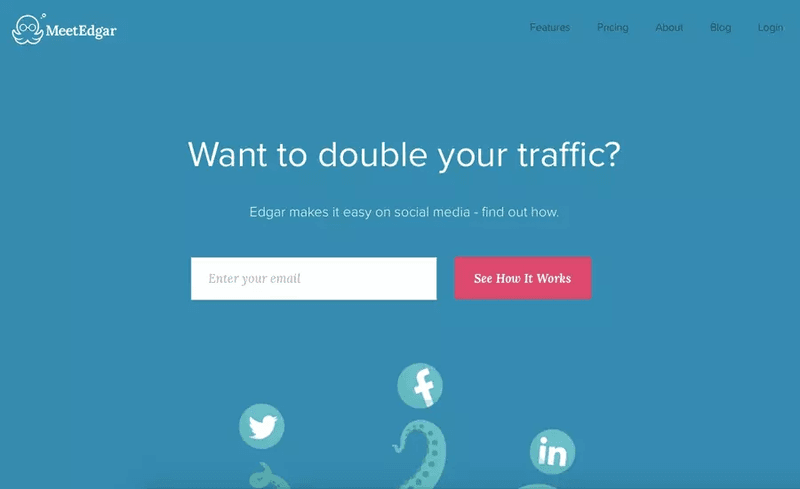
MeetEdgar's launch campaign demonstrates how creating scarcity can trigger immediate user action and drive rapid growth.
#4 Loss framing: how your product protects users
In practice, it is more motivating to frame your benefits as a prevented loss than a gain! Prodpad follows this principle when they offer users to “clear the chaos”, essentially framing their product as letting you avoid a bad outcome.
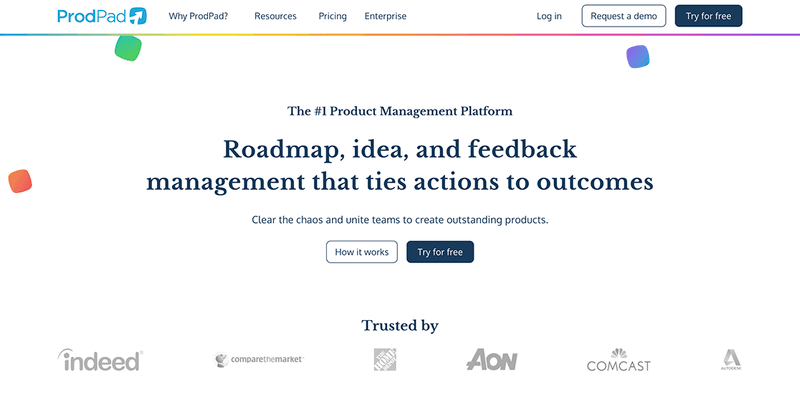
Prodpad uses loss framing by offering to "clear the chaos," positioning its product as a way to avoid negative outcomes.
#5 Increase motivation with gamified rewards (and boost referrals)
Dropbox turned 100,000 users into 4,000,000 in just 15 months - how? With a gamified rewards program that incentivized referrals. Additionally, this fueled the Network Effect, where users get more value because their network is also using the product. As a result, Dropbox drove its SaaS product adoption to great heights!
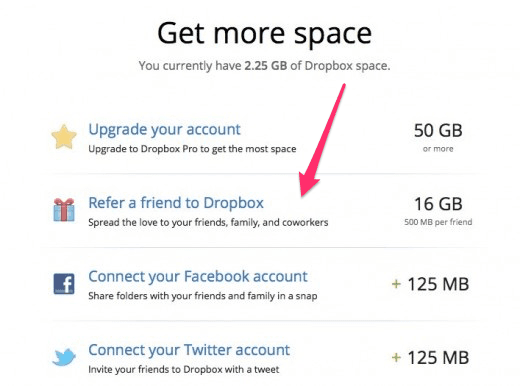
Dropbox’s successful referral program is a classic example of using gamified rewards to boost referrals and user acquisition.
#6 Relativity: comparisons enhance perceived value
Comparisons help you influence the most crucial step in SaaS product adoption: the purchase decision! In brief, side-by-side pricing tables with variable costs make cheaper tiers seem more valuable. In EngageBay’s example, purchasing the $8.99 tier feels like great value when the alternative could be $47.99!
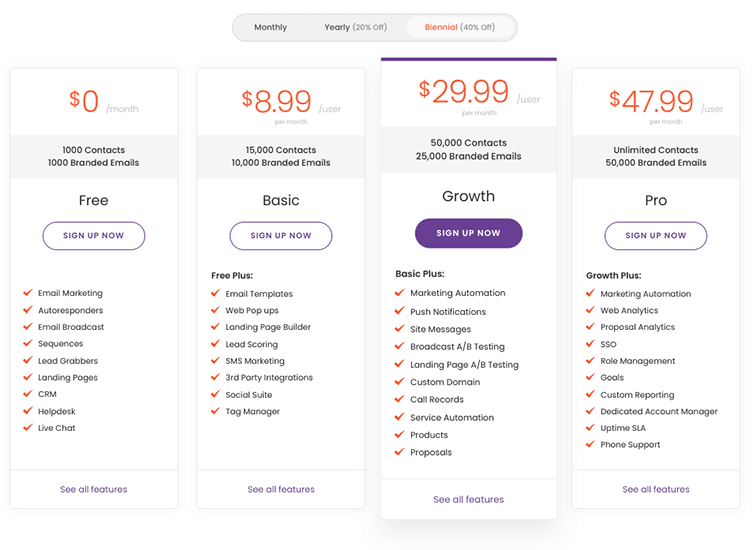
This pricing table from EngageBay shows how comparing different tiers can enhance the perceived value of a specific option.
#7 Boost product adoption with gamified checklists
Gamified checklists can revolutionize your onboarding. Take Keyhole, a social media analyzer. After they implemented gamified checklists, conversion rates rose by 550%!
Drive product-led growth with a gamified SaaS experience - Simply connect our gamification software & start testing!
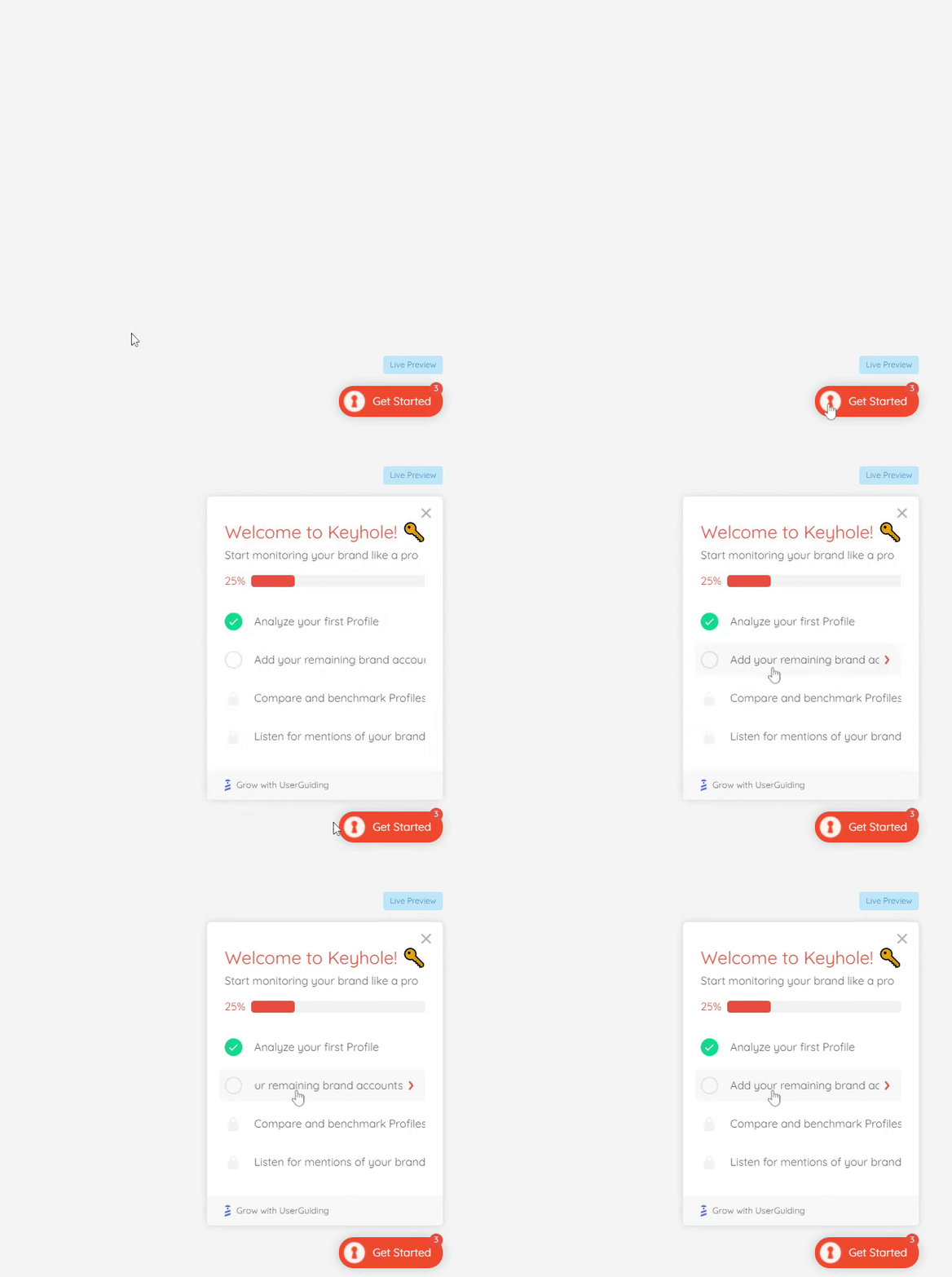
The animated checklist from Keyhole is a powerful demonstration of how gamification can dramatically increase user conversion rates during onboarding.
#8 Learn your customer’s concerns (and meet them)
Generally, requesting a user’s private details during onboarding is intrusive and results in churn. But for some apps, there’s no way around it! That’s the case for social media organizer Sprout Social. But with personable copy that focuses on the user’s concern, they instead reduce frustration and improve SaaS product adoption.
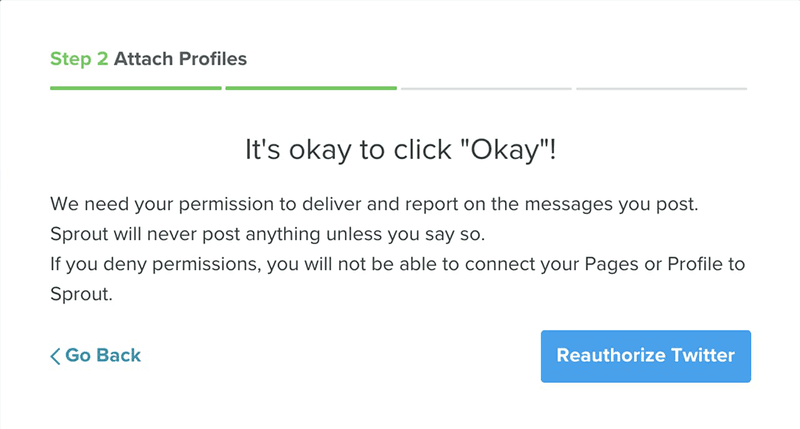
Sprout Social addresses user privacy concerns head-on with transparent and reassuring copy, which helps build trust during a sensitive step.
#9 The ‘Zeigarnik effect’ will make your product memorable
Human brains are wired to remember uncompleted tasks. This is called the Zeigarnik Effect, and it can help you drive SaaS product adoption! The job-finding tool Handshake for instance, uses gamified onboarding to increase profile completion. They do this through features like progress bars and checklists to remind users that they’re not done yet.
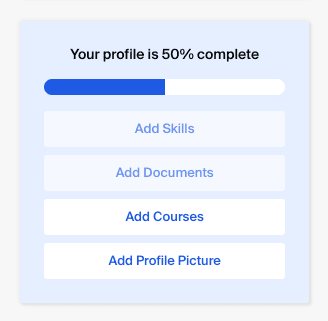
Handshake applies the Zeigarnik effect by using progress bars and checklists to remind users of their incomplete profile, encouraging them to finish the task.
#10 Leverage social proof through testimonials & smart copy
The SaaS product adoption process starts with skepticism. Prospects will question your credibility, your app’s benefits - everything! In short, don’t take prospects for granted! Instead, follow Proof’s model and boost your credibility with copy like “1594 people requested a demo in the last 30 days”.
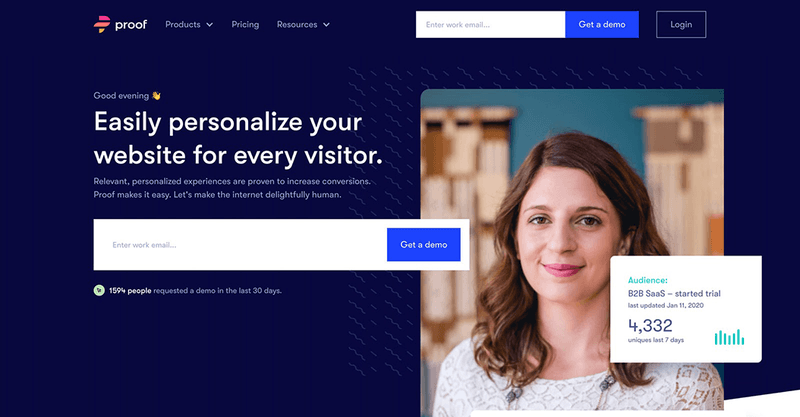
This example from Proof leverages social proof by showing the number of recent demo requests, creating a sense of urgency and popularity.
#11 Remove the fear of change with free, accessible trials
Fear of change is a killer of SaaS product adoption. But one of your greatest tools to combat it is with demos and trials. Take HelloSign for example. On their landing page, the right frame features a cartoon of how the UI functions - and what value the user can draw from it. Pair that with the CTA ‘Try HelloSign Free’, and you have a magnetic product.

HelloSign reduces the fear of change by offering a free trial alongside a clear visual of how the product works, making it easy for users to get started.
#12 Add the element of social status through community
Communities add a ton of opportunities to increase user engagement for your SaaS. Not only does it help scale support, but it also creates power users and drives SaaS product adoption. You can put a gamified layer on top with features like leaderboards and badges.
Airtable for instance has a wide range of badges. Each badge rewards desired behaviors such as sharing links, inviting friends, or answering questions in the support community.
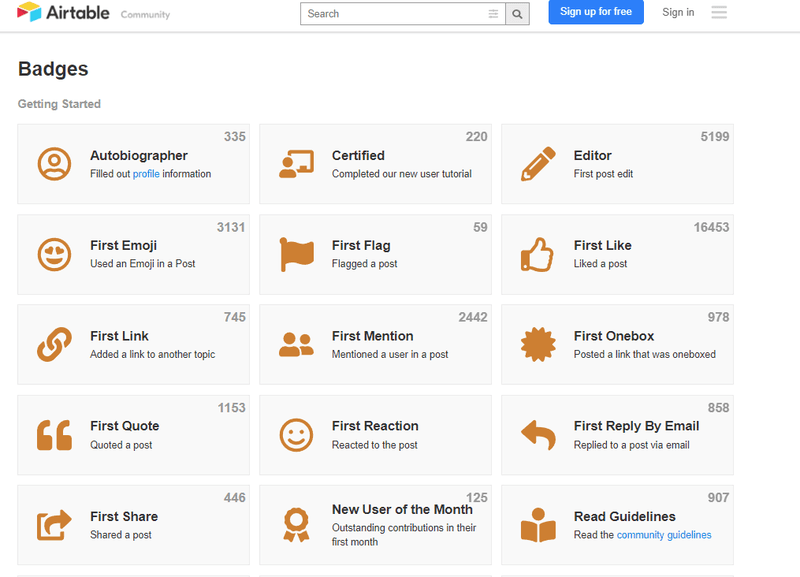
Airtable's community badges are a great example of using social status and gamification to encourage desired user behaviors and build a strong community.
FAQ - SaaS Product Adoption
What is SaaS product adoption?
SaaS product adoption happens when customers show repeating patterns of user engagement. Basically, they’ve started to adopt your product into their workflow, routine, and habits.
Why is user adoption so important?
It’s simple - effective SaaS product adoption creates sustainable growth. In short, a better adoption process ensures users experience your full value, making long-term user engagement and retention more likely.
When does onboarding end and adoption begin?
In general, a user is considered ‘onboarded’ after they demonstrate having made a commitment to your platform. In terms of SaaS product adoption, this can be seen as increased or repeated user engagement on your platform.
How does behavioral science impact SaaS product adoption?
Leading SaaS companies have adopted the principles of behavioral science to drive long-term user engagement. Psychological triggers, variable rewards, and cognitive bias effects like loss avoidance, can greatly influence the purchase decision.
What does PLG mean?
PLG stands for product-led growth. It’s a growth strategy where the product experience in itself drives full funnel growth. Product-led companies often acquire users through free trials or freemium models and then convert, expand and retain them with in-app experiences.

4 ways to drive growth in the product adoption process!
Currently, the average SaaS conversion rate hovers at 7%. But market leaders like Slack reach up to 30%! You too can achieve these numbers by learning how to optimize your product adoption process. Discover which steps to take & 5 stress-tested growth tactics!
4 ways to drive growth in the product adoption process!
This graphic introduces the key strategies for accelerating the product adoption journey for SaaS products.
To be sure, SaaS can still do more to lift adoption rates throughout the product adoption process. Currently, the average visitor-to-lead conversion rate hovers at 7%. Meanwhile, market leaders like Slack achieve 30%! But it’s easy to see how tools like app gamification and psychology can boost product adoption for SaaS.
In the previous article, we learned about the Product Adoption Curve and how it helps growth. Today, let’s discuss the best ways to optimize your product adoption process.
- What is the product adoption process?
- Why is my product adoption process important?
- The 6 stages of the product adoption process
- The 5 types of adopters you need to know
- The 4 crucial forces that influence the product adoption process
- How to drive product adoption for your new software
- 5 tried and true techniques to improve product adoption
- FAQ
What is the product adoption process?
The product adoption process is the journey of users becoming more aware of your product. At the beginning of their journey, users are unaware. They might not even realize they have a problem yet. However, the further they get in the process, the more aware they’ll become.
People are most aware when they’re avid users of your product and understand the full benefit of its features compared to alternative solutions.
Why is the product adoption process important?
The product adoption process is what drives revenue & growth for SaaS companies. Here you generate interest & demand and turn them into paying customers. Additionally, a great adoption process prevents churn by showing users the full value of your product first.
Power up your product adoption process! Check out our ultimate guide and discover how to increase SaaS product adoption.
The 6 stages of the product adoption process
Generally, you can organize how users adopt a product into 6 distinct sequences:
#1 Awareness
Firstly, users need to learn about you. But awareness gets harder every year as the market grows. In 2022, the number of SaaS unicorns is predicted to triple!
#2 Interest
Show users that you have a solution to their problem - and that you can solve it better than anyone else! This involves discussing your pricing and features, for instance.
#3 Evaluation
The potential customer now assesses if your product is worth the time and financial investment. Here, you should use social proof and illustrate use cases to persuade.
#4 Trial
Users now decide to try your free trial, sample, or demo. The more efficient your time to value is, the quicker users can evaluate if your product is what they want.
#5 Activation
By now, the user realizes what your value is. But have they experienced it? Before any long-term adoption is possible, they need to feel the AHA moment!
#6 Adoption
Maybe it was your customer support or use of exciting app gamification, but the prospect decides to stick with you. Congratulations, you have now successfully guided the prospect through the product adoption process!
Increase product adoption with app gamification! Start gamifying with an expert-led workshop by StriveCloud.
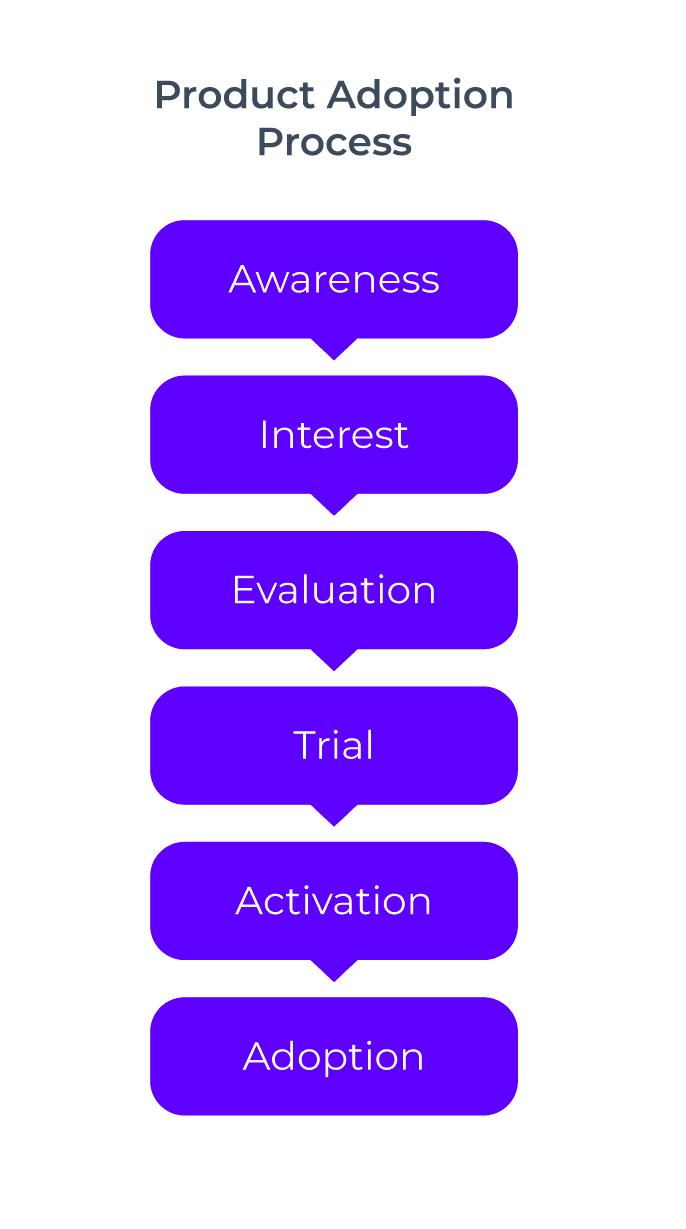
The graphic illustrates the six distinct stages of the product adoption process, from awareness to final adoption.
The 5 types of adopters you need to know
However, not all customers are equal. Clearly, an emerging product and a famous brand will attract different and distinct audience segments. Luckily, the unique segments are outlined in the timeless Product Adoption Curve model:
- Innovators. Tech enthusiasts and risk-takers searching for the best user experience possible.
- Early adopters. These users have issues they want to be solved, and they have the money to pay for them!
- Early majority. The early majority values credibility and continuity. Convince these slow decision-makers and your product will become a market leader.
- Late majority. A competitive disadvantage is what pushes late majority users to adopt. With smaller budgets, these users can’t afford a failed venture!
- Laggards. Laggards are older, risk-averse, and budget-conscious.
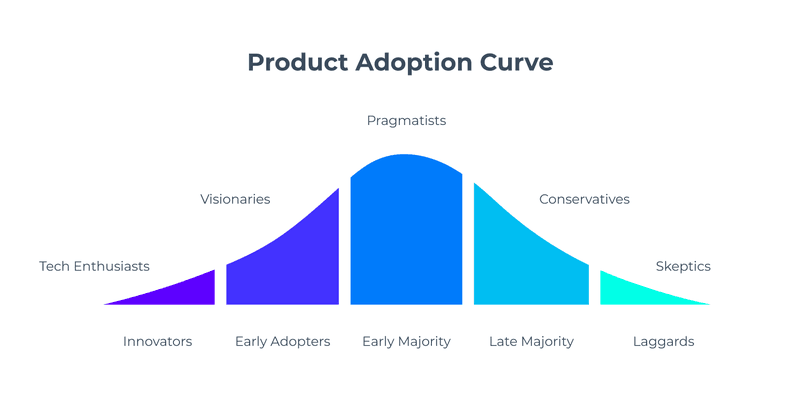
This diagram visualizes the different segments of product adopters, based on the classic Product Adoption Curve model.
The 4 crucial forces that influence the product adoption process
The product adoption process hinges entirely on very few critical decisions, and psychological factors play a huge part. To influence these choices, you can leverage these 4 forces and maximize your product adoption:
#1 Increase the push-away
In short, highlight flaws in the prospect’s current product! This can be done elegantly like in the case of the search engine DuckDuckGo. In their copy, DuckDuckGo pushes away by emphasizing that they value privacy (as opposed to other search engines, who could put your data up ‘for sale’).

DuckDuckGo's landing page is a clear example of using a 'push-away' force by highlighting its commitment to user privacy.
#2 Build up your product magnetism
In essence, a pull force means making your value proposition so attractive that prospects are willing to put in the work of learning new software. Take Slack - just how did they achieve that 30% conversion rate mentioned earlier? Because they make their product sound so magnetic! In addition, they even include a push-away in the same line.
Slack - "It’s faster, better organized, and more secure than email - and it’s free to try."

Slack's marketing copy demonstrates product magnetism by presenting a compelling and attractive value proposition.
#3 Decrease the fear of change
It turns out that avoiding loss is actually more motivating than making progress. In conclusion, people are often scared to change due to the sense of loss linked to it. This is especially true for the ‘late majority’ adopters. However, you can make the switch less scary with testimonials, trials, or even guarantees!
To provide an example, Grammarly calms its prospects by offering a free demo that requires no registration. Following Grammarly’s model could be a good idea - just last year the app was valued at a stunning $13 billion!

Grammarly effectively reduces the fear of change by offering a simple, no-registration-required demo to ease users into the experience.
#4 Decrease customer attachment to the status quo
Innovative products always face resistance. As a result, your product strategy needs to make the customer’s status quo less attractive. This force can be particularly powerful among late majority and laggard users, who are often more attached to their ‘normal’.
Github - "Figma has replaced the whiteboard for us."
To illustrate, the collaborative graphic design tool Figma shakes things up with social proof. Moreover, the use of testimonials from trusted companies enforces the persuasive idea that not using Figma puts you at a competitive disadvantage!

Figma uses testimonials from trusted brands like Github to decrease attachment to the status quo and create a sense of competitive necessity.
How to drive product adoption for your new software
Business wisdom tells us there are 5 concepts that impact the product adoption process:
Relative Advantage. Compared to the competition, is your product cheaper, more convenient, or higher in status? In short, that is a relative advantage.
Compatibility. Essentially, does your product suit the market’s culture? Usually, this is discovered through PESTLE analysis.
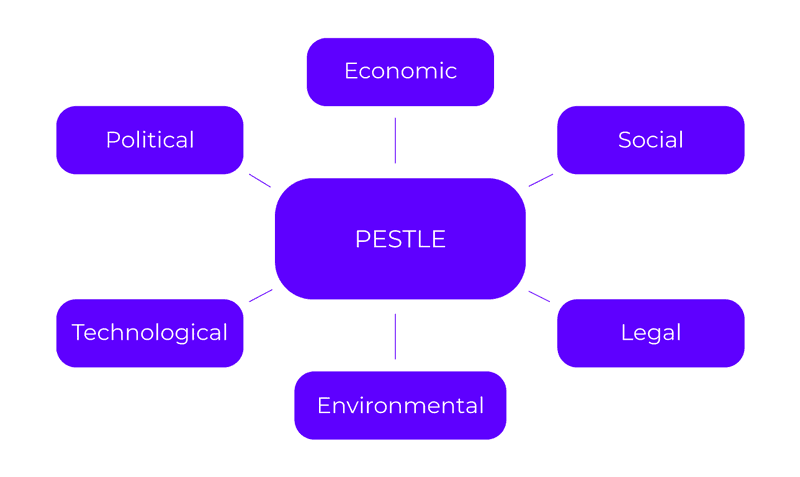
This chart outlines the five key concepts that influence the rate of product adoption, including relative advantage and compatibility.
Complexity. Is your user interface intuitive to use? Will users find friction in the user experience? To reduce complexity, keep your value proposition simple and clear!
Divisibility. If your product can be trialed, then users are more likely to give you a chance. Typically in SaaS, this comes in the form of free trials and freemium demos.
Communicability. Did you know that word of mouth results in 5x more sales than paid media impressions? But before you can benefit, users must be able to explain your value! Does your product pass the mom test?
5 tried and true techniques to improve product adoption
1) Optimize your onboarding experience with Churn Analysis
To discover if you are falling short by frustrating users in their first and most critical moments, use Churn Analysis. In short, this means analyzing each step of onboarding and tracking when and where users churn. By highlighting the largest drop-offs in user activity, you can find exactly what part of your product adoption process needs to improve.
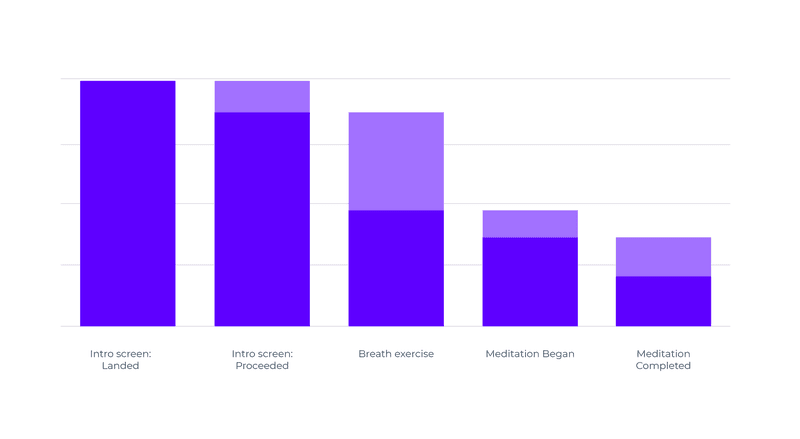
A churn analysis funnel helps identify where users drop off during onboarding, highlighting areas for improvement in the adoption process.
2) Learn how to improve your product!
Improving your product is harder than it sounds. To provide just one example, sudden updates that significantly change the UI can frustrate users. When you are improving your platform - as you should always be - there are some ways to do it so you don’t threaten the product adoption process:
- Add new features based on user feedback. Forums for users are a powerful guide to future tweaks, especially when you have innovators on board.
- Validate features before launching. Before spending lots of time in development for a feature users don’t want, try and add a “fake” button or waiting list in your product. You’ll get to see how many users show interest in a feature before building it!
- Focus on increasing usage frequency. Every unused feature is wasted money in a customer’s mind. Make features more appealing by upping the value - for example with personalization or an integrated layer of fun app gamification.
3) Drive user motivation with app gamification
App gamification makes your app intrinsically motivating. In other words, users enjoy interacting with your app because of the experience and not just the end result. You can do this through gamified rewards, messages, or even challenges. Basically, a feeling does more than a thousand words.
Email software Superhuman for instance stays focused on its goal of hitting inbox zero. When users eventually get there they get to experience a sense of relief with a gorgeous and serene reward screen. It’s a free and easy way to incentivize user engagement!
Rahul Vohra, Superhuman CEO - "We obsess about how users feel. What we make users feel is just as important as what we make. And what we actually make is joy, in software form."

Superhuman uses a rewarding visual, an example of app gamification, to celebrate when a user achieves 'inbox zero,' motivating continued use.
Creating a great platform has never been easier! Boost product adoption with our app gamification software.
4) Make support more accessible
There’s a reason live chats have the highest satisfaction of any support channel - they’re fast, easy to find, and responsive! Furthermore, every minute that a user spends frustrated on your platform with an unsolved problem is a minute that they don’t feel your value!
5) Retargeting campaigns can catch every user
Past studies show that about 26% of retargeted prospects will return and purchase from you. Therefore, this group should not be ignored! In practice, they need a product adoption process tailored to their level of awareness. Because these users are already aware of your product, your messaging and positioning should differ. For example, you could use a different landing page to ‘Welcome Back’ these users.

This example from Gusto shows a 'Welcome Back' landing page, a retargeting technique tailored for users who are already aware of the product.
FAQ
What is the product adoption process?
The product adoption process is the journey of users becoming more aware of your product. At the beginning of their journey, users are unaware. They might not even realize they have a problem yet. However, the further they get in the process, the more aware they’ll become.
Why is the product adoption process important?
The product adoption process is what drives revenue & growth for SaaS companies. Here you generate interest & demand and turn them into paying customers. Additionally, a great adoption process prevents churn by showing users the full value of your product first.
What are the most important forces that influence the product adoption process?
These 4 crucial forces impact how motivated a user is to adopt a product: if users are pushed away from their existing product, pulled by the magnetism of your product, the customer’s fear of change, and finally attachment to the status quo.
The 5 stage product adoption framework to drive your business growth
As product-led growth is becoming the new standard, SaaS companies are looking for ways to boost user engagement and adoption. In other words, they need a product adoption framework that speeds up feature discovery & time-to-value. Let's look at some examples from companies like Canva, Airtbale, Wistia, and more!
The 5 stage product adoption framework to drive your business growth
This visual introduces the key concept of using a product adoption framework to effectively guide and accelerate business growth.
What are the best ways to drive product adoption in SaaS? As product-led growth is becoming the new standard, SaaS companies are looking for gamified tactics & growth hacks to boost user engagement and adoption. In other words, they need a product adoption framework to get different types of users from trial to power users.
In this article, we’ll cover the 5 stages of the Product Adoption Curve and discuss 7 famous examples guaranteed to boost product adoption for SaaS apps.
- What is product adoption?
- Why customer adoption should be a SaaS priority
- What are the benefits of product adoption?
- The Product Adoption Curve: a framework for strong product positioning
- The 5 stages of the Product Adoption Curve
- What is a product adoption lifecycle?
- Let the product adoption curve guide your product-led growth
- 7 examples of increasing product adoption from companies like Airtable, Canva, Wistia,...
- FAQ
What is product adoption?
Product adoption is a metric that measures your user engagement. In short, it describes the lifecycle, depth & breadth of usage according to a set of desired actions. After user acquisition, a good product adoption framework turns new users into engaged users!
Why customer adoption should be a SaaS priority
To scale SaaS you need a product-led approach to growth. In other words, if your product already does the heavy work, things like sales and customer support will get easier. To complement your user acquisition process you also need a clear product adoption strategy.
By using a product adoption framework you should achieve a faster time to value and a smoother onboarding that reduces any possible friction and frustration. As a result, you’ll not only be able to drive more user engagement but also diminish churn!
Start growing your SaaS business today! Get to grips with the basics of product adoption with our ultimate guide.
What are the benefits of product adoption?
Usually following the trial period, product adoption happens when users perceive that the benefits of your product outweigh its costs. In fact, it’s fair to say that the choices users make at this stage will clearly define the success of your platform!
If users choose to adopt your product, the benefits for you are transformative:
- Reduction of churn and increase in user engagement and retention
- Boost customer lifetime value, lowering user acquisition costs
- Increased success of upselling and cross-selling
- Generation of predictable revenue streams (letting you plan with confidence)
The Product Adoption Curve: a framework for strong product positioning
Sociologist Everett Rogers first developed the Product Adoption Curve in 1962, and it remains an indispensable framework for growing businesses. In short, the curve illustrates when each user segment is best placed to adopt your product.
This powerful product adoption framework has 5 key stages:
The 5 stages of the Product Adoption Curve
This graph illustrates the classic Product Adoption Curve, showing how different user segments adopt a new product over time.
Phase 1: Innovators
Basically, a cutting-edge product attracts cutting-edge users! While innovators make up just 2.5% of the market, they’re highly active and offer tons of great insights. On the other hand, innovators are always looking for new great products, so they move on quickly and pay little.
Pro tip: Get your early product feedback here! Innovators are savvy risk-takers who also tend to forgive bugs or missing features. But most of all, they know what they want to see.
Phase 2: Early adopters
Forming around 13.5% of the total market, early adopters are a prime audience for new SaaS products. Compared to innovators, this group has issues they want to be solved, and they have the money to pay to solve them!
Pro tip: Early adopters see themselves as ahead of the curve. As such, they expect a wide range of customization and amazing customer support. Find out what drives user engagement and double down on it!
Phase 3: Early majority
Here, you must convince the next 34% of consumers, who prefer continuity to innovation. In other words, your product is becoming the new normal. Certainly, it’s a challenge - early majority customers are slow decision-makers and rely strongly on good references.
Pro tip: To persuade the early majority, you need credibility. Employing social proof in your campaigns can set users at ease. Additionally, you can use gamified growth tactics like incentivizing referrals and reviews to generate word-of-mouth.
Phase 4: Late majority
The late majority, 34% of all consumers, live at the peak of the Product Adoption Curve. At this point, your growth begins to slow. These customers are more conservative, have smaller budgets, and simply can’t afford to fail with a new product.
Pro tip: Late majority users adopt out of necessity, not curiosity. In short, they must feel they are at a competitive disadvantage by not using your product! Help your users get to value with stellar support, in-app education, or even product training!
Phase 5: Laggards
Laggards, older and more traditional, are the last segment and form 16% of the market. If this skeptic-heavy group does adopt your product, it means your software is likely in decline. However, they can still provide considerable revenue and market share!
Pro tip: Laggards are risk-averse and budget-conscious. Given this, offer trials, guarantees, and money-back assurances to entice product adoption.
What is a product adoption lifecycle?
Embedded in the curve’s product adoption framework are ‘Lifecycles’. For example, marketing and sales is an early lifecycle where users first become aware of your product. Then, they move through trial, onboarding,... Altogether, the lifecycles form a user journey that can inform your product adoption strategy.
Let the product adoption curve guide your product-led growth
Use the adoption curve as a product adoption framework! By identifying the stage your product is in, as well as what attracts different user segments, you can shorten the time between early adopters and the early majority and grow your business faster!
Get inspired by these 7 amazing examples of how to increase product adoption in SaaS:
7 examples on increasing product adoption from companies like Airtable, Canva, Wistia,...
#1 Shorten your time to value like ProdPad
For users, the race to find your value starts from the very first interaction with your platform. To drive users to that AHA moment, you need a few things. First, you need to give clear directions on where to go, and what to do. Then, you’ll also want to incentivize user engagement to keep users moving forward.
Take ProdPad for instance. This product management software experienced high churn after a 30-day trial. So, the team measured their time to value. ProdPad assessed it to be just 9 days. As it turns out, all those extra days discouraged users from engaging! So, the trial was cut to 7 days and extensions were gamified. As a result, ProdPad tripled conversion rates!
How to increase product adoption with a gamified product? Get your expert-led workshop & learn how to use behavioral psychology to your advantage!
ProdPad's interface shows how completing tasks can unlock trial extensions, a clever gamification tactic to boost engagement.
#2 Prioritize user engagement over acquisition like Duolingo
Define your growth lever. Boosting acquisition can sometimes have an effect on user engagement and long-term growth. That’s why it’s important to measure the impact of experiments and mirror them to your goals. Language learning software Duolingo is famously good at this, and it has boosted their Day 1 retention from just 13% on launch to a truly impressive 55%.
For example, the Duolingo team tested download buttons to let users complete courses offline. The result? A rise in conversions, but a dip in daily active users. This was deemed too high of a long-term loss for the short-term gain, and the feature was shelved. In other words, without initial testing, this fall in users would have been a nasty surprise!

This a/b test from Duolingo illustrates the critical choice between short-term acquisition and long-term user engagement.
#3 Give users a headstart as Airtable does
Sometimes setting up a new product can be hard just for the fact of getting started. Nobody likes to start from scratch, so why not give users a headstart? Templates can be part of your product adoption framework. You can even build out user flows to customize templates according to to use cases and user profiles.
Airtable for instance gives users a range of customized templates after onboarding. It gives users instant value and serves as motivation to further discover the product. Especially with a multi-faceted tool like Airtable, it’s important to inspire your users in what ways they can use it and give them the best practices to succeed!

Airtable reduces user friction by providing ready-to-use templates, helping new users find value and start projects faster.
#4 Boost user engagement with gamified rewards like Todoist
To get users to adopt your product, make it fun! A gamified approach triggers intrinsic motivation, a powerful psychological phenomenon where users are motivated by enjoyment and personal satisfaction.
Productivity platform Todoist for instance used a range of gamified tactics to boost keep users active. Whenever you complete a to-do list you’ll get rewarded with karma points. Additionally, Todoist uses gamified features such as progress bars, leaderboards, and even daily streaks!

Todoist effectively uses Karma points and levels to make task completion more engaging and rewarding for its users.
#5 Promote your features like Wistia
An excellent product adoption framework should maximize the breadth of user engagement. This entails users engaging with a wide range of features, and it’s a must for successful platforms. For customers, every unused feature lowers the value they could get out of your product!
As said before, you need to show your users what your product is capable of! So, when you launch a new feature be like the video hosting platform Wisitia. They promoted their new A/B testing feature by emailing existing users with a clear CTA and a video that looks extremely clickable.

Wistia's promotional email is a perfect example of how to clearly announce a new feature and encourage users to try it out.
#6 Leverage gamified checklists like Loom
Whenever users need to complete grunt work they experience lots of friction and sometimes also frustration. With gamified checklists, you can take this away! The psychology behind it is simple: humans like progress and clear directions.
For example, video messaging SaaS Loom uses gamified checklists to remind users of their goals and drive them to the crucial AHA moment.

Loom's onboarding checklist effectively guides new users through essential first steps, ensuring they experience the product's core value.
#7 The proof is in the pudding or product
Every stage of the product adoption framework will be different. You’ll need to shift focus from acquisition to onboarding, to user engagement, and so on. But the best thing you can do to drive viral growth is to make your product better!
An inspiring example here is the simplest design tool out there: Canva! Their amazing growth story is full of product-led growth tactics from customized landing pages and onboarding to template libraries.
Did you know it only takes around 52 seconds to create a Christmas card in Canva? Compare that to the average graphic design process where it could take weeks or even years to finally get value.
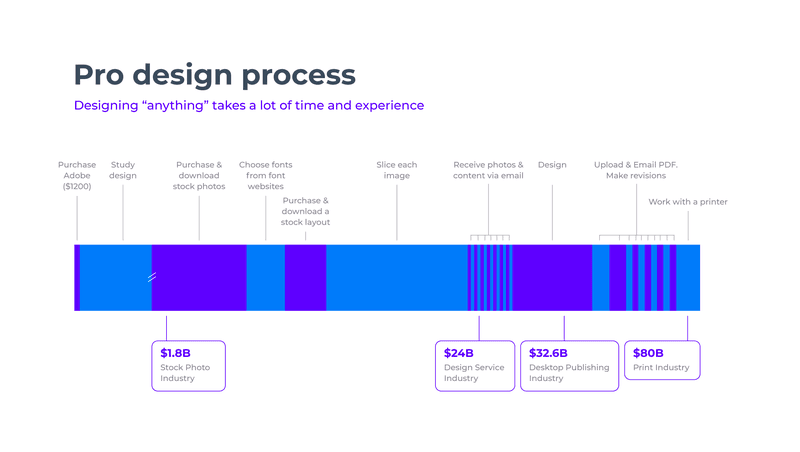
This comparison chart demonstrates the dramatic difference in time-to-value between Canva and traditional design software.
And that’s what is required today in our world of product-led growth!
Creating a sticky platform has never been easier! Drive product-led growth and boost adoption with our gamification software.
FAQ
What is product adoption?
Product adoption is a metric that measures your user engagement. In short, it describes the lifecycle, depth & breadth of usage according to a set of desired actions. After user acquisition, a good product adoption framework turns new users into engaged users!
Why should SaaS companies care about customer adoption?
To scale SaaS you need a product-led approach to growth. When your product already does the heavy work, sales and customer support become easier. By using a product adoption framework you achieve a faster time to value. As a result, you’ll be able to drive more user engagement and diminish churn!
What are the benefits of product adoption?
Next to user engagement and retention, product adoption also influences a range of other factors. If users choose to adopt your product, the benefits for you are transformative:
- Reduction of churn and increase in user engagement and retention
- Boost customer lifetime value, lowering user acquisition costs
- Increased success of upselling and cross-selling
- Generation of predictable revenue streams (letting you plan with confidence)
What is the Product Adoption Curve?
Sociologist Everett Rogers first developed the Product Adoption Curve in 1962, and it remains an indispensable framework for growing businesses. In short, the curve defines 5 segments from innovators and early adaptors to the early and late majority, and finally laggards.

How to increase software adoption? Start now with this 7-step template.
Increasing software adoption means a rise in retention - which 64% of businesses say increases customer lifetime value! With StriveCloud’s user adoption strategy template, you can easily create your very own roadmap to success.
How to increase software adoption? Start now with this 7-step template.

Learning how to improve your software adoption plan can be an intensive process. But it doesn’t have to be! With our user adoption strategy template, you can easily create your very own roadmap to success.
In this article, we’ll cover the step-by-step process of developing a user adoption strategy for SaaS and explore some of our best tips and tools you can use to generate growth.
- What is a user adoption strategy in SaaS?
- Why do SaaS companies need a software adoption strategy?
- When does onboarding end and adoption begin?
- How to measure product adoption & customer onboarding?
- Why increasing customer lifetime value is key for SaaS companies
- Guide your plan with this 7-step SaaS user adoption strategy template
- 5 ways SaaS companies can improve software adoption today
- FAQ
What is a user adoption strategy in SaaS?
A user adoption strategy is your plan to convert prospects and acquisitions into loyal users. But it’s more than simply achieving conversions. Ideally, a great strategy reveals what behaviors foretell product adoption - and then how to increase that behavior!
Download our Free User Adoption Strategy Template here 👉
Why do SaaS companies need a software adoption strategy?
A user adoption strategy is high in scope and high in benefits! Mainly, your strategy will positively impact the first stages of the customer journey, resulting in increased product adoption. But why is it important to have an efficient software adoption plan?
Low user adoption means higher churn and acquisition costs
If you’re losing customers to churn, you’re forced to replace them. But that’s expensive! Research shows that acquisition is up to 7 times more expensive than retention.
Fully adopted users are more likely to realize your customer value
A great user adoption strategy is also a template for a feature discovery strategy. As a result, your perceived value increases. Of course, nobody wants to pay for features they never use!
Download our Free User Adoption Strategy Template here 👉
Simply put, increasing customer lifetime value is profitable!
Even a tiny 5% rise in customer retention can increase revenue by as much as 95%.
Stop churn and kick-start your product adoption strategy! Read our complete guide on how to increase software adoption.
When does onboarding end and adoption begin?
The line between onboarding and adoption is blurry, but there are ways to tell the difference. Firstly, ‘onboarded’ users generally have higher user engagement with various features. As such, they also demonstrate a better understanding of your value - and that means they’re primed for software adoption.
How to measure product adoption & customer onboarding?
Before you can tackle how to increase software adoption, you must be able to measure your progress! That’s why product managers use Cohort Analysis. In short, segment users by acquisition date and then track their journeys using these key metrics:
- Conversion rate. This calculates the total number of users who make it from signup to purchase. A leading example is Slack’s 30% conversion rate!
- Time to value. In essence, how long it takes to reach the ‘activation event’.
- Frequency of usage. Essentially, how often does user engagement occur?
- Average session duration. Longer sessions might mean your time to value is too long. Conversely, short sessions might be signs of frustration and churn!
Basically, Cohort Analysis shows you which user segments have the highest retention. After collating the data, you might start to notice patterns. When the best groups share results in a metric, then that is your way to increase software adoption in users!
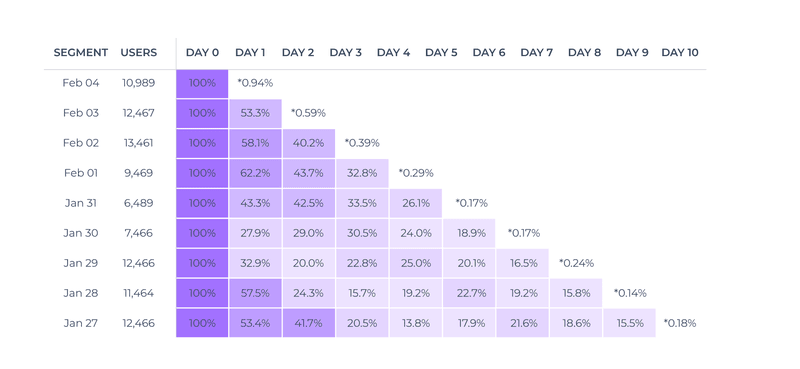
This cohort analysis graph helps visualize user retention over time, a key metric for measuring the success of a software adoption strategy.
Download our Free User Adoption Strategy Template here 👉
Why increasing customer lifetime value is key for SaaS companies
Put simply, customer lifetime value (CLV) calculates the revenue gained throughout a customer’s lifespan. Without a doubt, if you craft an excellent software adoption plan, you will also boost your CLV. According to software research group SaaS Scout, the top 1% of customers are ready to spend 5 times more than the average customer.
Additionally:
- 65% of profits will be from existing customers.
- 77% of customers stick with one brand for more than 10 years.
- 66% of existing customers tend to spend more to increase rewards.
Sounds great! So how do you work out CLV? Follow the formula below:
Avg user value = Avg purchase value X Avg purchase frequency in one year
Guide your plan with this 7-step SaaS user adoption strategy template
#1 Understand your product's mission & vision
Your business objectives have to be true to your mission. This consistency is key to a memorable and coherent UX! More than that, basing your user adoption strategy on exactly why you do what you do makes the plan more sustainable. Look at this amazing example from HumanForest!
Download our Free User Adoption Strategy Template here 👉
#2 Know your customers!
It goes without saying that your strategy will resonate more if it matches your target audience! Besides your own goals, what are their goals? Understanding the core user needs and use cases will help you build better features & support to drive customer success!
Download our Free User Adoption Strategy Template here 👉
#3 Define the activation and adoption events
It’s imperative that you define when the user first experiences your value - the ‘activation event’ or AHA moment. How long does it take to get there? What steps do they take?
After experiencing this moment, your user adoption strategy starts! How will you lead users to the right features? By leveraging methods like cohort analysis you’ll be able to find out which behaviors lead to long-term retention and customer value.
In fintech, for example, activation could be opening an account - whereas adoption might mean making a cash deposit. Then, expanding on other features or services. It’s up to you to define what’s best for your app!
Download our Free User Adoption Strategy Template here 👉
#4 Arm yourself with the best tools to increase software adoption
After defining your desired user events, it’s time to set up the tool stack to drive those behaviors! Besides support software like chat functions or forums, in-app tools are more direct for creating product-led growth.
For instance, some tools focus on onboarding, whilst others go deeper into feature adoption or user engagement. Here are some examples:
- Apty: Revolutionize your walkthroughs and tooltips. Apty is the highest-rated product adoption software on P2P review site G2. It’s ideal for enterprise brands.
- Appcues: Build a personalized experience. When you want to increase feature discovery, try Appcues. Easily add messages without any code!
- StriveCloud: Create a sticky UX that users love. StriveCloud’s app gamification software is flexible and easy to use. Design, test, and build gamified in-app experiences from a single control panel. Plus, it boosts daily active users by 58%!
Download our Free User Adoption Strategy Template here 👉
#5 Develop an onboarding plan that drives adoption
It’s simple - lengthy onboardings frustrate users. The key step of your software adoption plan is to make onboarding interactive! Use as few screens as possible, then opt for timely tooltips over mandatory tutorials. Furthermore, use gamified tactics such as progress bars, rewards, and leveling systems to keep your user engaged.
Download our Free User Adoption Strategy Template here 👉
#6 Plan for continual optimization
You can’t rest on your laurels. Using your mission & vision as a guide, you must continue to improve your app. To do this, make it easy for users to return feedback. Additionally, try to increase the adoption of any underused features that threaten to devalue your product.
Download our Free User Adoption Strategy Template here 👉
#7 Encourage adopters to become loyal brand advocates
At this point, you know who your ideal users are. After identifying them, and converting them with your great product, you need to give them the tools to promote your product! Integrate your brand with social media, incentivize referrals, and implement a loyalty program that rewards loyal users. After all, customers are much more likely to choose your brand if you offer a loyalty program.
Maximize the benefits of our user adoption strategy template with an expert-led gamification workshop & go home with a custom plan!
5 ways SaaS companies can improve their software adoption plan today
Focus on data-driven, goal-based user engagement
Your data is the best guide to achieving success. Once you’re able to interpret your data, you can use it to drive your software adoption plan and develop ambitious targets. Duolingo is famous for its goal of increasing user engagement by 1% every week - and sticks to it religiously. Along with its daily streak feature, they have become the top education app in the US!
Establish self-set goals and define the key milestones
Customers want to know how you are going to get them from A to B. Given this, you should establish the roadmap they have to journey to solve their problem. That includes key milestones which will act as positive reinforcement to continue engaging. You could take the route of Salesforce and gamify the user adoption journey to make it both clear and exciting.
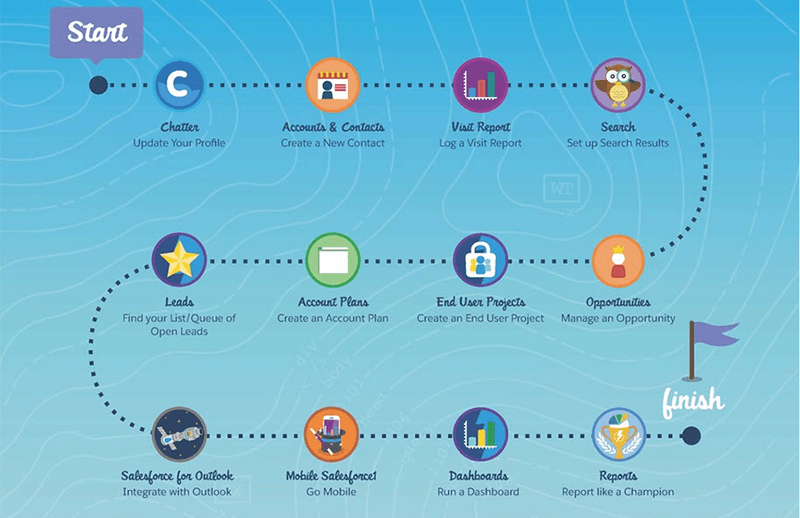
Salesforce Trailhead uses timed challenges and milestone badges to make learning interactive and encouraging, a powerful technique for user adoption.
Build a customer community
One of the most powerful and pervasive motivators is the need to belong. That might be why active in-app communities have been found to boost user retention rates by 40%! As a bonus, an active community builds credibility with like-minded prospects. In short, if it’s good enough for them - why not me?
Choose the right software adoption tool and software!
The right tools can significantly accelerate your software adoption plan. However, it’s crucial to pick the right one, as this software will become a key part of your user experience. How easy is it to use? Can you customize it? Is the support team hands-on or not? What are its main and additional functionalities? Do these fit your goals?
Deploy a competitive strategy with app gamification
Today, over 2/3 of customers say their standard for good experiences is higher than ever! In practice, a great UX needs to be 3 things: useful, easy, and enjoyable to use. And that’s where app gamification excels! Don’t fall behind - gamify your app and get ahead.
Get that competitive advantage! Build a gamified experience & slash churn by 23% from just 1 solution!
FAQ
What is a user adoption strategy in SaaS?
A user adoption strategy is your plan to convert prospects and acquisitions into loyal users. But it’s more than simply achieving conversions. Ideally, a great strategy reveals what behaviors foretell product adoption and how to increase that behavior!
Why do SaaS companies need a software adoption strategy?
When research shows that acquisition is up to 7 times more expensive than retention, the benefits of a good user adoption strategy become clear. Not to mention, adopted users are more likely to see your full value - increasing their customer lifetime value!
When does onboarding end and adoption begin?
The line between onboarding and adoption is blurry, but there are differences. Firstly, ‘onboarded’ users engage more and in a wider breadth. As such, they also demonstrate a better understanding of your value - meaning they’re primed for software adoption!