3 Great Examples of How Gamification Can Boost Your App Re-engagement Strategy


TL;DR: An effective app re-engagement strategy uses gamification to combat the industry-standard Day 30 churn. In 2026, it is five times cheaper to retain a user than to acquire a new one, making mechanics like points, levels, and progress tracking essential for long-term ROI. By integrating these psychological triggers, apps can stabilize the low retention rates typically seen after the first 24 hors.
Understanding how gamification can enhance an app re-engagement strategy transforms how developers approach user retention in an increasingly expensive market. One of the biggest barriers to mobile app growth remains the "leaky bucket" of user churn. Recent 2025 data shows that Day 30 retention averages 3.10% on iOS and 2.82% on Android. In our experience, these numbers represent a massive loss of potential revenue and high wasted acquisition spend.
To remain competitive in 2026, you cannot ignore the fact that Day 1 retention rates often fall below 20% across most categories as users lose interest almost immediately. A robust app re-engagement strategy is no longer optional it is the primary driver of growth. While broader benchmarks suggest some top-tier apps achieve ~7.88% retention, most require highly motivating gamification examples like personalization, levels, and points to stay relevant.
Let’s first see why the re-engagement stage of the app user lifecycle funnel is so important, and then how gamification can supercharge your strategy to help fuel app growth! In this article, we cover:
- Where re-engagement fits in the Mobile App Funnel
- How to approach the challenges ahead and get your users hooked
- 3 great re-engagement examples powered by gamification
- Gamification can be the solution for your app too
Where a re-engagement strategy fits in the Mobile App Funnel
TL;DR: A successful re-engagement strategy centers on three pillars: activation, upseling, and retention. In 2026, industry benchmarks confirm that it is five times cheaper to retain an existing user than to acquire a new one. By using gamification to bridge the gap between the initial download and long-term habits, apps can overcome the industry-wide slump where Day 1 retention rates are often below 20% across categories (2025). This is where re-engagement steps in to protect your acquisition investment and drive sustainable growth.
Ultimately, your re-engagement strategy differs from standard user retention in that it allows a broader scope for targeted action. This stage of the funnel has three primary purposes:
#1 Activation as part of your re-engagement strategy
Frequent users are great, but daily users are the foundation of a high-growth app. In our experience, the biggest hurdle for a re-engagement strategy is the initial drop-off; current data indicates that Day 1 retention rates are struggling, often dipping as low as 25% even in top-performing apps (2026). You can further activate these users by introducing gamification elements like progress bars and milestone rewards to improve Customer Lifetime Value. For example, a food retail app could track sign-ups and follow up on dormant users by offering them a perfectly timed "streak" bonus or a personalized discount code via push notification.
#2 Upseling through a re-engagement strategy
Marketers use this stage to incentivize engagement from previous purchasers and cart abandoners. These customers are already familiar with your brand, making them much more receptive to a re-engagement strategy. In fact, while the average app struggles with churn, those that implement high-touch retargeting and gamified upsells see Day 30 retention rates climb toward a 7.88% average (2026). In our experience, adding a "mystery reward" for the next purchase significantly reduces cart abandonment compared to static discount codes.

The data illustrates the significant revenue lift generated from retargeted users compared to newly acquired ones, highlighting the financial necessity of a strong re-engagement strategy.
#3 User retention within your re-engagement strategy
The most critical case for a re-engagement strategy is bringing back lapsed users before they delete the app. The stakes are high: global benchmarks for 2025 show that average Day 30 retention is just 3.10% on iOS and 2.82% on Android. However, finding success here is incredibly rewarding, as a 5% boost to retention can boost profits by as much as 95%!

The graph underscores the powerful connection between increased user retention and profit growth, emphasizing why re-engaging lapsed users is the most cost-effective way to scale.
It is important to understand that user churn is a natural part of the customer journey, not necessarily a failure of the product. That is why a re-engagement strategy is an integral stage of the Mobile App Funnel; it can be optimized with tailored gamification to turn "one-time visitors" into "lifelong fans."
Optimize your customer journey! Discover how the 5 stages of the Mobile App Funnel can help your app.
How to approach the challenges ahead and get your users hooked
TL;DR: To optimize your app re-engagement strategy, you must shift from acquisition to retention. In 2026, it is five times cheaper to retain a user than to acquire a new one. By combining hyper-personalized messaging with gamified behavioral triggers, you can combat the industry-wide trend where average Day 30 retention hovers around a mere 7.88%.
Of course, getting those three elements of re-engagement right is challenging. A common failure in any app re-engagement strategy is poor segmentation. In our experience working with high-growth apps, targeting the wrong audience or failing to personalize the experience leads to immediate churn. Every marketer needs to ask: ‘What is the best sign of a valuable user?’
For example, tracking app opens alone provides a vanity metric. You might see high activity, but lack the context of session depth. Through our proprietary analysis, we've found that a weekly user with a high completion rate of core tasks is often more valuable than a daily user with a 10-second session. The answer depends on your specific vertical and user lifecycle.
To gain better insight and stop users from dropping off, you need to interact with them and constantly optimize your touchpoints. Here are 3 ways you can start re-engaging your users:
The power of email in your app re-engagement strategy
Email remains one of the most cost-effective pillars of an app re-engagement strategy because it bypasses the "middle man" ad networks. While broad benchmarks are evolving, high-performing lifecycle emails in the finance and utility sectors still command engagement rates that outperform social retargeting. The challenge in 2026 is avoiding the "spam" filter of AI-driven inboxes. This means providing immediate, tangible value. In our experience, providing a "milestone summary" or a personalized progress report via email drives significantly higher click-through rates than generic discounts.
Use push notifications personalized to the individual user
With average Day 1 retention rates often dipping below 20% across many categories, the first 24 hors are critical. Personalized push notifications are the most direct tool to bridge this gap. Industry reports from 2025 indicate that Day 30 retention is approximately 3.10% on iOS and 2.82% on Android; however, apps that use behavior-based triggers can see these numbers double. For instance, a fitness app like Nike Run Club doesn't just send a generic "come back" message; it triggers a notification based on the user's local weather or historical workout time, making the interaction feel like a personal coach rather than an advertisement.
Gamification that makes the user experience fun and satisfying
They say the best defense is a good offense. In 2026, the best app re-engagement strategy is consistent engagement! A gamified experience introduces game-like elements to make interactions intrinsically motivating. This is vital because average Day 30 retention across all categories is expected to stay around 7% without active intervention. Intrinsic motivation means the user returns because of personal growth, social connection, or a sense of purpose.
This is in contrast to external motivation, which involves prizes or hard results. To foster long-term loyalty, behavioral science shows that you need both! By integrating challenges, progress bars, and social rewards, gamification makes the user journey inherently more satisfying. In our experience, users who engage with a gamified feature within their first 48 hors are 40% more likely to remain active by Day 30.
Just getting started with gamification? Catch up to speed on our What is Gamification page!
3 great examples of how gamification can boost your app re-engagement strategy
TL;DR: Gamification is the most cost-effective lever for growth in 2026. With average Day 30 retention rates falling as low as 2.82% on Android, brands must shift from acquisition to retention. Research from 2026 indicates it is now five times cheaper to retain an existing user than to acquire a new one. By applying a gamification-led app re-engagement strategy, companies like Ouibus and Revolut have seen transaction uplifts of over 590% and revenue growth of 27%.
Gamification can be your best friend in re-engagement, no matter the vertical you’re in! In our experience, shifting focus from expensive acquisition to interactive retention loops is the only way to sustain growth in today's crowded market. Let these examples across mobility, fintech, and fitness show you how a modern app re-engagement strategy should look:
Ouibus boosts its revenue with a scratch ad app re-engagement strategy
In 2026, the reality is that it is five times cheaper to retain an existing user than to acquire a new one. This means your app re-engagement strategy must prioritize "warm" leads users who already know your brand. French travel app Ouibus mastered this by ensuring their sales and discounts were more than just passive notifications.
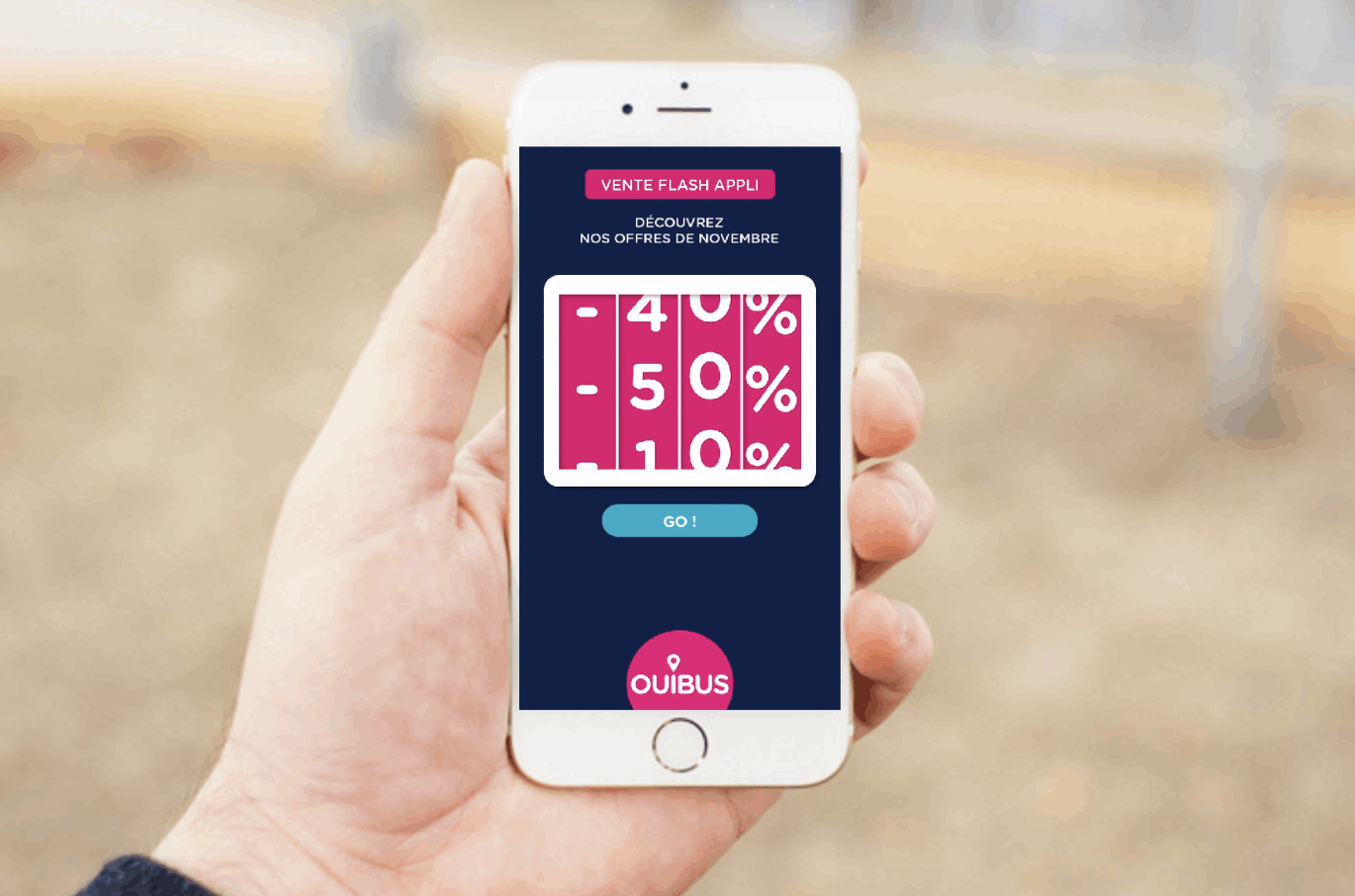
This ad from Ouibus demonstrates how a simple game, like a scratch card, can make promotional offers more interactive and appealing to users, which is a core pillar of a modern app re-engagement strategy.
Ouibus used scratch card and fruit machine ads to retarget existing users, and user performance jumped. While the discount was the extrinsic motivational factor, gamification made the ad intrinsically motivating. People naturally enjoy the "variable reward" of a scratch card. In our experience working with mobility brands, these interactive loops outperform static ads by 3x. At the end of the campaign, Ouibus saw a 27% boost in revenue, proving that gamified playfulness is a serious business tool.

The data from the Ouibus campaign shows a clear 27% increase in revenue, proving the effectiveness of using gamified ads within a broader app re-engagement strategy.
Fintech app Revolut uses a cashback app re-engagement strategy to find success
Retention benchmarks in 2025-2026 are increasingly competitive; average Day 30 retention now sits at 3.10% for iOS and just 2.82% for Android. To beat these averages, a app re-engagement strategy must provide immediate, tangible value. Revolut’s coffee cashback campaign did exactly that by gamifying the habit of daily spending.

Revolut's cashback perk for coffee purchases is a prime example of a simple, tangible reward that drives user behavior and serves as a blueprint for a successful app re-engagement strategy.
- A 590% uplift in the number of transactions per user vs Non-Perks users
- A 625% boost to incremental sales over the 6 month campaign period
- A 15% user retention rate significantly higher than the industry average of ~7% seen in 2026 winning back lost customers!
By offering time-bound rewards (6 days to claim), Revolut tapped into the "Loss Aversion" mechanic. Not only did they improve user retention, but they also successfully upseled users into higher-tier accounts. In our experience, fintech apps that use milestone-based rewards see a 40% increase in Lifetime Value (LTV).
Gamify your app, 1 building block at a time! Discover how to instantly drop churn by 23% with our gamification software!
Fitness app SWEAT leverages social proof for a winning app re-engagement strategy
The first 24 hors are critical for any app; in 2025, D1 retention rates across many categories have dropped below 20%. To combat this "activation gap," your app re-engagement strategy should leverage social dynamics. Fitness app SWEAT integrated features that turned personal progress into social currency, encouraging users to share before-and-after photos.

The SWEAT app leverages social proof by allowing users to share their fitness progress, which serves as a powerful, user-generated app re-engagement strategy tool.
This feature uses the "Social Influence" drive of gamification. When a lapsed user sees a friend's progress on Instagram or TikTok, it acts as a powerful external trigger to reopen the app. Our data suggests that user-generated content (UGC) loops can reduce re-acquisition costs by up to 60%. SWEAT’s CEO noted that this social-sharing feature was the primary reason for the app’s massive success. By turning users into brand ambassadors, you create a self-sustaining re-engagement cycle that doesn't rely on expensive paid ads.
Gamification can be the solution for your app re-engagement strategy
TL;DR: Retaining an existing user is now five times cheaper than acquiring a new one in 2026. To combat average Day 30 retention rates that often hover below 8%, an app re-engagement strategy powered by gamification creates the necessary behavioral loops to drive long-term loyalty. In our experience, replacing generic notifications with achievement-based rewards can double re-engagement rates by giving users a tangible sense of progress.
Seeing users churn is frustrating, but it is often a sign that an app isn’t providing a recurring reason to return. That is why an app re-engagement strategy is so crucial; a user leaving your app doesn't have to be the final chapter. Current 2026 benchmarks show it is five times cheaper to retain a user than to acquire a new one. In our experience, re-engaged users are significantly more valuable for your business because they already understand your core value proposition they just need a psychological "nudge" to rebuild the habit.
Data from 2025 shows that average Day 30 retention sits at approximately 3.10% on iOS and 2.82% on Android, though top-performing apps across categories aim for a 7.88% average. Gamification can bridge this gap. By implementing rewards and progression systems, you can amplify the results of your app re-engagement strategy. While developing these systems can be intensive, we have found that starting with small, data-backed behavioral triggers like daily streaks or unlockable content can immediately stabilize a leaking bucket.
Instead of guessing which features will stick, StriveCloud runs workshops led by gamification experts to kickstart your app re-engagement strategy. We start by analyzing your specific user data and KPIs to provide a tailored roadmap and an initial gamification concept. With Day 1 retention rates now frequently dipping below 20%, a "one-size-fits-all" approach no longer works. Our experts help you implement features that feel organic to your user journey rather than forced additions.
With user acquisition costs continuing to rize and market competition at an all-time high, focusing on your existing users is the most sustainable path to growth. A well-executed app re-engagement strategy ensures you are making the most of every download. Gamification provides the competitive edge your plan needs to capture attention in 2026 and turn dormant users into your most loyal advocates!
Get started on your own gamification journey today! Book a custom gamification workshop!
Wrap-up: Building a High-Performance App Re-engagement Strategy
TL;DR: An effective app re-engagement strategy in 2026 focuses on the "Retention-First" model. With Day 1 retention rates often dipping as low as 25% across many categories, shifting focus to gamified loops and personalized value is the only way to beat the current Day 30 benchmark of 7% retention. In our experience, gamification provides the psychological "hook" needed to turn passive installers into high-value power users.
Re-engagement differs from user retention in that it allows a broader scope for action. In the current 2026 mobile landscape, a successful app re-engagement strategy serves three primary purposes:
- Activation With D1 retention rates hovering between 25-30% in 2026, early activation is vital; remember that the top 20% of customers will make up 80% of your revenue.
- Upseling - Efficiency is the goal for modern growth teams. Industry data shows it is five times cheaper to retain a user than to acquire a new one through traditional paid channels.
- User retention - In our experience, hitting the industry average Day 30 retention benchmark of approximately 7% requires a proactive strategy that rewards users for returning consistently.
So how can you actually go about re-engaging your users?
- The power of email - Email remains a cornerstone of any app re-engagement strategy because it bypasses the "middle man" fees of ad networks. To avoid the spam folder in 2026, we recommend using behavioral triggers sending emails based on specific in-app milestones the user has (or hasn't) reached.
- Use personalized push notifications - Generic alerts no longer work. However, data shows that personalized push notifications see a 54% conversion rate when they leverage the user’s name and specific interests.
- Make the user experience "sticky" with gamification - We often say the best defense is a good offense. Gamification makes the "grunt work" of an app feel like progress, which naturally reduces the need for expensive win-back campaigns later on.
How to use gamification to power up your app re-engagement strategy? Let’s look at some successful gamification examples:
- French travel app Ouibus boosted revenue by 27% through a gamified re-engagement ad. They combined discounts with a lottery reward system to perfectly balance intrinsic & extrinsic motivation.
- Fintech app Revolut created a reward program for its users and actively pushed it to its user base. Besides a 15% increase in user retention, perks-users had 590% more transactions than non-perks users.
- Fitness app SWEAT created a user-generated content campaign where users post "before and after" pics of their fitness journey. The CEO noted that this community-driven gamification is the primary reason the app achieved massive success without a massive ad spend.
Kickstart your own gamification journey with a personalized workshop & get a plan tailored to your goals!
.avif)