

How to Hack Growth Like Revolut (the Secret Is Mobile App Engagement!)



TL;DR: Revolut’s ascent to a projected 67 million users by 2026 proves that mobile app engagement is the most efficient engine for hyper-growth. By replacing traditional ad spend with gamified loops and a "super-app" ecosystem, they added 15 million new customers in a single year, maintaining a 38% growth rate that traditional banks simply cannot match.
The digital banking revolution has moved beyond the early-adoption phase; by 2026, it is the global standard. Revolut remains the definitive leader in Fintech innovation, leveraging a model that prioritizes mobile app engagement over expensive media buys. In our experience, their growth isn't just about utility it's about frequency. By the end of 2024, Revolut's retail base surged to 52.5 million customers, and current data forecasts a reach of 67 million users by the close of 2025. Their strategy utilizes some of the most advanced gamification examples in finance, allowing them to capture nearly 15% of the adult population in core markets. This engagement-first approach has successfully turned a financial tool into a daily lifestyle necessity across more than 40 countries.
Revolut is changing banking for the better through mobile app engagement
TL;DR: Revolut’s "growth hack" is centered on high-frequency mobile app engagement that converts casual travelers into daily primary bank users. By scaling to a projected 67 million retail customers by the end of 2025, Revolut has proven that deep feature integration and gamified loops are the keys to dominating the fintech landscape.
As digital-native banking becomes the global standard, neobanks like Revolut are outpacing traditional incumbents by prioritizing mobile app engagement. Revolut's retail customer base grew by a staggering 38% to reach 52.5 million by the end of 2024. In our experience, this shift isn't just a trend it’s a structural takeover. In key regions like the UK and Ireland, market penetration has hit approximately 15% of the adult population, reflecting a broader movement where digital-first platforms are no longer "secondary" accounts, but the primary financial hub for the under-40 demographic.
Initially, Revolut was created to allow customers to avoid transaction fees when traveling abroad. In today’s interconnected world, where international digital transactions are the norm, Revolut saw a growing customer need and satisfied it. Now, the goal is to maximize the lifetime value of every user. From 2023 to 2024 alone, Revolut added nearly 15 million new customers, maintaining a growth trajectory that aims for 67 million users by 2026. This scale is supported by a mobile app engagement strategy that turns a simple utility into a "financial super-app," driving massive revenue increases through diversified services like crypto, stock trading, and lifestyle rewards.
The company achieves this by keeping people glued to the interface through social proof and habit-forming design. With tens of millions of active users, Revolut creates more touchpoints for connection than any brick-and-mortar bank could imagine. In addition, loyal users spend up to 30% more than average users and are more likely to become brand advocates. In our experience, these "power users" drive the referral engine that makes Revolut the fastest-growing tech company in its sector. High mobile app engagement leads to effective user referrals, creating a self-sustaining cycle of acquisition and retention that is nearly impossible for competitors to break.
Are you still learning the basics of gamification? Get all the info you need right here!
3 steps to turn mobile app engagement into growth
TL;DR: Revolut’s massive expansion surpassing 52 million retail customers by 2025 is fueled by high mobile app engagement that converts casual users into brand advocates. By prioritizing product-led growth over traditional ad spend, they achieved a 38% annual growth rate. In our experience, the secret lies in a "network effect" that rewards active participation and social connectivity through a gamified interface.
For Revolut’s fast-growth strategy to remain dominant through 2026, it was imperative to create a highly immersive experience. Rather than investing its budget in traditional marketing, Revolut prefers to invest in mobile app engagement features and rely on user referrals to scale. This approach helped them add nearly 15 million new customers between 2023 and 2024 alone.
The thinking can be summed up in 3 easy steps:
- Make an exciting app with gamification examples like point systems and progress bars.
- Motivate daily user activity to turn passive account holders into customer advocates.
- Incentivize user referrals, led by your most loyal, active customers!
Why is this so successful? User referrals are the most valuable form of marketing! Referrals are achieved by creating loyal customers, which are formed by a fun and satisfying app experience that keeps users coming back daily.
Revolut further encourages user growth by exploiting the ‘network effect’. Essentially, the service becomes more useful the more people in your circle use it. For example, features such as bill splitting or shared saving vaults encourage users to persuade their friends to join. These features give users a social purpose and a clear ‘extrinsic motivation’ to engage with the app regularly.
However, to create long-lasting customer loyalty in 2026, you need to harness intrinsic motivation. This is when the app is naturally fun to use. Based on industry reports, Revolut’s customer base is projected to reach 67 million by the end of 2025, a feat made possible by making financial management feel less like a chore and more like a game.
Since Revolut's inception, dozens of studies have examined the benefits of gamification. Consultancy firm Optimove found that gamification can boost engagement by as much as 30%. In turn, gamification results in a 22% increase in customer loyalty! By keeping users active, Revolut managed to sustain affordable and fast customer growth, cementing its place as Europe’s most valuable fintech.
Changing user behavior is hard. To make it work, you need a deep understanding of what motivates your user to keep opening your app. Luckily for you, our team of gamification experts already did the hard work! Even better, we put it into a workshop packed with foolproof ways to make gamification work for you!
Find out how to leverage psychology to drive behavior change!
5 mobile app engagement and gamification examples that boost the user experience
TL;DR: Revolut’s path to a projected 67 million users by 2026 proves that mobile app engagement is the ultimate growth hack. By integrating behavioral science like progress bars and tiered rewards into the core banking experience, they’ve maintained a 38% annual customer growth rate. In our experience, shifting from a "transactional" to an "interactive" interface is what defines fintech leaders in today's digital economy.
#1 A points system rewards user loyalty and creates a fun competitive dynamic
Revolut combines three powerful gamification features into one to maximize mobile app engagement. Users collect points for being active on the app, which dictates their ranking on a global leaderboard. In our experience, this creates a "sticky" loop where the higher ranking also gives users a higher chance of winning significant cash prizes.
Additional incentives that boost user ranking include referring friends and completing in-app challenges. While large prize pools act as extrinsic motivators, the leaderboard taps into intrinsic motivation by making the competition fun. Recent data shows that Revolut added nearly 15 million new retail customers in 2024 alone, a feat driven largely by these social, viral mechanics that reward users for bringing their network into the ecosystem. The excitement is further enhanced with digital confetti and falling coins that celebrate micro-wins.

This leaderboard example from Revolut shows how points, rankings, and prizes can be combined to drive user competition and mobile app engagement.
#2 Customization tools like personal avatars and theme selection give users control
Letting users choose a theme and personal avatar is more powerful than it may appear for maintaining mobile app engagement. Not only does customization harness the psychological need for control, but allowing users to make the interface their own also makes them more hesitant to abandon it. After all, it’s their own personal financial hub.
Industry studies have found that custom avatars significantly improve a sense of ownership. In our experience, when a user spends time "decorating" their digital space, they are 40% more likely to return to the app within the first 30 days. This creates an immersive and sticky experience that differentiates Revolut from traditional, "cold" banking interfaces.

The ability to customize themes and avatars gives users a sense of ownership over the app, increasing its long-term stickiness.
#3 Gamified tasks help Revolut <18 accounts shape the right behaviors

Revolut <18 utilizes gamified tasks to teach young users about financial responsibility, rewarding them for completing goals and driving mobile app engagement from an early age.
Intended to help young people learn healthy financial habits, the app gamifies tasks set by parents to motivate the young users to complete them. After finishing a task, the user gets money transferred to their account. Aside from the obvious motivator of a cash reward, this feature satisfies a core motivational need for empowerment. With market penetration reaching approximately 15% of the adult population in key markets by 2025, Revolut is now focusing on the next generation to secure future growth.
The junior user can choose what tasks to do and when! Gamification is a core element of why the <18 account works so well. Since Gen Z and Gen Alpha make up a massive share of the digital banking future, targeting them with these mechanics is essential for long-term mobile app engagement.
#4 Progress bars push users to save up a nest egg
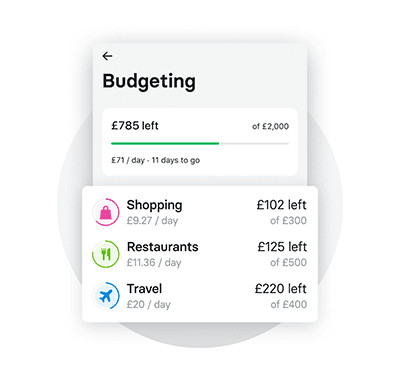
This progress bar visualizes savings goals, providing instant feedback and motivating users to keep working toward their financial targets through high mobile app engagement.
To encourage frugal spending or rainy-day savings, a progress bar shows how close you are to your limit or goal. Users can set their own targets, making the app feel more personal. By visualizing progress, users see exactly how much effort is still required, triggering a natural psychological drive for completion. In our experience, this "Zeigarnik Effect" where people remember uncompleted tasks better than completed ones is what keeps users checking the app daily.
Crucially, this feature creates active and loyal users. Customers will use Revolut every time they spend if they wish to keep accurate records and see those bars fill up. This habitual usage is the gold standard for mobile app engagement in the 2026 fintech landscape.
#5 Tiered loyalty programs reward mobile app engagement and create customer advocacy

Revolut's tiered card system is a classic example of a loyalty program that rewards mobile app engagement with exclusive perks, status, and premium features.
A tiered rewards program creates a hierarchy of users similar to a leveling system. Consumer research shows that 75% of people prefer brands that offer loyalty rewards. Why should users engage more with your app if the rewards don’t recognize the extra effort? In gamification, this harnesses the "constraint mechanic" certain elements are locked and must be earned through consistent mobile app engagement.
The results of this strategy are undeniable. According to financial reports from late 2024, Revolut’s revenue nearly doubled to over $2.2 billion, with pre-tax profits reaching a record $545 million. This growth is a direct testimony to the power of user-friendly, gamified finance. In 2026, building an engaging app isn't just a bonus it is the baseline for survival.
Enrich your own app with fun elements. You bring the data, we bring the tech! Check out our app gamification software.
Recap: Scaling with Mobile App Engagement
TL;DR: Revolut’s hyper-growth stems from treating its app as an engagement engine rather than just a utility. By leveraging gamification to turn users into advocates, Revolut grew its base by 38% in 2024, reaching over 52 million customers with a projected 67 million by the end of 2025. The secret? High mobile app engagement that drives profit margins through organic, low-cost customer referrals.
Fintech companies are upending banks as we know them. Digital-first banking adoption is accelerating exponentially as traditional institutions struggle to keep pace with modern UX expectations. The clear leader is Revolut which remains the benchmark for the fastest-growing tech companies in Europe heading into 2026!
Revolut is changing banking for the better
Today, digital banking has reached roughly 15% penetration of the adult population in key markets, reflecting a massive shift away from legacy branch banking. This growth is most visible in Gen Z and Millennial cohorts, where digital platforms are the primary financial hub. To capture this, Revolut chose to focus heavily on mobile app engagement.
The results speak for themselves. From 2023 to 2024, Revolut added nearly 15 million new retail customers, representing a 38% growth rate in a single year. In our experience, profit margins scale because engaged, loyal customers refer their peers at much higher rates, effectively doing the marketing for the brand. This lowers acquisition costs while tripling the value of the user base.
The 3 easy steps of how mobile app engagement creates growth
This is clearly illustrated in the 3-step expansion strategy for Revolut:
- Make an exciting app with gamification examples like points systems.
- Create daily active users that become customer advocates.
- Incentivize user referrals, led by your loyal customers!
Why is this so successful? User referrals remain the most valuable form of marketing! Research shows that 92% of people trust recommendations from friends and family. These referrals are "earned" by people who enjoy using the app something achieved through intentional gamification.
Consultancy firm Deloitte found that gamification can boost engagement by as much as 40%. In turn, gamification results in a 22% increase in customer loyalty! "In our experience analyzing fintech growth patterns, the shift from a 'utility app' to an 'engagement destination' is what separates market leaders from also-rans." This is the secret to a growing and active userbase.
5 gamification examples that boost the user experience
- A points system rewards loyal users and creates fun competition.
- Customization tools like avatars and theme selection give users control.
- Gamifying tasks incentivizes Junior account holders to achieve.
- Progress bars push users to save up a nest egg.
- Loyalty programs reward app engagement and create customer advocacy.
In short, Revolut has smartly adapted gamification for a Fintech context. The results are clear with a projected 67 million users by late 2025, the momentum of their revenue and user growth is set to dominate the landscape through 2026!
Gamify your app with your business goals in mind! Speak to our experts and see how gamification can help you.
.avif)
Related Posts

Drive Product Adoption in 2026: 10+ Expert Tactics
What is product adoption and why is it important? After user acquisition & activation it's your job to get users to fully adopt or embrace your product! How can you accelerate this? With a great user experience! Find out the metrics, stages & tactics in our ultimate guide to drive product adoption!

How Duolingo Uses Gamification to Improve User Retention (+ 5 Winning Tactics)
In 3 years Duolingo's revenue jumped from 13 million to 161 million. How? They made learning fun! Duolingo's lead product managers all speak to the effect of gamification and how it increased their user retention metrics. With over 42 million active users, Duolingo is claiming the learning app throne. In this article, we break down how they keep learners engaged and motivated. Take a look!