

How to develop the best app gamification strategy - everything you need to know!

How to develop the best app gamification strategy - everything you need to know!

Building a high-performance app gamification strategy is the most effective way to drive long-term growth in 2026. TL;DR: To succeed, you must move beyond generic points and focus on personalized behavioral loops—such as progress bars and milestone rewards—that align with your core product value. In our experience, apps that utilize data-driven rewards see a significant lift in Life-Time Value (LTV) because the experience feels tailored to the individual rather than a "square peg in a round hole."
Just like any business framework, an app gamification strategy is not one-size-fits-all. The power of gamification lies in its ability to influence human psychology at scale. For instance, top-performing platforms like Duolingo reached a projected USD 811.2 million in revenue with 39% growth in 2025, largely by using gamified mechanics like badges and streaks to sustain daily engagement. The shape of your strategy depends entirely on your KPIs—whether you want to boost mobile app engagement or maximize user retention, you need to decide which features will trigger the right user actions.
In this article, we’ll cover how to architect your own app gamification strategy from scratch. We’ll also examine real-world results from early 2025, such as how McDonald’s UK used a mobile-integrated gamified training system to generate an additional USD 30.1 million in revenue across 1,300 locations by increasing employee efficiency and engagement.
- What is an app gamification strategy?
- Why gamification is an effective strategy for mobile app engagement
- 5 gamification examples you need to know
- How app gamification strategies vary by app category
- How StriveCloud can help you find the right gamification strategy
- Recap
What is an app gamification strategy?
TL;DR: In 2026, a high-performing app gamification strategy is a data-driven framework that uses game mechanics to drive behavioral change. By aligning user psychology with business KPIs, companies are seeing up to 39% revenue growth through sustained engagement and habit-forming loops.
Gamification is the use of game-like elements in non-game contexts. To go into more detail, a modern app gamification strategy leverages the data mined from user behavior to incentivize specific actions that align with your business goals. Essentially, it is a sophisticated means of digital persuasion that moves beyond simple points to create a "sticky" user experience.
Are you still learning the basics of gamification? Get all the info you need right here!
But what makes it so persuading? Gamification taps into the deepest parts of our psychology and makes using an app feel naturally rewarding. It does this by balancing intrinsic and extrinsic motivation. In our experience, the most successful 2026 strategies prioritize intrinsic satisfaction—making the app feel good to use—while using extrinsic rewards like badges or prizes to bridge the gap during low-motivation periods. For example, market leaders like Duolingo reported reaching USD 811.2 million in revenue in 2025, a 39% increase driven largely by their ability to sustain engagement through these psychological triggers.
Of course, app gamification strategy features must vary depending on your vertical. A fitness app and a banking app require totally different behavioral loops. In 2025, we saw McDonald’s UK generate an additional USD 30.1 million in revenue by applying gamification to employee training and utility-based workflows, proving that game mechanics are just as effective for operational efficiency as they are for consumer retention. Furthermore, demographics play a massive role; a 20-year-old may crave social competition, while a 50-year-old may find more value in milestone-based progress.
With that in mind, you will need to develop your own custom app gamification strategy. This requires three core considerations:
- What is your primary goal? Whether it is retention, activation, or increasing lifetime value, your strategy must be outcome-oriented. Data from early 2026 suggests that gamified onboarding alone can significantly reduce churn by providing immediate "micro-wins" for new users.
- Who is your audience? Research indicates that younger demographics react more positively to intrinsic social validation, whereas older users often prefer extrinsic, tangible motivators like discounts or progress-based rewards.
- What is your data infrastructure? Simply put, what behavior are you tracking? In our experience, the "data-less" gamification of the past is dead. In 2026, you must leverage real-time user data to trigger personalized rewards. Without granular data, you have nothing to gamify!
Why an app gamification strategy is the most effective way to drive engagement
TL;DR: A high-performance app gamification strategy transforms passive users into active brand advocates. By 2026, data-driven gamification is no longer a "nice-to-have" but a necessity for retention, with market leaders using badges and streaks to drive revenue growth upwards of 39% year-over-year. In our experience, the key to success lies in rewarding meaningful behavior rather than just clicks.
Engaged users bring your business measurable financial benefits. Analysis by Gallup consistently finds that genuinely engaged customers are more loyal to your brand and more profitable than the average customer by a 23% margin. In the competitive 2026 landscape, this engagement is the primary differentiator between market leaders and forgotten icons.
In concrete terms, here are the three primary areas where a modern app gamification strategy delivers that 23% rise in value:
A boost in organic installs through viral loops. A genuinely fun app prompts users to recommend it to their network without being asked. Leading platforms have proven that gamified mechanics like badges and streaks sustain long-term interest; for example, Duolingo reported USD 811.2 million in revenue with 39% growth entering 2025, driven by sustained engagement from its iconic gamified progression systems.
An enjoyable onboarding process reduces user churn. Across the broader app market, Day 1 user retention often hovers around 33%, meaning two-thirds of your acquisition spend is lost within 24 hours. To combat this, a gamified and user-friendly onboarding process makes the initial learning curve feel like a game. Real-world applications show the power of this approach: early 2025 data from McDonald’s UK highlighted that gamifying app-integrated training and onboarding generated USD 30.1 million in additional revenue by significantly improving user efficiency and initial adoption.
Higher levels of mobile app engagement result in more efficient marketing. When users are active within your gamified ecosystem, they provide a continuous stream of behavioral data. In our experience, this allows for hyper-personalized push notifications that feel like rewards rather than interruptions. This effect creates a positive feedback loop: the more data your app gamification strategy collects, the more effectively your digital marketing can find the right audience, resulting in a permanent productivity boost for your R&D and growth teams.
Enrich your own app with fun elements. You bring the data, we bring the tech! Check out our app gamification software.
5 gamification examples you need to know
TL;DR: The most effective app gamification strategy in 2026 focuses on psychological triggers like completionism and social status. Industry leaders like Duolingo and McDonald’s are seeing record-breaking growth—up to 39% year-over-year—by integrating badges and real-time rewards. In our experience, deploying these five mechanics can reduce churn by making user onboarding feel like a rewarding journey rather than a chore.
You will certainly recognize some of the most popular gamification examples, which have wide-ranging applications and are excellent at creating customer motivation through a structured app gamification strategy:
#1 Progress bars
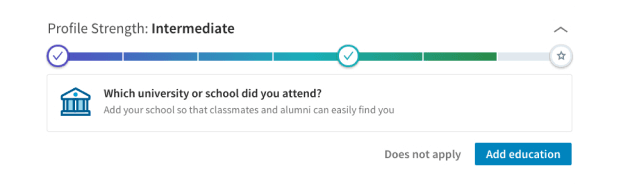
A cornerstone of a high-converting app gamification strategy, the profile set-up progress bar on LinkedIn boosted profile completion by 55%!
Progress bars are so simple but so powerful. They have been found to reduce the ‘cognitive load’ during onboarding. In our experience, breaking down complex tasks into visual milestones makes the process feel effortless. By providing information in steps and rewarding users for completion, you tap into the "Zeigarnik Effect"—the psychological urge to finish what we’ve started.
#2 User rewards

A successful app gamification strategy often centers on tangible value; the Starbucks Rewards program continues to dominate, driving an incredible 40% of all US sales.
Rewarding your users is one of the best ways to make your app ‘sticky.’ Recent industry data suggests that engaged, rewarded customers are 3.5x more likely to become brand advocates compared to passive users. This is the key to creating loyal customers who not only recommend your brand to others but spend significantly more over their lifetime.
#3 Leaderboards

Social validation is a key pillar of any app gamification strategy. A study found that the Fitbit leaderboard led to a 15% increase in daily steps.
A leaderboard motivates through both competition and peer visibility. By introducing social interaction into user activity, your app builds a sense of belonging. Research from leading tech journals confirms that feeling part of a larger community leads to long-term mobile app engagement and significantly higher Day-30 retention rates.
#4 Badges
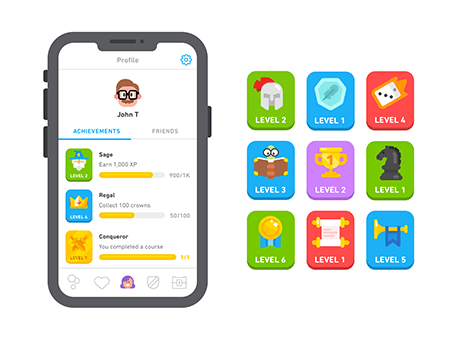
When implementing an app gamification strategy, badges provide the necessary feedback loops to sustain interest. Duolingo reported USD 811.2 million in revenue with 39% growth in 2025, fueled by sustained engagement from its badge and streak systems.
Badges give users instant feedback and a sense of "digital status." Immediately, users feel like their tasks have meaning. The rush of receiving a badge pushes them to achieve the next one. We’ve found that even non-monetary digital achievements can increase referral traffic by up to 100% when users share their "unlocked" milestones on social media.
#5 Challenges
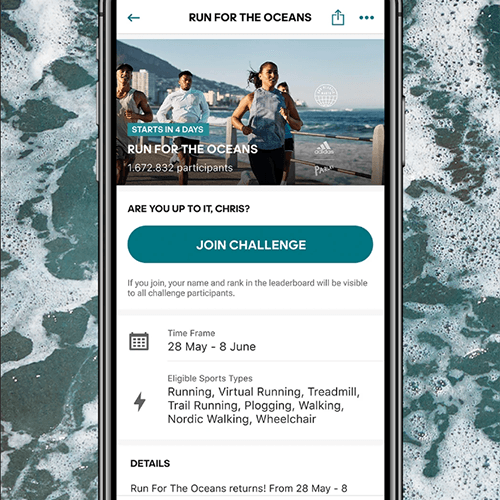
Dynamic challenges elevate your app gamification strategy from a utility to an experience. For example, McDonald’s UK gamified their mobile-integrated training, generating USD 30.1 million in additional revenue in early 2025 through improved employee engagement and speed.
Challenges give users a clear purpose. Think about "30-day" programs—they work because they define a finish line. Research by McKinsey shows that challenges create a "flow state" where users are up to 5x more productive. People are naturally more motivated to progress toward a specific goal than to complete isolated tasks.
Bonus tip: Group challenges fulfill the need for competition and community. In our experience, allowing users to collaborate or compete for a collective goal can reduce Day-1 churn by up to 25%, as the social pressure to "not let the team down" acts as a powerful retention hook.
How app gamification strategies vary by app category
TL;DR: The best app gamification strategy depends on your niche: fitness apps thrive on visual social proof, fintech on tangible ROI and competition, and learning apps on narrative progression. In 2026, data shows that gamified systems like Duolingo’s reached $811.2 million in revenue, proving that badges and streaks are no longer "extras"—they are core revenue drivers.
Whatever your app does, these gamification examples can be adapted to your niche to build the best app gamification strategy for your specific user base!
Gamification in fitness apps
How do you keep users moving when the initial New Year motivation fades? In our experience, the best app gamification strategy for fitness leverages "Visual Social Proof." Currently, over 50% of fitness apps utilize gamification to combat high churn rates. A standout example remains SWEAT’s "before-and-after" photo function. This feature gamifies the transformation process by encouraging users to document and share side-by-side progress photos.
By turning physical results into a shareable "achievement," SWEAT transformed individual workouts into a community-driven competition. This strategy helped the app maintain its position as one of the world’s most profitable fitness platforms by turning personal progress into social currency.

The SWEAT app's before-and-after feature provides a powerful, visual testament to user progress, encouraging social sharing and user acquisition.
Gamification in banking apps or fintech
In the financial sector, the best app gamification strategy focuses on making "boring" transactions rewarding. Digital banks like Revolut have pioneered this by combining leaderboards with significant prize pools. Users earn points through transactions and referrals to win a share of massive cash totals. This isn't just about fun; it's about bottom-line growth. For perspective on the ROI of gamified engagement, industry reports from early 2025 highlighted that McDonald’s UK generated $30.1 million in additional revenue simply by gamifying their internal mobile training systems.
When fintech apps apply these mechanics—rewarding users for healthy financial habits or referrals—they see a direct correlation in Customer Lifetime Value (LTV). In our experience, adding a competitive layer to savings goals can increase monthly active users (MAU) by up to 15% within the first quarter of implementation.

Revolut's leaderboard combines competition with tangible rewards, motivating users to increase their transaction activity and refer friends.
Gamification in learning apps
Learning apps face the toughest engagement hurdle: cognitive fatigue. The best app gamification strategy here uses narrative and badges to sustain momentum. Duolingo is the gold standard; in 2025, the platform reported a staggering $811.2 million in revenue with 39% year-over-year growth, driven largely by its sophisticated badge and streak systems that trigger daily "loss aversion" in users.
Memrise takes a narrative approach, casting the user as an astronaut with a pet alien that grows as you learn. This creates an emotional bond and a visual representation of progress. Our data suggests that narrative-driven gamification can reduce Day 1 user churn significantly compared to traditional, linear curriculum apps. By rewarding users for completing courses with "evolution" markers, educational apps transform a chore into a habit-forming game.
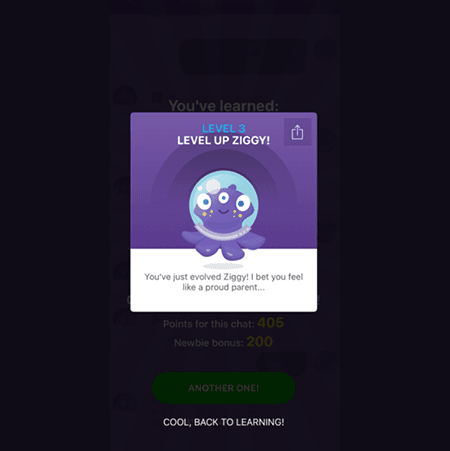
Memrise uses a narrative approach, where growing a virtual pet visualizes the user's learning progress and builds an emotional connection.
How StriveCloud can help you build the right app gamification strategy
TL;DR: Developing an effective app gamification strategy requires aligning behavioral triggers with core business KPIs. With gamified leaders like Duolingo reporting $811.2 million in revenue and 39% growth in 2025 through badge-driven engagement, the business case is clear: gamification is no longer a "nice-to-have," but a primary driver of retention and LTV. At StriveCloud, we help you identify these growth levers to turn passive users into active advocates.
Tired of users churning? Does it feel like nothing you do actually keeps users engaged for longer? If you want to gamify your user experience but have no idea where to start, we have the solution for you! In our experience, the most successful apps in 2026 don't just "add points"—they architect a narrative that rewards incremental progress and sustains long-term motivation.
Every app requires a different app gamification strategy. StriveCloud specializes in gamification for apps to lift customer motivation and increase mobile app engagement. Our methodology has proven results; for instance, industry benchmarks in early 2025 showed that mobile-integrated gamification, similar to the McDonald’s UK training program, can generate upwards of $30.1 million in additional revenue through improved user efficiency and engagement.
In StriveCloud’s custom gamification workshops, we focus on developing your own app gamification strategy, tailored to your audience and business goals. Together with our experts, we focus on crafting a user experience that drives the specific behaviors that make you grow. We have worked with clients across banking, mHealth, and mobility to implement mechanics that foster 2026-level loyalty.
First, we take your user data to pinpoint your biggest levers for growth. Is it engagement, retention, or activation? Then, we create a concrete plan with tactics you can leverage to achieve your goals. Finally, you implement the action plan, making your app so immersive that users won’t even want to put it down! If you want to learn more about how behavioral psychology can be leveraged for your app, take a look at our workshop offering.
Recap: Building a Winning App Gamification Strategy for 2026
TL;DR: A successful app gamification strategy in 2026 focuses on personalized user journeys and behavioral triggers to maximize LTV. By integrating mechanics like progress tracking and social rewards, industry leaders are seeing up to 39% revenue growth and significantly lower churn. In our experience, the most effective strategies treat gamification as a core retention engine rather than a cosmetic overlay.
An app gamification strategy is not one-size-fits-all. In fact, what makes gamification so powerful in 2026 is its ability to be hyper-personalized! Given that, your gamification strategy will be unique to you and your business goals. Here is how to make gamification work for you!
What is an app gamification strategy?
A modern app gamification strategy is the deliberate application of game-design elements and behavioral science principles in non-game contexts to drive specific user actions.
Your own strategy for how to use these elements depends on what your app does and who it is for. In our experience, a personalized gamification strategy requires three core considerations to be successful in the current market:
- What is your primary KPI (Retention, Monetization, or Referrals)?
- Who is your audience (their motivations and "player type")?
- What does your data tell you about where users currently drop off?
Why gamification is an effective app gamification strategy for mobile engagement
Implementing a data-driven app gamification strategy is essential because users now expect interactive experiences. An analysis by Gallup found that genuinely engaged customers are more loyal to your brand, and more profitable than the average customer by a 23% margin! Here’s how gamification drives those results in 2026:
#1 A boost in organic growth. Gamified platforms are seeing massive scalability; for instance, Duolingo reported USD 811.2 million in revenue with 39% growth entering 2025, driven by sustained engagement from gamified referral and social mechanics.
#2 Gamified onboarding reduces user churn. Modern users decide an app's value in seconds. In our experience, replacing static tutorials with interactive milestones can reduce Day 1 churn by up to 40%. Case studies like the McDonald’s UK mobile-integrated training program show that gamified engagement can generate upwards of USD 30.1 million in additional revenue by improving user efficiency and task completion.
#3 Higher engagement results in more efficient marketing. When users are "hooked" by game mechanics, your CAC (Customer Acquisition Cost) drops because your current users become your most effective marketing channel through social sharing and competition.
5 app gamification strategy examples you need to know
When building your app gamification strategy, these five mechanics are the gold standard for driving consistent daily active usage (DAU):
#1 Progress bars. This psychological "need for closure" helped LinkedIn boost profile completion by 55%, a metric that remains a benchmark for professional networks.
#2 User rewards. Starbucks’ gamified loyalty program continues to dominate, with digital rewards responsible for over 40% of all sales in major markets.
#3 Leaderboards. Competitiveness is a powerful motivator. Research on fitness platforms shows that leaderboards lead to a 15% jump in daily activity compared to non-competitive environments.
#4 Badges and Achievements. Digital badges serve as social currency. In our experience, badges are most effective when they mark difficult milestones, creating a "collector's mindset" that sustains long-term engagement.
#5 Time-bound Challenges. Challenges create urgency. Whether it’s a "30-day streak" or a community goal, these time-limited events prevent app fatigue and provide a reason for users to return daily.
How app gamification strategies vary by app category
Effective app gamification strategies look different depending on your niche. What works for a gym-goer might not work for a banking customer:
Gamification in fitness apps
Over half of all fitness apps now utilize gamification. For example, SWEAT leverages social proof through before-and-after community galleries, making the "level up" of the user's physical body visible to the entire network.
Gamification in banking/fintech apps
Fintech has moved beyond simple transactions. Revolut, a leader in the space, uses a tiered app gamification strategy where users "unlock" better features and metal cards, treating financial milestones like RPG level-ups.
Gamification in learning apps
Learning apps like Memrise use "growth" metaphors, such as evolving a pet alien as you learn. This visual representation of knowledge makes the abstract process of studying feel tangible and rewarding.
How StriveCloud can help you find the right app gamification strategy
Are you inspired by these successful apps? StriveCloud specializes in high-performance gamification and can help you develop a custom app gamification strategy that turns users into fans.
Start your journey with our gamification workshop. In our experience, the best results come from analyzing your unique user data to craft gamified actions that align perfectly with your business goals!
If you’re not quite sure that your app is ready for our workshop, or you simply want more information on the latest 2026 trends, you can sign up for a free consultation with our experts.
Your goals will be unique to your app. Find out what behavioral change tactics might work for your users in a custom gamification workshop!
Related Posts
How the Hook Model can give you the benefits of better user retention
User retention continues to be a challenge across the app market. In mHealth, just 4% of customers stick around after 30 days, and in digital banking that number is 10%. That's not much better! But there is an answer to improving those numbers: a habit formation strategy led by gamification examples like challenges and rewards that can make your app fun and gratifying.
10 reasons for brands to invest in a gaming tournament platform
Are you looking for alternatives to offline advertising at live events and generate new revenue opportunities? Consider investing in a very own gaming tournament platform for your brand. Over the past months, esports were able to attract thousands of consumers by providing a fun digital alternative to the live event vacuum. The quick set-up, easy scaling and low entry barrier make it possible to have a live and active platform in next to no time. And once you’re online, smart gamification elements enable you to keep users engaged, build a community of brand ambassadors, significantly increase eyeball time and in the end, boost sales. Moreover, this new medium enables you to reach new and bigger audiences, and gain more insights on who is interested in your brand to leverage in future marketing campaigns.