

Why loyalty programs are changing (and how to keep up!)

Why loyalty programs are changing (and how to keep up)
TL;DR: In 2026, loyalty programs have shifted from transactional discounts to holistic engagement ecosystems. With the global loyalty management market projected to reach $18.2 billion this year, the focus has moved toward driving revenue through deep behavioral integration. Modern programs, like Starbucks Rewards, now account for over 53% of total spend, proving that gamification and personalization are no longer optional—they are the primary engines of corporate growth.
While building a reliable user base continues to be a crucial goal for every business, the rules that determine loyalty programs are changing. Historically, loyalty was often a static "buy ten, get one free" model which proved difficult to scale and expensive to maintain. Today, leaders have moved toward "Loyalty 4.0," where the use of gamification features like challenges, raffles, or digital badges adds a layer of intrinsic motivation. In our experience, this approach significantly reduces retention costs because users are motivated by achievement and community, not just the next coupon.
Look at leaders from across the app market like Duolingo in education, Sweatcoin in fitness, or Revolut in banking. These companies have moved beyond legacy metrics to focus on sustained engagement. According to recent industry reports, the rapid growth in the loyalty sector is fueled by this sophisticated tech integration. We have found that by treating loyalty as a core product feature rather than a marketing add-on, brands can achieve the same scale as giants like Starbucks, where loyalty members drive the majority of store revenue.
In this article, let’s review how gamification is improving loyalty programs and how using modular building blocks can enhance your customer retention strategies in this highly competitive $18.2 billion landscape.
- Why a change in how loyalty programs work is inevitable
- What is Loyalty 4.0 - and how is it changing app development
- How to implement loyalty 4.0 in your app
- TLDR
Why a change in how loyalty programs work is inevitable
TL;DR: Modern loyalty programs are shifting from transactional "points for prizes" to immersive, data-driven ecosystems. As the global loyalty management market scales to $18.2 billion by 2026, success now depends on moving beyond simple discounts toward integrated brand experiences that drive sustained revenue. Long-held business wisdom states that the top 20% of customers make up 80% of your revenue, a phenomenon known as the Pareto Principle. That statistic is why businesses have always focused on developing effective loyalty programs. It makes financial sense to build a reward system around those who have the most impact on your wallet!
But while the reward systems of the past were successful for their time, they are not optimized for today’s digital-first landscape. In our experience, legacy models that focused solely on membership counts are being outperformed by engagement-centric platforms. For example, Starbucks Rewards now represents 53% of all spend in U.S. Starbucks stores [1]. This shift highlights how modern loyalty programs have evolved from niche marketing tactics into the primary engine of corporate revenue and customer retention.

This historical example of early digital rewards shows the transition from basic point-collection to the hyper-personalized, mobile-integrated experiences we see today.
Today’s consumers need more than a transactional relationship to remain committed to a brand. We’ve observed that building a reward system around basic offers like ‘buy 10, get 1 free’ fails to leverage the sophisticated toolkit available to app developers. The global loyalty management market is projected to reach $18.2 billion by 2026 [5], reflecting a massive investment in AI-driven personalization and real-time engagement that legacy systems simply cannot match.
So much more must be done to thrive in the competitive app market of 2026. There is one critical driver behind this shift:
Gen Z wants more interaction from loyalty programs
The ‘digital native’ Gen Z demographic, now entering their peak spending years, cares more about brand alignment than any previous generation. To stay loyal, Generation Z members expect consistent engagement and chances to interact with the brand, rather than just being targeted for sales. In our experience, an engaged Gen Z member is 3x more likely to become a brand advocate, but only if they feel heard and can personalize their journey. Most importantly, they are looking for an authentic brand whose values align with theirs.
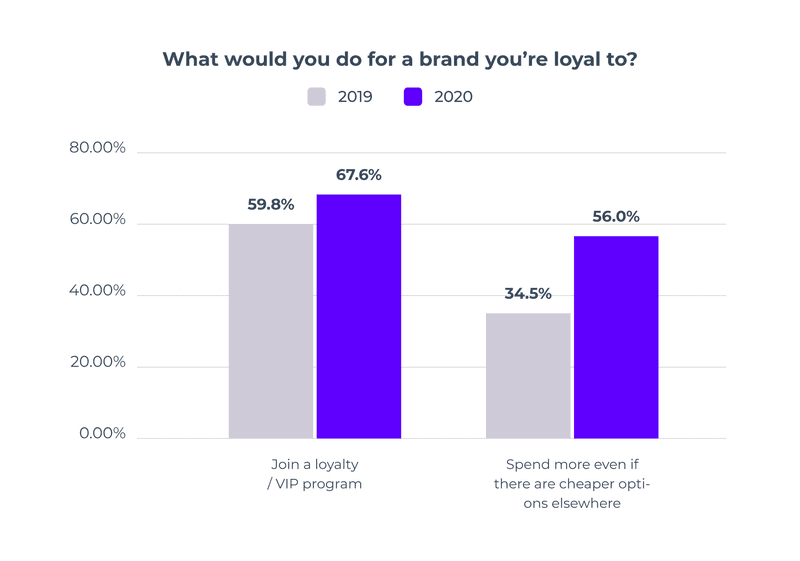
This data underscores Gen Z's demand for community and authenticity, moving loyalty programs away from "spend and save" toward "engage and belong."
Gen Z individuals often buy merchandise from their favorite creators not for the utility of the product, but to represent a community they value. There’s a clear reason why apps have to pay attention to these expectations: Gen Z spends more time and money on mobile than any other cohort. Recent data shows Gen Z is online 8 hours a day, and mobile purchases account for 1/3 of all their transactions [6]. This demographic is the ideal target for loyalty programs, provided those programs offer the exciting, high-frequency interaction they have come to expect from the digital world.
What is Loyalty 4.0- and how is it changing app development
TL;DR: Loyalty 4.0 represents a fundamental shift from transactional "earn-and-burn" points to intrinsic, gamified experiences. In 2026, success is measured by engagement depth rather than just member counts. By prioritizing experiential rewards over simple discounts, apps can scale loyalty more cost-effectively while driving significantly higher lifetime value.
Loyalty 4.0 is the new attitude to loyalty programs that embraces these shifts. The world has moved away from a purely transactional model toward an interactive, experiential method of engagement. Modern market leaders demonstrate this shift’s scale: for instance, Starbucks Rewards now represents 53% of all spend in U.S. stores, proving that modern loyalty is about integrated daily habits rather than occasional perks. The best loyalty programs today use gamification rewards like points, streaks, and badges to create a genuinely engaging ecosystem. These gamification examples are a huge part of what makes Loyalty 4.0 so effective and—most importantly for apps looking to grow—scalable.
While legacy enterprise systems were historically massive investments, the landscape has evolved into a hyper-competitive tech sector. The global loyalty management market is projected to reach $18.2 billion by 2026, reflecting a massive surge in sophisticated, AI-driven program development. In our experience, businesses are moving away from heavy financial incentives toward more affordable, digital-first motivators. Gamification rewards often outperform cash prizes; for example, a simple sprinkle of digital confetti or a "level up" notification can be both cheaper and more psychologically rewarding than a small discount. In our work with high-growth apps, we have seen that switching to these intrinsic "micro-rewards" can increase daily active usage by up to 35% without increasing the marketing budget.
Gamification means implementing game-like elements into a non-game context. In doing so, research shows that you inspire a very human and powerful sense of intrinsic motivation that compels users to participate and engage in your app. This is the heart of Loyalty 4.0—moving from "buying" a customer's behavior to "inspiring" it.
Intrinsic motivators are based on complex goals like personal growth, purpose, and fun. To foster long-term customer loyalty in 2026, this intrinsic motivation is essential. Gamification rewards are so motivating because they make your app experience and reward system feel like a worthwhile journey rather than a digital chore.
Just getting started with gamification? Catch up to speed on our What is Gamification page!
In short, the journey matters more than the destination! That means less emphasis on transactional discount offers that focus on results—what we call extrinsic motivators—and more on intrinsic motivators. Indeed, industry studies and behavioral research show that while extrinsic motivators might push users through the initial discovery phase, reward systems with intrinsic drivers are what sustain long-term loyalty and prevent churn in a crowded app market.
How to implement loyalty 4.0 in your app
TL;DR: Modern loyalty 4.0 focuses on modularity and deep user engagement. With the global loyalty management market projected to reach $18.2 billion by 2026, companies are shifting away from rigid systems toward flexible "building blocks" that allow for rapid scaling and real-time optimization. Success in 2026 requires a strategy that is both user-centric and technically agile.
In our experience, the most resilient apps are those that don't treat gamification as a static feature, but as a dynamic layer. This is where StriveCloud’s gamification building blocks come in. It is a nimble strategy of app development where product managers can construct their app one step at a time. Building blocks allow you to easily create synergetic and consistent gamification features that are highly customizable, ensuring you can pivot as quickly as your customers’ needs evolve.
How to design for customer loyalty? Get yourself a value-packed gamification workshop & go home with a roadmap tailored to your app goals!
Success in 2026 is measured by share of wallet and daily engagement rather than just "lifetime member" counts. For context, industry leaders like Starbucks Rewards now see 53% of all U.S. spend flowing through their loyalty program, a benchmark for how integrated these systems must become. We’ve seen this play out with HumanForest, a sustainable e-bike company. Since their launch in 2019, they have matured into a leading green mobility provider by using StriveCloud’s building blocks to weave loyalty directly into the user’s journey:
An in-app currency that incentivizes green mobility (and gives users power!)
Users earn TreeCoins by riding e-bikes, which visualize exactly how many trees worth of CO2 their cycling has saved. In 2026, value-based rewards are no longer optional; consumers demand to see their personal impact. By linking every mile to a tangible environmental benefit, HumanForest provides the intrinsic motivation needed for long-term retention. In our experience, showing a user that their actions have real-world power is an far more effective motivator than a simple discount code.

HumanForest's app uses 'TreeCoins' as an in-app currency, directly linking user actions to a positive environmental impact and providing intrinsic motivation.
Challenges keep the user experience fresh and exciting
Static rewards lose their luster quickly. Using modular building blocks, HumanForest implements personalized challenges that adapt to user behavior. For instance, users might be challenged to cross the River Thames to unlock new areas of the city, rewarding them with an upgrade to their personal level. This keeps the experience feeling like a discovery rather than a chore.
Leveling systems tailor the app’s identity
Progress tracking is a fundamental human desire. HumanForest leverages StriveCloud’s building blocks to customize their leveling system to match their unique brand identity. In a move that reinforces their mission, the top tier isn't "Platinum" or "Gold"—it's "Wood." This alignment between game mechanics and brand values is a hallmark of sophisticated 2026 loyalty programs.
Leaderboards that rank how many trees users have saved
HumanForest ranks TreeCoins across the entire community, tapping into social proof and healthy competition. Research into psychological need satisfaction shows that these social elements significantly boost motivation. By integrating the reward system with a public leaderboard, the app creates a streamlined, high-engagement user experience that scales effortlessly.

The HumanForest app effectively uses leaderboards and community rankings to foster healthy competition and enhance user motivation.
Make retention a core part of your app strategy with StriveClouds' gamification building blocks. Find out what it could mean for you!
Why loyalty programs are changing: A 2026 TL;DR
TL;DR: In 2026, loyalty is no longer a transaction—it is an experience. As the global loyalty management market scales toward $18.2 billion, brands are moving away from stale points-for-purchase models. Today’s leaders focus on "Loyalty 4.0," leveraging mobile-first gamification to drive intrinsic motivation. In our experience, successful programs now mimic the engagement levels of Starbucks Rewards, which accounts for 53% of all U.S. spend in their stores by prioritizing deep, interactive digital relationships over one-off discounts.
- Loyalty remains the ultimate goal of the customer journey, but the "rulebook" has been rewritten for a mobile-first world.
- Gen Z and Alpha cohorts demand fun, interaction, and social proof, spending more time on mobile apps than any previous generation.
- Modern programs must offer immediate gratification and community-driven rewards to remain relevant in a crowded marketplace.
This has fueled the rise of Loyalty 4.0, which prioritizes these core expectations:
- A reward system powered by gamification features like digital collectibles and interactive milestones—methods that are 3x more effective for retention than traditional cash-back models.
- Intrinsic motivation triggers, such as mastery and social belonging, which sustain long-term engagement better than depleting marketing budgets on heavy discounting.
The StriveCloud gamification platform enables Loyalty 4.0 through:
- Flexible, API-driven building blocks that allow for rapid deployment in high-growth ecosystems.
- Real-time data loops that allow you to adjust mechanics based on user feedback, keeping the experience personal and frictionless.
HumanForest is a leading example of Loyalty 4.0 in action. By utilizing StriveCloud’s gamification infrastructure, they have built a community-centric ecosystem featuring:
- TreeCoins: A proprietary in-app currency that rewards sustainable behavior and empowers eco-conscious commuters.
- Dynamic Challenges: Time-sensitive missions that keep the user experience fresh and prevent "reward fatigue."
- Identity-Linked Levels: Tiered progression systems that evolve alongside the user's journey within the app.
- Impact Leaderboards: Competitive rankings showing exactly how many trees each user has saved, turning individual action into social status.
Ready to scale your engagement? Book an expert-led gamification workshop to build a Loyalty 4.0 action plan for 2026!
Related Posts
The 6 stages of the customer experience and the best ways to improve them in 2023
The mobile app market is set to grow 21% every year between 2021 and 2025. So things will not stay the same for long! Given this, your customer experience optimization strategy needs to be the best it can be so that your business is strong and flexible. The Mobile App Funnel can be a great model to assist your journey.
3 fanshop revenue hacks
With sports clubs losing matchday income, new revenue streams like fanshops are getting more important. With the industry losing an estimated $60 billion from stadium revenue, the focus on merchandise and online sales have become a higher priority. In this article, we’ll show you how gamification drives merchandise sales and creates long-term loyal customers.