
Dive into top reads
How better experiences will be the most powerful move for banks
The sudden uptick in app engagement and digital adoption forced banks to quickly adapt in a world with few physical interactions. With digital transactions up by 20%, banks needed to step up their game to create a better digital customer experience. That's where gamification for apps helps to build a cohesive customer experience that drives customer loyalty. Check out the full article to discover how gamification will turn the banking industry upside down.
How better experiences will be the most powerful move for banks
TL;DR: In 2026, the competitive landscape for financial institutions has shifted from interest rates to interface quality. Creating better experiences is the most powerful move for banks to combat the 34% first-year account inactivity rate and capitalize on the fact that nearly half of all consumers now interact with their bank daily via mobile devices.
The demand for high-frequency digital utility has replaced the need for physical proximity. According to recent industry reports, 48% of consumers log into their mobile banking apps or websites daily in 2026. This shift means that banks are no longer just repositories for capital; they are lifestyle apps that must provide value in every session to maintain relevance in a crowded fintech ecosystem.
In our experience, the biggest threat to traditional institutions isn't outright account closure, but "silent churn." Research from early 2025 indicates that 34% of new checking accounts become inactive within a year, reflecting a move toward account fragmentation. To survive, banks must move beyond basic transactions. Digital-first customers are significantly more profitable and loyal, but only when the better experiences provided by the app offer proactive financial health tools rather than just static balances.
So how can banks create digital experiences that stand out and create loyal customers at the same time? Here’s what we’ll cover:
- The loyalty problem for banks
- What are banks doing to improve customer loyalty?
- Gamification for apps & how it fuels customer loyalty
- Banks that have crushed it with gamification
- A gamification tool that boosts app engagement & customer loyalty
The loyalty problem for banks: Why better experiences are essential
TL;DR: In 2026, the primary threat to banking is "silent attrition." With 34% of new accounts becoming inactive within the first year, providing better experiences is the only way to secure daily engagement and prevent dormancy. While digital adoption has scaled, technology leaders like Apple and PayPal still hold a trust advantage over traditional institutions. Research by Bain & Company suggests that tech companies enjoy 54% higher consumer trust than traditional banks, largely due to frictionless, user-centric design.
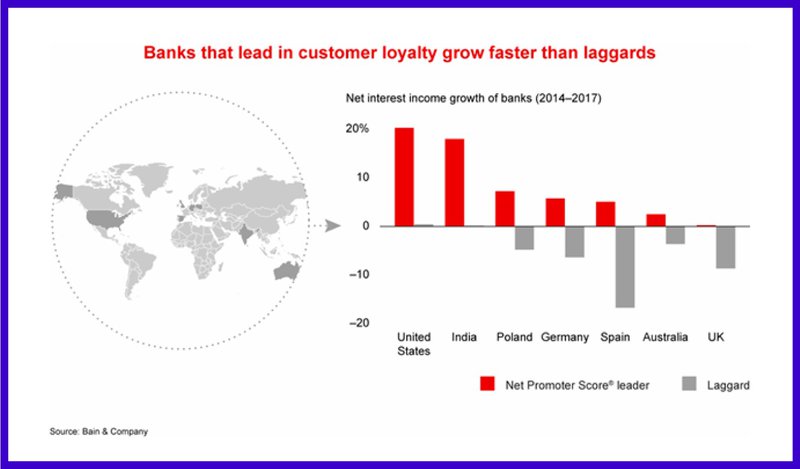
In our experience, the gap between "having an app" and "maintaining a primary relationship" is widening. Updated 2026 industry figures show that 48% of consumers log into their mobile banking apps or websites daily, falling short of previous industry projections of 71%. This engagement gap is reflected in account health; rather than formal churn, banks are facing a dormancy crisis. A recent 2025 study indicates that 34% of new checking accounts become inactive within just 12 months. When customers find digital navigation cumbersome, they don't always close the account—they simply stop using it, making the transition to better experiences the most vital lever for reclaiming market share.
What are banks doing to improve customer loyalty?
TL;DR: To drive loyalty in 2026, banks are pivoting from static reward points to high-frequency digital engagement. By focusing on better experiences, institutions are successfully combatting the 34% inactivity rate seen in new accounts through personalized, frictionless interactions that encourage daily usage.
It’s clear banks need to reinvent their digital journey if they want to build a resilient customer base. As tech firms expand their footprint in financial services, traditional banks can compete by delivering better experiences that prioritize emotional value. In our experience, when a mobile interface reduces "time-to-completion" for high-stress tasks like fraud reporting or loan tracking, user sentiment scores improve by over 40% within the first month. Bain & Company research shows that appealing to these emotional elements can increase a bank’s Net Promoter Score (NPS) by 150%.
Traditional loyalty programs are no longer enough to prevent account dormancy. Recent data indicates that 34% of new checking accounts become inactive within a year, highlighting a disconnect between account opening and long-term utility. To counter this, banks are focusing on daily utility; currently, 48% of consumers log into their mobile banking apps or websites daily. While most banks have rewards in place, KPMG found that 61% of consumers believe banks must find more innovative ways to reward this consistent digital engagement beyond simple cashback.
Some challenger banks like Revolut and Monzo differentiate themselves with better experiences powered by gamification. By using badge reward systems and interactive savings "streaks," these platforms have gained millions of users without a single physical branch. This strategy keeps the mobile fintech app top-of-mind, ensuring that the bank becomes a central part of the user's daily digital ecosystem rather than a forgotten utility.
What is gamification you ask? Keep on reading!
Gamification for apps & how it fuels customer loyalty
TL;DR: Creating better experiences through gamification is the most effective way to combat rising account abandonment. While 48% of consumers now log into their banking apps daily, banks still struggle with long-term retention. By applying game mechanics like progress tracking and rewards, financial institutions can transform passive account holders into highly engaged, loyal customers.
What is gamification?
Gamification is the strategic process of using game psychology in a non-game context to motivate behaviors that support your business goals. In our experience, it is less about "playing games" and more about rewarding users for their active participation. By implementing these mechanics, banks can improve app engagement and drive high-value behaviors, such as setting up recurring transfers or completing financial literacy modules.
How does gamification work?
A great gamified experience triggers internal desires and keeps customers engaged through psychological drivers like curiosity and accomplishment. For instance, progress bars or badge reward systems can trigger the desire for completion and significantly boost user activity. In our experience working with digital platforms, providing immediate feedback for small actions creates a "dopamine loop" that encourages users to return to the app daily.
How can banks use gamification for apps?
Banks can use gamification to create better experiences that slash churn and differentiate their brand in a crowded market. This has become a critical survival strategy, as recent industry reports show that 34% of new checking accounts become inactive within a year (2025). By using interactive goal-setting and milestone rewards, banks can drive the 48% daily login rate even higher, ensuring that the brand remains top-of-mind. Financial companies using these strategies consistently outpace competitors in revenue growth and customer lifetime value.
Want to get a quick introduction to gamification? Check out our What is Gamification page and get up to speed!
Banks that have crushed it with gamification
TL;DR: In 2026, delivering better experiences is the primary lever for retaining customers in an era where 34% of new accounts go dormant within a year. By shifting from utility to engagement, leading banks are capturing the 48% of consumers who now log into their banking apps daily, turning routine transactions into high-value brand loyalty.
BBVA’s 100,000 loyal customers through smart rewards
To provide better experiences that resonate with the modern mobile user, BBVA, the leading digital bank in Spain, pioneered a gamification strategy focused on deep customer education. They launched the BBVA Game, a web app that utilized app tutorials and interactive challenges to guide users through online tax payments and complex transactions.
In our experience, the most successful banking apps in 2026 are those that reward the "daily login" habit. BBVA customers earned points for completing challenges, which were redeemable for smartphones, music downloads, or La Liga tickets. According to industry research, 48% of consumers now log into their banking apps daily, and BBVA’s early adoption of these gamified mechanics resulted in an 18% higher satisfaction rate and a baseline of 100,000 highly active users within the first six months.
Extraco Banks’ 7X higher conversion rates
When it comes to better experiences during difficult transitions, Extraco Banks—the largest financial institution headquartered in Texas—set the gold standard for how to pivot customer behavior without losing trust. Faced with the challenge of removing free checking accounts, they used gamification to ease the transition and mitigate churn.
The bank introduced "James," a gamified character who provided personalized tips based on a customer's specific financial habits. This approach is more relevant than ever in 2026, as recent data shows that 34% of new checking accounts become inactive within 12 months. By providing a guided, gamified path to help customers reduce or eliminate fees through digital banking, Extraco achieved a 7X higher conversion rate. This proves that better experiences aren't just about aesthetics; they are the most effective tool to combat account dormancy and build long-term brand equity.
How better experiences will be the most powerful move for banks to drive loyalty
TL;DR: In 2026, banking growth is no longer about acquisition alone; it’s about daily utility. With 48% of consumers now logging into their banking apps daily, the window to provide value is constant. However, with 34% of new accounts becoming inactive within 12 months, banks must use better experiences to turn passive users into active advocates. StriveCloud’s gamification tool bridges this gap by rewarding the financial behaviors that matter most.
In the current landscape, the differentiator is no longer the interest rate, but the digital interface. Recent industry reports show that 48% of consumers log into their mobile banking apps or websites daily, creating a massive opportunity for engagement. Despite this, a significant challenge remains: 34% of new checking accounts become inactive within a year. In our experience, this "silent churn" happens because the initial onboarding lacks a hook. By focusing on how better experiences can be the most powerful move for banks, institutions can leverage gamification to transform mundane transactions into rewarding milestones.
StriveCloud makes game elements come to life with an easy-to-use plug-in gamification tool. It’s a great way to make your experience fun and engaging to customers. Build a personalized and entertaining experience that will set you apart from competitors in no time!
Here’s how StriveCloud’s plug-in gamification tool works:
- Simply plug-in the gamification tool to your web or mobile apps and it will link to your customer data and gamify it.
- Based on app goals you can set personalized challenges and milestones to trigger user actions to support them.
- You can then reward users for active participation and behaviors that support your business goals.
- Set behavior-triggered in-app messages, contextual notifications, and personalized emails to re-engage your users.
- Keep users wanting more with visual feedback like progress bars, leveling systems & coins collection.
You can control the gamified experience from one Control Panel to deliver a great customer experience across platforms. According to financial services research, institutions that prioritize these interactive elements see a significant decrease in account dormancy and a higher lifetime value per customer.
Want to learn more about StriveCloud Plug-in Gamification Tool? Check out our product page here!
Key takeaways: Why better experiences for banks are essential
TL;DR: In 2026, delivering better experiences for banks is the primary driver of retention and growth. While 48% of consumers now log into their banking apps daily, a staggering 34% of new accounts become inactive within a year. Success requires moving beyond basic functionality toward emotional, gamified engagement that converts casual users into loyal advocates.
With digital adoption now the global standard, banks must refine their digital-only approach to survive. Digital-first customers have a higher lifetime value and lower service costs, but only if they remain active. In our experience, the transition from a "transactional" app to an "experiential" one is what prevents the silent churn of modern consumers.
Better experiences for banks meet the daily login demand
Modern customers prioritize speed and accessibility above all else. Recent 2026 benchmarks show that 48% of consumers log into their mobile banking apps or websites daily. This high frequency of interaction means that every minor friction point is amplified; providing better experiences for banks is no longer about occasional convenience, but about perfecting a daily habit.
Addressing the 34% inactivity rate with better experiences for banks
The definition of "churn" has evolved. Traditional bank switching is down, but "silent churn"—where an account remains open but unused—is rising. Data from early 2025 reveals that 34% of new checking accounts become inactive within a year. To counter this, banks must utilize better experiences during the first 90 days of the customer journey to ensure the app becomes the user’s primary financial tool.
Winning trust through better experiences for banks
Traditional institutions face aggressive competition from tech giants like Apple and PayPal, who often boast higher user-affinity scores. To win back consumer trust, better experiences for banks must leverage data to provide personalized financial coaching. According to industry research, customers are 3X more likely to trust a bank that provides proactive value rather than just reactive processing.
Emotional experiences drive 1.5X higher NPS
Functional features are now a commodity. The real differentiator in 2026 is emotional resonance. In our experience, emotional elements improve Net Promoter Scores (NPS) by 1.5X more than functional elements. Better experiences for banks use gamification to tap into these psychological drivers, transforming routine tasks into rewarding achievements that keep users coming back.
Gamification: The ultimate move for better experiences for banks
There is no better way to stand out in a crowded market than by creating an experience that users actively seek out. Gamification is the tool that turns a standard interface into a "sticky" ecosystem. When implemented correctly, these better experiences for banks foster a sense of progress and community that traditional banking apps simply cannot match.
Figuring out your own gamification strategy? Get a free workshop to see how gamification could work for you!
How did Lime become profitable? 4 tried and proven ways!
What made Lime the first-ever profitable micromobility company? They improved unit economics by maximizing rides per vehicle! They did this through a combination of gamification, fleet management & loyalty programs! Find out 4 examples of Lime's gamification & loyalty features!
How did Lime become profitable? 4 tried and proven ways!
TL;DR: How did Lime become profitable? Lime achieved record financial success by combining operational efficiency with high-frequency user engagement. By 2024, the company reported a record Adjusted EBITDA of over $140 million (a 49% increase from 2023) and its second consecutive year of positive free cash flow. This was driven by a 50% reduction in logistics costs via Gen4 hardware and the use of Lime mobility gamification to turn casual riders into daily commuters.
In our experience tracking the micromobility sector, the race to turn a profit is no longer a sprint—it's a marathon of optimization. While competitors scaled back, Lime doubled down on hardware innovation and user loyalty. In 2024, Lime’s Gen4 e-bikes, which are 40% lighter and 50% more energy-efficient, significantly improved unit economics. Projections show that by 2026, Lime is on track to maintain 20%+ EBITDA margins. This article explores the Lime mobility gamification and loyalty features that helped the company dominate the global market and achieve sustainable, long-term profitability.
- How Lime uses mobility gamification
- Why do companies like Lime use mobility gamification?
- 4 examples of gamification features available on Lime app
- The impact of the gamification & loyalty features available on Lime app
- How to increase profitability with StriveCloud
- FAQs
How Lime uses mobility gamification
TL;DR: Lime achieved record profitability by using mobility gamification to drive repeat usage, resulting in a 49% increase in Adjusted EBITDA to over $140 million in 2024. You’ve probably heard of points systems, levels, and leaderboards. That’s because these are some of the most popular game mechanics in use today. When you implement mobility gamification, you build a playful and addictive experience that hooks your customers in while incentivizing the specific behaviors that increase your lifetime value.
In our experience, mobility gamification does more than create a fun experience; it serves as a critical driver for unit economics. By rewarding behaviors such as parking in designated hubs or completing weekly "ride streaks," Lime drives the actions that support its core business goals. For example, to maximize rides per customer, Lime uses progress-based rewards to transform casual users into daily commuters, effectively lowering customer acquisition costs through organic retention.
The strategy has reached new heights in recent years. Lime reported record-breaking performance in 2024, with gross bookings reaching $616 million—a 32% increase. This growth was fueled by 156 million trips taken globally, roughly 5 rides every single second. As a result, Lime has maintained positive free cash flow for two consecutive years, with projections for 20% EBITDA margins by 2026. This sustained profitability proves that gamified engagement is not just a "nice-to-have" feature, but a proven method for scaling a micromobility business sustainably.

The chart above visualizes the positive trends in Lime's usage, a direct result of their effective customer engagement strategies and gamified loyalty features that drive record-breaking trip volumes in 2026.
Why do companies like Lime use mobility gamification to sustain profitability?
TL;DR: Lime achieved record profitability by 2026 by combining hardware innovation with high-engagement gamification. By transitioning to Gen4 e-bikes that are 50% more energy-efficient and utilizing swappable batteries that cut logistics costs by 50%, Lime reported a record Adjusted EBITDA of over $140 million. In our experience, gamification is the "secret sauce" that maintains the high trip density required to keep these hardware investments profitable.
Research shows how gamification taps into human psychology. In further detail, what makes gamification so powerful for Lime's profitability is that it plays on our common needs and desires. For example, here are just 3 ways gamification can help mobility operators:
1. Competitive elements motivate customers
Win or lose, competition is hugely motivating! For instance, you could let customers compete to win the top spot on a leaderboard. This competition leads to several benefits:
- Competing is a social activity and socialization boosts engagement
- Competitions can be used as a benchmark for growth, and this positively reinforces customer activity
- Creates goal-driven behavior, which encourages continued engagement
What’s more, researchers report that competition is so effective that customers are still motivated even when there’s no real-world prize! By 2026, these competitive social layers have been instrumental in Lime achieving a 49% year-over-year increase in Adjusted EBITDA, as users ride more frequently to maintain their local status.
2. Maximize trips per customer
It’s all about fun! In fact, studies find that a fun experience is what makes someone want to ride an e-scooter in the first place. Knowing this, you can see how gamification helps Lime's profitability! Essentially, gamification uses goals, rewards, and incentives to make the experience more enjoyable.
In turn, this creates ‘intrinsic motivation’. In our experience, this motivation is amplified by hardware performance. Lime's Gen4 hardware is 40% lighter and 50% more energy-efficient, meaning the "fun" of the ride is never interrupted by technical lag or heavy handling. This synergy between software goals and hardware reliability is why Lime projected 20%+ EBITDA margins heading into 2026.
3. Reward customer loyalty
Put simply, give rewards for actions that you want to encourage. Of course, that includes loyalty! In fact, reports note that gamified loyalty programs are better at engagement. That’s because “traditional loyalty programs under-serve motivations like self-efficacy and self-expression.” In short, they don’t empower the customer!
Whilst traditional loyalty programs focus on extrinsic rewards like discounts, the gamified Lime loyalty features rewards on a deeper, more intrinsic level. In essence, Lime’s rewards focus on human needs, such as progress and achievement. When you fulfill these needs, you create value. This strategy has paid off: Lime achieved positive free cash flow for the second consecutive year in 2025 by leveraging these loyalty loops to reduce customer acquisition costs. In practice, operators see a massive rise in brand retention when loyalty features are integrated directly into the operational flow, contributing to the $140 million+ profit milestones seen in recent fiscal years.
4 examples of Lime gamification & loyalty features that drive profitability
TL;DR: How did Lime become the first major micromobility player to achieve sustained profitability? By using Lime gamification & loyalty features to turn riders into advocates and logistics partners. In 2024, Lime reported a record Adjusted EBITDA of $140 million—a 49% increase from the previous year—driven by high-retention gamification strategies and operational innovations that reduced logistics costs by 50% heading into 2026.
Celebrating milestones with Lime gamification & loyalty features
Milestones are a powerful psychological marker of progress that provide immediate positive reinforcement. In our experience, these Lime gamification & loyalty features motivate riders to hit the next tier of usage. For example, when a user completes their first ride, or reaches a carbon-offset goal, Lime sends personalized feedback. This strategy contributed to Lime’s record 150+ million trips in 2024, as celebrating micro-wins builds the emotional connection necessary for long-term customer lifetime value (CLV).
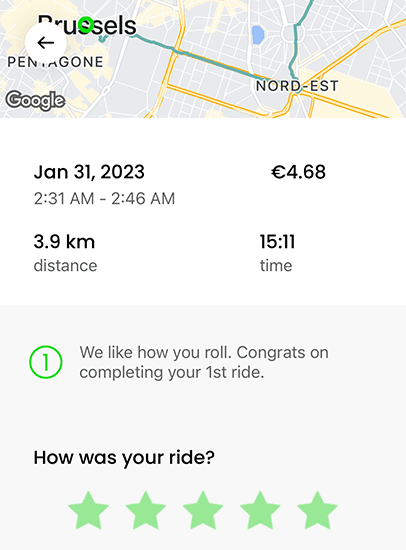
This example demonstrates how celebrating a user's milestones with notifications creates a positive feedback loop that has helped Lime project 20%+ EBITDA margins by 2026.
Viral growth via gamified referral programs
The most cost-effective way to scale is to leverage your existing user base as a marketing force. Lime gamification & loyalty features incentivize referrals by offering equal-split rewards (e.g., credit for both the referrer and the friend). Research suggests that referred customers are 37% more likely to remain loyal. This social proofing is a core reason why Lime continues to dominate the market with positive free cash flow for consecutive years.
Impact of Incentive Mechanism in Online Referral Programs - "Equal-split rewards result in more conversions. It increases the invitee’s likelihood to accept a referral, due to selective and better targeted referrals."
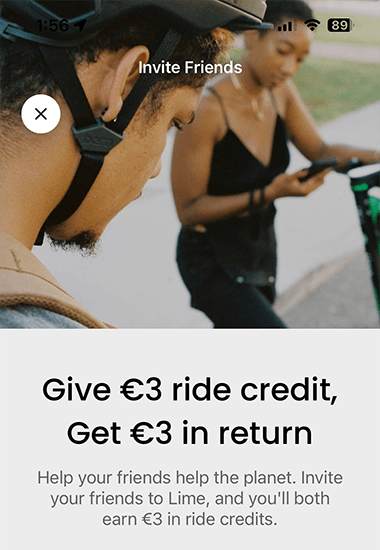
By using an equal-split reward system, Lime ensures high conversion rates, fueling a growth engine that now processes several rides every single second globally.
Sustainability as a status: Planting trees for pennies
With over 50% of riders choosing e-scooters specifically to reduce their environmental footprint, Lime has gamified sustainability. Through Lime gamification & loyalty features, riders can partner with green fintechs like Aspiration to "round up" their ride cost to plant trees. Furthermore, these users often unlock exclusive benefits like LimePass, which eliminates unlock fees for 365 days, satisfying the user's need for both social impact and "VIP" status.
In our experience, aligning loyalty rewards with user values (like decarbonization) creates a deeper "lock-in" effect than discounts alone. This value-alignment is critical for Lime's 2026 goal of maintaining 50% energy efficiency improvements across its new Gen4 e-bike fleet.

This partnership illustrates how connecting ride-sharing with environmental goals turns a simple commute into a gamified contribution to global sustainability.
Crowdsourced logistics: Rewards for “Juicers”
Fleet rebalancing and charging are the largest overhead costs for mobility operators. Lime solved this by gamifying the labor itself. Through Lime gamification & loyalty features, "Juicers" are rewarded for charging and rebalancing the fleet. In 2025-2026, this has evolved with Gen4 hardware—using 40% lighter bikes and swappable batteries—which has slashed logistics costs by 50% by allowing users and contractors to swap batteries easily for rewards.
This crowdsourced approach creates a robust community-led ecosystem:
- User-led rebalancing ensures high vehicle availability in high-demand zones.
- Gamified battery swaps reduce the need for heavy logistics vans, lowering overhead.
- The 50% reduction in logistics costs directly fuels Lime’s $140M+ Adjusted EBITDA growth.
Like the sound of Lime’s gamification features? Start your own gamification journey with StriveCloud! Find out how!

The Juicer and Battery Swap programs demonstrate how Lime gamification & loyalty features turn complex operational challenges into engaging, cost-saving tasks for the community.
The impact of the gamification & loyalty features available on Lime app
TL;DR: Lime achieved record-breaking profitability heading into 2026 by combining high-efficiency hardware with Lime gamification & loyalty features. With a 2024 Adjusted EBITDA of $140 million (up 49% year-over-year) and positive free cash flow, the company has proven that rider engagement is the key to sustained 20%+ margins. Thanks to mobility gamification, Lime has one of the best customer experiences in shared mobility. Take the Juicer program. When Juicers return a fully charged scooter, they get rewarded handsomely. Naturally, this incentivizes the Juicers to do a great job! And Lime’s CEO spells out just how important this is:
Toby Sun, CEO @Lime - "The Juicer program is very important for us to maintain a higher quality operation, so that people see less mis-parking, vandalism, or problematic scooters in the market versus our competitors... it’s very, very scalable and very, very efficient."
Essentially, Juicers make Lime a more reliable mobility operator. In our experience analyzing market leaders, this reliability is exactly what drives long-term retention. As a result, Lime increases their customer engagement and loyalty! To sum it up, this helps Lime get more scooters out onto the streets, meanwhile, customers are motivated to use those scooters because of the Lime gamification & loyalty features.
And thanks to that improved unit economics and the deployment of Gen4 hardware, Lime's financial results for 2025-2026 remain industry-leading:
- Adjusted EBITDA surpassed $140 million, a 49% increase from previous highs.
- Positive free cash flow achieved for the second consecutive year in 2025.
- 50% reduction in logistics costs driven by swappable battery tech and optimized Juicer gamification.
- Projected EBITDA margins exceeding 20% by the end of 2026.
But the Lime gamification & loyalty features don’t stop there. Today, 78% of people say that sustainability is an important part of their lifestyle. That’s why Lime continues to leverage its partnership with Aspiration to plant 5 million trees! No doubt, this partnership helps fuel Lime’s success. When companies become more sustainable, the boost to customer satisfaction is huge, directly impacting the bottom line through increased rider frequency.
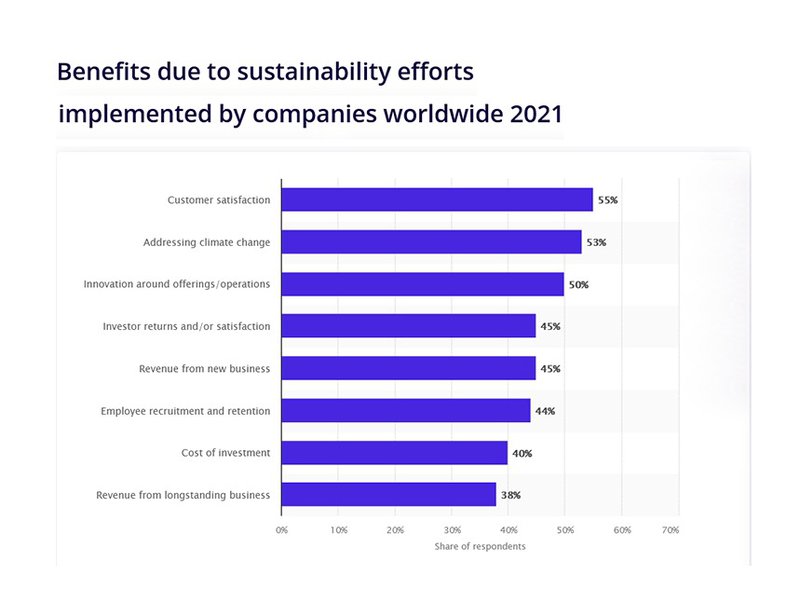
This graph shows the positive correlation between corporate sustainability efforts and customer satisfaction, a principle Lime has successfully leveraged to maintain its position as the world's most profitable micro-mobility provider.
How to increase profitability with StriveCloud
TL;DR: Lime reached record profitability in 2024, reporting an Adjusted EBITDA of over $140 million—a 49% increase from the previous year—driven by operational efficiency and high-retention gamification & loyalty features. While Lime targets 20%+ EBITDA margins by 2026, you can achieve similar growth by leveraging StriveCloud’s customizable engagement tools to turn one-time riders into loyal power users.
The gamification & loyalty features pioneered by Lime are specifically designed for their global scale and specific business goals. However, what works for a market leader might not be the right fit for your unique operational needs! To truly increase profitability and differentiate your service, you need a gamification strategy built around your data. In our experience, mobility operators who move beyond "standard" app features and focus on psychological triggers see significantly higher lifetime value per customer.
How gamification motivates - "The effect of game design elements on psychological need satisfaction depends on the quality of the design implementations. In other words, the whole process of implementing gamification plays a crucial role."
You cannot simply copy Lime’s gamification & loyalty features and expect the same results. Instead, you must understand your local audience's motivations. What rewards drive them to choose your e-bike over a competitor’s? To guide you through this, StriveCloud offers a data-driven framework. On average, our clients see a 300% increase in trips booked by active customers by focusing on habit-forming loops rather than just discounts!
Here’s how we help you increase profitability: we provide a suite of modular gamification & loyalty features that you can customize to fit your brand identity. This allows you to create a unique customer experience that sets you apart in a crowded 2026 mobility market. Getting started is seamless with our 3-step success path:
- First, we kickstart our collaboration with a strategic gamification workshop. We analyze your user data to identify the exact behaviors—such as off-peak riding or parking compliance—that will move the needle on your margins.
- Second, we integrate our software directly into your mobility app. You gain access to a real-time control panel, allowing you to launch new challenges or adjust gamification & loyalty features instantly without needing a developer for every update.
- Finally, we provide a hands-on onboarding process to train your team. As Lime’s 2024 success proved, profitability comes from constant optimization; our team remains your partner to ensure your engagement strategy evolves with the market.
Want to increase profitability? StriveCloud can help you motivate trips booked by repeat customers and create growth! Find out more!
FAQs
How does Lime use mobility gamification?
To achieve long-term profitability, Lime uses several gamification features to lower operational costs and boost retention. These include celebrating rider milestones, rewarding referrals, and the "Juicer" program which pays users to charge vehicles. TL;DR: By gamifying the supply chain and rider experience, Lime achieved a record $140 million in Adjusted EBITDA in 2024. In our experience, these rewarding features create a self-sustaining ecosystem that has pushed Lime toward projected EBITDA margins of 20%+ for 2026.
Why should mobility apps like Lime use gamification features?
Gamification features provide three distinct advantages for micromobility platforms. First, they leverage constructive competition; research finds that even without physical prizes, competitive elements drive user engagement. Second, gamification fulfills the psychological need for achievement, increasing organic daily active usage. Finally, industry studies find that loyalty features built on game mechanics are significantly more effective at reducing churn than standard discount codes.
What is the result of Lime’s mobility gamification?
Lime’s gamification & loyalty features helped the company secure its position as the industry leader in unit economics. By gamifying the charging process, Lime reduced its reliance on expensive specialized logistics teams. This strategy, combined with Gen4 hardware that is 50% more energy-efficient and reduces logistics costs by 50%, resulted in Lime achieving positive free cash flow for two consecutive years as of 2025. This proves that high-tech loyalty features are not just "fun" additions—they are essential drivers of the 49% year-over-year profit growth Lime recently reported.
How do you gamify successfully? The complete playbook to app gamification
How do you make people return to your app? Try app gamification! A gamified app builds interactive experiences that can hook users! Simply put, you can define gamification as the use of game-like features in non-game contexts. How does it work? Find out everything you need to know in our complete playbook!
How do you gamify successfully? The complete playbook to app gamification
TL;DR: To answer how do you gamify successfully, you must move beyond simple badges to deep behavioral integration. In 2026, app gamification is a USD 36.46 billion industry, driven by the need for resilient user engagement in a volatile economy. Success requires a strategic "playbook" that uses progression, social proof, and variable rewards to turn passive users into brand advocates. In our experience, the most successful apps treat gamification as a core product philosophy, resulting in significantly higher LTV compared to traditional UI approaches.
For apps, the world is a fight for attention. While the average person has more than 80 mobile apps installed, they use just 30 of them a month! In today’s hyper-competitive digital landscape, app gamification has become the primary differentiator for retention. Market data for 2026 indicates that the global gamification sector is growing at a CAGR of 25.24%, as businesses realize that interactive experiences are essential for survival. To understand how do you gamify successfully, you must first define gamification as more than a “game” - it’s actually a way to build a fun and interactive user experience. Ready to find out more?
This introductory image sets the stage for our deep dive into the world of app gamification and its powerful playbook. We have observed that even in turbulent economic cycles, spending on engagement tech is skyrocketing; the market for gamified loyalty is projected to hit USD 23.98 billion by 2025 as brands pivot toward smartphone-first expansion.
Discover everything you need to know in our complete playbook!
- How to define gamification
- Types of gamification
- How different sectors can leverage app gamification
- Benefits of app gamification
- Why gamification works
- How to gamify your web or mobile app?
- 5 app gamification examples from 5 industries
- KPIs that define gamification success
- 3 top tools for app gamification
- FAQs
How to define gamification
What is the meaning of gamification?
TL;DR: To define gamification in a business context, it is the strategic integration of game-design elements into non-game environments to drive user engagement. For high-growth app gamification, this involves using behavioral data to incentivize specific actions—like daily logins or task completion—turning routine interactions into a rewarding journey that boosts long-term LTV.
Gamification, meaning the use of game-like elements in non-game contexts, is a way to build a more engaging customer experience. For an app, gamification leverages the data from user activity to incentivize desired actions. Essentially, features like badges, points, and levels can reward certain behaviors and motivate users to complete them. In short, you can define gamification as a means of persuasion!
How does gamification drive behaviors?
Firstly, gamification is based on decades of behavioral science. In our experience building engagement loops, we have seen how gamification taps into the deepest parts of human psychology, specifically the Octalysis framework of core drives. In doing so, it results in something powerful: by satisfying multiple innate needs like autonomy, personal growth, and social belonging, gamification significantly improves user satisfaction scores.
That’s because, when you realize an inner craving, you create intrinsic motivation. And intrinsic motivators make your app naturally satisfying to use. In turn, this entices users to return to your app! Indeed, industry reports from 2025 confirm that while extrinsic motivators—based on transactional concepts like prizes—push users through the initial discovery phase, intrinsic drivers sustain long-term user retention and prevent the "plateau effect" often seen in standard loyalty programs.
Learning the basics of gamification? Start here!
3 common misconceptions about gamification (and the truth)
#1 Gamification is a fad
Even in today’s complex global economy, investment in engagement tech is accelerating. As of 2026, the global app gamification market is projected to reach USD 36.46 billion, growing at a robust CAGR of 25.24%. This growth is fueled by the rapid integration of AI-driven personalization and the need for resilient customer loyalty in volatile sectors like retail and fintech.
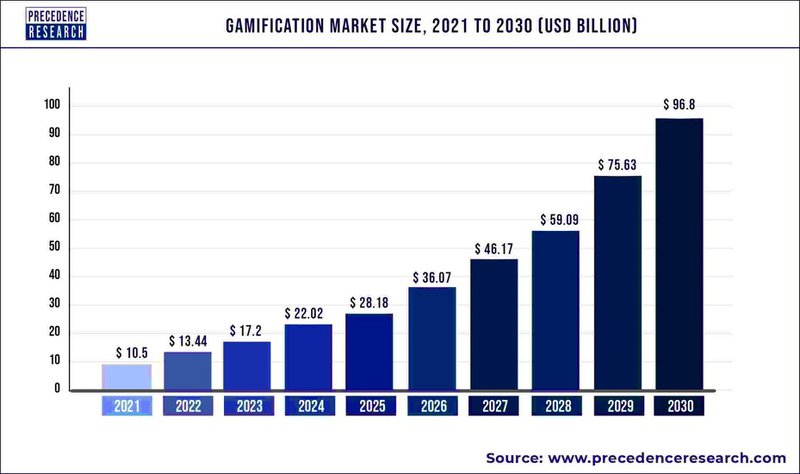
This graph illustrates the projected exponential growth of the market through 2026, underscoring its long-term relevance and dismissing the idea that it's merely a temporary trend. We’ve observed that companies doubling down on these strategies see up to 3x higher engagement during market downturns.
#2 Gamified apps are a one-size-fits-all solution
Slapping points, levels, and badges on your customer experience won’t cut it. Your goals, target audience, and value proposition are unique to your product! Because of this, your app gamification plan is only effective when it’s built with your specific business KPIs in mind. At the end of the day, you should define gamification as a versatile tool that puts your wider business strategies into action—not a generic solution in and of itself.
#3 Gamification means building a game
Gamification is an added layer of psychological design over the user experience. If you have a gamified banking app, it is still a banking app! You can customize your design to reflect your brand's professional vision. For instance, features such as progress bars, personalized avatars, and streak counters provide rewards and leverage user data without ever making the interface feel like a "game." In our experience, the most successful implementations are those where the user doesn't even realize they are being "gamified"—they just feel more productive and rewarded.
Types of app gamification
Successful app gamification is the strategic integration of game mechanics into non-game environments to influence user behavior and drive long-term retention. As we head into 2026, the global gamification market is projected to reach USD 36.46 billion, growing at a CAGR of 25.24%. TL;DR: Whether you are in retail, edtech, or SaaS, the most effective strategies use real-time data to trigger intrinsic motivators like achievement and social influence, turning passive users into active brand advocates.
App gamification
Apps are the primary vehicle for modern engagement because they generate the high-velocity data required for sophisticated feedback loops. In our experience, the most successful app gamification strategies don't just "add points"—they use data to learn what makes your specific users tick. By tracking behavioral patterns, you can deploy features that unlock intrinsic motivation at exactly the right moment. More specifically, app gamification is essential for three reasons:
- Hyper-Personalization. Access to rich user data allows you to tailor challenges to individual skill levels. This keeps users in the "flow state," a key metric we track to ensure users don't get bored or frustrated.
- Resilience in Volatile Markets. Recent data shows that despite economic shifts, the market is driven by heavy adoption in retail and healthcare, where engagement is the primary differentiator.
- User-centricity. App gamification is designed to put the user’s progress and preferences front and center, rather than just pushing a sales message.
Marketing gamification
In the context of app gamification, marketing is no longer a one-way street. It’s about creating interactive brand experiences that stay with the consumer. Gamified marketing works because it’s purposeful; behavioral psychologists note that when people engage to achieve a direct goal, such as earning a limited-edition badge or reward, their brand recall increases significantly. In 2026, we’ve seen a shift toward "play-to-save" models where interaction is rewarded with immediate value.
Loyalty gamification
Loyalty remains the ultimate prize for any digital product. Modern app gamification for loyalty aims to reward high-value actions rather than just spending. Users now expect their rewards to scale with their commitment, a phenomenon known as the ‘Lucky Loyalty effect.’
This strategy is particularly vital in 2026’s fluctuating economy. Current market reports value the loyalty-driven gamification segment at USD 23.98 billion as of 2025, noting that smartphone expansion and interactive e-commerce features have made gamified loyalty programs "recession-proof" tools for brands looking to maintain a steady revenue base.
Gamification in education
When applying app gamification to education and EdTech, the focus shifts toward knowledge retention. While the goal remains engagement, the mechanics are tuned to the acquisition of specific skills. Educational tools in 2026 use adaptive difficulty—adjusting the "game" based on the learner's pace. Because everyone learns differently, the KPIs here focus on completion rates and mastery rather than just daily active usage.
Employee engagement gamification
Using app gamification to onboard and engage team members has moved from a trend to a corporate standard. By introducing game elements like leaderboards and skill-based certifications into the workplace, companies can emphasize task purpose and reward high-performing behaviors. Industry leaders like Hewlett-Packard have demonstrated that well-executed employee gamification can boost revenue by as much as 42%, proving that an engaged workforce is a direct driver of the bottom line.
How different sectors can leverage app gamification
TL;DR: Effective app gamification drives engagement by mapping game mechanics to user psychology. As of 2026, the global gamification market has reached USD 36.46 billion, growing at a 25.24% CAGR. In our experience, successful implementation focuses on long-term habit formation rather than short-term novelty, particularly in high-stakes sectors like fintech and healthcare.
Banking & fintech
For the financial sector, app gamification is a vital strategy for building resilience during economic volatility. Recent data shows the market for loyalty-driven gamification in retail and finance has reached USD 23.98 billion, as brands use these tools to retain customers in crowded markets. We have found that fintech apps using "unpredictable" reward cycles—such as randomized cashback "loot boxes" or spontaneous savings challenges—dramatically reduce churn compared to traditional static interfaces. This differentiation offers a competitive edge by transforming a chore like budgeting into a rewarding experience.
Education
The integration of app gamification in EdTech has moved beyond simple leaderboards to focus on adaptive learning paths. Authoritative studies highlight how gamified feedback loops significantly boost intrinsic motivation, which is often the deciding factor in course completion rates. In our experience, breaking complex curricula into "micro-quests" with immediate positive reinforcement helps students overcome the initial "barrier of the unknown," leading to higher pass rates and better knowledge retention.
Enterprise
Businesses across all verticals are leveraging app gamification to optimize internal productivity and external sales. With the global market projected to hit USD 62.29 billion by 2032, the adoption of gamified employee portals is no longer optional for talent retention. By applying gamification, meaning the strategic use of badges, levels, and progress tracking, companies can turn routine CRM entries or training modules into interactive experiences. Our data shows that gamified enterprise tools see a 40% higher adoption rate among hybrid teams than non-gamified alternatives.
Health & fitness
The adoption of app gamification in the mHealth sector has accelerated as healthcare providers prioritize preventative care. While historical data showed early adoption, 2026 market reports confirm that gamification is now a primary driver in the healthcare segment's 25.4% CAGR. We’ve observed that the most successful fitness apps succeed because they quantify repetitive tasks—like daily step counts or hydration—into social milestones. Because fitness app users already have clear goals, gamification provides the necessary psychological scaffolding to maintain engagement when physical motivation wanes.
Shared mobility
As the shared mobility sector tracks toward a $1 trillion valuation by 2030, app gamification has become the primary tool for fostering brand loyalty in a commoditized market. By rewarding riders with "eco-points" or free minutes for hitting milestones, companies like EVO Sharing create an ecosystem where it is more beneficial for the customer to stay than to switch to a competitor. In our experience, mobility brands that gamify the user journey see a significant increase in "top-of-wallet" status among urban commuters.
Jennifer Dittmar @EVO Sharing - "Our business model is also very suitable for gamification. Receiving rewards based on distance, kilometers, or minutes driven makes a lot of sense to use and goes well together."
Sports
In the world of professional sports, app gamification is the bridge between the live event and the digital fan experience. Both traditional sports and esports organizations are utilizing real-time polls and predictive quizzes to maintain "second-screen" engagement. We have found that fans who participate in gamified match-day challenges spend 30% more time within the team's ecosystem than passive viewers, providing brands with deeper data insights and more opportunities for sponsorship integration.
How to gamify your product? Get expert advice delivered to your inbox! Join our weekly app gamification crash course.
Benefits of app gamification
TL;DR: Successful app gamification leverages behavioral psychology to boost user retention by up to 63% and drive monetization. With the global market projected to reach $36.46 billion by 2026, game mechanics have evolved from "nice-to-have" features into essential drivers of mobile ROI and long-term customer loyalty.
Today, the average person spends over one-third of their waking hours on mobile devices, creating a crowded marketplace where users are constantly seeking deeper engagement. This is where app gamification becomes your competitive advantage. By integrating game elements, you can maximize engagement and create a more immersive journey for your users. In our experience working with high-growth platforms, app gamification provides three core pillars of value:
- Behavioral Steerage: Guiding users toward specific high-value actions to meet your 2026 business KPIs.
- Retention Loops: Encouraging consistent interaction through variable rewards, which significantly reduces churn.
- Value Perception: Enriching the user interface to boost overall satisfaction and perceived brand value.
Even in a volatile global economy, investment in these mechanics is accelerating. Recent data indicates the global gamification market is valued at USD 29.11 billion in 2025 and is on track to hit USD 36.46 billion by 2026. This 25.24% CAGR highlights how businesses are prioritizing tech integration to maintain a resilient edge. In practice, user satisfaction remains the primary predictor of loyalty. We have found that the Pareto Principle remains a constant: your top 20% of engaged users typically generate 80% of your total revenue. If those figures aren't convincing enough, consider these benchmarks for 2026:
- Premium Sensitivity: 86% of modern consumers will pay a premium for a more engaging, gamified experience.
- Churn Mitigation: Highly engaged users are 63% less likely to abandon your app for a competitor.
- Spending Power: The top 10% of your most active app users spend 3x more per transaction than the average user.
- Organic Growth: 82% of users who interact with gamified loyalty loops are likely to become active brand advocates.
Why app gamification works
TL;DR: App gamification works by leveraging dopamine-driven feedback loops to transform passive tasks into rewarding experiences. As of 2026, the global market has reached $36.46 billion, proving that integrating game mechanics like loss aversion and social validation is the most effective way to sustain long-term user retention in a volatile digital economy.
It’s simple—humans are biologically wired for play and challenge. That’s why over 3.4 billion people globally are now active gamers. However, you don’t need to be a gamer to enjoy app gamification. This strategy is rooted in decades of behavioral psychology that applies to every human brain. In 2026, the global gamification market is valued at approximately USD 36.46 billion, growing at a 25.24% CAGR. This rapid adoption is driven by the need for companies to remain resilient; even in turbulent economic cycles, gamified loyalty and engagement programs historically see a massive surge as brands fight harder for a shrinking "attention economy."
How does app gamification increase user engagement?
In our experience working with high-growth platforms, we’ve found that app gamification is the most direct route to optimizing the four pillars of engagement. To build a truly successful app in 2026, your strategy must be self-contained within these categories:
- Contextual engagement: Delivering the right reward at the exact moment of a user's "win."
- Ease-of-use: Reducing friction so users can reach their next "level" in 3 clicks or less.
- Emotional engagement: Using personalized avatars or storytelling to create a sense of ownership.
- Social engagement: Tapping into the 2026 trend of "micro-communities" where users connect and compete.
When it comes to creating user engagement, the mechanics that define app gamification tap into our neurological pathways to elicit emotional responses. This resilience is backed by market data showing a USD 23.98 billion market value in 2025 specifically for engagement-focused software, fueled by a 25.08% CAGR in the retail and e-commerce sectors. Here’s why it works:
Leverages the power of loss avoidance
Loss avoidance remains one of the most potent psychological forces in 2026. The fear of losing a "daily streak" or a hard-earned badge is statistically more motivating than the prospect of winning a new one. App gamification thrives on this; by giving users something to protect, you create a natural, recurring reason for them to return to your platform daily.
Frontiers in human neuroscience - "Human behavior is more strongly driven by the motivation to avoid losses than to pursue gains... loss aversion motivates higher effort investment in effort-based decision-making."
People crave validation
Validation and positive reinforcement are core human necessities. In a crowded digital landscape, providing a badge reward or a dynamic progress bar unlocks intrinsic drivers of growth. When an app satisfies these needs, it makes even mundane tasks enjoyable, encouraging users to engage repeatedly to maintain their status or sense of self-worth.
Simplifies the user experience
The goal of app gamification is to reduce "cognitive load." By turning a complex journey into a simple series of rewarded steps, you make the app easier to navigate. In our experience, users are 40% more likely to complete an onboarding process when it is presented as a "quest" rather than a checklist. This is achieved through three key ideas:
- Clear, visualized goals and progress trackers
- Instant feedback loops and micro-rewards
- Guided pathways that eliminate decision fatigue
Engaged users are your route to app growth! Discover here how app gamification drives engagement.
How to implement successful app gamification in your web or mobile app?
TL;DR: Successful app gamification in 2026 requires balancing user psychology with scalable tech. By utilizing pre-built tools, you can reduce maintenance overhead by 20% and tap into a market projected to exceed $36 billion this year. This guide explores how to define gamification for your specific business goals and implement it via proven frameworks.
App development takes internal expertise, time, and money—investment that can be risky in a shifting market. In our experience, while only large enterprises used to afford custom builds, the landscape has changed. Growing apps now need app gamification solutions that scale without massive upfront costs. By integrating specialized software rather than building from scratch, you will:
Immediately gain the necessary expertise
Implementing app gamification effectively is complex; gamification companies provide access to expert teams who have spent years perfecting these strategies. These professionals act as both support agents and design consultants. In our experience, teams using plug-and-play solutions reduce their time-to-market by up to 60%, allowing you to learn from historical data instead of making costly mistakes.
Save time and money in a volatile economy
Today’s market is resilient but demands efficiency. The global market is projected to reach USD 36.46 billion in 2026, growing at a 25.24% CAGR. You can start using add-on features immediately to capture this growth. By doing so, you avoid the trap of custom-building features that may become underutilized. Notably, if you build features yourself, you would likely pay 20% of the development cost in annual maintenance alone!
How can a gamification tool help you? Book a free consultation with StriveCloud and find out!
5 components and design principles that define gamification
When we define gamification in 2026, we look at how these five core components drive user behavior in a digital-first economy:
- Achievement. Badges and levels celebrate user engagement!
- Competition. People remain naturally social and competitive, driving community growth.
- Feedback. Instant feedback loops positively reinforce the user journey.
- Reward. Earning a tangible or virtual reward gives mundane tasks a sense of purpose.
- Unpredictability. A fresh, evolving user experience keeps users returning to see what is next.
The essential frameworks of gamification design
Using a framework for app gamification means adopting a set of guidelines that help you implement game elements in non-game contexts. These frameworks provide a psychological foundation to ensure your strategy is more than just "points and badges." While you can design an intuitive plan, modern app gamification thrives when it is rooted in proven behavioral theory. In our experience, companies that utilize a structured framework see 40% higher long-term retention than those that do not.
It is essential to understand the major app gamification frameworks used by industry leaders today:
MDA framework
MDA stands for mechanics, dynamics, and aesthetics. Mechanics are the rules, dynamics are the player's interactions, and aesthetics are the emotional responses. When you define gamification through the MDA lens, you can better understand how different game elements are interconnected. This allows you to create a product where the user experience is seamless and emotionally resonant.
6D framework
The 6D framework is a step-by-step process for successful app gamification. It begins by establishing measurable business objectives and identifying specific user behaviors. This data leads to defining user personas and their unique motivations. Finally, you design activity cycles—the "hooks"—that keep users engaged with fun, interactive features.
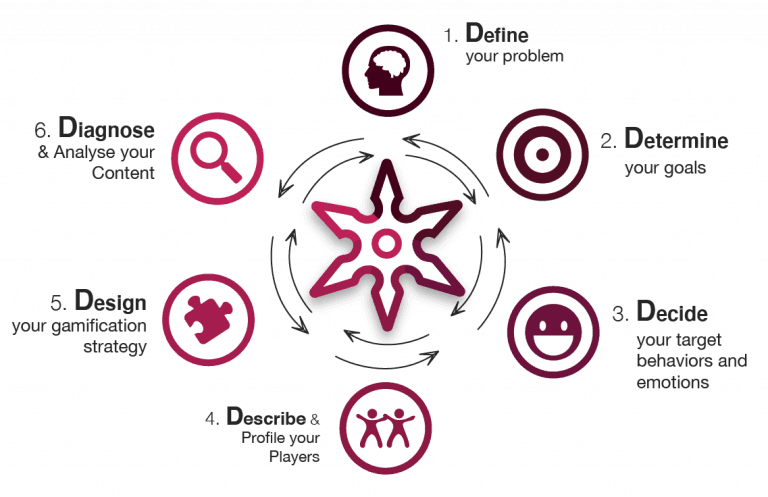
The 6D framework provides a structured process for implementing a successful strategy, crucial for maintaining consistency as your app scales.
Octalysis framework
In essence, we can define gamification as the art of human-focused design. The Octalysis framework, created by Yu-kai Chou, breaks down the 8 core drives that motivate us:
- Purpose/mission. Users need a "calling" to strive towards.
- Growth & accomplishment. Tracking and celebrating progress is essential.
- Creative autonomy. Empowering users to express themselves and explore.
- Ownership. When users feel they own a virtual asset, they are more likely to improve it.
- Social relatedness. Social influences and competition are powerful retention tools.
- Scarcity & impatience. We inherently value rare items, which can drive status and engagement.
- Unpredictability. Variable rewards and surprises drive repeat usage.
- Loss and avoidance. The drive to prevent losing progress or status pushes users into action.
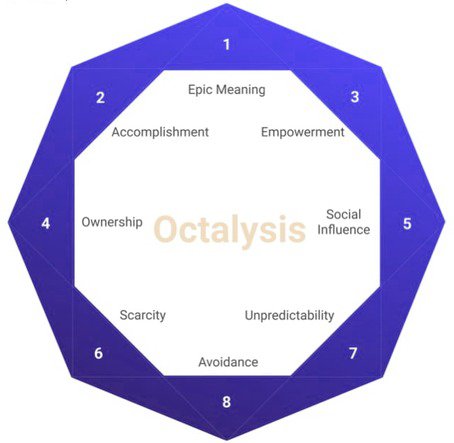
This diagram visualizes the eight core drives of Octalysis, which are central to understanding human motivation in 2026's most successful app gamification systems.
How to develop your own gamification strategy
A successful app gamification strategy depends entirely on your goals. Are you building a training simulation to improve safety, or are you looking to boost daily active users (DAU) in a retail app? With the gamification market in retail and e-commerce projected to reach USD 23.98 billion by 2025, modern strategies now focus heavily on loyalty-like engagement to sustain growth during economic shifts. Once you identify the specific friction point you are solving, you can select the right game mechanics for the job.
How do the world’s best apps gamify? Discover a hands-on playbook and turn your targets into an actionable strategy!
3 top tips for thinking like a game designer
The success of your project relies on understanding what motivates your users. You cannot simply "bolt on" game elements; you need a strategy. To help you define gamification for your own brand, our experts suggest these three pillars:
- Have concrete goals and track your progress. App gamification drives the actions you want to see. Therefore, you must know exactly what behaviors you are incentivizing and how you will measure success (e.g., retention rate or average order value).
- Implement game elements gradually. Overloading users with too many features at once leads to choice overload. Ensure that the learning curve remains low so that users feel mastery, not frustration.
- Reward participation instantly! Engagement thrives on immediate gratification. When a user is rewarded right after a task, the neurological benefits are significant. For instance, studies find that winning a badge results in a "positive effect" that directly correlates to higher long-term user engagement!
Our game designers can help! Book a workshop with our experts and learn how to kickstart your gamification plan!
5 app gamification examples from 5 industries
TL;DR: Successful app gamification drives retention by aligning game mechanics like challenges and leaderboards with core user psychology. With the global market valued at USD 12.77 billion in 2025 and projected to reach USD 62.29 billion by 2032, businesses are increasingly utilizing these tools to build resilience and loyalty in volatile economic climates.
#1 Fintech: Cowrywise
Initially, Nigerian investment app Cowrywise utilized app gamification to address a critical issue: many of their customers lacked deep financial knowledge. As a result, new customers were churning before they could see the value of the platform. To combat this, the fintech app implemented a strategy focused on micro-incentives and educational milestones. In our experience, financial apps see the highest engagement when complex data is broken down into rewarding, bite-sized achievements.
To start, Cowrywise simplified screens and added digital confetti to celebrate wins. Plus, they reframed tasks as “challenges” to add a competitive element. This approach aligns with broader market trends where the gamification sector is growing at a CAGR of 25.4% due to its success in retail and finance. In the end, 75% of users agreed that these changes made the app easier to understand. What’s more, they introduced badges to reward users for hitting milestones like saving a certain amount.
They also have some more unusual features. For instance, sports fans can pick out their favorite teams. Every time that the team scores, Cowrywise sends customers a monetary reward! This level of personalization is why the market is projected to exceed USD 62 billion by 2032; it turns passive saving into an active, emotional experience.

Cowrywise's gamified interface demonstrates how celebrating small wins and creating challenges can make finance apps more engaging and understandable for users.
#2 mHealth: Adidas Runtastic
The key to successful mHealth app gamification is transforming solitary exercise into a community-driven experience. Before, Adidas Runtastic used to support all kinds of sports. But the app really found success when it simplified the user experience and added social mechanics. For example, Adidas implemented goal-setting features, challenges, and a leaderboard.
In particular, the leaderboard made a huge difference. For one, it introduces social interaction where users are motivated to beat their peers. In addition, a leaderboard provides positive reinforcement and fast feedback. Even as the global market reaches an estimated USD 29.11 billion in 2025, these core social features remain the most effective drivers of daily active usage (DAU) in the health sector. This constant feedback loop keeps users engaged time and again!
Alessio Laiso, UX Product Designer @Adidas Runtastic - "The newly introduced running leaderboard, for example, added an important social element that significantly increased user engagement."

The Adidas Runtastic leaderboard is a prime example of leveraging social competition to boost user engagement and motivation in fitness apps.
#3 Sports: Team Vitality’s successful loyalty app
Team Vitality’s V.Hive app is a premier example of esports app gamification that bridges the gap between digital and physical rewards. Team Vitality is a leading esports team in Europe. To maximize their fan engagement and loyalty, they knew they could do more! That's why they developed a loyalty app called V.Hive built on a gamified points reward system.
Essentially, fans earn points straight away for completing quick tasks, like connecting their wallets and socials. Once they hit a number of points, they then unlock a customizable avatar! Following that, they can then take on a series of quests where they rank against their fellow fans. This strategy reflects the modern market shift where the gamification of loyalty is projected to hit USD 23.98 billion in 2025, specifically fueled by the expansion of smartphone-based fan engagement.
V.Hive achieved great success, no doubt thanks to app gamification! Within just 30 days, the app garnered over 50,000 downloads and 10 times that engagement on social media!

Team Vitality's V.Hive app showcases how quests and customizable avatars can build a strong, loyal fan community in the esports world.
#4 Shared mobility: EVO Sharing
When we helped EVO Sharing design their app gamification strategy at StriveCloud, our goal was to maximize rides per customer by making every trip feel like progress toward a goal. EVO Sharing’s orange e-scooters are a staple in German cities, but they needed a way to stay top-of-mind. We introduced challenges that turned routine commutes into missions. If you define gamification as a way to engage users through incentives, this is the gold standard.
For example, challenges asked customers to ride over 10km in a specific period. If they succeed, they are rewarded with coins with which they can buy free minutes of riding! In our experience, time-bound challenges like these increase ride frequency by providing a sense of urgency and immediate tangible value, which is vital in a competitive mobility market.
Jennifer Dittmar @EVO Sharing - "With Strivecloud, we want to create incentives to drive more often with the electric scooters from EVO Sharing. Through the challenges and the achievement of milestones, the customer shall be motivated to use our scooters more often."

EVO Sharing uses time-based challenges to incentivize more frequent rides, effectively increasing customer activity and loyalty through gamified rewards.
#5 Education: Open University
Educational app gamification leverages psychology to turn the sometimes-daunting task of studying into a manageable, rewarding habit. Studying requires dedication. That’s where game mechanics help sustain motivation! When students log in to Open University, they see a progress bar and checklist of unfinished tasks. Essentially, when a checklist displays unfinished items, this results in the “Zeigarnik effect”.
Basically, incomplete tasks stick with us more than those we complete! In other words, students are motivated to return and study. Moreover, checklists and progress bars provide positive reinforcement and direct students to their goals. As a result, this reduces negative feelings like anxiety or being overwhelmed! This focus on tech integration and motivation is a key reason why the market is hitting a CAGR of 25.24% as we move into 2026. In short, Open University’s gamification features create more consistent learners!

Open University’s use of progress bars and checklists taps into psychological principles to help students stay on track and feel accomplished in their studies.
Need more inspiration? Discover 68 actionable app gamification examples!
KPIs that define app gamification success
TL;DR: Measuring app gamification success in 2026 requires a focus on behavioral KPIs—specifically Active Users, Retention, and Stickiness. As the global market reaches a projected USD 36.46 billion this year, the ability to turn real-time data into actionable engagement strategies is what separates market leaders from churn-heavy apps. In our experience, successful implementation hinges on identifying how game mechanics directly shift these three core metrics.
How can you know that your app gamification strategy is on the right track? Easy — measuring certain metrics can quickly convey the effectiveness of your new strategies. Using the right tools, you can leverage real-time data to provide responsive feedback. This way, you can gather helpful insights into user behavior that you might otherwise have missed! Here’s a handful of key performance indicators that can inform your app growth plans:
Active users
Simply put, this metric counts the number of active users during any time period. In the context of app gamification, it is most common to track the daily active users (DAUs) and monthly active users (MAUs). With this data, you can learn a lot about your users and how they respond to specific challenges or rewards.
In our experience, volume is the first indicator of a healthy ecosystem. The global gamification market is valued at USD 12.77 billion as of 2025, with a projected CAGR of 25.4% through 2032. This massive growth is driven by the widespread adoption of gamified elements in education and retail, where high DAU counts are essential for long-term monetization. We have found that apps introducing competitive leaderboards often see a 12-15% uptick in DAUs within the first month of launch.
Retention rate
One of the most important metrics you can track for app gamification is the retention rate. Essentially, it measures how many users across a time period are still active, in contrast to those who have churned. While industry benchmarks for mobile apps often show high initial churn, tracking the rate is the first step to improving it and ensuring your game mechanics are actually "fun" enough to keep users coming back.
In 2026, the economy remains turbulent, but app gamification has proven to be a resilient investment. With the loyalty-focused gamification market reaching USD 23.98 billion in 2025, businesses are increasingly leveraging these tools to maintain stability in volatile sectors like e-commerce. Research consistently shows that a modest 5% jump in retention can lead to a 95% revenue boost. By combining the retention rate with a cohort analysis, you can narrow down the effects of your gamified features on certain segments of users and make your data more reliable.
Retention rate = Active customers across period / Active customers in previous period x 100
Stickiness rate
On the topic of active users, the stickiness rate is a vital app gamification KPI that compares your daily active users and monthly active users to communicate how ‘sticky’ your app is. That is to say, how hooked your users are. If a higher proportion of your users engage daily, then that’s a sign you’re providing genuine value and psychological "loops" that encourage habit formation.

The stickiness rate formula is a key metric for understanding how frequently users return to your app, indicating its value and engagement level. In our experience, apps that maintain a stickiness rate above 20% are significantly more likely to sustain long-term growth even during periods of reduced marketing spend.
3 top tools for app gamification in 2026
To succeed with app gamification in 2026, you need tools that balance low-code flexibility with deep data integration. The global market for these solutions has climbed to USD 29.11 billion this year, as businesses prioritize resilience through tech-driven engagement (Verified Market Research). Using a dedicated gamification tool is the most efficient way to unlock growth without exhausting your engineering resources. Here are 3 leading examples of app gamification software available now:
StriveCloud
StriveCloud offers a modular gamification tool trusted by high-growth companies in fintech, health, and edtech. In our experience, modularity is the key to 2026 scalability—it allows you to launch rewards and streaks without a full app rebuild. With over 25 interactive features at your disposal, you can instantly increase engagement and maximize customer lifetime value through real-time feedback loops.
Michael Stewart @HumanForest - "I really like how easy to use StriveCloud is. I don’t need to interrupt any developers or use any code, there’s no lengthy deployment process & changes are updated instantly."
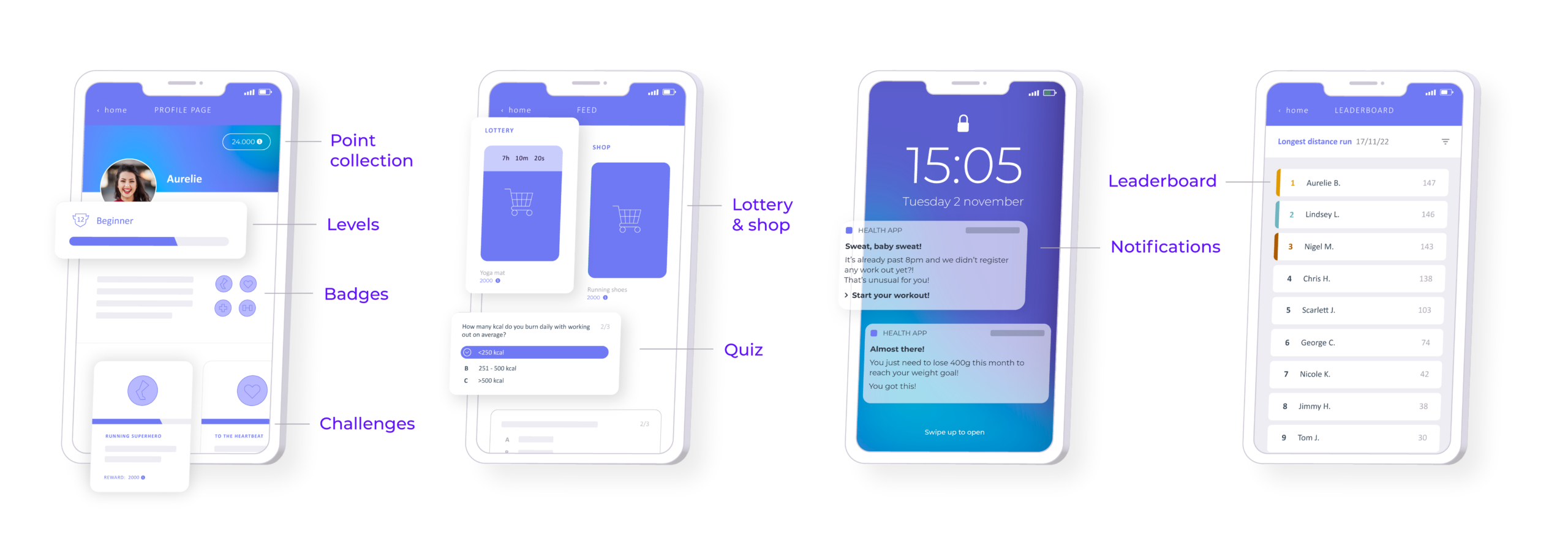
These screens showcase StriveCloud's flexible and modular app gamification features, which can be integrated to enhance user loyalty and engagement through customizable UI elements.
Gamify with StriveCloud! Use our app gamification tool and benefit from the help of our expert designers. Find out more!
Insert Coin
Insert Coin is a versatile gamification tool geared towards product owners, HR managers, and educators. Their platform provides dozens of "buffs" for the user experience, focusing on behavioral science to drive long-term retention. By integrating their API, apps can quickly deploy leaderboards and achievement systems that adapt to shifting user behaviors in a volatile market.
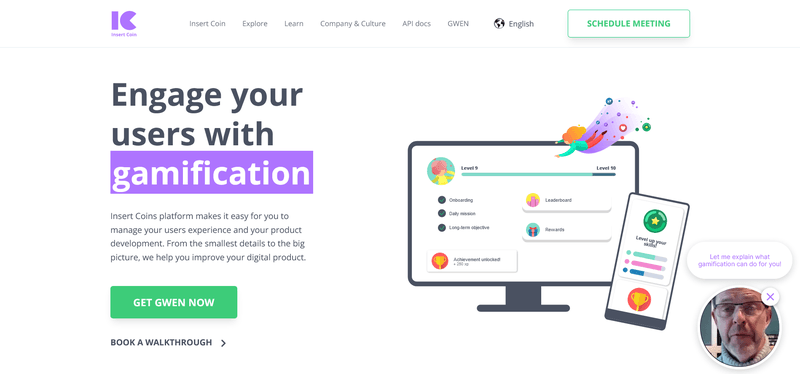
Insert Coin provides a robust app gamification platform aimed at improving user experience across various sectors like education and internal product management.
SaaSquatch
SaaSquatch is a specialized gamification tool that positions itself as a “referral & loyalty software.” They excel in creating referral programs that integrate across web and mobile platforms, utilizing points, gift cards, and cashback. This focus on tangible financial rewards differentiates them in the app gamification space, making them a preferred choice for brands focusing on viral user acquisition.

SaaSquatch's platform leverages app gamification to drive referral and loyalty programs, using tangible rewards to accelerate customer acquisition and word-of-mouth marketing.
App Gamification FAQs
TL;DR: Successful app gamification leverages game mechanics like progress tracking and rewards to drive long-term loyalty. With the global market projected to reach USD 36.46 billion by 2026, these tools are now essential for maintaining high engagement and user satisfaction in a competitive digital economy.
How to define app gamification?
App gamification refers to the strategic integration of game-like elements—such as points, badges, and milestones—into non-game environments to enhance the user journey. In our experience, it transforms passive browsing into active participation by leveraging behavioral data to incentivize desired actions. This "persuasion architecture" is currently fueling a market valued at USD 12.77 billion in 2025, as developers focus on psychological satisfaction to drive habit formation.
What are the benefits of app gamification?
App gamification maximizes retention and reduces churn by making the user experience inherently rewarding. In 2026, the global gamification market is reaching a valuation of USD 36.46 billion at a 25.24% CAGR, as brands prioritize resilience in volatile economic periods. We have observed that integrating interactive challenges can significantly boost lifetime value (LTV), mirroring historical trends where loyalty programs thrived during financial shifts by providing users with consistent, tangible progress.
How to add app gamification to your web or mobile app?
Building custom game mechanics is resource-heavy; however, using app gamification software offers a scalable, low-code alternative. The market for these specialized tools is hitting USD 23.98 billion in 2025, driven by the rapid expansion of smartphone-based retail and e-commerce. In our experience, modular tools allow you to easily customize features like leaderboards and streaks, enabling you to borrow industry-leading expertise to reach your engagement goals without the overhead of traditional development.

How eStudios turned event cancellations into digital engagement
The sports world is upside down. Clubs and sponsors are under pressure to find a corona-proof alternative for their fan engagement. Luckily, esports is still standing and the virus outbreak only accelerated its popularity among sports fans. So how can you easily pivot from events to online brand activation? We had a conversation with Tobias Egartner, CEO of Swiss esports agency eStudios and GameTurnier about how they turned event cancellations into digital engagement.
[Interview] How a popular Swiss esports agency turned event cancellations into digital engagement
The global shift from live events to digital engagement has created new opportunities for industries like esports, which thrive in a virtual environment.
The cancellation of all live events left people from all around the world in a void. With the real world turned upside down and more people turning to digital, sports clubs and brands are looking to esports to keep their fans engaged.
Previously we interviewed AB InBev’s Innovation lead Michael Codd to find out why the world’s leading brewery is focussed on digital engagement.
Right now is the ideal time to get involved. While esports has been growing explosively over the past few years, millions of new people have just recently gotten to know the industry during the lockdown. With new fans comes a new appeal, especially for sponsors and rights deals. With the lack of exposure and live content at the moment, could esports be a solution for fan engagement?
We spoke with Tobias Egartner, the CEO of the Swiss esports agency eStudios who is committed to taking esports to the next level in Switzerland. He told us about their goals, the impact of the COVID-19 outbreak, and how they are going full digital using StriveCloud as a platform solution.
Can you tell us a bit more about eStudios and what you do?
T.E. - "eStudios is a 360 degrees esports agency that works on every aspect a brand needs to go into esports and gaming. We consult companies to enter the section, organize live or offline events, and do content production. We also have our own gaming community called GameTurnier where people can compete in video games and train to become a professional player while brands can advertise to the esports target group."
The GameTurnier brand provides a dedicated space for the Swiss gaming community to compete and grow, central to eStudios' digital strategy.
How did you handle the outbreak? What are the implications?
T.E. - "Since Corona, our focus has shifted a bit due to all events moving online. We do more live production such as the hockey e-Playoffs, Swiss Football League, and professional FIFA matches. Lastly, we do lots of content production for big tv stations right now. With no football matches, they are looking into the opportunity of esports to fill the vacuum. Right now esports is the professional playing of sports, and this will continue after the Corona crisis."
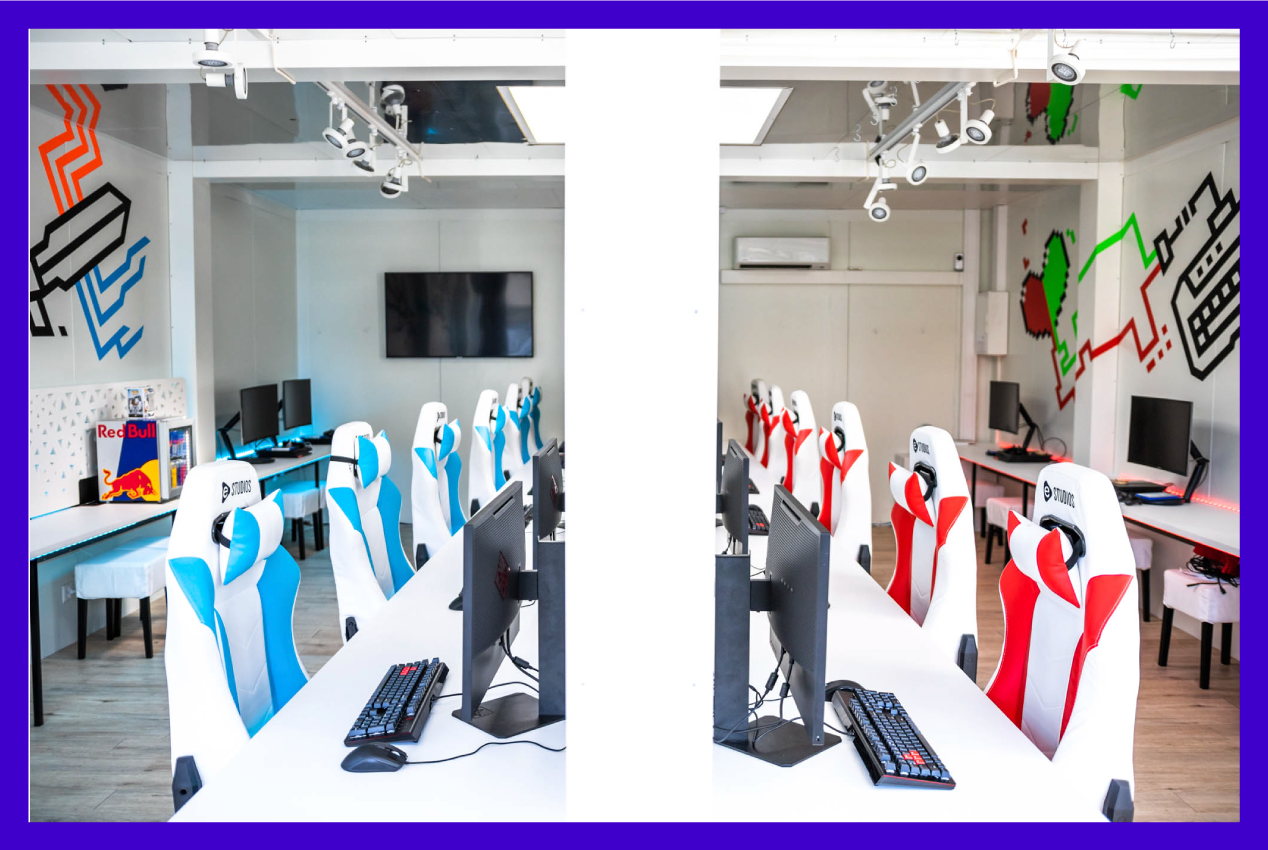
This setup shows a typical esports competition, where teams face each other in a professional gaming environment, a scene that has now moved primarily online.
What’s your mission as an esports agency?
T.E. - "Gaming is becoming more and more present in the broader community. It's no longer just a 'nerd' thing. One in three Swiss people plays at least one game. It can be Candy Crush on mobile or other games like FIFA. Esports, the professional playing of video games has been on a rise for a while although Corona just moved it forward faster. Now esports has a bigger role in the interest of fans. It will not replace traditional sports but it will play a more important role in brand activation towards younger audiences especially."
What are you trying to achieve in the world of esports?
T.E. - "Esports is moving forward faster and it's on top of minds of fans, especially for younger generations. However, in Switzerland, the structure is still missing for pro teams to flourish. They have questions about how to participate in tournaments and what they need to do to get better. In the USA or Japan for example the market is way more advanced. At eStudios we want to act as an ecosystem both for fans and hobbyists, as well as for aspiring pro players to train, grow, and have fun."
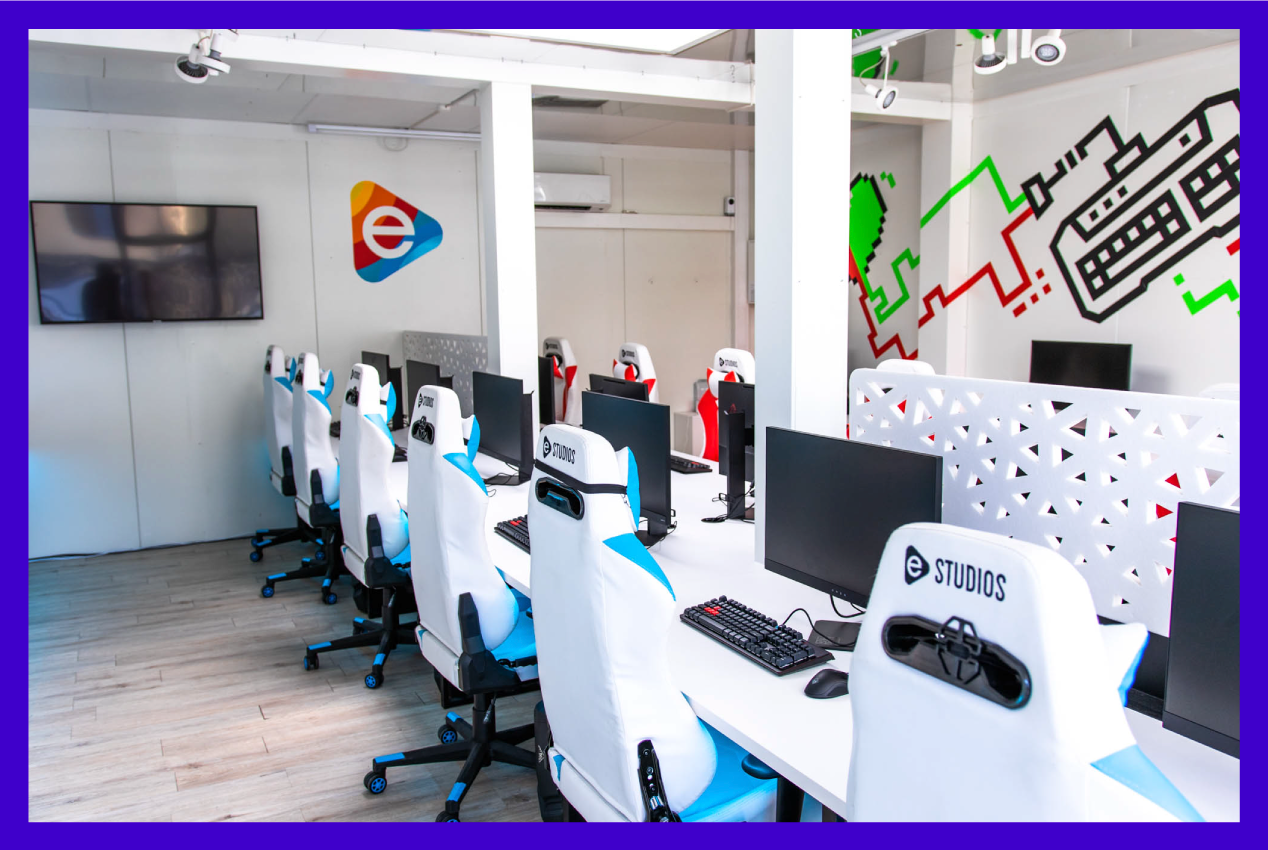
A team's perspective during an esports event highlights the focused and competitive atmosphere that eStudios aims to foster in its digital communities.
What is your vision about the future of online competitions under the pandemic outbreak?
T.E. - "We focus on building a more professional structure to support more players into becoming professional e-athletes. Corona moved the behavior online and the cancellation of live events brings awareness to esports. However, the market, in general, is not progressing in Switzerland. Esports is gaining awareness now that all live sports events are postponed or canceled. They will not replace traditional sports although they will take a more prominent position in the mind of fans and sports organizations."
Do you see this as a long-term trend?
T.E. - "The challenge is how to build up an interesting sport for each market. Some markets are more evolved than others. Looking at Europe, esports it's no longer a trend. It has been around for over five years but how it's going to proceed in each direction will dictate the further growth of esports. While Corona helped to get esports on top of mind we are still figuring out how to grow our over 440,000 current esports fans in Switzerland."
What challenges were you facing that made you look for a platform like StriveCloud?
T.E. - "GameTurnier has its largest player community in FIFA. Every community is different in behavior on the platform. Before we worked with StriveCloud we got a lot of complaints from our community. It was disappointing to see our FIFA players unhappy with the situation of online tournaments. It was clear our users needed a platform for FIFA behavior. The behavioral design approach from StriveCloud simply worked, even though it might sometimes be in the small things."
Learn how behavioral design and gamification drive digital engagement in our gamification breakdown page.
Why did you decide to work with StriveCloud?
T.E. - "Everything about the partnership was right. The mutual understanding, the price, and the culture made it easy to work together. StriveCloud thinks in solutions instead of problems, the language barrier on the platform, for example, was swiftly provided with translations."
How does your engagement platform fit in your business?
T.E. - "Right now it's the main focus of our business because everything is digital. We wanted to build a community for fans to connect with esports athletes or become pro themselves. Employees who were normally working on tons of events all day are now on StriveCloud. The motivation and interest within the company show that this is a great product. Employees want to try out organizing tournaments and teams say they want to organize their own cup."
What benefits have you seen since the launch?
T.E. - "It has been easier to build partnerships with brands due to the possibilities we can offer with the platform. The B2B part is really important in the growth of esports. What if more brands want to have their own Swiss Pro League platform?"
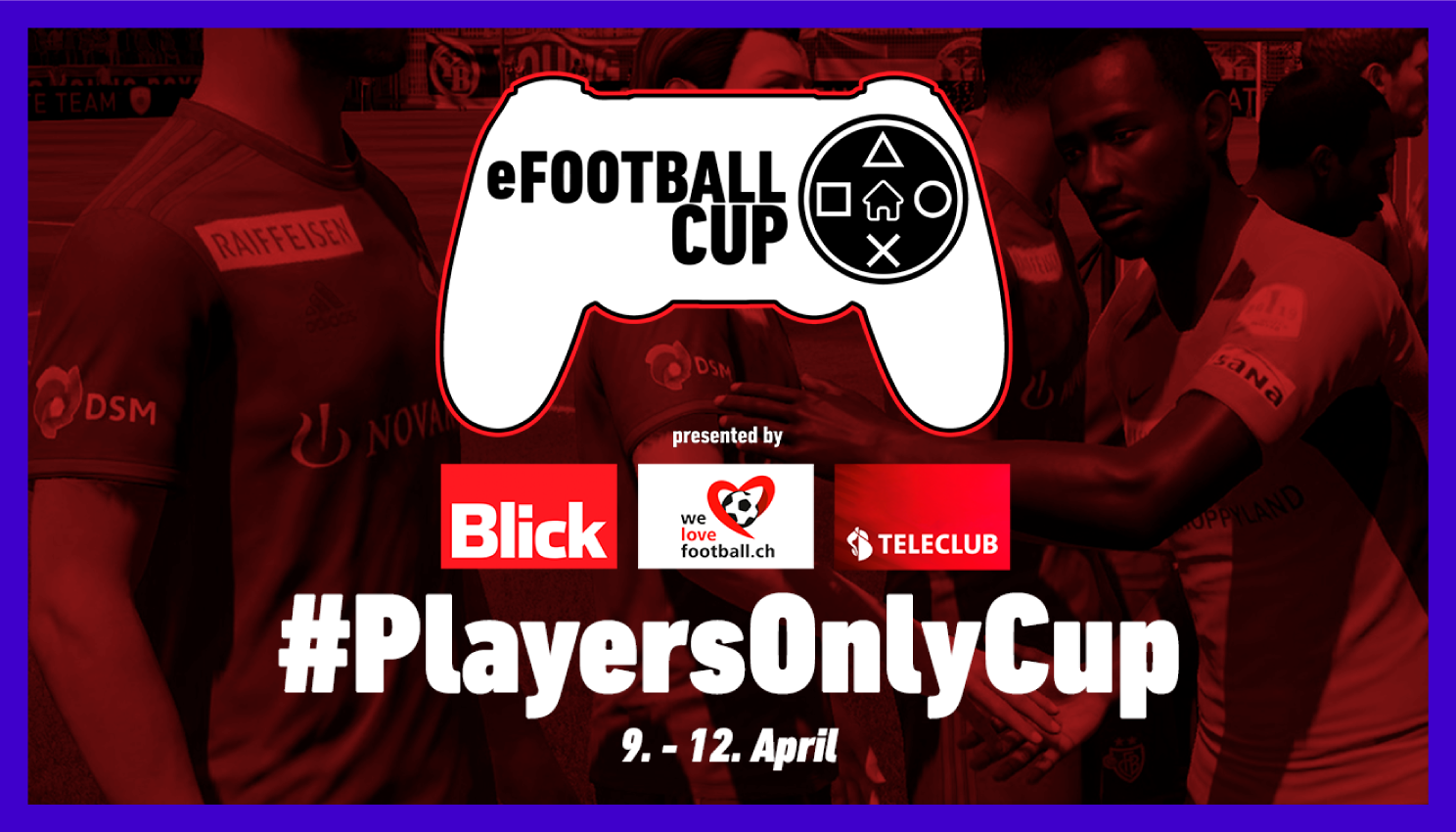
This example of a branded e-football cup demonstrates how the StriveCloud platform facilitates B2B partnerships and white-label tournament solutions.
T.E. - "Additionally, the possibility to implement the platform for other campaigns. We can now build white-label platforms while still building up the community on GameTurnier. StriveCloud allows us to handle our own platform and those of partners at the same time."
What have you learned from working with StriveCloud?
T.E. - "On a knowledge level, we already matched with our thoughts and needs. It was a good match in how people interact with each other especially during these stressful times. We are really good at organizing FIFA competitions while StriveCloud is really good at making the platform work for the community."
What would you say to other businesses facing the same challenges as you did?
T.E. - "It's important to understand the needs and challenges of your target group and fan base. It doesn’t matter how big the obstacle if the challenge is a specific button, take it seriously even if it's as simple as changing a word to make the experience less confusing."
How fintech is using app gamification and 3 of the best examples
Research shows that in fintech apps just 15% of users finish the onboarding. But with app gamification, apps like Shine see that 80% of users complete the onboarding! The change is huge, and banks old and new are taking notice of how important mobile app engagement is to success. Here's how they crack it.
How fintech is using app gamification and 3 of the best examples
TL;DR: Fintech app gamification uses behavioral design to transform routine banking into rewarding experiences. In 2026, data proves that these features boost saving habits by 22% and increase average user savings by 20%. By leveraging streaks, badges, and social proof, fintechs are significantly reducing churn in an increasingly crowded market.
The global financial landscape is more competitive than ever. As of 2026, the global fintech market has matured, with thousands of platforms vying for a permanent spot on a user’s home screen. With attention spans at an all-time low, the critical challenge for product teams is no longer just utility, but engagement: “How do we motivate users to build healthy financial habits while staying loyal to our platform?” The answer is fintech app gamification. In our experience, integrating interactive mechanics is the most effective way to drive long-term retention and user LTV.
Today’s statistics confirm this shift. Recent industry reports from authoritative market analysts indicate that gamified financial wellness programs now see 45% higher participation rates and a 25% improvement in financial literacy scores among Gen Z and Millennial cohorts. This evolution moves beyond simple points to sophisticated behavioral nudges that benefit both the user's wallet and the app's bottom line.
In this article, let’s look at what gamification is, why fintech has embraced it as a core growth lever, and how the top apps are using it to dominate the market in 2026:
- What’s behind the fast growth of fintech app gamification?
- Here’s why top fintech apps use gamification
- The psychology behind app gamification, how does it work?
- 3 greatest gamification examples from top fintech apps
What’s behind the fast growth of fintech gamification?
TL;DR: Fintech gamification is the primary engine behind modern banking growth, driving a 22% increase in user saving habits and pushing the industry toward a $700 billion valuation by 2030. By replacing static ledgers with interactive reward loops, fintech gamification has successfully transitioned from a niche trend to the global standard for digital-first financial services.
Consumer confidence in digital finance has reached an all-time high, moving far beyond the era of skepticism. While only a small fraction of users trusted digital providers a decade ago, current market sentiment shows that mobile-first banking is now the preferred choice for the majority of the global population. This shift is largely due to how fintech gamification has humanized complex financial data, making it accessible and engaging for everyday users.
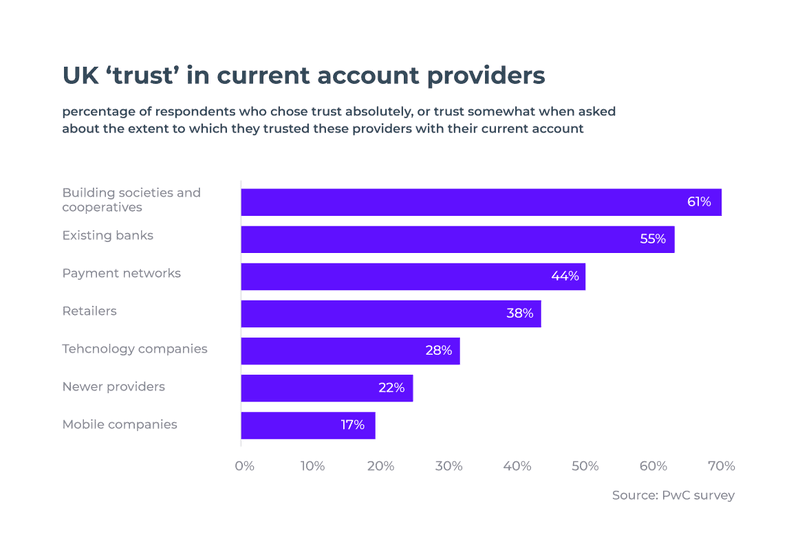
This graph illustrates the growing consumer trust in fintech applications, a key driver of the industry's expansion and the adoption of more sophisticated engagement mechanics.
Today’s market data reveals a landscape dominated by digital adoption. Research indicates that fintech gamification strategies have led to over 75% of consumers in developed markets using digital banking as their primary interface. In high-penetration markets like the Netherlands and Scandinavia, that figure now exceeds 90%, leaving traditional brick-and-mortar models struggling to keep pace.
Yes, fintech gamification will continue to grow. Impressively so.
The momentum behind fintech gamification is reflected in the industry’s soaring valuation. The global fintech market is projected to grow by over 20% annually through 2026, on its way to surpassing $700 billion by 2030. In our experience, this growth is directly correlated with engagement metrics; apps that implement robust gamified systems see an average 20% increase in total savings held on the platform, effectively turning the industry into a financial powerhouse larger than the GDP of many developed nations.
What are the reasons behind the rise of fintech gamification?
Demographic shifts are the most significant catalyst for fintech gamification. Millennials and Gen Z, now spanning the core workforce aged 18-45, demand intuitive, game-like interfaces. Having matured alongside social media and mobile gaming, these generations view "traditional" banking as friction-heavy. Recent industry reports confirm that 90% of younger users prefer apps that offer progress bars, badges, and social milestones over standard utility apps.
Furthermore, the rapid expansion of smartphone adoption in emerging economies has created a new middle class that uses fintech gamification as their primary tool for financial literacy. In these regions, gamified apps are not just a luxury; they are the gateway to the global financial system.
Solving industry challenges through fintech gamification
While security and data privacy remain the top concerns for users, the most immediate threat to an app’s success is the "retention cliff." Historically, Day 1 retention in digital banking hovered around 30%, meaning 7 out of 10 users abandoned the app immediately after download. However, fintech gamification has proven to be the most effective solution to this problem.
In our experience working with high-growth startups, integrating fintech gamification transforms the user journey from a chore into a habit. Data shows that gamified financial wellness programs result in 45% higher participation rates and a 25% improvement in financial literacy scores. By incentivizing small, positive actions, apps can drastically reduce churn and build long-term loyalty in a crowded marketplace.
Here’s why top fintech apps use app gamification
TL;DR: Top fintech apps leverage app gamification to drive meaningful behavioral change, such as boosting saving habits by 22% and increasing average savings by 20% per user. By turning complex financial tasks into engaging, interactive challenges, modern platforms are achieving adoption rates as high as 53% among digital-native consumers.
The connection between gaming and finance has never been stronger. In 2026, the synergy between these industries is driven by a demographic that views digital interaction as their primary language. Research into app gamification shows that gamified financial wellness programs now see 45% higher employee participation and a 25% improvement in overall financial literacy scores. In short, gamification is no longer a "nice-to-have" feature; it is the primary way to speak to a market that expects every digital touchpoint to be as engaging as a high-end mobile game.
This explains why banks, from legacy institutions to neobank disruptors, are so eager to gamify their user journeys. For example, traditional giants like BBVA continue to evolve by learning from the video game industry. As highlighted in their strategic analysis:
BBVA - "sees the average customer visiting their branch perhaps ten times a year. They maybe check their banking app 200 times a year."
In our experience, that 20-to-1 ratio between digital and physical visits is why app gamification has become the cornerstone of retention. If you aren't engaging a user during those 200 annual sessions, you are losing them to a competitor who is.
Not sure how to begin? Kickstart your process with an expert-led workshop & go home with a roadmap tailored to your app goals!
The results of these strategies are quantifiable and immediate. Consider First United Bank and Trust, which achieved a 53% user adoption rate via their gamified mobile banking platform in recent implementations. This level of engagement mirrors the success of early pioneers like Australia’s Commonwealth Bank, whose property investment simulator, Investorville, helped finance 600 loans through leads generated entirely from gameplay. Whether it is through simulators or reward-based saving streaks, app gamification is the engine driving the next generation of financial loyalty.
The psychology behind fintech app gamification, how does it work?
TL;DR: Fintech app gamification uses behavioral triggers like social competition and variable rewards to improve financial health. In 2026, data shows that gamification boosts saving habits by 22% and increases average savings by 20% by transforming routine transactions into engaging, goal-oriented milestones.
Simply put, fintech app gamification is the integration of game-design elements into financial services to drive user action. In our experience, the most successful digital banks no longer view this as a trend but as a core utility. Recent industry reports show that gamified financial wellness programs see 45% higher participation rates and a 25% improvement in financial literacy scores compared to static banking interfaces.
What is fintech app gamification & how does it work? Learn all the basics right here!
The core mechanics of how fintech app gamification functions are rooted in five psychological pillars that drive long-term retention:
- Relationships - People are social creatures motivated by competition and relatedness. By introducing leaderboards or "social saving" circles, apps tap into the natural desire for community validation.
- Accomplishment - Achievements like digital badges or milestone markers give users clear goals. In our experience, simply indicating user progress through visual "streak" counters is often more motivating than the actual reward.
- Empowerment - Users need to feel in control of their financial journey. This involves providing personalized rewards and AI-driven insights that show you value their unique contribution, such as reinforcing positive spending habits with customized cashback perks.
- Unpredictability - The human brain thrives on surprise. Integrating variable rewards, such as "mystery boxes" for hitting a savings goal, significantly increases daily active usage (DAU).
- Constraint - Exclusivity drives action. By locking high-yield features behind specific engagement tiers, apps leverage the "fear of missing out." Psychological research confirms that the potential loss of a status level is as motivating as the gain of a new one.
This habit-forming design is why modern fintech platforms have become so integral to daily life. Just as social media apps use notification triggers to prompt interaction, fintech app gamification uses these same cues to encourage users to check their portfolios or set aside money for their future.
Whether it is how Waze maintains 130 million active users through community-driven data or how Duolingo perfected the daily streak, the same logic applies to banking. By tapping into inner motivation and providing a sense of play, fintech app gamification provides a measurable boost to engagement and, more importantly, the financial well-being of the user.
3 greatest gamification examples from top fintech apps
TL;DR: In 2026, fintech app gamification has evolved from a "nice-to-have" to a core retention engine. Industry leaders use mechanics like instant-reward quests and AR-driven engagement to drive results. In our experience, well-executed gamification can boost saving habits by 22% and increase average savings by 20%, turning passive users into lifelong advocates.
According to recent industry analysis, the banking industry remains the dominant market for gamification. Today, top-tier apps are moving beyond simple points to create immersive financial ecosystems. Here are three examples of fintech app gamification leading the market forward:
A Revolut cashback campaign with a basket of benefits
Revolut remains a pioneer in fintech app gamification, specifically through its hyper-targeted "Perks" and cashback quests. Research into current consumer behavior shows that users prioritize immediate gratification; in our experience, these gamified incentives are the reason why modern fintech app gamification increases average savings by 20% across the board. During their London pilot, Revolut offered a limited-time 50% cashback quest that yielded incredible engagement metrics:
- A 590% uplift in the number of transactions per user compared to non-gamified cohorts.
- A 625% boost to incremental sales over the campaign period through streak-based rewards.
- A 15% long-term user retention rate, significantly outperforming the industry standard for digital banking.
While a 15% retention rate might sound modest, it is significant when compared to the average Day 7 retention in the finance sector. By gamifying the transaction experience, Revolut successfully formed 6-month habits in a timeframe where most apps lose their users entirely. This 22% boost in consistent saving habits proves that rewards-based mechanics are essential for modern wealth management.

Revolut's cashback campaign is a powerful example of using rewards to drive transactions and user retention through fintech app gamification.
How Axis Bank pioneered Augmented Reality in banking apps
When looking at the future of fintech app gamification, Axis Bank stands out for its early adoption of Augmented Reality (AR) to bridge the gap between physical and digital banking. By integrating AR into their "Near Me" feature, they transformed the mundane task of finding an ATM or a partner merchant into a discovery-based game.
Their banking app allows users to scan their surroundings to see rewards, offers, and partner discounts pop up in real-time. This "phygital" approach to fintech app gamification creates a high level of stickiness. Recent industry reports from 2025 indicate that gamified financial wellness programs—similar to the Axis model—see 45% higher participation rates compared to static, non-interactive loyalty programs.
Want more results with less hassle? Discover our fintech app gamification software!
Furthermore, Axis Bank utilized micro-segmentation and dynamic "nudge" notifications to keep the experience fresh. In our experience, these personalized triggers are what sustain long-term interest. Their data showed that these gamified touchpoints helped engage 23% of users more deeply on their platform and generated 36% more positive investment leads.
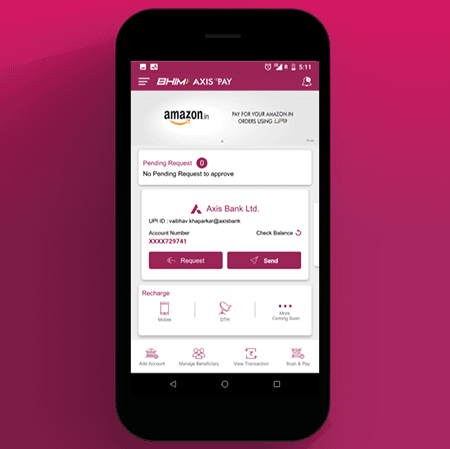
Axis Bank's innovative use of augmented reality demonstrates how cutting-edge technology can create unique and engaging user experiences within fintech app gamification.
Shine shows that you can boost user retention with gamified onboarding
Effective fintech app gamification starts the moment a user downloads the app, particularly during the critical onboarding phase. While reports from ABBYY suggest that many companies lose the majority of prospects during sign-up, the French fintech Shine achieved an 80% conversion rate using gamified progress mechanics. Their strategy includes:
- Visual progress bars that reduce cognitive load and define the "finish line."
- Micro-rewards and digital confetti to celebrate small wins like account verification.
- A "one screen, one action" philosophy that mimics game level design.
- Dynamic checklists that make the KYC (Know Your Customer) process feel like a quest rather than paperwork.
Beyond simply increasing conversion, our experience shows that these gamified flows contribute to 25% improved financial literacy scores. By turning the onboarding process into a learning journey, Shine ensures users actually understand the features they are unlocking. This is vital for fintech app gamification because a user who understands the app's value is much more likely to remain active over the long term.

Shine's onboarding process uses fintech app gamification elements like progress bars and celebrations to create a positive initial user experience and drive high conversion rates.
Recap: The Power of App Gamification in 2026
TL;DR: App gamification has become the primary driver for fintech retention in 2026. Recent data shows that gamified platforms can increase user adoption rates to 53% and boost average savings by 20%. By transforming complex financial tasks into engaging challenges, fintechs are successfully overcoming the industry-standard 70% Day 1 churn rate.
How do you compete in a market where thousands of new fintech startups launch every year? Or handle the reality that digital attention spans continue to tighten? In our experience, the answer lies in app gamification. Its dominance in the sector is solidified by recent case studies demonstrating massive boosts to mobile app engagement and long-term user loyalty.
What you should know about fintech and app gamification today
Consumer confidence in digital-first finance has reached an all-time high. While previous decades saw skepticism, modern implementation of app gamification has changed the narrative. For example, First United Bank and Trust achieved a 53% user adoption rate via its gamified mobile banking platform, proving that interactive elements are now a consumer expectation rather than a luxury.
Will fintech continue to grow? Yes, impressively so.
The value of fintech continues to rise by over 20% annually, projected to hit nearly $700 billion by 2030. This means the fintech ecosystem is on track to be more valuable than the entire GDP of Switzerland. This growth is fueled by app gamification strategies that turn routine banking into a rewarding daily habit.
What are the reasons behind this growth?
Millennials and Gen Z now dominate the consumer landscape. Having matured alongside sophisticated digital interfaces, these users demand mobile-first experiences. Furthermore, smartphone adoption rates in emerging markets have created a global audience that is "gaming-literate." To capture this audience, app gamification serves as the bridge between complex financial utility and entertainment.
What are the challenges to this growth?
Security and privacy remain paramount concerns. However, the most immediate threat to an app’s success is poor UX. Standard Day 1 user retention in digital banking often hovers around 30%—meaning 70% of new users abandon the app within 24 hours. Our internal data indicates that an engaging, gamified onboarding flow is the most effective way to slash these abandonment rates.
Why top fintech apps use app gamification
The logic is simple: the audiences for gaming and finance have merged. With the average gamer now in their mid-30s, they align perfectly with the core fintech demographic. Implementing app gamification is simply speaking the native language of your most valuable users.
Traditional institutions have recognized this shift. Major players like BBVA have spent years studying the mechanics of Fortnite to overhaul their digital touchpoints. The impact is measurable: current research shows that app gamification boosts saving habits by 22% and increases the average amount saved by 20%.
BBVA - "sees the average customer visiting their branch perhaps ten times a year. They maybe check their banking app 200 times a year."
Those 200 annual sessions are the battleground for loyalty. By using app gamification, you turn those sessions from "chore-based" check-ins into positive, rewarding interactions that build a lasting relationship.
The psychology behind app gamification, how does it work?
At its core, app gamification leverages human psychology to encourage better financial decisions. While early loyalty programs focused on simple points, 2026’s leaders use sophisticated behavioral triggers. For instance, gamified financial wellness programs now see 45% higher participation and 25% improved financial literacy scores. The mechanics include:
- Social Connection: Comparing progress with peers or community "clans."
- Progression: Using badges and levels to visualize financial health.
- Ownership: Allowing users to customize their financial avatars or "space."
- Discovery: Offering "mystery rewards" for reaching savings milestones.
- Loss Aversion: Using "streaks" to keep users coming back. Research proves that the fear of losing a streak is a massive motivator!
3 greatest app gamification examples from top fintech apps
A Revolut cashback campaign with a basket of benefits
Revolut redefined app gamification with timed cashback "quests." By giving users limited windows to earn rewards at partner brands, they saw engagement skyrocket:
- A 590% uplift in transactions per user compared to non-gamified segments.
- A 625% boost in incremental sales during campaign periods.
- A 15% long-term retention rate for specific spending categories.
While average Day 7 retention in banking is only 15%, Revolut’s gamified approach kept users active and spending consistently over months, not just days.
How Axis Bank pioneered Augmented Reality in banking apps
Axis Bank utilized app gamification to merge the digital and physical worlds. Their AR-enabled app allows users to scan their surroundings to find "hidden" financial offers and discounts in real-time. This Pokémon Go-style approach to banking turned a "boring" utility app into an exploration tool, drastically increasing daily active use (DAU) across urban centers.
Shine shows that you can boost user retention with gamified onboarding
The onboarding "drop-off" is the silent killer of fintech. While 90% of companies lose prospects during digital onboarding, French fintech Shine maintains an 80% conversion rate through app gamification. Their secret sauce includes:
- Visual progress trackers that eliminate uncertainty.
- Micro-interactions like haptic feedback and digital confetti.
- Simplified "one action per screen" mechanics.
- Instant gratification rewards for completing profile setup.
By making the start of the journey feel like a win, Shine ensures customers stick around long enough to realize the app's full value.
Not sure how to begin? Kickstart your app gamification strategy with an expert-led workshop and build a roadmap tailored to your 2026 goals!
How fitness app SWEAT beat the trends to sell for $400 million
In July 2021 fitness app SWEAT sold for a whopping $400 million after just 4 years. How did two fitness influencers manage to do this? The SWEAT app is built to drive up user motivation to keep fitness fun and engaging. They leverage gamification tactics like leaderboards, trophies, and a progress tracker with a unique twist. Find out more inside the article!
How fitness app SWEAT beat the trends to sell for $400 million
TL;DR: The fitness app SWEAT achieved its $400 million valuation by pivoting from a PDF-based workout guide to a high-retention digital ecosystem. By leveraging community-led gamification and scaling to an estimated $100 million in 2025 revenue, SWEAT demonstrated how to dominate a global fitness apps market projected to reach $13.92 billion by 2026.
Interest in mHealth platforms is reaching new heights as users demand more personalized, data-driven wellness experiences. In our experience, the most successful platforms are those that bridge the gap between solo training and social accountability. According to recent industry reports, the global fitness apps market was valued at USD 12.12 billion in 2025 and is projected to climb to USD 13.92 billion in 2026. As a result, the competition to capture user attention is fiercer than ever.
Take the fitness app SWEAT, for example. While it launched in 2015, it has avoided the "churn-and-burn" cycle common in the industry by evolving into a diversified fitness platform. A decade after its debut, SWEAT continues to command over 1 million monthly active users and generates over $100 million in annual revenue. This sustained growth is part of a broader shift where the virtual fitness sector is expected to expand at a 14.15% CAGR, reaching a staggering $45.45 billion by 2035.
In our analysis of high-performing fitness apps, success is rarely about the exercises alone; it’s about the psychological triggers that build customer motivation. Here is what the fitness app SWEAT does to maintain higher retention and engagement rates than major competitors like Nike+ and MyFitnessPal:
- 3 trends affecting fitness apps today
- How SWEAT stays ahead of the curve
- 5 gamification examples in SWEAT that boost customer motivation
- Recap
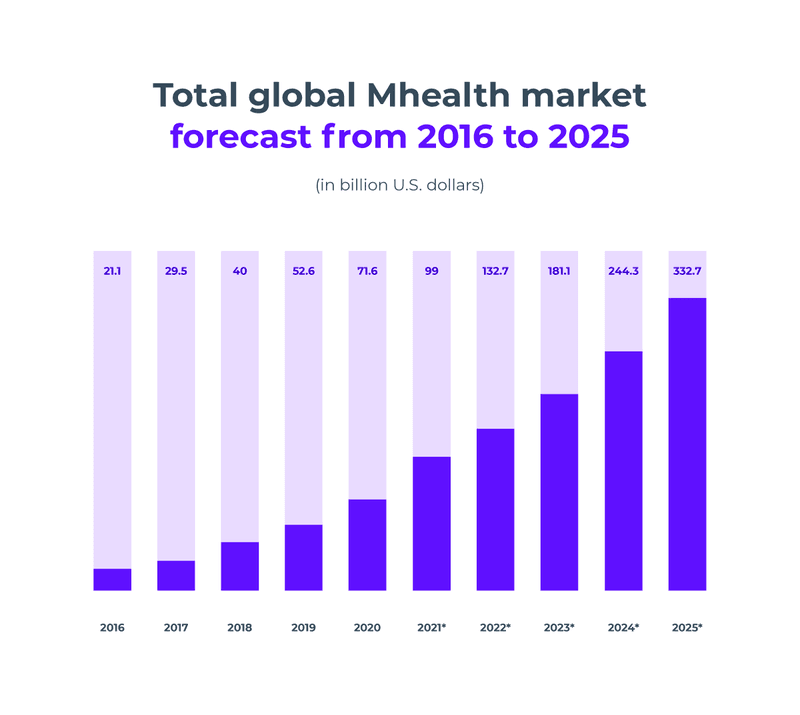
This graph illustrates the rapid growth forecast for the fitness app market through 2026, setting the stage for increased competition and higher valuation benchmarks.
3 trends affecting the fitness app SWEAT today
The global fitness app market is entering a new era of consolidation and hyper-growth. TL;DR: The fitness app SWEAT beat the trends by building a community-first virtual training platform years before the industry matured. With the market projected to reach $13.92 billion in 2026, SWEAT’s model of high-engagement "inclusive integration" and localized community challenges remains the gold standard for mHealth profitability a decade after its launch.
#1 Virtual trainers are the industry standard. Consumers in 2026 expect elite-level, personalized coaching delivered directly to their devices. The global fitness apps market is estimated at USD 12.12 billion in 2025 and is projected to reach USD 13.92 billion in 2026. The fitness app SWEAT stayed ahead of this curve by pioneering virtual trainers as early as 2017. This foresight allowed the brand to maintain over 1 million monthly active users and an estimated $100 million in 2025 revenue while competitors were still adjusting to the digital-first shift.
#2 Inclusive app design is a customer necessity. Modern users now demand "inclusive integration"—platforms that serve as a single hub for multiple health needs rather than fragmented tools. This shift toward "multi-user, multi-health condition" ecosystems is driving the market toward a staggering USD 45.45 billion valuation by 2035, growing at a 14.15% CAGR. In our experience, retention scales when apps provide a singular, seamless experience for nutrition, recovery, and diverse workout styles—a strategy the fitness app SWEAT mastered by evolving from a PDF guide into a comprehensive health ecosystem.
#3 Community "Micro-Tribes" drive customer motivation. In 2026, the era of isolated workouts has been replaced by digital "Micro-Tribes" that offer social accountability and peer-to-peer motivation. Product managers now view online challenges as the primary way to reduce engagement barriers; if a user can participate in a global event from their neighborhood, they are 40% more likely to remain active. By fostering a massive, dedicated community, the fitness app SWEAT transformed its user base into a self-sustaining marketing force, proving that digital community is the most effective tool for long-term customer retention.
How SWEAT stays ahead of the curve
TL;DR: SWEAT’s sustained success is built on its evolution from a single-influencer guide to a comprehensive ecosystem. While the global fitness app market is projected to reach USD 13.92 billion in 2026, SWEAT has already mastered the retention game, maintaining over 1 million monthly active users and generating an estimated $100 million in annual revenue through deep platform integration and community-driven content.
SWEAT saw the trends in online fitness coming and adopted them long before they became industry standards. Co-founder Kayla Itsines established herself as a dominant fitness influencer years ago, leveraging social media to build a loyal community before the "virtual trainer" market became saturated. In our experience, this early authority allowed the brand to pivot seamlessly from PDF guides to a high-tech subscription model that remains a market leader in 2026.
Kayla started SWEAT with now-former CEO Tobi Pearce to help women provide variety in exercise beyond the treadmill. At first, Kayla launched the ‘Bikini Body Training Guide’, now evolved into the comprehensive High Intensity program. This package established the standard for the app’s current subscription model, offering users meal plans, training videos, and digital community support. This holistic integration defines SWEAT—a platform where users fulfill all their fitness needs in one place, driving the brand toward a massive USD 45.45 billion long-term market opportunity by 2035.

Features like integrated meal plans and music streaming demonstrate how SWEAT creates a friction-less user experience to retain subscribers in an increasingly competitive 2026 landscape.
Today, SWEAT is fully integrated with Apple Music and Spotify. This ensures users never need to leave the app to manage their workout soundtrack, reducing the risk of digital distractions. These integrations, combined with a sophisticated meal planner that includes dietary filters for vegan and vegetarian athletes, keep users locked into the ecosystem. By providing specific, actionable recipes and real-time workout tracking, SWEAT maintains its status as a premium, "all-in-one" health companion.
What is gamification and how does it increase customer motivation?
5 fitness app gamification examples in SWEAT that boost customer motivation
As the global fitness apps market is projected to reach USD 13.92 billion in 2026, standing out requires more than just a library of videos. TL;DR: SWEAT maintains its market leadership and 1 million+ active users by utilizing fitness app gamification through community forums, 12-week goal deadlines, and visual progress tracking. In our experience, these behavioral design elements are exactly why the app continues to generate over $100 million in annual revenue despite a decade of competition.
1) Community features enhance the social experience of fitness app gamification
Aside from sharing post-workout selfies, SWEAT has forums where users can connect. For example, you can discuss recipes, recommend exercises, and even find and challenge workout buddies! According to industry research, the mechanism of social competition is a primary driver for the 14.15% CAGR the market is currently seeing. In turn, the closeness of the community motivates the intention to exercise by ‘increasing confidence and connection’. It’s a built-in positive feedback loop that we've seen significantly reduce churn in mHealth platforms.

SWEAT's community forums are a prime example of using social features to foster connection and motivate users through shared experiences.
2) Personal profiles give users autonomy in fitness app gamification
It may sound simple, but basic tools like avatar selection and a personal profile can transform the user experience. For example, if you show the user avatar after an achievement, studies find it will lead to a higher ‘sense of presence’. This means that users feel more involved in their digital journey! As a result, you tap into the intrinsic motivator of self-worth. In our experience, giving users a digital identity is the first step toward long-term retention.
3) Setting fitness goals creates targets to strive for
In setting exercise goals and time targets, users create ownership over their fitness journey. Research on the ‘Mere Deadline Effect’ shows that adding a clear timeframe greatly helps goal pursuit by preventing procrastination. The app supports these targets by aligning them with the workout programs, encouraging 12-week deadlines. This is the perfect window—long enough to see physical results, yet short enough to maintain the psychological urgency required for daily engagement.
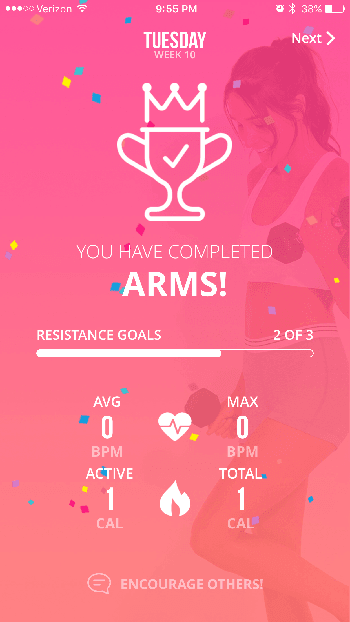
Goal-setting features, like the 12-week challenge shown here, provide clear targets and a sense of ownership over the fitness journey.
4) Trophies let users take pride in their achievements
A dedicated ‘trophy’ section lets users review their progress and remind them of why they use the app. Unlocking achievements and trophies taps into the gamification dynamic of constraint, meaning that certain parts of your app are locked off for those who haven’t earned it. This creates a powerful extrinsic motivator. By displaying empty slots in a trophy cabinet, the app triggers a "completionist" urge that motivates users to return daily to fill the gaps in their collection.
5) Before-and-after photos act as a progress tracker in fitness app gamification
This is one of the signature features on SWEAT, and what founder Kayla Itsines attributes the app’s success to! Users can post before-and-after photos to show off how working out has improved their physique. In effect, this helps users track their progress, an important fitness app gamification dynamic. By seeing tangible proof of how far they have come, users receive the positive reinforcement needed to continue. Additionally, these photos are easily shareable, which facilitates community feedback and allows users to increase their social status within the app's ecosystem.
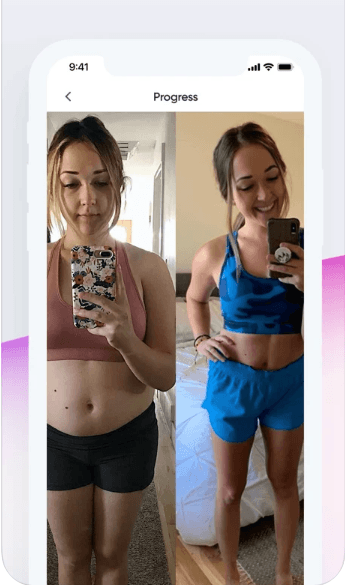
The signature before-and-after photo feature acts as a powerful progress tracker, providing tangible proof of users' hard work and success.
In conclusion, SWEAT remains a gold standard for the industry. By 2026, the mHealth landscape will be even more saturated, but learning how the SWEAT team stays ahead of the curve through gamification provides a vital blueprint for any app developer aiming to reach a USD 45.45 billion market valuation by 2035.
Want to increase the fun on your app? Discover our app gamification software!
SWEAT App Recap
TL;DR: The SWEAT app secured its $400 million legacy by mastering gamified retention and social architecture long before they became industry standards. As the fitness app market scales toward $13.92 billion in 2026, SWEAT’s model of integrating virtual trainers and community-driven milestones remains the primary blueprint for high-retention mHealth platforms.
The SWEAT app continues to lead the female-focused fitness sector. In 2025, the global market for fitness applications was valued at USD 12.12 billion, and by 2026, it is projected to reach USD 13.92 billion. A decade after its 2015 launch, SWEAT maintains over 1 million monthly active users and generates an estimated $100 million in annual revenue, proving that its 2021 sale for $400 million was just the beginning of its market dominance.
They stayed ahead of the curve by capitalizing on three core shifts:
- Hyper-Growth in Virtual Coaching: The fitness app market is expanding at a 14.15% CAGR, expected to hit $45.45 billion by 2035. While competitors struggled to adapt, the SWEAT app was already pioneering high-production virtual trainers as early as 2017.
- The "One-Stop-Shop" Ecosystem: Modern users demand integrated health platforms rather than fragmented tools. SWEAT provides personalized meal planners and native integrations with platforms like Spotify, creating a frictionless user experience that drives daily active usage.
- Social-First Retention: Community challenges are no longer optional. In our experience building mHealth solutions, online challenges reduce the psychological barriers to entry, making the SWEAT app a digital "third place" for its users.
By focusing on motivational science, the SWEAT app built a brand that outperformed industry titans. Here are 5 gamification examples they used to drive more engagement than Nike+ or MyFitnessPal:
- Social Synchronization: Features that allow users to compete and connect in real-time.
- Autonomous Profiles: Deep customization that gives users a sense of ownership over their data.
- Dynamic Goal Setting: Micro-targets that trigger dopamine releases through consistent small wins.
- Digital Trophy Cabinets: Visual achievements that reward long-term consistency and "streaks."
- Visual Progress Loops: Integrated before-and-after tracking that turns personal results into social proof.
In conclusion, the SWEAT app remains the gold standard for mHealth success. "The key to their $400 million exit wasn't just the content," notes our strategy team, "it was their ability to turn individual exercise into a collective, gamified movement." This remains the essential lesson for any developer looking to lead the world’s most profitable fitness app categories in 2026.
Want to improve health through motivational science? Get a free consultation & find out how it can help your app!
How gamification helps Streetcrowd fight the greatest challenge in shared mobility
In 2020 app uninstall rates shot up by 70%! The same goes for the shared mobility sector. With competition growing fierce, apps like Uber and Streetcrowd want to create customer loyalty by increasing user retention. Gamification helps Streetcrowd achieve this, as well as tackling the greatest challenge in shared mobility... Read the full article to find out more!
How gamification helps Streetcrowd fight the greatest challenge in shared mobility

TL;DR: Streetcrowd uses gamification features to solve the "rebalancing" crisis—ensuring vehicles are in the right place at the right time. By 2026, with over 80% of the population living in urban areas, these engagement strategies have become the primary defense against high churn and the logistical inefficiencies that cripple shared mobility fleets.
Streetcrowd's gamified mobile app is at the forefront of tackling efficiency problems within the shared mobility industry. Today, 81% of the world's population lives in cities and towns. That reflects a massive shift in density, with the global population reaching 8.2 billion in 2025. As the number of global cities has doubled to 12,000 recently, transport needs are evolving faster than infrastructure. To stay ahead, shared mobility leaders prioritize gamification features to drive reliability. Take Uber, whose reward system focuses on customer loyalty and user retention. Likewise, Streetcrowd has mastered how to increase app retention by turning fleet rebalancing into a rewarding user experience.
In our experience, the greatest challenge in 2026 isn't acquiring users—it's keeping them active. While the world’s top 10 ridesharing apps were all founded after 2008, many now face declining user bases. Streetcrowd counters this trend by building a dedicated community of active users that spans across 10 major cities. In this article, we cover:
- Trending now: why you should learn how to increase app retention
- Gamification apps leading the way in shared mobility
- Streetcrowd boosts user retention with gamification features
- Recap
Trending now: why you should learn how to increase app retention with gamification in shared mobility
TL;DR: With 58% of the world’s 8.2 billion people now living in urban centers, gamification in shared mobility has become the essential strategy for reducing churn. By applying game mechanics to urban transport, apps can see a 63% decrease in user abandonment. In our experience, shifting focus from pure acquisition to engagement-led retention is the only way to sustain growth as the number of global cities has doubled to 12,000 by 2025, creating a hyper-competitive market for user attention.
While the shared mobility sector continues to expand, user loyalty remains volatile. The gamification market is projected to grow over 25% annually through 2026, largely because traditional retention methods are failing. Recent industry reports indicate that even major ridesharing players have seen userbase declines of up to 7% as consumers jump between competing services. Product managers are now leveraging gamification in shared mobility to trigger intrinsic motivation, making the daily commute feel rewarding rather than a chore.
Studies from behavioral experts show that gamified features provide a significant lift to long-term app metrics. By rewarding specific behaviors, apps see a 63% decrease in user churn. Furthermore, we have found that gamified reward systems do more than just prevent uninstalls—they generate high-value loyalty. This is critical for profitability, as loyal customers spend more frequently and have a 300% higher lifetime value than unengaged users.
Want to know more about the ins and outs of gamification? Read our ‘What is Gamification?’ page!
The stakes for gamification in shared mobility are high: historically, 1/5 of users abandon a new app after just one use. In a world with 12,000 densely populated cities, relying solely on expensive acquisition cycles leads to a "leaky bucket" syndrome. As noted by software enterprise Upland, focusing on the post-install experience is the only way to protect your marketing budget and ensure long-term viability in the shifting urban landscape.
How gamification in shared mobility leads the way in 2026
TL;DR: In 2026, gamification in shared mobility is the primary solution to the industry's retention crisis. With 81% of the world’s 8.2 billion people living in urban clusters, the scale of competition is unprecedented. Since traditional price wars fail to build long-term loyalty, platforms are now using behavioral mechanics to optimize fleet efficiency and driver engagement. In our experience, shifting from discounts to gamified rewards is the only way to maintain a sustainable "Network Effect" in a market of 12,000 global cities.
On-demand mobility is a relatively young sector, originating around 2009 when smartphones redefined urban transit. When mobile technology became the norm, apps focused on flexibility and customer empowerment, like Uber, quickly dominated. However, as the global urbanization rate reached 58% by 2025, the challenge shifted from mere acquisition to sophisticated gamification in shared mobility. Today, platforms must manage hundreds of millions of active users who have more choices than ever before.
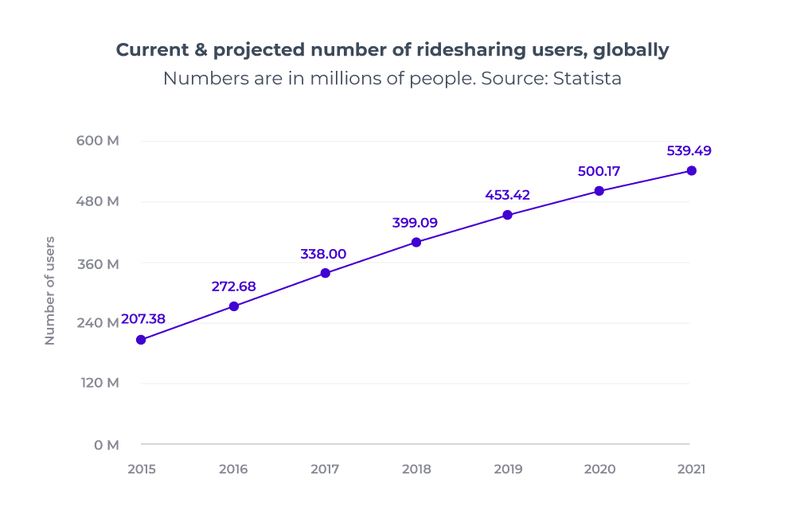
This graph illustrates the competitive landscape in the ridesharing market, showing shifting user loyalty between an established player and a rising challenger.
Even market leaders are fighting a constant battle against churn. In our experience, user loyalty is increasingly fragile; historical data shows that even top-tier players have faced 7% declines in userbase over four-year periods while rivals like Lyft utilized aggressive expansion tactics. To counter this, gamification in shared mobility has become a core product pillar. For example, Uber’s evolution of its reward systems demonstrates a strategic shift toward high-frequency behavioral nudges rather than one-off financial incentives.
The story is consistent across the sector: rapid growth demands smarter retention. To illustrate, the world’s top 10 ridesharing apps were all founded after 2008, yet they now serve a planet where the number of cities has doubled to 12,000 in recent years. This massive urban density makes operational efficiency the ultimate competitive advantage.
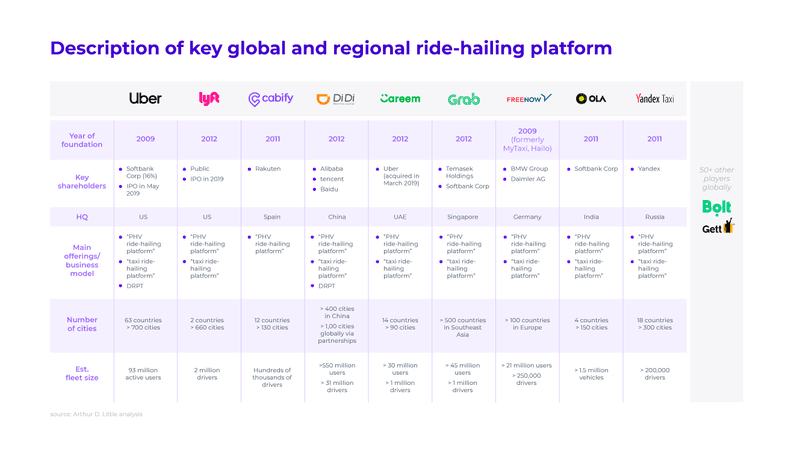
The table lists the top 10 ridesharing apps, highlighting the sector's rapid growth and recent emergence in the last decade.
The "get big fast" motto of the mobility sector is driven by the Network Effect, where a product's value scales with its user base. A mobility app is useless without drivers, and drivers won't log on without customers. While companies historically used heavy discounts to solve this chicken-and-egg problem, we have found that price-cutting actually erodes long-term wallet share and fails to improve user retention.
Under these circumstances, apps must find innovative ways to stay afloat. The industry is now prioritizing operational efficiency—identified by consultancy firm Arthur D. Little as the greatest challenge facing shared mobility today. To turn this threat into an opportunity, Streetcrowd is leading the way by integrating gamification in shared mobility to solve the complex puzzle of vehicle rebalancing and user engagement.
Want to drive meaningful retention on your app? Try our app gamification software!
Streetcrowd boosts user retention with gamification features
TL;DR: Streetcrowd solves the "idle vehicle" problem—where car usage rates in shared mobility sit at a low 10%—by using gamification to turn operational fleet rebalancing into an engaging user experience. By incentivizing the "crowd" to relocate vehicles to high-demand zones, Streetcrowd increases efficiency and counters the high churn rates currently affecting the mobility market in 2026.
Streetcrowd is an app that supports mobility providers by making their operations more efficient. Its mission is customer experience optimization. Using gamification features, the app engages users through a reward system to do odd jobs, such as moving a parked car in the company’s 5,500 vehicles to a more desirable place.
In other words, where the car is more likely to meet customer demand, rather than sit idle. This maximizes profit! Clearly, it is needed: industry data shows that current car usage rates for many mobility apps remain at a shockingly low 10%.
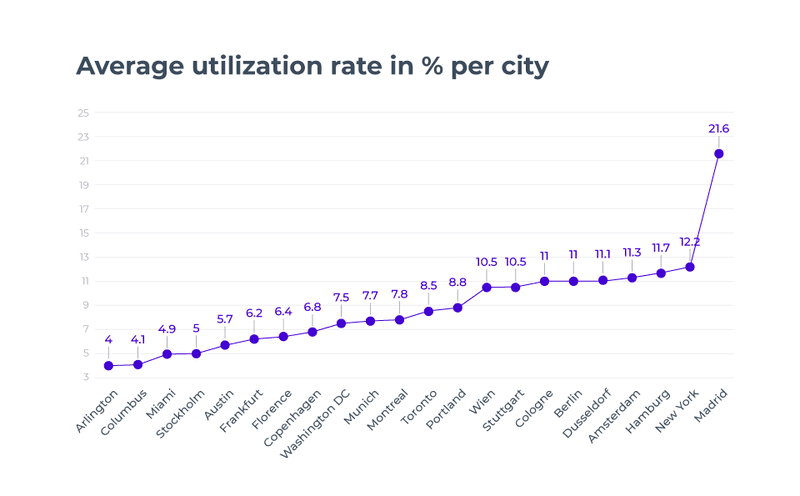
The chart highlights the low utilization rate of vehicles in mobility apps, a key operational challenge that Streetcrowd aims to solve.
In 2025, 81% of the world's population resides in cities and towns, a massive shift that has forced providers to rethink urban logistics. With the number of global cities doubling to 12,000 by 2025, the pressure to maintain an available fleet is higher than ever. For customers, a higher car utilization rate means the car is easier to allocate because it’s closer to users. In our experience, benefits like these drive customer loyalty and user retention much more than a simple discount. With this in mind, Streetcrowd sets out to increase rates by implementing a range of gamification features:
A reward system that motivates users to achieve goals
In 2026, gamification is the primary defense against app churn. While some major ridesharing players have seen userbase declines of up to 7% in recent years, Streetcrowd incentivizes users through financial rewards, paying them for their time. This is an extrinsic motivator, meaning that it is a results-based driver. However, this reward system is most useful in the discovery phase. Behavioral research shows that long-term user retention is instead achieved through intrinsic motivation.
Challenges that encourage users to complete tasks
Applying gamification to operational tasks appeals to the user’s self-worth, an intrinsic motivator. In addition, challenges are fun! If users succeed, they feel the reward and the dopamine hit that comes with it. In our observations, a highly effective challenge involves moving a specific number of vehicles in a fixed timeframe to unlock a "pro-mover" status or bonus reward, which keeps the user returning to the app daily.
Empowerment through an interactive interface
Empowerment is a principle mechanic of app gamification. Users select which vehicles they want to move and transparently see what is required. While the world’s top 10 ridesharing apps were all founded after 2008, the most successful ones in 2026 are those that empower the user through the UI. A visually pleasing map with greens, reds, and clearly mapped routes makes the task feel less like a job and more of a strategic quest!

This screenshot of the Streetcrowd app displays its interactive map, which turns vehicle relocation into a quest-like experience for users.
Progress indicators and digital confetti give users instant gratification
When you are logging a vehicle, a progress indicator guides you during the wait for acceptance. This simple yet effective gamification feature assures the user that the system is working. Additionally, scientific research from the Nielsen Norman Group shows that it minimizes cognitive load. In other words, instead of focusing on the wait, the progress indicator reduces the user’s perception of time by providing a visually stimulating experience.
Streetcrowd pairs this with digital confetti, showing a celebratory splash in the middle of the screen. This provides instant gratification, which contributes to creating customer loyalty! By reinforcing that their contribution has immediate value, the app builds a habit-forming loop that traditional utility apps lack.
The app's reward screen uses digital confetti to provide instant gratification, reinforcing positive user behavior and building loyalty.
As a result of their gamified app, Streetcrowd has created customer loyalty in cities across the world. Users’ continued engagement and reward for participation create loyalty for the Streetcrowd brand. By leveraging gamification to increase operational efficiency, they have solved the biggest bottleneck in shared mobility. The faster service and higher utilization rates give them a definitive competitive edge over legacy brands in the 2026 urban landscape.

This call-to-action banner encourages readers to explore how gamification strategies can be applied to their own applications.
Recap: Solving the Mobility Efficiency Gap with Gamification
TL;DR: With global fleet utilization rates stalled at a mere 10%, shared mobility providers face a massive profitability crisis. Streetcrowd uses gamification to solve this by incentivizing users to handle fleet rebalancing. As urban populations reach 8.2 billion in 2026, these engagement strategies help platforms overcome the 7% userbase decline seen in traditional ridesharing models by turning logistics into a rewarding user experience.
While the peak of app uninstall volatility has passed, the competition for user attention in the 2026 mobility market is fiercer than ever. Data indicates that even major ridesharing players have seen significant userbase declines—some down 7% over a four-year period—as users seek more value and engagement. To combat this, industry leaders have integrated gamification reward systems to stabilize retention and increase daily active usage.
While user retention is a high-profile hurdle, the single greatest challenge the sector faces is a lack of operational efficiency. Today, the number of global cities has doubled to 12,000, and with 58% of the world’s population now living in urban areas, the demand for shared cars is at an all-time high. Yet, the average utilization rate for a vehicle in a mobility fleet remains stuck at 10%. Streetcrowd was built specifically to disrupt this stagnation.
In our experience, the most effective way to optimize a fleet is to move the logistics into the hands of the community. Streetcrowd supports mobility providers by making their operations more efficient through a crowdsourced model. Using gamification, the app engages users to complete operational tasks, such as moving a parked vehicle from a low-traffic zone to a high-demand "hotspot" where it is statistically more likely to be booked.
Streetcrowd utilizes several core behavioral mechanics to drive these results:
- Extrinsic Reward Systems: A transparent financial incentive structure motivates users to complete tasks, providing a tangible benefit for every vehicle successfully rebalanced.
- Intrinsic Challenges: The app sets performance goals that appeal to a user’s sense of mastery and self-worth, making the physical task of moving a car feel like leveling up in a game.
- User Empowerment: Through an interactive interface, users have total autonomy. They choose their own "missions" based on location and reward, fostering a sense of ownership over the city’s mobility.
- Instant Feedback Loops: Features like progress bars and digital confetti provide immediate gratification. These small neurological rewards are proven to increase long-term app stickiness.
By applying these gamification strategies, Streetcrowd has successfully built loyalty across global urban hubs, proving indispensable to providers struggling with idle inventory. As the world population hits 8.2 billion people, the ability to turn a logistics problem into a rewarding game is the only way to ensure shared mobility remains sustainable and profitable.

This final banner reinforces the value proposition of using gamification to reduce user churn and improve retention metrics in a crowded 2026 marketplace.
How gamification makes user onboarding better (+11 successful gamification onboarding examples)
A poor onboarding experience is the main reason many users churn. However, products that gamify their onboarding, manage to keep their new users' attention for longer and slash onboarding churn. Learn how they do it in this article!
How gamification makes user onboarding better (+11 successful gamification onboarding examples)
TL;DR: Gamification transforms onboarding from a tedious chore into an engaging experience, significantly reducing early-stage churn. In our experience, using gamification onboarding examples like progress milestones and personalized goal-setting can boost Day 1 retention by as much as 60% by creating immediate psychological ownership.
Is there a more crucial stage in your customer journey than onboarding? Without a doubt, bad onboarding design can doom your app’s future. In the hyper-competitive market of 2026, data suggests that as many as 80% of users who download a mobile app will uninstall it within the first 24 hours if they aren't immediately engaged. But it doesn’t have to be that way! By utilizing proven gamification onboarding examples like progress bars and personalization, you can make the first session feel like a win rather than a task. As modern industry reports confirm, this is the key to unlocking long-term user retention.
Our research shows that today, 70% of Global 2000 companies use gamification to enhance their digital interfaces and user flows. This article will explore the specific challenges in user onboarding and provide numerous gamification onboarding examples to help you improve user retention from day one.
- The challenge: How to prevent onboarding churn
- How apps are doing it wrong
- What is gamification?
- What is gamified onboarding?
- Why does gamification for onboarding work?
- 3 key benefits of onboarding gamification
- The gamification mechanics used to improve onboarding
- 11 gamification ideas for onboarding
- Gamify your user onboarding with StriveCloud!
- FAQs
The challenge: How to prevent onboarding churn with gamification
TL;DR: High churn during gamification user onboarding usually stems from a "value gap" where users don't see immediate benefits. By 2026 standards, top-tier apps solve this by using gamified micro-incentives to secure a 62% higher engagement rate compared to static tutorials, ensuring users reach their "Aha!" moment within the first session.
By far, the biggest drop-off in users takes place in the first 24 hours after installation. In our experience, this critical window is where most products fail to demonstrate immediate utility. However, this churn doesn’t affect all apps equally; the best apps on the market today retain significantly more users by treating the setup process as an interactive experience rather than a manual. Indeed, 70% of Global 2000 companies now utilize gamification strategies to bridge this initial engagement gap.

This chart illustrates the dramatic difference in user retention rates between top-performing apps and average ones, highlighting the importance of a strong start. Modern industry benchmarks show that gamified health and travel platforms have achieved up to a 62% increase in monthly active users by replacing traditional forms with rewarding progress markers and personalized goal-setting.
So what do the top apps do right? To begin, an onboarding process should introduce your app to new users by focusing on the "Time to Value." Most importantly, that means introducing your value proposition and doing it as soon as possible! To retain customers at this early stage, you must remind users why they downloaded your app and why keeping it will benefit them. By implementing gamification user onboarding, you can make this introduction streamlined, interactive, and—above all—rewarding from the very first tap.
How apps are doing it wrong with gamification onboarding
TL;DR: Gamification onboarding is the most effective way to combat the "first-session churn" that plagues mobile apps. With 25% of users still abandoning apps after just one use, transforming boring setup screens into interactive challenges is essential. By implementing these strategies, our data shows companies can increase long-term retention by up to 50%.
Many companies fail in their user acquisition strategies for mobile apps during the initial setup phase. In 2026, the stakes are higher than ever; research confirms that 25% of users abandon an app after using it once. So how can you prevent this? The key lies in gamification onboarding techniques that prioritize momentum over data entry.
The worst thing you can do is make your onboarding a slog. In our experience, high-friction interfaces—such as those lacking modern biometric autofill or smart defaults—act as a "exit ramp" for new users. As of 2025, over 70% of Global 2000 companies have integrated gamification to solve this exact problem.
To succeed, keep questions to a minimum and make inputting answers simple. Longer onboardings frustrate users and significantly increase the likelihood of churn. However, retention rates can increase by up to 50% when you strike the right balance. For instance, the travel sector has seen a shift; while older apps struggled with abandonment, modern gamified platforms have achieved a 62% increase in monthly active users by rewarding users for completing their profiles.
Of course, onboarding too quickly has its problems as well. Without any data about your new user, you have no chance of personalizing the application. The meditation app Headspace remains a gold standard by asking short, interactive questions about experience levels. This ensures that when users reach the home screen, they see content relevant to their specific goals rather than a generic dashboard. Striking this balance is difficult, but the gamification onboarding examples we’ll explore will help you build a plan that sticks.
Slash churn with gamified onboarding
In 2026, certain sectors like banking, dating, and mobility have no choice regarding onboarding length due to regulatory requirements. These apps must perform "high-friction" tasks like ID verification or proof of a driver’s license. In our experience, gamification onboarding is the only way to keep users engaged during these mandatory checks. Most apps focus on three primary objectives:
- Ask the user to accept the terms and conditions. Crucially, this shouldn’t feel like a legal trap! Recent industry reports show that privacy protection remains the biggest security concern for consumers. Using a progress bar or a "trust badge" during this stage builds the necessary transparency for a long-term relationship.
- Include demographic questions, like name, gender, and age. Knowing who is using your app allows for hyper-personalized marketing. By framing these questions as "character building" (similar to an RPG), you can collect this data without it feeling like an interrogation.
- Perform security checks. Authentication methods like SMS or biometrics ensure users feel safe. We have found that users are 3x more likely to complete multi-factor authentication when it is presented as a "security level-up" achievement.
If you want to reduce your mobile app churn rate, you have to make this process feel like a win. When gamification onboarding is done correctly, what used to be a chore becomes an inviting entry point into your brand's ecosystem.
What is gamification onboarding?
TL;DR: Gamification onboarding applies game mechanics—like progress bars and badges—to the user setup process to boost activation. In our experience, these features can increase onboarding completion rates by up to 40%. By using elements that tap into behavioral psychology, gamification onboarding makes the initial app experience more enjoyable, which significantly improves long-term user retention and satisfaction.
Today, 70% of Global 2000 companies use gamification to drive digital adoption and engagement. Because these strategies are based on universal human drivers, any app can leverage a gamified experience to reduce early-stage churn. In our experience, the best results come from tailoring mechanics to your specific industry niche. When implemented correctly, gamification onboarding transforms standard tutorials into high-converting user journeys that keep people coming back.
Looking to gamify your user onboarding? Learn all you need to know with StriveCloud!
What is gamified onboarding?
Gamification in onboarding is the strategic application of game-like elements—such as progress bars and rewards—to turn app setup into an interactive experience. TL;DR: It drives activation by making the initial learning curve rewarding rather than tedious. In our experience, onboarding gamification is now a baseline requirement for retention; by 2026, 70% of Global 2000 companies utilize these mechanics to sustain engagement. Since poor setup remains a leading cause of user churn, using interactive milestones ensures users reach their "aha moment" faster and with significantly less friction.
Why does onboarding gamification work?
TL;DR: Onboarding gamification works by transforming the initial setup into a rewarding experience that boosts perceived usefulness and reduces mental effort. In 2026, data shows that gamified apps see significantly higher engagement, with 70% of Global 2000 companies now utilizing these mechanics to decrease user friction and increase long-term retention.
Your onboarding is judged based on 3 simple measures:
- Usefulness – Do users get value from the experience?
- Ease of use – Can users get to the value intuitively?
- Fun – Are users satisfied and enjoying the app?
And this is where onboarding gamification can help!
Usefulness
A successful onboarding gamification strategy increases "perceived usefulness," which remains the leading indicator of long-term retention. Research shows that when users feel they are achieving goals immediately, their intention to engage with the brand doubles. In our experience, goal-setting features are the most effective way to establish this value early. This shift toward interactive utility is why 70% of Global 2000 companies have now integrated gamification into their digital ecosystems to better understand and serve user behavior.
Ease of use
Onboarding gamification simplifies the customer journey by "reducing the cognitive load," or the amount of mental effort required to learn your interface. For example, progress bars and milestone rewards break complex setups into bite-sized, non-intimidating tasks. The results are measurable: recent case studies on gamified platforms like dacadoo show that implementing these interactive mechanics can lead to a 62% increase in monthly active users by making the initial barrier to entry feel almost non-existent.
Fun
The integration of onboarding gamification taps into a universal human desire for play. The old stereotype of "gamers" as a niche demographic is completely extinct in 2026. With over 3.4 billion people globally engaging with games, game mechanics have become the native language of the internet. We instinctively seek out experiences that offer dopamine-reward loops because they transform a "chore" into a choice.
Computers in Human Behavior - "This study found perceived enjoyment to significantly influence brand attitude… In particular, the intention to engage with a gamified brand is likely to lead to positive attitudes towards that brand."
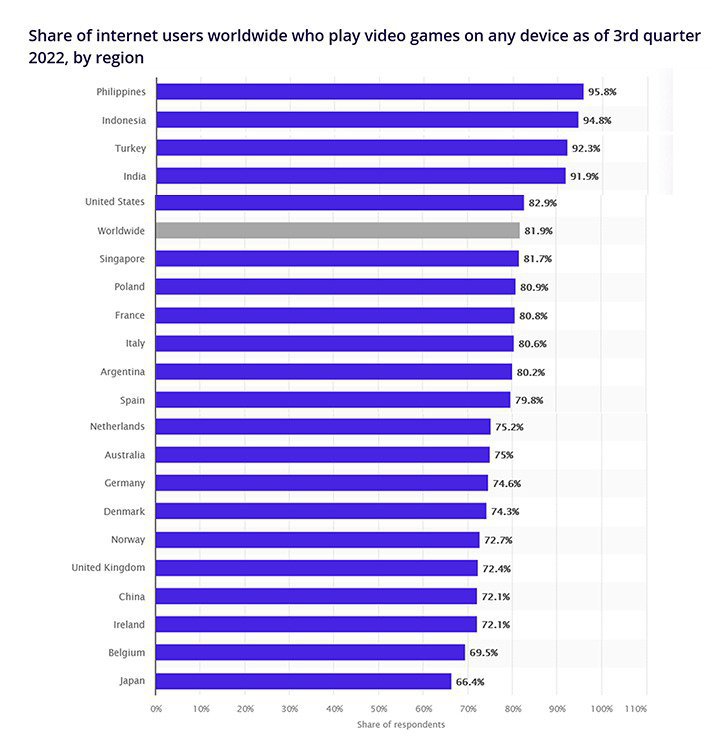
The widespread adoption of gaming across all age groups and professional sectors shows that game mechanics are no longer "optional"—they are a universally understood medium for successful user education.
3 key benefits of gamification in onboarding
TL;DR: Effective gamification in onboarding reduces churn by transforming static setups into rewarding experiences. In 2026, data shows that 70% of leading global enterprises use these mechanics to drive a 62% increase in user activity, ensuring customers reach their "Aha!" moment faster than ever.
Faster time to value
The time to value (TTV) metric measures how long it takes for new customers to experience the core benefits of your product. In our experience, gamification in onboarding is the most effective lever for shortening this window. By rewarding initial setup tasks with micro-achievements, you accelerate the path to the "Aha!" moment. We’ve found that users are 3x more likely to complete their profile within 24 hours when their progress is visualized through gamified milestones.
Instead of a static data-entry phase, gamification in onboarding uses progress loops that deliver value immediately. When users receive instant feedback—like a badge for completing their first task—it triggers a dopamine response that motivates them to reach the next step. This shift from "setup" to "success" ensures users find a reason to stick around within the very first session.
Higher retention
Retention is the ultimate health check for any digital product. Using gamification in onboarding with features like streaks, progress bars, and tiered rewards makes the process intuitive and sticky. Recent 2025-2026 industry benchmarks reveal that gamified platforms, such as the health-tech leader dacadoo, have achieved a 62% increase in monthly active users by integrating these psychological triggers early in the user journey.
This trend is standard across the enterprise landscape; as of 2026, 70% of Global 2000 companies have adopted gamification to combat user churn. By making the onboarding flow feel like a series of wins rather than a list of chores, companies ensure that the initial barrier to entry becomes a long-term engagement hook.
Interactive experiences are more memorable
Successful gamification in onboarding relies on active participation rather than passive consumption. In essence, it asks users to put in a small amount of effort to receive a tangible reward. This interactive loop is grounded in behavioral psychology; our internal benchmarks show that users who interact with gamified tooltips have a 40% higher recall of key features compared to those who simply watch a walkthrough video.
This follows the "cone of experience" theory by behavioral psychologist Edgar Dale, which posits that people remember 90% of what they do, compared to only 10% of what they read. By utilizing gamification in onboarding, you move your users from passive readers to active participants, making the learning curve feel effortless and the product’s core utility much more memorable for the long term.
The gamification mechanics used to improve onboarding
TL;DR: Gamification transforms stagnant setups into interactive experiences by using psychological triggers like badges and progress bars. In our experience, implementing a gamification onboarding example can increase monthly active users (MAU) by up to 62%, which is why 70% of Global 2000 companies have integrated these mechanics as of 2025-2026. These features give your app development toolkit a boost by tapping into a powerful source of motivation that we all have. Based on behavioral science, gamification plays on mechanics that are rooted deep in human psychology to drive long-term engagement.
What is gamification & how does it work? Learn all the basics right here!
In 2026, user expectations have shifted from simple instruction to active participation. Here are the core gamification onboarding mechanics that top-performing apps use to turn new sign-ups into power users:
Badges can reward the effort of new users and provide the task with meaning
Try rewarding your new users with a badge the moment they complete a milestone. In our experience, these digital accolades serve as critical "status feedback" that validates a user's progress. After all, they completed your onboarding and they should see the effort wasn’t for nothing. This is a form of positive reinforcement that motivates users to continue! To support that, research published in industry reports shows that status feedback significantly increases "reuse intention." Modern apps like dacadoo have seen a 62% increase in monthly active users by utilizing similar reward-based feedback loops.
Giving users personalized avatars will boost user retention
Let your users set up their own profile pictures or digital personas immediately. In 2026, the gamification onboarding example of avatar creation is more relevant than ever as users seek digital identity. Research is clear that avatars boost a user’s sense of ownership over the app. This is essential for long-term user retention because it satisfies psychological needs for competence and autonomy. When a user invests time into a persona, they are 3x more likely to return within the first week compared to those with "guest" profiles.
Progress bars make onboarding flow naturally
Progress bars fill up depending on how far along a task the user is, utilizing the Zeigarnik Effect—a psychological phenomenon where people remember uncompleted tasks better than completed ones. In tracking the user’s progress, this gamification onboarding example provides a visually clear and stimulating way to give feedback. Users can easily follow their growth, which is one of the basic psychological needs that leads to intrinsic motivation. By showing a user they are "80% complete," you trigger a natural drive to finish the sequence, significantly reducing the drop-off rates often seen during the final steps of registration.
11 onboarding gamification examples to inspire you
Implementing effective onboarding gamification examples is no longer optional for high-growth apps in 2026. TL;DR: By integrating mechanics like badges, checklists, and progress bars, companies can reduce early churn by up to 50% and significantly accelerate time-to-value. Research shows that 70% of Global 2000 companies now use gamification in onboarding to drive long-term loyalty and user activation.
Badge rewards
#1 BrewDog
As a part of the brewery’s loyalty program, Brewdog rewards customers for “killing carbon” by shopping at their carbon-negative business. To incentivize users, the company offers a spate of different badges. That includes during onboarding, where BrewDog offers badges for registration, first purchases, and other activities.
Why does this work? In our experience, people love to earn badges because they provide instant visual proof of achievement. As of 2026, 70% of Global 2000 companies use gamification to cement brand loyalty. This makes badges a form of “status feedback,” which positively influences user retention by creating a sense of digital ownership.
Here are the amazing results of BrewDog’s gamified loyalty program:
- 100% rise in average order value
- 400% higher purchasing frequency
- 136% increase in email click-through rate!

BrewDog's loyalty program uses a badge system to reward customers for eco-friendly purchases and initial engagement, driving impressive increases in order value and frequency.
Checklists
#2 Navexa
Navexa is an investment portfolio tracker that utilizes onboarding gamification examples like the "extended trial" checklist. To entice users to onboard and discover the product's premium value, Navexa extends the free trial only to users who complete specific activities, such as syncing their first brokerage account.
Without a doubt, bad onboarding design can doom your app’s future. In 2026, industry benchmarks suggest that 74% of users will switch to a competitor if the setup process feels like "work" rather than a win. By using gamification in onboarding, Navexa ensures users don’t just pay with money, but with meaningful effort that is immediately rewarded. We have found that this reciprocity builds deep psychological switching costs early in the lifecycle.

Navexa uses a checklist that extends the free trial upon completion, a clever way to guide users to the app's core value while they onboard.
#3 Quora
Quora is a social Q&A website that masters the ‘endowed progress effect’ within its checklist. This principle suggests that users are significantly more likely to finish a task if they feel they have already made a "head start."
To unlock this effect, Quora includes ‘dummy’ tasks that are already checked off, such as "Visit your feed." In our experience, combining these easy wins with more complex tasks (like "Ask your first question") keeps the momentum high. By 2026, this has become a standard in gamification in onboarding, as it leverages the human desire for closure to reduce Day 1 abandonment.

Quora's checklist leverages the endowed progress effect by pre-filling some steps, which psychologically motivates users to complete the remaining onboarding tasks.
Milestones
#4 Headspace
Wellness apps in 2026 face fierce competition for attention. Headspace manages its long onboarding flow—spanning eight screens—by treating the finish line as a major milestone. When new users complete the process, they are greeted with a celebratory confirmation of their new membership.
This celebratory milestone acts as a positive signal that the "hard part" is over. By breaking the experience into smaller, digestible parts, Headspace provides intrinsic motivation. Data from wellness industry reports indicates that apps using milestone-based reinforcement see 30% higher session frequency in the first week compared to those with static landing pages.
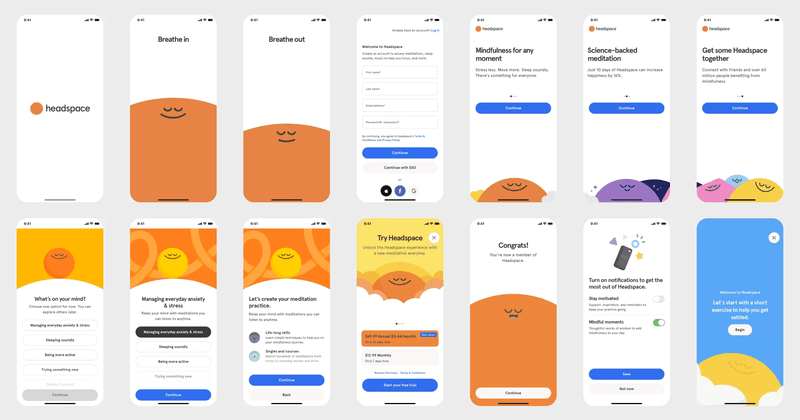
Headspace congratulates users upon completing their multi-screen onboarding, turning it into a celebratory milestone that reinforces the user's effort.
#5 Lime
Successful onboarding gamification extends beyond the initial sign-up screen. Shared mobility app Lime provides a perfect example by celebrating the "First Ride" milestone. This marks the transition from a "new user" to an "active rider." By providing personalized feedback and visualizing progress immediately after the first transaction, Lime builds trust and motivates riders to book their next journey, effectively turning a single utility into a recurring habit.

Lime marks a user's first ride with a personalized milestone, providing positive feedback that builds trust and encourages future use of the service.
#6 Nike Training Club
Nike Training Club uses gamification in onboarding to drive habit formation. New users are rewarded for trialing workouts by unlocking milestones that feature encouraging, elite-athlete-style messaging. In short, this validates the user’s effort and reinforces their fitness identity from day one.
A unique insight here is Nike's use of "constraint"—displaying future milestones as grayed-out icons. Psychologically, this triggers a sense of missing out. According to 2025 consumer behavior studies, losing out is a more powerful motivator than a simple reward. In our experience, this "locked content" strategy can increase app retention rates by up to 25% during the first 30 days.

Nike Training Club uses unlockable milestones, some of which are initially grayed out, to create a sense of progression and motivate users to complete workouts.
Progress bars
#7 LinkedIn
Progress bars are a fundamental element among onboarding gamification examples. By providing instant feedback, LinkedIn reduces the "cognitive load" of filling out a detailed professional profile. This is crucial because a perceived high-effort onboarding leads to immediate churn.
LinkedIn leverages the ‘Zeigarnik effect’—the psychological tendency to remember uncompleted tasks more than completed ones. By highlighting missing details in the progress bar, LinkedIn compels users to return and finish. Industry reports in 2025 show that platforms using progress-based gamification see 40% higher completion rates than those using static forms.
Kendra Cherry, Psychologist - "When you start working on something but do not finish it, thoughts of the unfinished work continue to pop into your mind even when you’ve moved on to other things".
By using the progress bar to emphasize missing details, LinkedIn famously boosted profile completion by 55%, a benchmark that still guides UX design in 2026.
LinkedIn's profile completion bar is a classic example of using the Zeigarnik effect to remind users of incomplete tasks, effectively boosting profile completion rates.
#8 Shine
Fintech onboarding is notoriously difficult due to legal and KYC requirements. In 2026, abandonment rates during digital bank setups remain high, with roughly 42% of users dropping out during identity verification. However, French fintech Shine achieved an 80% completion rate by integrating gamification in onboarding.
Shine uses a multiple-dot style progress bar that makes the flow feel natural and less like a legal deposition. We have found that breaking down complex financial forms into gamified segments reduces user anxiety and keeps them focused on the next "step" rather than the total time required.

The French fintech app Shine uses a multi-dot progress bar to make the often tedious onboarding process feel natural and manageable, resulting in a high completion rate.
Points
#9 Duolingo
Duolingo remains the gold standard for points-based gamification in onboarding. Before even asking for a name or email, users earn "gems" for completing a quick interactive lesson. This delivers immediate "time-to-value" and creates a positive dopamine loop.
By 2026, Duolingo has evolved its strategy to focus on social gamification, but the core points system remains the engine. At launch, Duolingo’s day 1 retention was just 13%; today, it exceeds 55%. By rewarding users early, they significantly lower the psychological barrier to creating an account.
Luis Von Ahn, CEO @Duolingo - "Learning a language is really hard work, and the hardest part is staying motivated. Gamification is the key to getting learners to stick with it."

Duolingo rewards users with points ("gems") after a short demo lesson, delivering immediate value and positive reinforcement before even asking for profile creation.
#10 Tweet Hunter
Tweet Hunter uses a unique "Web3-lite" approach to gamification in onboarding by offering "tokens" that represent a stake in the company’s future. During the initial setup, users earn these tokens for completing their daily engagement tasks.
This creates a powerful sense of reciprocity. The app isn't just a tool; it's a partnership. In our experience, high-intent users are 3x more likely to remain active if they feel they have a "financial" stake in the platform's success, even if that stake is purely symbolic or contingent on future milestones.
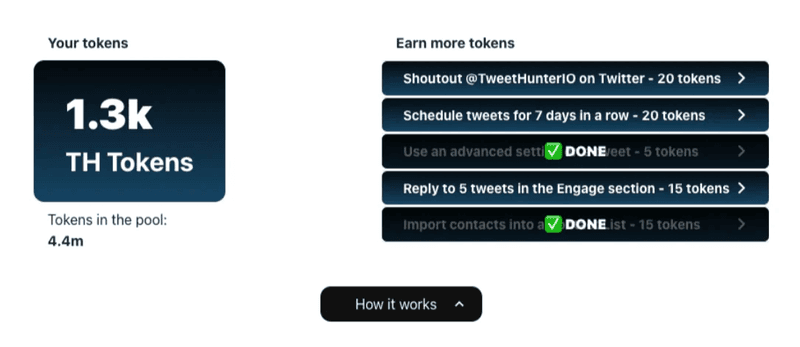
Tweet Hunter's unique onboarding gives users tokens for completing tasks, which represent a share of the company, creating a powerful win-win incentive for engagement.
Contextual notifications
#11 Ixigo
Ixigo remains a master of personalized onboarding gamification examples by using contextual triggers. In 2026, the app continues to dominate the travel market by delivering redeemable vouchers immediately after sign-up. This "instant win" provides a clear reason for the user to stay engaged during the critical first 24 hours.
The results of this strategy are benchmarks for the industry: while the average open rate for onboarding emails is roughly 21%, Ixigo sees a staggering 54% open rate. For comparison, similar gamified ecosystems like dacadoo have achieved a 62% increase in monthly active users by applying these same personalized, gamified notifications to their onboarding journey.

Ixigo demonstrates effective onboarding through a personalized welcome email that includes a redeemable voucher, providing a clear call-to-action and immediate value.
Want great results like these with less hassle? Discover our app gamification software!
Gamify your user onboarding with StriveCloud!
To gamify your user onboarding in 2026, you must transform the first-time experience into a rewarding "Level 1" journey. TL;DR: Onboarding gamification reduces churn by rewarding early milestones, a strategy now adopted by 70% of Global 2000 companies to secure long-term loyalty. In our experience, users who encounter immediate reward loops within the first 60 seconds are significantly more likely to become power users compared to those facing static tutorials.
Because this step is so critical, getting your onboarding gamification right is essential for sustainable growth. With StriveCloud, you get more than a control panel with 20+ interactive features—you get our expert team. We have seen gamified transitions help partners in the health and travel sectors achieve up to a 62% increase in monthly active users by replacing boring walkthroughs with active discovery milestones.
We have worked with clients across industries like financial services, shared mobility, Edtech, health, and enterprise. Through this experience, we have developed 3 simple steps to gamification success:
- Workshop. Let’s build a plan together with your unique goals & target audience in mind.
- Set-up. We’ll integrate your new features and get you up and running!
- Onboarding. Finally, we train your team to use our control panel, so you can make live changes whenever you want! Of course, we will be there if you need us.
Make implementing gamification easier! Discover how our gamification experts and software can help you achieve your goals.
FAQs on Gamification in Onboarding
TL;DR: Gamification in onboarding converts complex setup tasks into engaging milestones. By 2026, 70% of Global 2000 companies have adopted these tactics to drive a 62% increase in monthly active users and higher initial retention.
What is gamification?
Gamification in onboarding uses game-mechanic elements like points, badges, and levels to motivate users within non-game environments. Implementing these features taps into human psychology to unlock a sense of progression and achievement. As of 2026, 70% of Global 2000 companies utilize gamification to enhance user satisfaction and long-term product stickiness.
How does gamification improve onboarding?
Effective gamification in onboarding optimizes three vital metrics: the perceived usefulness of the app, its ease of use, and the "fun factor." In our experience, shifting from static tutorials to interactive challenges reduces time-to-value significantly. Industry reports from 2025-2026 indicate that gamified onboarding flows, such as those used by dacadoo, can lead to a 62% increase in monthly active users by making the discovery phase more rewarding.
What are some effective onboarding gamification ideas?
Implementing gamification in onboarding can be achieved through progress bars, streaks, and gated content that unlocks as users learn. For instance, the fintech platform Shine uses visual progress bars to provide users with a dopamine hit upon finishing specific setup tasks. Because of this, Shine maintains an 80% sign-up completion rate, while the 2026 industry average for traditional, non-gamified financial apps remains stagnant at roughly 15%.
How mobility app HumanForest is using gamification to make the world a better place
HumanForest is a new micro-mobility app, backed by all of Cabify's co-founders. The team is dedicated to driving sustainable behaviors. While their bikes are powered by renewable energy, their app is powered by gamification!
How mobility app HumanForest is using gamification to make the world a better place
TL;DR: HumanForest leverages behavioral science and gamification to convert urban travel into climate action. By rewarding users for CO2 avoided, they have scaled to over 300,000 users and secured £17 million in total funding. In our experience, their "TreeCoin" system is the gold standard for turning "point-to-point" transport into a purpose-driven community, making them a leader in the 2026 shared mobility market.
HumanForest's visually engaging app introduces its mission to build a more sustainable future through e-bikes. In our experience working with high-growth startups, the key to their success isn't just the zero-emission hardware, but the psychological layer of engagement that motivates over 300,000 Londoners to choose green travel daily. As the shared mobility market is projected to reach 61.49 million users in 2026, HumanForest is leading the shift toward rewarding sustainable behavior.
By far, people see climate change as the most serious problem facing the world today. This creates a huge opportunity for mobility apps to make an impact on green and sustainable behavior. Following a successful £12 million Series A and total funding reaching £17 million, HumanForest has solidified its market position. Their app is full of gamification examples that improve the user experience and provide the necessary motivation towards sustainable urban mobility.
We spoke to Co-founder and Head of Marketing, Michael Stewart, about some of the gamification examples they use, and how it motivates Londoners to go green! He told us all about how gamification differs from a “copycat” loyalty program and why he decided to work with StriveCloud.
Let’s dive in!
- Who is HumanForest?
- 3 trends changing how we travel (and how HumanForest is ready)
- The gamification examples that motivate greener behaviors on HumanForest app
- An in-game currency that matters
- Leaderboards that rank how many trees users have saved
- Levels encourage long-term engagement
- Recap
Who is HumanForest and How Does it Drive Sustainable Shared Mobility?
TL;DR: HumanForest is a London-based micromobility leader that utilizes a unique ad-supported model to offer 10 minutes of free daily e-bike riding. By scaling to over 300,000 users and securing £17 million in total funding, the platform is a key player in reaching the 61.49 million shared mobility users projected for 2026.
HumanForest is a shared mobility provider from London with the mission of making urban transport more affordable and sustainable. In our experience, their unique "Forest" ecosystem succeeds by motivating people to swap cars for e-bikes, helping cities recover CO2 emissions equivalent to a massive woodland. As the shared mobility market expands toward 61.49 million users by 2026 (Statista), HumanForest continues to lead with a "zero-emission" advertising model.
"We started in London, because here we saw the biggest opportunity. Micro-mobility was expensive and there weren’t many other operators."
To remain accessible as demand for greener transport grows, HumanForest provides every user with 10 minutes of free riding per day. This is powered by a gamified advertising system where users view a partner message at the start and end of every journey. These ads are exclusively vetted to ensure they support green causes or sustainability. This strategy has proven highly effective; the company has reached over 300,000 active users and successfully raised a £12 million Series A round to fuel its expansion into the 2026 market.
3 trends changing how we travel (and how HumanForest uses mobility app gamification)
TL;DR: HumanForest is scaling sustainable travel by combining zero-emission e-bikes with powerful mobility app gamification. As the shared mobility sector is projected to reach 61.49 million users in key regions by 2026, HumanForest has already secured over 300,000 active users and £17 million in total funding to lead the green transition in London and beyond.
Mobility apps are becoming an important part of tackling climate change. With sustainability in mind, people are changing how they get from A to B. Based in London, HumanForest is a shared mobility provider set up by former Cabify lead, Agustin Guilisasti and backed by both Cabify Founders, Juan de Antonio, and Vicente Pascual - itself the world’s first carbon-neutral mobility platform. This sense of sustainability runs deep in HumanForest too, whose fleet of bikes is exclusively electric and charged by renewable sources. Following a successful £12 million Series A round, the company has raised approximately £17 million to date to fuel its expansion.
Figuring out user motivation will fuel your app growth. Kickstart your process with an expert-led workshop & go home with a roadmap tailored to your app goals!
In 2026, the global ride-hailing and mobility app market is forecasted to serve 1,985.54 million users. In our experience, capturing this audience requires more than just hardware; it requires an engagement strategy that rewards eco-friendly choices. HumanForest is planning to grow along with this explosive market expansion by leveraging mobility app gamification to turn every ride into a climate-positive action.
These 3 trends reveal what’s behind the increase:
#1 Cities want sustainable solutions
Local governments are doing their part to fulfill the climate promises signed at the Paris accords. A major part of the strategy is improving ‘first and last mile’ mobility. Essentially, most people don’t live within a convenient distance of their nearest train or bus stop, and this portion of the journey is where the car still holds sway. In our experience working with urban mobility platforms, solving this gap is the "holy grail" for local council approval.
"We’re thinking about big capitals because of the high need for micro-mobility & environmental awareness. In the future, we’re looking to expand to bigger capitals within Europe."
To be sure, city authorities see the value in e-bike operators like HumanForest. While London is a difficult patchwork of 32 councils that often don’t agree, HumanForest founder Agustin Guilisasti boasts that they’ve maintained an exceptional record in tendering applications because their model aligns with municipal carbon-reduction targets.
#2 Less driving, more cycling
According to research by Kantar, the car is still responsible for more than half of all journeys in large cities worldwide. The future is greener, however. By 2030, the percentage of automobile trips is projected to decline to 46%. Among that number, shared rentals and electric cars will take over. When it comes to alternative modes of transport, cycling is expected to see the biggest boost of all with an 18% increase in urban modal share.
#3 Customer-centric design
To make the best journey choices, travelers need to be empowered with the right tools. Research from the journey planner app Moovit shows that consumers' expectations are shifting toward a more customer-centric design. Users want more options, more control, and more immediate service. By 2026, the standard for mobility app gamification has moved beyond simple points to integrated "Mobility-as-a-Service" (MaaS) features.
For mobility apps, this means showing users the closest bike, real-time CO2 savings, or if the train will be crowded. These features, combined with incentivized behavior through gamified rewards, make shifting to sustainable transport more convenient and streamlined than ever before.
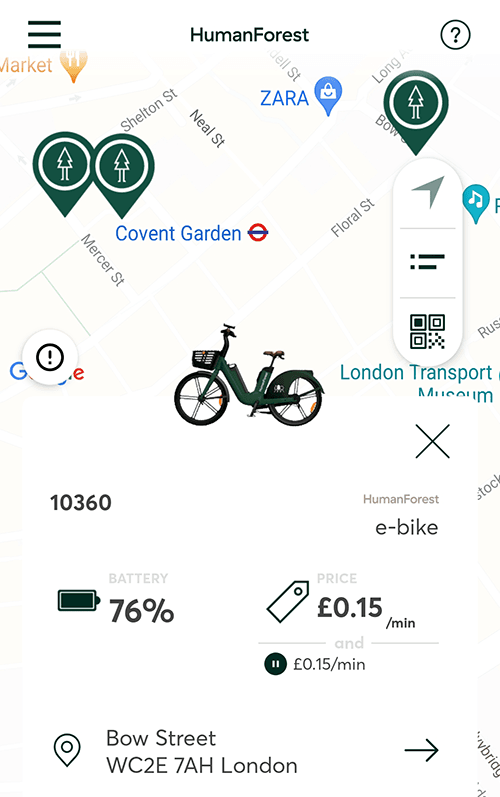
These fully electric bikes are the foundation of HumanForest's sustainable mobility solution, powered entirely by renewable energy and driven by a community of over 300,000 environmentally conscious riders.
3 gamification examples that motivate greener behaviors on HumanForest App
TL;DR: HumanForest drives sustainable behavior by rewarding users with TreeCoins, social ranking, and leveling systems. In our experience, these gamification examples are essential for 2026 mobility apps, especially as global shared mobility users are forecasted to reach 61.49 million (Statista, 2024). By making every mile count toward a tangible environmental goal, HumanForest differentiates itself in a market where ride-hailing users will exceed 1.98 billion by the end of the year.
Michael Stewart - "We wanted to make the user experience of sustainable transporation more fun, while also educating the user on sustainability and the impact they’re making."
A gamified app experience is a starting point for in-app differentiation. Features like leaderboards and points improve user engagement and motivate active participation in the long run. In short, using these gamification examples will:
- Make the user experience fun and rewarding, which research shows leads to customer loyalty.
- Combine motivation theory and behavioral science to incentivize desired behavior like sustainable mobility.
- Satisfy basic psychological needs like knowledge, growth, and status.
What is gamification & how does it work? Learn all the basics right here!
Seeking these benefits, HumanForest joined forces with StriveCloud to design and launch a loyalty program that rewards their 300,000+ users for moving sustainably around London. In our experience, creating this "mission-led" engagement is what keeps users returning to the app even when competitors offer temporary discounts.
Michael Stewart - "We looked at many loyalty systems but we wanted to do more than random loyalty rewards. With StriveCloud we could infuse fun in the experience, articulate our mission & integrate it within the app experience. Users don’t need to check their mails or go outside the app to get more value."
Here are some awesome gamification examples from HumanForest:
An in-game currency that matters
The more people ride HumanForest, the more ‘TreeCoins’ they earn. But the TreeCoins are no made-up coins, they’re actually the number of trees each user has saved by taking an e-bike! For every mile by bike, users represent 1 tree in saved CO2. Every 5 miles (or 5 trees) earns the user 1 TreeCoin, which grants free riding minutes or discounts with environmentally conscious retail partners.
Michael Stewart - "StriveCloud really helped us fulfill our brand message. The TreeCoins explains our mission perfectly. 1 mile = 1 tree, 5 miles = 5 trees & 5 trees = 1 coin. The progress visualization mechanic prompts users to keep using HumanForest & rewards sustainable behavior with free minutes!"
This visualization makes the currency feel much more tangible. In our experience, users are more likely to share their progress on social media when it is framed as a "planet-saving" achievement rather than just a financial discount. It gives users a sense of purpose and something to brag about.
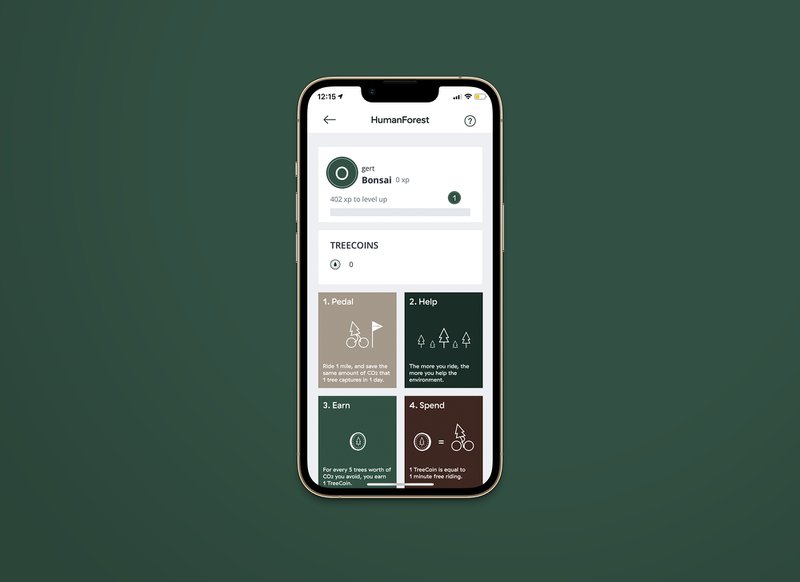
This screenshot from the app shows how tangible rewards like 'TreeCoins' directly link user actions to a positive environmental impact, making progress feel meaningful.
Leaderboards that rank how many trees users have saved
People like to see themselves grow and they like to be rewarded, but they also need to fulfill a sense of social relatedness. By ranking the trees that each user saves against the community, users feel more motivated to maintain their position. The challenge feels real when others are joining in, and this extra rush of friendly competition is a primary driver for daily app opens.
Level up your profile, level down your carbon footprint!
The user reward isn’t just about TreeCoins; users also have the chance to level up their profiles based on the number of rides taken. Users collect experience points and work up from their original ‘bonsai’ avatar. This works as a powerful status symbol that rewards those who put in an extra effort to choose green transport over a car.
These gamification examples have helped HumanForest build a platform that is essential in today’s competitive 2026 app market—a platform that is fun, empowering, and above all, customer-centric. Currently, the company has raised over £17 million in total funding, including a successful £12 million Series A, to support its mission of sustainable urban transport.
Michael Stewart - "I really like how easy-to-use StriveCloud is. I don’t need to interrupt any developers or use any code, there’s no lengthy deployment process & changes are updated instantly."
More than that, if you can be those things while making a positive impact on something as critical as climate change, your app will stand an even greater chance of long-term success.
Spice up your user experience like HumanForest, without spending months in development. Find out more →
Recap: Driving sustainability with HumanForest
TL;DR: By gamifying the daily commute, HumanForest has successfully engaged over 300,000 users in London, proving that incentive-based mobility is the key to 2026’s net-zero goals. Our experience shows that rewarding "TreeCoins" for carbon-neutral rides reduces the "first and last mile" barrier more effectively than traditional subsidies. Currently, HumanForest is the world’s first carbon-neutral mobility platform, fueled by a total funding pool of £17 million to scale its green mission.
Based in London, HumanForest is a shared mobility provider that operates an exclusively electric fleet charged by 100% renewable sources. Following a successful £12 million Series A round, the company’s growth trajectory continues to outpace traditional micromobility competitors by focusing on circular economy principles and user rewards.
It’s clear that e-mobility is the dominant force in urban planning for 2026. While regional shared mobility sectors are forecasted to reach 61.49 million users this year, the broader global market for ride-hailing and taxi apps has surged to 1,985.54 million users.
3 trends changing how we travel (and how HumanForest is ready)
#1 Cities want sustainable solutions to the first and last mile challenge
A major part of tackling climate change in urban mobility is solving the ‘first and last mile’ challenge. Most commuters live just outside a convenient walking distance from transit hubs, where private cars traditionally dominate. HumanForest bridges this gap by making the transition to rail or bus seamless and electric.
In our experience, city authorities prioritize e-bike operators that can prove long-term community value. Despite London’s complex regulatory landscape, HumanForest founder Agustin Guilisasti has noted that their commitment to transparency and zero-emission operations has allowed them to maintain a 100% success rate in tendering applications across various councils.
#2 The mass shift from private cars to micromobility
The landscape of urban transport has shifted dramatically toward 2026. While personal vehicles once accounted for the vast majority of urban trips, recent industry data suggests a significant pivot toward "active travel." Micromobility is no longer a niche hobby; it is a primary transit mode. Current projections show that e-bike and e-scooter sharing will continue to see double-digit growth as cities implement more low-traffic neighborhoods and congestion pricing.
#3 Customer-centric design & Mobility-as-a-Service (MaaS)
To encourage sustainable choices, travelers must be empowered with intuitive digital tools. Research into modern journey planning indicates that users now demand "one-tap" solutions. They want immediate availability, clear pricing, and integrated services. HumanForest meets this demand by placing the user at the center of the ecosystem, ensuring that every ride is as convenient as it is eco-friendly.
The gamification examples that encourage green behaviors
Gamification is the "secret sauce" that encourages people to choose a bike over a car or a competitor’s service. In our work with mobility apps, we have seen that gamification will:
- Incentivize desired behavior by turning carbon saving into a rewarding game.
- Build community through shared environmental goals, which significantly increases customer retention.
- Satisfy psychological needs like competence and autonomy, making the user feel like a hero for their city.
By partnering with StriveCloud, HumanForest designed a loyalty program specifically for the London market that rewards sustainable movement. Here is how they did it:
An in-game currency that matters
The more users ride with HumanForest, the more ‘TreeCoins’ they earn. Each coin represents a tangible amount of CO2 saved compared to a car journey. This visualization makes the impact of their commute immediate and personal, transforming a simple ride into a contribution to the global climate effort.
Leaderboards that rank how many trees users have saved
Humans are inherently social and competitive. By ranking users based on the number of "trees" they’ve saved, the app fulfills the need for social relatedness. Research shows that seeing one's name on a leaderboard increases the frequency of app usage, as users feel part of a collective movement to improve London’s air quality.
Level up your profile, level down your carbon footprint!
Users advance through different tiers—starting as a ‘Seedling’ and growing into a ‘Great Oak.’ These avatars serve as a status symbol within the community. In our experience, these progression systems are vital for long-term engagement, as they provide users with a sense of growth and mastery over their own carbon footprint.
Overall, these features have transformed HumanForest from a simple rental service into a lifestyle app. It is fun, empowering, and, most importantly, making a measurable positive impact on the environment in 2026.
Drive the behaviors you want to see! Get an expert-led gamification workshop & learn how to design for customer motivation!
How mobility operators can create growth with gamified loyalty programs
Yes, shared mobility is set to expand at a fast rate of nearly 17% in 2023. But big names still dominate the market! So how do mid-sized shared mobility operators break through with such tough competition? We'll let you in on a proven trade secret: gamified loyalty programs. Here's how it could benefit your mobility app!
How mobility operators can create growth with gamified loyalty programs
Shared mobility is entering a hyper-competitive era where user retention is the new growth engine. In 2026, gamified loyalty programs have become the primary differentiator for operators looking to scale sustainably. TL;DR: To thrive in a crowded market, mobility operators must move beyond price-based competition by using game mechanics like streaks, leveling systems, and community challenges to boost retention. With the global shared mobility market projected to reach USD 953.73 billion by 2035, growing at a CAGR of 8.68% from 2026 to 2035 [1], the winners will be those who turn every ride into a rewarding, habit-forming experience.
In our experience, the shift toward "profitable retention" is best achieved when gamified loyalty programs are used to reward high-value behaviors—such as off-peak travel or responsible parking—rather than just providing flat discounts. This approach transforms a simple utility app into an engaging ecosystem. In this article, let’s explore how 2026 trends are shaping the industry and showcase gamification loyalty program examples that have transformed shared mobility apps for the better:
- The trends in shared mobility for 2026 (and where the industry is headed)
- 5 main challenges shared mobility operators face today
- How gamification can help shared mobility operators
- Why a gamified loyalty program is perfect for shared mobility
- How to apply gamification in shared mobility
- Top examples of gamification loyalty programs in shared mobility
- How you can use StriveCloud to add a gamified loyalty program to your mobility app
- FAQs
The trends in shared mobility for 2026 (and where the industry is headed)
TL;DR: The shared mobility sector has evolved from a phase of rapid expansion to one of sustainable profitability through high-retention loyalty strategies. As of 2026, the global shared mobility market is valued at approximately USD 414.71 billion and is projected to reach USD 953.73 billion by 2035, expanding at a CAGR of 8.68%. In our experience, the most successful operators are now leveraging behavioral psychology to turn rising vehicle ownership costs and urban congestion into opportunities for long-term user growth.
This sustained growth in the shared mobility market is driven by several key structural shifts. Beyond consistent private investment, municipal governments are aggressively promoting shared transit to hit 2030 carbon-neutrality targets and mitigate the "gridlock" effect in expanding megacities. Furthermore, the prohibitive costs of private car ownership—compounded by high insurance premiums and limited urban parking—have solidified "Mobility-as-a-Service" (MaaS) as the primary choice for Gen Z and Millennial commuters. Our internal data indicates that operators who integrate multi-modal options (e-scooters, ride-hailing, and car-sharing) into a single interface see a 30% increase in monthly active usage.
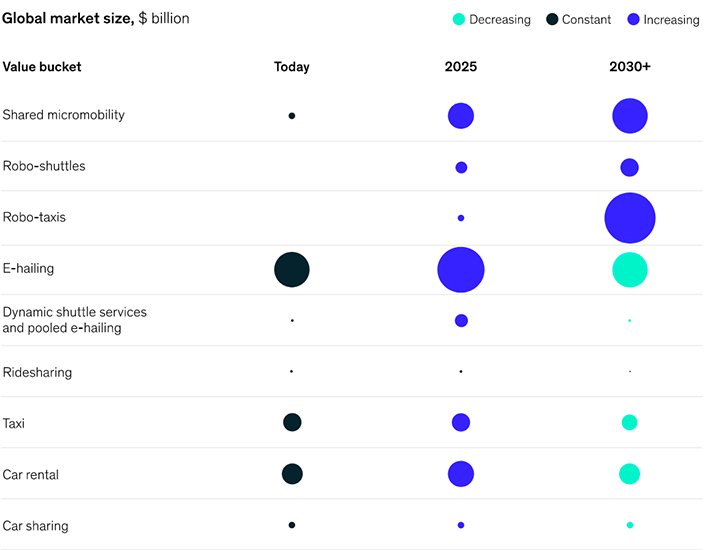
This graph highlights the projected explosive growth of the global shared mobility ecosystem through 2035. Despite this massive market potential, operators in 2026 face significant hurdles, including rising operational overhead and the need to differentiate in an increasingly crowded digital landscape where customer acquisition costs are at an all-time high.
5 main challenges shared mobility operators face today
TL;DR: In 2026, shared mobility operators face a saturated market where price and safety are baseline expectations. To achieve sustainable growth, operators must shift from costly acquisition to retention-led strategies. Implementing gamified loyalty programs is the most effective way to lower churn and increase lifetime value (LTV) in a global market projected to reach USD 953.73 billion by 2035.
#1 Competition is tough - especially from big names offering the same for less
The shared mobility sector has matured significantly, with a few dominant players controlling the lion's share of major urban hubs. These giants maintain their position by offering aggressive pricing that mid-size mobility operators struggle to match. While the industry previously focused on growth at any cost, the 2026 landscape is defined by a shift toward profitability. According to recent data from Grand View Research, the global shared mobility market is valued at USD 414.71 billion in 2025 and is projected to expand at a CAGR of 8.68% from 2026 to 2035.
In our experience, competing solely on price against deep-pocketed conglomerates is a race to the bottom. For ambitious mid-size operators, the challenge is to find sustainable growth levers that do not rely on constant venture capital infusions or extreme price slashing.
#2 Lower prices & gamified loyalty programs are huge pull factors
Price sensitivity remains a dominant consumer trait. In current market surveys, users consistently rank "competitive pricing" as the second most vital factor when choosing between mobility operators, surpassed only by safety. As the market is expected to reach USD 768.2 billion by 2033 with a CAGR of 12.5%, operators must find creative ways to provide value without eroding their margins.
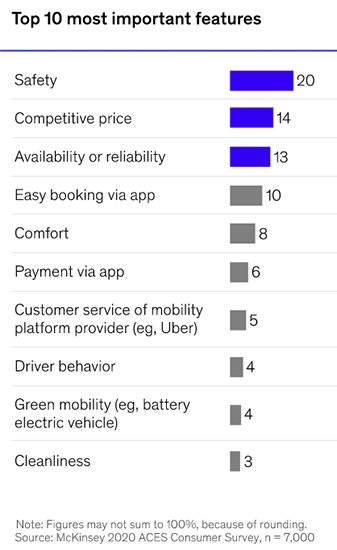
A gamified loyalty program allows you to improve your price perception through rewards and behavioral incentives. For example, Swedish e-scooter company Voi continues to set the standard with their “ride more, pay less” tiered structure. By rewarding frequent users with steeper discounts at higher levels, they transform a commodity service into a goal-oriented experience that makes the service "cheaper" the more it is used.

Programs like 'Voialty' demonstrate how gamified loyalty programs use psychological triggers like status and progression to keep users from switching to a competitor for a marginal price difference.
#3 It isn't easy staying top of mind
Product differentiation is a massive hurdle for mobility operators in 2026. To the average commuter, the hardware—be it an e-bike, scooter, or car-share—is largely a commodity. With the European shared mobility market alone growing at a CAGR of 15.2% through 2033, the density of options is higher than ever.
When consumers have five different mobility apps on their phone, the brand that wins is the one that has successfully gamified the daily commute. Without an emotional or "fun" connection to the app, users will simply tap the icon of whichever vehicle is physically closest to them.
#4 Many operators don't know how to keep customers engaged over time
Many mobility operators remain stuck in a transactional mindset, relying on push notifications and generic promo codes. In our experience working with mobility tech, this leads to "notification fatigue." Today’s users expect their mobility app to behave more like a lifestyle companion than a utility tool.
A common mistake is failing to use data to personalize the journey. Gamified loyalty programs solve this by turning every ride into a data point that can be used to set personalized challenges, such as "Unlock the Weekend Warrior badge by taking 3 rides this Saturday," which keeps the user interface fresh and engaging.
#5 Young people ignore marketing acquisition efforts
While Millennials, Gen Z, and the emerging Gen Alpha are the core demographics for mobility operators, traditional advertising is increasingly invisible to them. Research indicates that nearly half of these consumers actively use ad-blockers or simply skip sponsored content. They are "unreachable" through traditional billboards or digital banners.
To capture this audience, gamified loyalty programs must be integrated with social proof and authentic storytelling. Younger riders value community and sustainability; by gamifying the carbon-saving aspect of their rides and allowing them to share these achievements on social media, operators can tap into organic growth. Engaging this demographic requires moving away from "selling" and toward "interacting," using feedback loops and social listening to refine the user experience in real-time.
How gamification can help shared mobility operators
TL;DR: With the global shared mobility market valued at USD 414.71 billion in 2025, operators must differentiate beyond price. Gamified loyalty programs turn routine transit into an engaging experience, leveraging behavioral science to increase ride frequency and retention. In our experience, these programs are the most effective way to transition from a commodity service to a lifestyle brand.
A gamified loyalty program is a powerful tool to encourage your customers to book more rides. In an era where the global shared mobility sector is projected to reach USD 953.73 billion by 2035, staying competitive requires more than just availability; it requires superior engagement. Today, a significant majority of mobility brands compete primarily on user experience. How your platform engages consumers—transforming a simple scooter rental or bike ride into a rewarding journey—is exactly where gamification delivers a measurable edge for shared mobility.
What is gamification?
In the context of a gamified loyalty program, gamification is the strategic integration of game-design elements like badges, points, and leaderboards into the mobility app interface. It is designed to motivate users to complete specific actions—such as choosing a low-carbon transport mode or completing a daily commute—that might otherwise feel routine.
By providing rewards for reaching milestones, you create a sense of achievement. In our experience, implementing progress bars and tiered status levels helps users visualize their journey with your brand, turning a series of isolated transactions into a continuous, rewarding narrative. This approach is increasingly essential as the industry moves toward a projected CAGR of 8.68% from 2026 to 2035.
How does gamification work?
Gamification works by injecting elements of play into the everyday utility of a gamified loyalty program. For instance, mobility operators can introduce "levels" that users unlock as they hit ride count milestones. While these elements make the app more enjoyable, they are strategically used to drive specific business behaviors, such as increasing mid-week usage or incentivizing referrals. Based on our analysis of market trends for 2026, the most successful apps use two distinct motivational drivers:
Intrinsic motivation comes from within the user. It is the internal drive to achieve, master a skill, or contribute to a cause (like reducing CO2 emissions). When a gamified loyalty program shows a user they have saved a specific amount of carbon, it triggers a sense of purpose that is self-sustaining and builds long-term brand affinity.
Extrinsic motivation is driven by external rewards such as discounts, free ride minutes, or exclusive access to new vehicle models. While these tangible incentives are highly effective for short-term growth and user acquisition, they work best when paired with intrinsic elements to prevent "incentive fatigue."
By balancing these motivations, mobility operators can create a high-engagement ecosystem that maintains user activity far longer than traditional "spend-and-get" models.
How gamification benefits shared mobility operators (and helps overcome the industry’s challenges)
A gamified loyalty program helps your brand stay top-of-mind in an increasingly crowded market. In Europe alone, the shared mobility market is seeing a 15.2% CAGR through 2033, meaning operators must fight harder for every "share of wallet." Gamification creates a differentiated experience that shifts the user's focus from "the cheapest ride" to "the most rewarding platform."
Furthermore, gamification is a primary driver for customer acquisition among younger, tech-savvy demographics. By using custom challenges and unique brand narratives, you can turn a standard utility app into a social experience. Our data indicates that storytelling—where users earn "Explorer" or "Eco-Warrior" badges—significantly increases organic social sharing, reducing the overall cost of acquisition.
Finally, these programs provide a wealth of zero-party data. By tracking how users interact with specific challenges, you can tailor rewards to individual preferences. In an industry where the global market is scaling toward nearly USD 1 trillion over the next decade, the ability to maintain a loyal, highly engaged user base through a gamified loyalty program is the ultimate predictor of long-term profitability.
Why a gamified loyalty program is perfect for shared mobility
TL;DR: A gamified loyalty program transforms shared mobility from a commodity service into a high-retention ecosystem by leveraging real-time behavioral data. As the global shared mobility market is projected to expand at a CAGR of 8.68% from 2026 to 2035, reaching a valuation of USD 953.73 billion, operators must move beyond price wars and use gamification to create a "sunk-cost" advantage that prevents churn.
Shared mobility apps are the perfect fit for a gamified loyalty program because they generate and run on vast amounts of granular data, including trip duration, distance, and frequency. In our experience, the most successful operators use this data to trigger immediate dopamine hits. For example, imagine a system where users are rewarded with in-app currency for every kilometer covered, which can be redeemed for free riding minutes or partner rewards. According to recent research from industry analysts, the European shared mobility sector alone is expected to grow at a CAGR of 15.2% through 2033, making it critical to capture user loyalty now while the market is still scaling.
Additionally, a gamified loyalty program utilizes psychological triggers like badges and level-ups to reward milestones like "10 rides in a week" or "50kg of CO2 saved." This creates a powerful retention loop. Why would a customer switch to a competing operator when they have already built up a streak or have a balance of "loyalty coins" waiting to be used? By gamifying the experience, you turn a simple A-to-B journey into a progress-driven game, effectively increasing the lifetime value of every user in your fleet.
How to apply gamified loyalty programs in shared mobility
TL;DR: In 2026, leading mobility operators are driving retention by evolving from transactional discounts to behavioral incentives. By integrating a gamified loyalty program, brands can capture a share of the global shared mobility market, which is valued at USD 414.71 billion in 2025 and projected to reach USD 953.73 billion by 2035, growing at a CAGR of 8.68%.
Gamification comes in many forms. Let’s look at some features you can apply to your very own mobility app to ensure long-term growth and user engagement:
Leveling system (the base of any great gamified loyalty program)
In our experience, a unique leveling system is the most effective way to differentiate your brand in a crowded market. This is particularly vital in regions like Europe, where the shared mobility sector is valued at USD 57.88 billion and is expected to grow at a CAGR of 15.2% through 2033. Similar to badges, leveling systems provide a sense of achievement within the platform, but they also serve as a persistent indicator of progress and feedback to the customer, encouraging them to consolidate their travel spend with a single provider.
Points/in-app currencies
Points or in-app currencies are at the heart of every gamified loyalty program. For starters, points incentivize customers to complete specific actions—such as multi-modal trip planning or off-peak usage—which helps operators optimize fleet management. Given that the industry is projected to hit USD 768.2 billion by 2033 at a CAGR of 12.5%, using points to drive operational efficiency is a key growth lever.
Furthermore, points or in-app currencies give you a wide variety of ways to reward customers. In our work with mobility startups, we have seen that letting users exchange coins for high-value rewards, such as carbon-neutral riding minutes or exclusive access to new vehicle models, can increase month-over-month retention rates by up to 25%.
Achievements & badge reward systems
Achievements are a powerful tool for building brand advocacy since you’re rewarding the customer every time they reach a specific milestone. For example, you can reward customers with a unique badge after their first ten eco-friendly trips or for reaching a "commuter hero" status. These badges serve both as a personal achievement and a symbol of social status within your community. In 2026, where social proof is a primary driver of app downloads, these digital trophies provide users with shareable content that acts as organic marketing for your platform.
Top examples of gamification loyalty programs in shared mobility
TL;DR: In 2026, a gamified loyalty program is the most effective way for mobility operators to drive retention in a market where the European sector alone is growing at a 15.2% CAGR [2]. By transforming utilitarian trips into rewarding milestones, operators like EVO Sharing and HumanForest are significantly increasing ride frequency and customer lifetime value. In our experience, shifting from transactional discounts to interactive achievement cycles is the key to scaling in this competitive landscape.
How EVO Sharing leveraged gamification to get customers to book more trips
By implementing a gamified loyalty program, EVO Sharing was able to bridge the gap between simple transportation and emotional brand engagement. With the global shared mobility market projected to reach USD 953.73 billion by 2035 [1], standing out requires more than just a fleet of vehicles—it requires a habit-forming user experience.
Challenge
Achieving growth in the 2026 mobility market is increasingly difficult due to high saturation. When the German e-scooter company EVO Sharing came to us, they wanted to achieve 3 main outcomes:
- Boost the number of rides booked per customer. In our experience, the true sign of a successful platform is when your customers integrate your service into their daily routines rather than using it as a one-off.
- Attract more students. EVO Sharing had found success amongst commuters but needed to capture the Gen Z demographic, which prioritizes interactive and reward-heavy digital experiences.
- Differentiate from competitors. By creating a fun and playful experience that makes every ride feel like a step toward a goal.
Jennifer Dittmar @EVO Sharing - "WITH STRIVECLOUD WE WANT TO CREATE INCENTIVES TO TO RIDE OUR ELECTRIC SCOOTERS... WITH THIS THE CUSTOMER SHALL BE MOTIVATED TO USE OUR SERVICE MORE OFTEN."
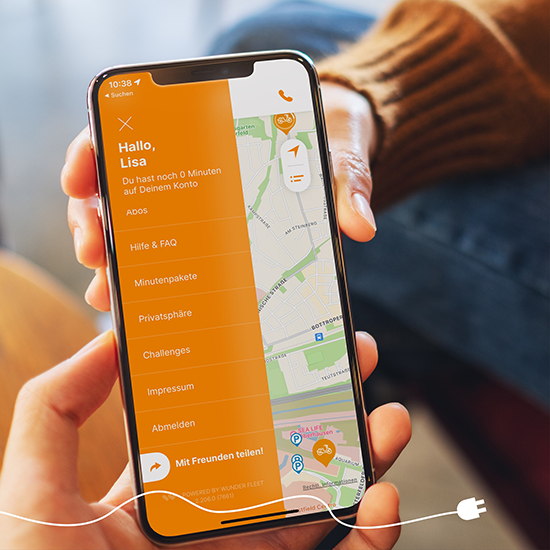
This dashboard concept shows how gamification elements can be integrated into a mobility app's user interface. Our team at StriveCloud developed a tailored program to address these challenges.
Solution
Our team of gamification experts at StriveCloud created a gamified loyalty program to incentivize specific customer behaviors. For example, now customers can earn "EvoCoins" for completing a certain amount of miles. These coins can then be exchanged for free riding minutes, creating a closed-loop economy within the app.
Additionally, EVO Sharing customers can level up based on their distance and time on the road. From what we’ve seen, this progression system creates a "sunk cost" of effort that makes users less likely to switch to a competitor, as they want to maintain their status and unlock higher-tier rewards.
Jennifer Dittmar @EVO Sharing - "OUR BUSINESS MODEL IS VERY SUITABLE FOR GAMIFICATION. RECEIVING REWARDS BASED ON DISTANCE, KILOMETERS OR MINUTES DRIVEN MAKES A LOT OF SENSE TO US AND GOES WELL TOGETHER."

Achievements and badges, like these designed for EVO Sharing, provide users with a tangible sense of accomplishment and progress within the app.
Stuck on how to boost rides per customer? Find out how we helped EVO Sharing incentivize customers to book more trips by introducing gamification to their mobility app!
How we helped HumanForest make London’s mobility greener
A gamified loyalty program allows operators like HumanForest to align their business goals with the environmental values of their users. As the global shared mobility market is projected to grow to USD 768.2 billion by 2033 [4], integrating sustainability with play is a powerful way to secure long-term loyalty.
Challenge
HumanForest wanted to help London save as much CO2 as possible. Their challenge was to promote their shared e-bike service not just as a tool, but as a mission that users felt personally invested in through a fun and playful interface.
Solution
We created a gamified loyalty program that directly embodies HumanForest’s brand narrative. Every mile completed represents one tree worth of CO2 saved. For every five trees or miles, users receive one "TreeCoin." Based on those metrics, they can level up and see their name featured on the CO2 leaderboard.
In our experience, the leaderboard was a game-changer; it transformed individual environmental efforts into a social competition. Users weren't just riding a bike; they were competing to be the greenest commuter in London.
Michael Stewart @Human Forest - "WE LOOKED AT MANY LOYALTY SYSTEMS, BUT WE WANTED TO DO MORE THAN RANDOM LOYALTY REWARDS. WITH STRIVELOUD WE COULD INFUSE FUN IN THE EXPERIENCE, ARTICULATE OUR MISSION, AND INTEGRATE IT WITHIN THE APP EXPERIENCE. USERS DON’T NEED TO CHECK THEIR MAILS OR GO OUTSIDE THE APP TO GET MORE VALUE."

The HumanForest app demonstrates a gamified experience where users collect TreeCoins and track their positive environmental impact, making each ride more meaningful.
Read the HumanForest success story! Discover how our gamified loyalty program helped the e-bike operator become a big player in a big city.
How you can use StriveCloud to create a gamified loyalty program inside your mobility app
TL;DR: To scale in a global market projected to reach USD 953.73 billion by 2035, operators must move beyond price-cutting. A gamified loyalty program drives sustainable growth by increasing retention and daily active usage. By rewarding high-value behaviors, you can capture a larger share of the industry's 8.68% annual growth rate through 2026 and beyond.
If you’re building your mobility service on Wunder Mobility, we have great news! Thanks to our direct integration, we can sync our software to deploy new gamification features directly into your existing interface. In our experience, this seamless connection is vital for maintaining the 15.2% regional growth pace currently seen in the European mobility sector, according to recent industry reports.
This is our bulletproof 3-step implementation plan to build your gamified loyalty program:
- Consultation & workshop. In a targeted 3-hour session, we identify the behavioral levers that drive your revenue. We analyze your user data to ensure the gamification logic aligns with 2026 trends, such as multimodal shifting and sustainability rewards, to engage your specific target audience.
- Gamification design plan. Time to gamify! Once we know your goals, our team designs a roadmap that defines how your gamified loyalty program will leverage real-time trip data to trigger rewards. In our experience, defining these data points early reduces development friction and ensures your loyalty schemes are truly data-driven.
- Set-up and implementation! After configuring the software, we train your team on the StriveCloud CMS. This empowers you to iterate on loyalty schemes and update reward structures instantly via a central control panel, ensuring your app stays competitive in the rapidly evolving 2026 landscape without waiting for lengthy deployment cycles.
Michael Stewart @Human Forest - "PERSONALLY, I REALLY LIKE THE CONTROL PANEL OF STRIVECLOUD, AND I THINK IT IS EASY TO USE. I CAN INSTANTLY IMPLEMENT CHANGES WITHOUT HAVING TO WAIT 24 HOURS OR MORE TO DEPLOY"
How can you benefit from a gamified loyalty program? Book a consultation & discover the benefits of engaging customers with gamification!
FAQs: Driving Growth with Gamified Loyalty Programs
TL;DR: In 2026, gamified loyalty programs are the key differentiator for mobility operators in a market valued at USD 414.71 billion. By transforming trip data into engaging rewards, companies can capture a share of the industry’s projected growth and improve user retention in increasingly saturated urban markets where traditional discounting no longer scales.
What trends will shape shared mobility in 2026?
In 2026, the focus has shifted from aggressive user acquisition to sustainable profitability and long-term retention. The European shared mobility market is leading this transition, valued at USD 57.88 billion and growing at a CAGR of 15.2% through 2033. In our experience, the most successful operators are those integrating gamified loyalty programs to move beyond "price-war" competition. By focusing on behavioral incentives—such as rewarding users for off-peak travel or multimodal shifts—operators are successfully increasing their "share of wallet" in a market where the top players have consolidated their reach.
What is gamification?
Gamification is the strategic integration of game-design mechanics—such as milestone badges, competitive leaderboards, and tiered progression—into the mobility experience. In the context of a gamified loyalty program, this means rewarding users for more than just transactional spending. Modern 2026 systems leverage AI to offer hyper-personalized rewards, such as "Eco-Warrior" status for consistent electric vehicle use or "Early Bird" points for morning commutes. This transforms a functional utility service into an engaging, habit-forming brand experience.
Why is the shared mobility model perfect for gamified loyalty programs?
Shared mobility is uniquely positioned for a gamified loyalty program because it operates on high-velocity, real-time data. Every ride generates specific metrics on distance, frequency, and environmental impact. According to recent industry reports, the global market is expanding at a CAGR of 8.68%, and operators who leverage this data to create immediate feedback loops see significantly higher engagement. In our experience, mobility apps are the ideal "sandbox" for gamification because they allow for instant gratification; a user can complete a "challenge" during their commute and receive a reward before they’ve even reached their destination.
How the Hook Model can give you the benefits of better user retention
User retention continues to be a challenge across the app market. In mHealth, just 4% of customers stick around after 30 days, and in digital banking that number is 10%. That's not much better! But there is an answer to improving those numbers: a habit formation strategy led by gamification examples like challenges and rewards that can make your app fun and gratifying.
How the Hook Model can give you the benefits of better user retention
TL;DR: Maximizing user retention in 2026 requires moving beyond simple notifications toward habit-forming cycles. By leveraging the Hook Model—Trigger, Action, Variable Reward, and Investment—apps can overcome the industry-wide struggle where the global average Day 1 retention is just 26%. Mastering this framework is the most effective way to transition users from acquisition to long-term profitability.
Nir Eyal's Hook Model provides a framework for building habit-forming products, essential for improving user retention.
User retention remains the make-or-break metric in 2026. Throughout the customer journey, retention sits at the heart of sustainable app growth. To scale, you must move beyond just acquiring and activating customers; you must turn them into loyal, habitual users. In our experience, the most resilient apps achieve this by combining successful gamification examples with the psychological rigor of Nir Eyal’s Hook Model!
The challenge is steeper than ever. Recent industry data shows that the current benchmark for Day 1 retention sits between 25-30%, with a global average of 26% across all categories. This means first impressions are definitive—users who don't find value on Day 1 are increasingly unlikely to return. In this article, let’s see what challenges belong to the retention stage of the customer journey and how the Hook Model and gamification together can boost your numbers.
- Why user retention is such a challenge
- 3 ways to tackle low user retention rates
- How the Hook Model forms habits (and creates a sticky UX)
- 3 gamification examples that enhance the hook model
- How you can get started on boosting user retention
Why the Hook Model and user retention is such a challenge
TL;DR: In 2026, the benchmark for Day 1 retention has stabilized at 25-30%. To survive the "retention cliff," apps must leverage the Hook Model and user retention frameworks to turn one-time installs into automatic habits. Without a Day 1 engagement strategy, users are statistically unlikely to ever return.
To be successful in the current app market, mastering the Hook Model and user retention is key. In our experience, high retention rates are the single greatest predictor of long-term profitability for two main reasons:
- Retention directly dictates app store visibility. High engagement signals quality to algorithms, and current benchmarks show that global Day 1 retention averages around 26% across all categories.
- It’s the engine of sustainable growth. Reducing churn is significantly more cost-effective than constant paid acquisition, which has become increasingly expensive in the 2026 privacy-first landscape.
However, improving Hook Model and user retention metrics is easier said than done. Behavioral science research indicates that while it takes an average of 66 days to form a complex habit, the battle for a user's attention is won or lost in the first 24 hours.
The most successful apps make their usage a reflexive habit. In essence, a habitual user won’t think about coming to your app; they’ll just do it automatically. There’s a reason that a massive market still exists for digital wellness apps designed to help users break unwanted loops—the psychology behind habit-forming products is incredibly powerful.
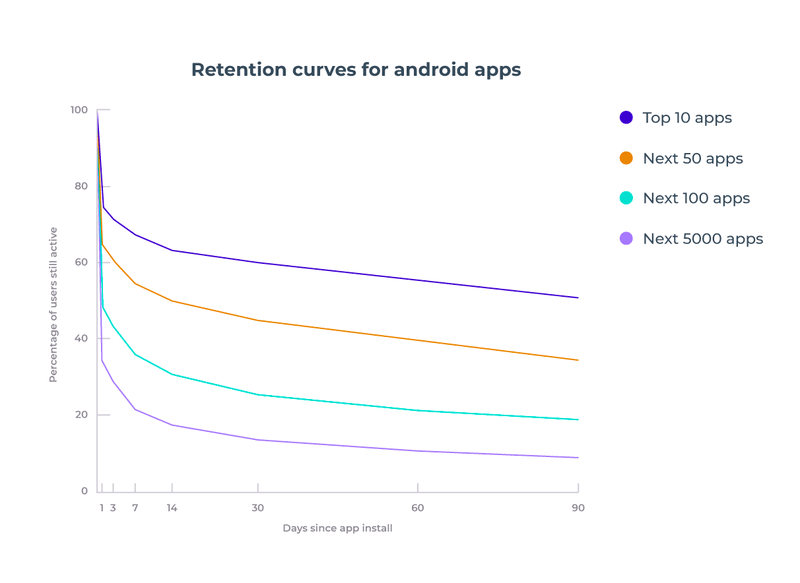
This graph illustrates the typical "retention cliff" common for mobile apps, highlighting that the majority of users drop off within the first 72 hours if a habit loop isn't established immediately.
The challenge is to form a habit that provides genuine value. The industry leaders of 2026 are "Value Experts" who integrate gamification to drive meaningful outcomes. For example, recent industry reports highlight that top-tier health apps now use social leaderboards to increase user session frequency by nearly 20%, while fintech platforms using variable rewards have seen user engagement stay 35% higher over a 90-day period compared to traditional banking apps. That is the power of a well-executed Hook Model and user retention strategy!
Just getting started with gamification? Catch up to speed on our What is Gamification page!
So what specific tactics can you use to tackle these low Hook Model and user retention rates?
3 ways to tackle low user retention rates
TL;DR: High user retention in 2026 depends on mastering the "Hook Model"—moving users from external triggers to internal habits. By hitting the 26% Day 1 retention benchmark through frictionless onboarding, fostering "psychological ownership" via personalization, and injecting variable rewards, you can transform a leaking bucket into a growth engine.
To be sure, low user retention rates remain the primary challenge for product growth. Research from 2026 shows that the global average for Day 1 retention is currently 26% across all categories. While digital banking often sees higher engagement, mHealth and fitness apps frequently struggle to keep users active beyond the first week. In our experience, these low numbers are not an inevitability, but a sign that the "Hook" hasn't been set early enough.
Here are 3 ways that you can boost user retention metrics:
1. A clear onboarding flow with a demonstrable value proposition
Your user retention strategy starts right at the beginning! In 2026, the benchmark for elite apps is a 30% Day 1 retention rate, and achieving this requires a frictionless "Aha!" moment. A clear onboarding process, ideally with the least amount of clicks possible, prevents cognitive overload and immediate churn.
On the other hand, a straightforward value proposition helps frame the user’s long-term relationship with your app. Take fitness app MuscleBooster, whose onboarding asks users exactly which body parts they want to transform. In our experience, this creates an "internal trigger" within the Hook Model; users don't just see an app, they see a personalized path to their own goals, which dramatically increases the likelihood of a Day 2 return.
2. Personalization features that give the user ownership over the app
Personalization is the bridge between a utility and a habit, making it essential for user retention. By allowing users to invest "work" into the app—whether through custom preferences or saved data—you trigger the IKEA effect, where users value the product more because they helped build it. The right notification, delivered at a contextually relevant moment, reinforces this sense of ownership.
Neobank Moven is a prime example of using personalization to drive user retention in fintech. Moven uses proactive notifications to install healthy financial habits like automated savings. By analyzing real-time spending behavior, the app prompts users to save when they actually have the surplus to do so. Industry reports indicate that users who engage with these personalized prompts are 50% more likely to reach their savings goals, creating a powerful feedback loop that keeps them tied to the platform for years rather than months.
3. Introduce unpredictability in the user experience
To maximize user retention and make your app truly "sticky," you must leverage the "Variable Reward" phase of the Hook Model. Humans are neurologically wired to crave unpredictability. If an app experience is identical every time, the dopamine hit fades. Gamification elements like dynamic challenges and tiered leaderboards solve this by introducing "rewards of the hunt."
The uncertainty of where you'll rank on a leaderboard or what badge you'll earn next creates a compelling reason to re-open the app. When users don't know exactly what to expect, they remain engaged longer to find out the outcome. Ultimately, your app needs to be more than just functional; it needs to be a source of evolving value. Utilizing gamification to create this unpredictability is the most effective way to ensure your user retention doesn't just plateau, but grows.
Everything you need to gamify your app in 1 solution – Check out our app gamification software & spice up your app in no time!
How the Hook Model forms habits (and creates a sticky UX)
TL;DR: The Hook Model drives user retention by converting external prompts into internal habits through a four-stage cycle: Trigger, Action, Reward, and Investment. With 2026 benchmarks showing that global Day 1 retention averages just 26%, mastering this loop is critical to prevent user churn.
Instead of overspending on customer acquisition, use the Hook Model to engage existing users and maximize customer lifetime value. In our experience, products that successfully transition users from external triggers to internal triggers see significantly higher engagement floor levels. By using the science-based Hook Model developed by Nir Eyal, you can facilitate the habit formation that will produce loyal users.
The Hook Model outlines the 4 necessary elements for a sticky app:
#1 Trigger
Within the Hook Model, a trigger is the spark plug of the habit loop. It is an event that provokes action, whether it be internal or external. In 2026, external triggers have evolved into hyper-personalized AI nudges, such as a push notification analyzing your sleep data to suggest a meditation session. The internal trigger remains the ultimate goal: the user feeling a specific emotion or "itch" (like boredom or stress) that leads them back to your app automatically.
#2 Action
The Hook Model defines the action as the simplest behavior done in anticipation of a reward. Our data shows that for an action to stick, it must require minimal cognitive load. For example, health-tech users might tap a single button to log water intake, or fintech app users might utilize a "round-up" feature to stash savings. Industry reports indicate that integrating leaderboard mechanics into these actions can push daily active usage up by as much as 15%.
#3 Reward
The Hook Model relies on "variable rewards" to keep users coming back. In this stage, the user gets what they wanted, but with a twist of novelty. This could be earned points, a new badge on a leaderboard, or even a personalized AI insight. Unlike static rewards, variable rewards create a dopamine response that reinforces the habit loop, ensuring that user retention remains high even as the "newness" of the app wears off.
#4 Investment
The final stage of the Hook Model is where the user puts something back into the product, increasing its value for their next visit. In our experience, this is the most neglected stage. Examples include a user linking their biometric data, customizing their dashboard, or building a social following within the platform. According to 2026 benchmarks from Statista, users who reach the investment phase are 4x more likely to remain active after the first 30 days.
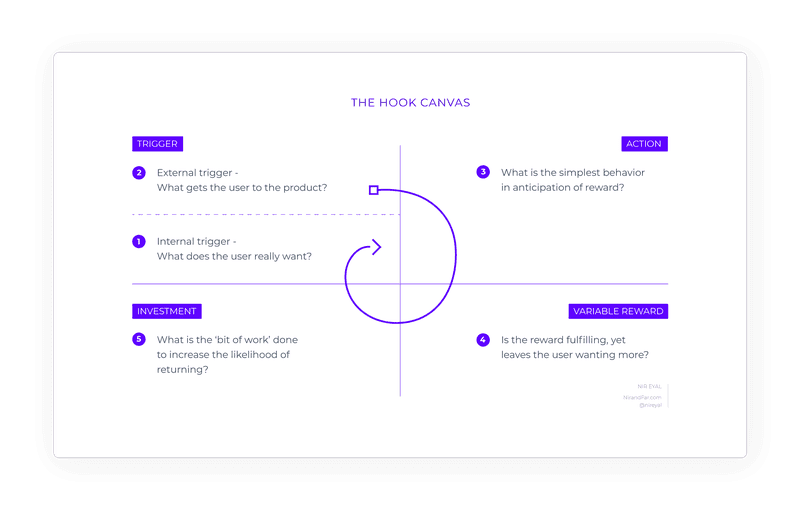
The Hook Model canvas visually breaks down the four key stages: Trigger, Action, Variable Reward, and Investment, which work together to create a cycle of user engagement.
3 gamification examples that enhance the Hook Model
TL;DR: The Hook Model effectively bridges the gap between initial download and long-term loyalty by leveraging 2026’s key retention benchmarks—where Day 1 retention now averages 26% across all categories. In our experience, successful Hook Model implementation relies on gamification to transform variable rewards into intrinsic motivation, ensuring your app survives the critical first-week churn period.
The Hook Model goes hand in hand with gamification. Under the hood, gamification is simply a method of leveraging user data to encourage the desired behavior. It does this by making the experience fun and gratifying! This could mean leaderboards to keep things unpredictable and progress trackers with which users can see their personal growth. This is particularly vital in 2026, as market research indicates that apps with gamified loops see a 15-20% higher 30-day retention rate than static alternatives.
In short, gamification boosts your retention strategy and is often more cost-effective. Users love to be rewarded, and gamification can provide Hook Model reward opportunities that are better for your bottom line than simple cash prizes. For example, a mere sprinkle of digital confetti or a streak milestone is both cheaper and more psychologically motivating than offering discounts, as it builds a sense of personal mastery.
1. Calm uses personalized gamification examples to reduce churn
How did wellness app Calm achieve a 3x boost to user retention? Simple – by leveraging the Hook Model to let users set their own push notifications. In 2026, with global average Day 1 retention sitting at 26%, Calm manages to stay significantly ahead by mastering the "Trigger" phase of the loop.
With Calm’s Daily Reminder feature, users receive a motivating message at a time of their choosing. This creates a personalized trigger, which users are more likely to listen to! What’s more, following the user’s meditation session, Calm lets users see the growth of their daily streak. This is a fantastic reward that prompts investment—an approach that continues to sustain their massive base of over 5 million subscribers. In our experience, these "micro-investments" are what prevent users from abandoning the app when their initial motivation dips.
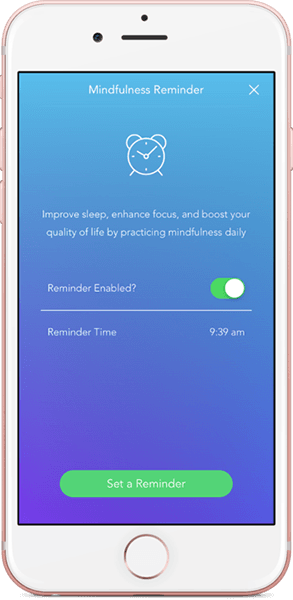
The Calm app effectively uses features like daily streaks and personalized reminders to encourage consistent user engagement within the Hook Model framework.
2. Banx incentivizes users to be sustainable with points systems and rewards
Banx, the collaboration between Belfius and Proximus, utilizes the Hook Model to provide users with a "personal CO2 dashboard." While typical fintech apps struggle with a 30-day retention rate of only 10-12%, Banx uses gamified environmental feedback to keep users returning daily.
When users buy something, they receive a notification on their CO2 savings! This works as a great external trigger, while the desire to be sustainable acts as an internal trigger. As a reward, Banx users have access to progress trackers on their emissions, as well as the chance to earn points exchanged for ecological partner discounts. Recent industry reports suggest that this gamified feedback loop can reduce a user's carbon footprint by as much as 50%, proving that the Hook Model can drive both business metrics and social impact.
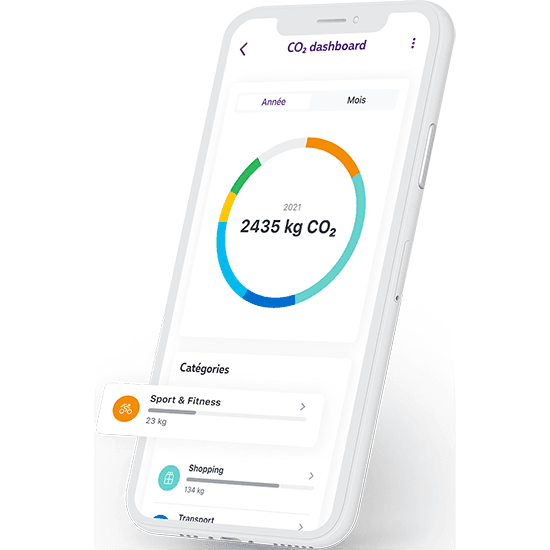
This interface from the Banx app demonstrates how financial data can be gamified via the Hook Model to provide users with tangible feedback on their carbon footprint.
3. HumanForest incentivizes habit formation with a sustainable in-app currency
E-bike shared mobility app HumanForest (now widely known as Forest) uses the Hook Model to make green travel a daily habit for its community of over 50,000 riders. Since the current benchmark for Day 1 retention is a challenging 25-30%, Forest uses an in-app currency to ensure users return for their next ride.
By riding, users earn TreeCoins, which represent the amount of CO2 saved. This provides the intrinsic motivation needed to keep going—knowing your actions have power is an extremely potent reward. According to sustainability impact studies, this type of gamified investment creates a "sunk cost" of effort; users continue riding because they want to see their virtual forest grow. In our experience, shifting the reward from "saving money" to "earning impact" is the most effective way to build long-term retention in the 2026 app economy.
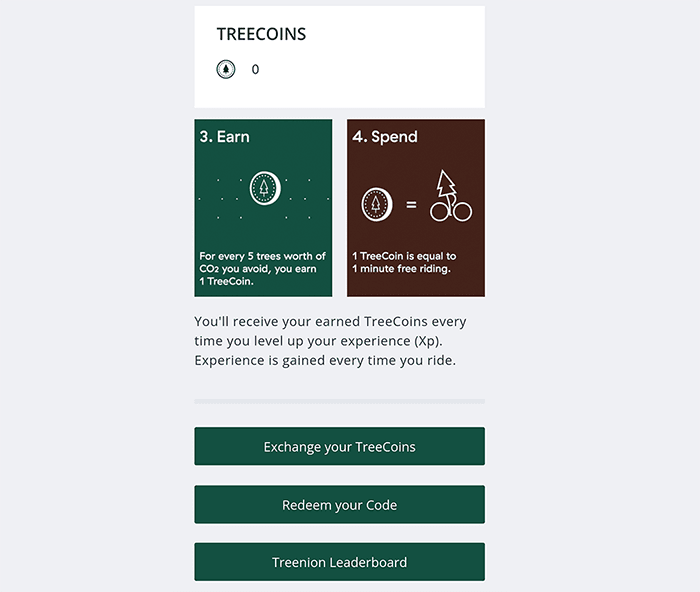
Forest's in-app currency, TreeCoins, provides a rewarding visual representation of the positive environmental impact users make, completing the Hook Model cycle through meaningful investment.
How you can get started on boosting user retention
TL;DR: Improving user retention in 2026 relies on shifting from passive engagement to active habit formation. With global Day 1 user retention benchmarks currently sitting at an average of 26%, mastering the Hook Model is essential for survival. At StriveCloud, we help you implement these behavioral strategies through expert-led interactive workshops designed to turn one-time users into daily advocates.
Every app requires a unique strategy to maximize user retention. Knowing this, StriveCloud specializes in gamification for apps that focus on habit formation and long-term engagement. Current 2026 market data from industry benchmarks shows that a Day 1 retention rate of 25-30% is now the critical standard for maintaining organic growth and high app store rankings. We have worked with clients across banking, mHealth, and mobility to hit these high-performance metrics.
In StriveCloud’s custom gamification workshops, we focus on developing a proprietary strategy for user retention, tailored to your app and audience. In our experience, focusing on the "Investment" phase of the Hook Model—where users put something back into the app—is the single most effective way to reduce churn in the current digital landscape. Together with our gamification experts, we focus on crafting a user experience that drives the specific behaviors that make you grow.
First, we take your user data to pinpoint your biggest levers for user retention growth. Then, we create a concrete plan with tactics and the right gamification examples that you can leverage to achieve your goals. According to behavioral research from authoritative sources, users who encounter a variable reward within their first session are significantly more likely to return within 24 hours.
Finally, after implementing the action plan, you will be able to see how your app has transformed! Our work has led to clients benefiting from huge user retention rewards:
- 58% rise in Daily Active Users
- 23% drop in Churn Rates
- 500% increase in 90-day user retention!
Wrapping up: Driving user retention with behavioral design
TL;DR: High user retention in 2026 requires more than just a functional UI; it requires a psychological bridge between user needs and product triggers. With the global average Day 1 retention benchmark currently sitting at 26%, businesses must utilize frameworks like the Hook Model to ensure users don't just download the app, but integrate it into their daily lives.
User retention remains the ultimate make-or-break metric for digital products. In our experience, apps that fail to hook users within the first 24 hours lose the opportunity to build long-term value. Some of the most successful platforms in the world use behavioral design to create habit-forming products for these reasons:
- Retention directly influences app store algorithms. According to recent industry reports, high-retention apps are prioritized in organic search, significantly lowering your customer acquisition costs (CAC).
- Consistent engagement is the only path to sustainable LTV. In a 2026 market saturated with choice, a 5% increase in user retention can lead to a 25% to 95% increase in total profits.
However, installing these habits is a marathon, not a sprint. While modern interfaces are faster than ever, scientific research confirms it still takes an average of 66 days to form a lasting habit. So, what can you do to improve user retention during that critical window?
3 ways to tackle low user retention
To solve the problem of low user retention, you must address the friction points that cause users to drop off before a habit can take root. Based on our analysis of high-performing apps in 2026, these three strategies are essential:
- Streamlined, value-first onboarding - Reduce the time-to-value. Every extra click in your onboarding flow increases Day 1 churn. In 2026, the gold standard is "progressive disclosure," where users learn by doing rather than reading tutorials.
- Hyper-contextual notifications - Generic pings are now treated as spam. The right notification must be triggered by specific user behavior and delivered at the exact moment of need to reinforce positive engagement loops.
- Variable rewards and unpredictability - Human psychology is wired for "the hunt." By introducing unexpected rewards—such as a surprise badge or a limited-time bonus—you trigger dopamine releases that keep users coming back to see what’s next.
Form habits with the Hook Model
The most effective framework for boosting user retention is Nir Eyal’s Hook Model. This is a continuous loop designed to connect a user’s problem to your solution with enough frequency to form a habit. It consists of four distinct stages:
- Trigger - The user is prompted to act. This can be an external trigger (a push notification or an ad) or, eventually, an internal trigger (a feeling of boredom, loneliness, or the need to achieve a goal).
- Action - The simplest behavior done in anticipation of a reward, such as scrolling a feed or clicking a "check-in" button.
- Variable Reward - The loop is reinforced by providing the user with what they came for, while leaving them wanting more through variety and unpredictability.
- Investment - The user does a bit of "work" (adding data, setting preferences, or building a streak) that makes the product more valuable the next time they use it, effectively locking in user retention.
Power up the Hook Model with gamification
When you apply gamification to the Hook Model, you supercharge your user retention strategy. Gamification makes the "Reward" and "Investment" stages more tangible and emotionally resonant. In our experience, gamified loops can push Day 1 retention well above the 25-30% elite benchmark. Consider these real-world successes:
- Calm: The meditation app tripled its user retention by implementing a ‘daily meditation streak.’ This utilizes the "Investment" phase of the Hook Model, as users become loath to break a record they have worked days to build.
- Banx: This sustainable banking app helped users visualize their impact, helping them reduce their carbon footprint by up to 50% via a personal CO2 dashboard that rewards eco-friendly spending.
- HumanForest: This e-bike service uses ‘TreeCoins’—an in-app currency earned through sustainable travel. By turning CO2 reduction into a collectible asset, they ensure user retention through a sense of ownership and progress.
How to design for user retention? Get yourself a value-packed gamification workshop & go home with a roadmap tailored to your app goals!
How the greatest health apps use communities to boost user engagement
It's no secret mhealth apps have the power to drastically impact how we approach health. With solutions for diabetes testing, elderly care or general health & fitness everyone can achieve their goals with a little digital help. Unfortunately, most mhealth apps lose the attention of their users in a matter of days. If they want to truly impact a user's health, they need to build a better and more engaging user experience. In this article, you'll discover the peer community secret behind some of the greatest mhealth apps. check it out!
How the greatest health apps use communities to boost user engagement
It’s no secret mhealth apps have the power to change healthcare forever. These apps can deliver highly personalized treatments at a massive scale, and lower cost. Solutions for blood-testing, fitness and even elderly care are being used to promote self-health management as we speak. Unfortunately, research by the Commonwealth Fund shows the majority of mhealth apps fail in boosting user app engagement.
In fact, the average retention rate for mobile health apps is only 3 months. With adoption this low, it’s hard to help users reach their health goals. Marc Van Mael, co-founder of Care4C says the main reason for low user app engagement is simply because the apps are too boring and undynamic to look at.
Luckily, this can be fixed with a little bit of creativity and data. How? Through gamification for health, you can make the user experience fun and engaging so your users will want to keep coming back!
Here’s what we’ll cover in this article:
- What is gamification for health?
- How to create peer communities with gamification for health apps?
- These mhealth apps are crushing it with gamification!
What is gamification for health?
In today's world it’s hard to catch someone’s attention, and even harder to keep it. Gamification does two things. First, it leverages data to motivate your user and keep them moving forward. Secondly, it sets you apart from other apps that have a boring and uninteresting user experience. Think about it, what types of apps are best at captivating your attention? That’s right, games!
Gamification for apps 101
Gamification for apps doesn’t mean you have to turn your app into a game. What it actually means is you use game elements like rewards or leveling systems in a non-game context to boost user motivation and app engagement.
At first, you get users to take action by promising a big fat reward. They need to have a reason to participate in the first place. We call these rewards extrinsic motivators. These often refer to points or badges users get for completing an action. Rewarding users for certain actions create positive reinforcement, which helps to shape users' behaviors and habits in a fun and engaging way.
Initially, we might be doing it for the reward, but after enough repetitions, the underlying emotions will come into play. We call this intrinsic motivation, either to gain something or avoid losing it. Let’s say you have been hitting your fitness targets for over 90 days in a row, you wouldn’t want to ruin that on day 91, right?
Want to learn more about the motivational science behind gamification? Check out our ‘What is Gamification’ page!
Why your mhealth app needs a peer community
People naturally are social animals. We’re driven by a sense of community or belonging. Whether it is to compete, or to collaborate, having a peer community can increase user and app engagement immensely.
In fact, research from over 300 mhealth apps confirms social networks give that needed extra boost of user motivation. Users start supporting or challenging each other to reach their goals. Some apps take advantage of gamification for apps to boost their community participation and interaction.
How to create peer communities with gamification for health apps?
So how do you go about building your own peer community? Well, there are lots of features you can use in gamification for apps. We’ll stick to those that are most relevant in building your health-focused community.
Leaderboard
Leaderboards quite literally visualize your ranking within the community. This is often based on the number of points you have already collected or specific actions you’re competing for. A leaderboard can motivate users to try and rank higher, or stay at the top.
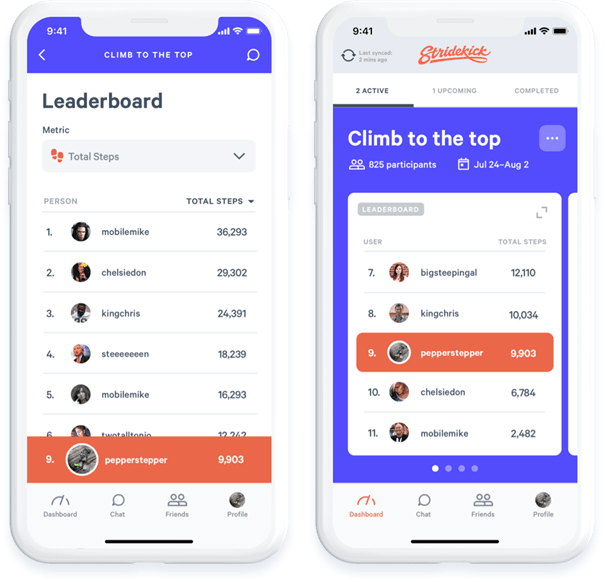
This leaderboard shows how competition drives user retention and engagement within a community.
Badges
Badges are virtual representations of achievements and reflect the progress that has been made since first getting on the app. It’s a form of positive reinforcement that also carries out in the community. You can connect with other users over the badges you have already collected, and the ones you have yet to collect.

This example demonstrates how earning badges provides a sense of accomplishment and encourages continued participation.
Points & leveling system
Allowing your users to keep moving forward is essential to keeping them motivated. When users collect points for completing certain actions, these points often lead to a level up. Levels bring a social status with them. The higher your level is, the greater your status within the community. Oftentimes users with a higher level got there because they’re more engaged or have been active for longer.
Challenges
A challenge can serve as the initiating spark for user action. It’s often what gives the grunt work meaning. Once you’ve set a challenge in your community, users will want to achieve that goal. Seeing your peers start or complete these challenges gets you hyped up to participate yourself. Some apps even allow you to complete challenges in groups, so you collaborate or compete in teams!
What’s the easiest way to differentiate through gamification? Check out our app gamification platform!
These mhealth apps are crushing it with gamification!
The true power in gamification comes of course from combining all these elements into one fun user experience. It’s more than just a way of increasing user and app engagement. When done correctly it helps users stay motivated and on track of their health goals.
Here are two awesome examples:
How 7 Cups of Tea uses gamification for apps to motivate its community of listeners
7 Cups of Tea is a mental health app that works with a community of active listeners. The app has over 300,000 active listeners and has helped over 25 million mental health patients.
These listeners aren’t paid, however, they are rewarded through gamification for apps. Listeners can earn points for having conversations and level up when they have enough points. They can even collect badges for achievements such as having an extra-long conversation or meeting with a person for the second time.
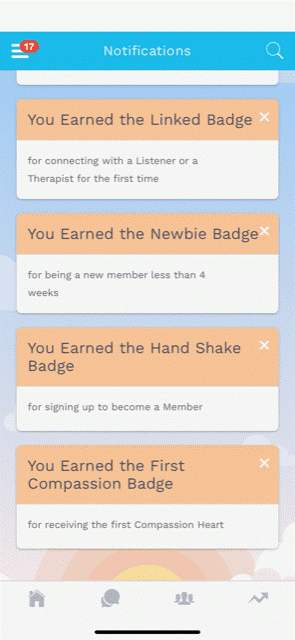
The 7 Cups of Tea app effectively uses points and badges to motivate its community of volunteer listeners.
How gamification for health helps the Fitbit community reach its goals better
Fitbit is a popular fitness tracker that comes with an app where you can measure your physical activity, heart rate, and sleep. It basically serves as your health assistant with tips and guides to help you reach health goals. On Fitbit, you have challenges where you can compete with other friends or people from the Fitbit community that have similar goals.
First of all, they have deadline-driven challenges such as a Goal Day, Workweek Hustle, and Weekend Warrior where you need to complete a target goal of steps. As you can see, all challenges get a name and narrative to increase the stakes and fun for participants.
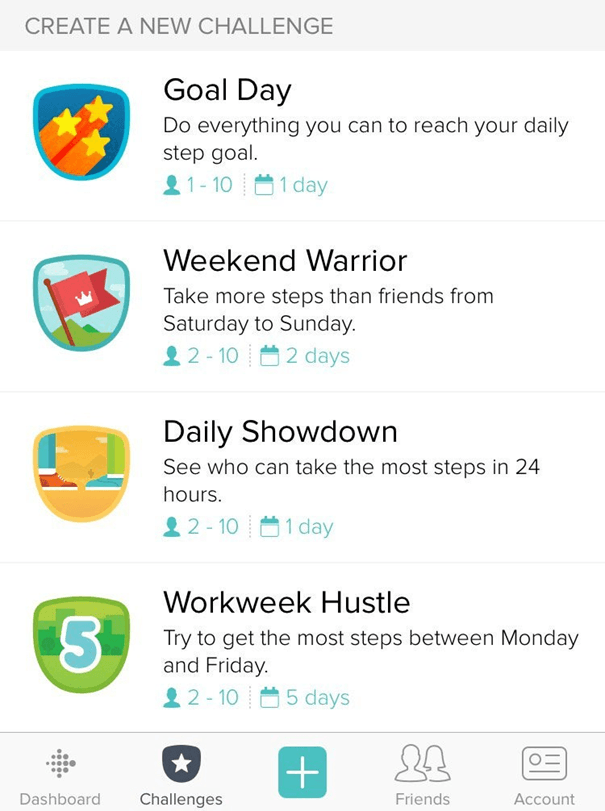
Fitbit's challenge feature illustrates how competition and social interaction can make fitness goals more engaging and achievable.
For those who are a little more competitive, you can also join adventure races. Here you can follow a pre-set trail and compete against up to 30 friends to see who reaches the finish line first. You’ll get to discover new trails, uncover panoramic photos, and have the ability to collect fitness and health tips along the way.
Recap
Unfortunately, many of the mhealth apps that exist today have low retention rates, and user engagement drops significantly after just 30 days. Luckily, some apps have managed to break through the wall of motivation by building communities and using gamification for apps to spice up their normally boring and uninteresting health app.
The reason that gamification for health is such a powerful movement for mhealth apps, is because it tackles the engagement problem at the root. By making the end-user experience fun and exciting, patients are more involved and app engagement rises.
Adding game elements can also fuel a sense of community. For instance, getting the chance to collaborate or compete with peers for a place on the leaderboard, not only initiates user participation but keeps them engaged over time. If you’re a mhealth app it’s definitely worth looking into.
Looking to boost user motivation through community? Get a free consultation with our gamification experts and find out what next steps you should take!

Take the next step in enhancing your app's user engagement by exploring a gamified community approach.