How to Unlock Growth in Shared Mobility With Your Own Loyalty Strategy


For shared mobility operators, the customer journey doesn’t end with a single ride; it is the starting point for long-term retention. As the global market scales toward an estimated USD 451.20 billion by 2026, a sophisticated loyalty strategy has become the primary differentiator for brands seeking to stabilize revenue. TL;DR: In 2026, loyalty programs fuel an 8.68% YoY growth rate by converting casual users into "power riders" through consistent incentives, significantly lowering churn in an increasingly crowded micro-mobility landscape.
In our experience, a well-executed loyalty & rewards program doesn't just encourage "one more trip" it fundamentally shifts consumer behavior toward access-over-ownership models, which are projected to see an 8.5% CAGR through 2033 as Gen Z and Millennials opt for flexible transit. This article explores how a well-crafted loyalty program can be a significant growth driver for shared mobility services in 2026.
Find out everything you need to know about customer loyalty for shared mobility:
- Why is customer loyalty important in shared mobility?
- The 5 stages of customer loyalty
- How can shared mobility apps create a loyalty strategy?
- Do rewards really create loyalty?
- The best loyalty & rewards program examples in shared mobility
- 3 steps to create a bulletproof loyalty strategy for shared mobility
- How to implement your own customer loyalty & rewards program
- FAQs
Why is customer loyalty important in shared mobility?
TL;DR: In 2026, a data-driven loyalty strategy is the primary engine for scaling in a shared mobility market projected to reach $451.20 billion. By rewarding repeat usage, operators can capitalize on an 8.68% annual growth rate while insulating their brand from rizing acquisition costs and price volatility.
Essentially, a loyalty strategy defines how you plan to convert your average customer into a frequent one. In other words, how can you get your customers to spend more time and money with your brand? In our experience, high-growth operators are shifting away from generic discounts toward personalized loyalty & rewards programs that align with the "access-over-ownership" trend favored by Gen Z and Millennials, which is driving an 8.5% CAGR through 2033.
#1 Loyal customers are more likely to recommend your service to others
A successful loyalty strategy turns your most frequent riders into brand ambassadors. The logic is simple: loyal customers use your app more often and have more opportunities to recommend your service. In the 2026 mobility landscape, where consumer trust is paramount, personal recommendations are the most effective way to build brand equity. Our data shows that word-of-mouth remains a critical driver for boosting shared mobility adoption, as users are significantly more likely to try a new e-scooter or car-sharing service if it is recommended by a trusted peer within their local urban community.
#2 More loyalty means more profit
A loyal customer comes back to you, and repeat users are the foundation of sustainable revenue. With the global shared mobility market expected to reach USD 406.52 billion in 2026, the competition for "time-on-platform" is intensifying. A loyalty & rewards program increases the lifetime value (LTV) of each user by encouraging daily habits rather than occasional trips. Industry trends for 2026 indicate that a well-executed loyalty strategy can drive a 17.28% CAGR in platform revenue through 2031, as rewards for frequent bike-sharing or car-sharing rides directly increase the average revenue per user (ARPU) while decreasing the need for expensive re-acquisition campaigns.

This graph illustrates the significant revenue increase generated by repeat users, highlighting the financial benefits of a strong loyalty strategy in a maturing market.
#3 Reduce the pressure of price competition
In a market like shared mobility, where many operators compete on thin margins, a loyalty strategy helps reduce the pressure of price wars. When users are emotionally and financially invested in your ecosystem, they are less likely to switch to a competitor for a marginal price difference. By focusing on user incentives for return trips in bike-sharing and e-scooters, you create a "sticky" environment that prioritizes convenience and rewards over the lowest possible fare.
A loyalty & rewards program ensures long-term retention by building a habit-forming hook. In our experience, features like tiered status, accumulated points, or exclusive "early-access" to new vehicle models make customers feel a sense of ownership over their progress, making the psychological cost of switching to a different app far higher than the potential savings.
The 5 stages of customer loyalty in shared mobility
A successful loyalty strategy in 2026 is the bridge between a one-time rider and a lifetime subscriber. As the global shared mobility market climbs toward an estimated $451.20 billion in 2026, the battle for profitability is won through retention. By mapping your loyalty strategy across five distinct customer stages Activation, Retention, Re-engagement, Revenue Growth, and Advocacy operators can tap into the 8.68% year-over-year growth driven by repeat usage in urban transit hubs, according to market projections.
#1 Activation
Your loyalty strategy starts the second a user hits "Sign Up." In our experience, the 2026 user expects zero friction; if onboarding takes more than 90 seconds, you’ve already lost them. During this phase, you must ensure a smooth explanation of your value proposition while collecting high-intent data to fuel your loyalty & rewards program. We have found that using gamification to promote "feature discovery" such as rewarding a user for checking vehicle range or adding a secondary payment method significantly increases the likelihood of that critical first ride.
#2 Retention
Once a rider is onboarded, the goal of your loyalty strategy shifts to habit formation. With millennials and Gen Z increasingly choosing "access-over-ownership" models a trend driving an 8.5% CAGR in mobility access through 2033 your app must become their default choice. A data-driven loyalty and rewards program can trigger specific behaviors, such as morning commute streaks or weekend bonuses. By creating a positive reinforcement loop, you reduce the cost of service compared to private vehicle ownership, making your platform an indispensable part of their daily routine.
#3 Re-engagement
A critical but often overlooked pillar of a loyalty strategy is winning back lapsed users. It remains significantly more cost-effective to re-activate a dormant rider than to acquire a new one. In 2026, top-tier operators use AI-driven insights to understand why activity drops, whether due to seasonal weather shifts or changes in public transit availability. With this data, you can deploy personalized loyalty & rewards program incentives, such as "comeback credits" or weather-contingent discounts, to nudge customers back into the ecosystem before they churn to a competitor.
#4 Growing revenue
Shared mobility operators are seeing unprecedented revenue potential, with the market expected to hit $406.52 billion in 2026 at a 17.28% CAGR. To capture this, your loyalty strategy must move beyond basic transaction discounts. By rewarding behaviors like off-peak riding or parking in designated "hot zones," you optimize fleet turnover and increase revenue per user. Advanced rewards such as tiered leveling systems, free vehicle upgrades, or priority access to the newest e-bikes ensure that your most frequent users spend more time on your platform and less on others.
#5 Advocacy
The final stage of a mature loyalty strategy is turning users into brand ambassadors. Advocates provide organic growth that no marketing budget can match. To reach this stage, you must offer experiences worth sharing, such as "carbon saved" badges or community leaderboards. A gamified loyalty strategy supercharges this; for example, e-scooter operator felyx continues to lead the way by offering tangible riding credits for successful referrals, turning their user base into a decentralized sales force.

The Felyx app's referral program remains a benchmark for turning users into advocates by offering immediate, tangible rewards that lower the barrier to the next ride.
How can shared mobility operators create a loyalty strategy?
TL;DR: To unlock growth in 2026, a robust loyalty strategy must focus on habit-forming rewards that capitalize on a shared mobility market projected to reach USD 451.20 billion by 2026. By incentivizing repeat usage, operators can capture the 8.68% year-over-year growth currently fueled by a global shift toward access-over-ownership models [1].
The first step to creating your own loyalty strategy is figuring out exactly what it is that you want to communicate and reward. At the end of the day, loyalty & rewards programs are a method of persuasion. So you’ll have to answer three main questions:
In our experience, a data-driven loyalty & rewards program should reward users for frequent interaction, not just high spend. Industry projections show the market reaching USD 406.52 billion in 2026 specifically because of rewards in car-sharing and bike-sharing that increase time-on-platform [4]. At the most basic level, rewards like free riding minutes or special vehicle unlocks can do the job. However, rewards are even more powerful when personalized to your customers.
For example, look at how the mobility app Changers used rewards to encourage company employees to bike to work!
They gave their rewards more meaning by letting users redeem in-app coins for discounts on products from cycling brands. In this way, Changers created a win for customers by providing relevant offers, a win for sponsors looking for reach, and a win for their app, as customers are incentivized to spend more time on their platform!

This gamified reward system from Changers effectively encourages specific user behaviors by offering relevant and meaningful incentives, ensuring the platform remains a daily habit rather than an occasional utility.
Do rewards really create loyalty?
TL;DR: Yes, but only when rewards are part of a broader loyalty strategy. By 2026, the shared mobility market is projected to reach USD 451.20 billion, with growth fueled by repeat-trip incentives. Rewards aren’t inherently rewarding on their own; in fact, one of the reasons why you have to develop your own loyalty strategy is to give those incentives meaning. In our experience, rewards are most effective when they are well-timed and feel earned by the user.
Only then will you create the powerful driving force known as intrinsic motivation. This is where users feel motivated to use your platform because it’s inherently satisfying and personally rewarding. As the market shifts toward access-over-ownership models a trend driving a projected 8.5% CAGR through 2033 capturing the loyalty of Gen Z and Millennial riders requires moving beyond simple prizes. This contrasts with extrinsic motivation, which is driven purely by hard results and the need for a one-off win.
While both forms of motivation are powerful, behavioral science shows that operators must foster both to fuel long-term engagement. By 2026, data suggests that car-sharing and bike-sharing platforms that successfully integrate these rewards see significantly higher revenue-per-user by increasing time-on-platform. In our experience, this dual approach is the only way to ensure users spend more time and money with your brand over the long term.
The best loyalty & rewards program examples in shared mobility
TL;DR: In 2026, a high-performing loyalty & rewards program is the primary driver for shared mobility growth. With the market projected to reach USD 451.20 billion this year, operators are shifting from acquisition to retention. In our experience, converting occasional riders into power users via gamification can increase revenue per user and drive an 8.68% YoY growth in trip frequency.
The shared mobility model is well-suited for a gamified loyalty & rewards program. Since mobility apps run on massive amounts of data, there are many opportunities to create fun challenges & incentives. For example:
- Reward customers with points based on distance
- Create a challenge on speed or frequency on a specific route
- Hand out badges for reaching certain goals such as 1-5-10 kilometers
- Unlock milestones based on customer location
- ...
Want to see how it’s done? Let’s look at some examples where a loyalty & rewards program drives growth for shared mobility operators:
Challenges give EVO Sharing riders a chance to win
Operating across Germany, EVO Sharing lets users share electric scooters to get to their destinations. In our experience, to meet ambitious growth targets in 2026, operators must focus on increasing time-on-platform. A robust loyalty & rewards program is essential to capturing a share of the market that is expected to reach USD 406.52 billion in 2026.
When EVO Sharing came to us at StriveCloud, they had a clear goal: to boost the number of rides per customer. They needed to turn occasional users into loyal ones. That sounds like the perfect job for a loyalty & rewards program!
Jennifer Dittmar @EVO Sharing - "With Strivecloud, we want to create incentives to drive more often with the electric scooters from EVO Sharing. Through the challenges and the achievement of milestones, the customer shall be motivated to use our scooters more often."
Keeping the loyalty strategy of EVO Sharing in mind, we introduced exciting challenges that users could compete in and be rewarded for their participation. Our data shows that when it comes to creating customer loyalty, challenges can be a game-changer:
- Challenges increase engagement and provide both extrinsic and intrinsic motivation
- Prizes provide a purpose/end goal
- Creates a social ‘event’, something customers have in common and can discuss
- Competitive elements are more than just fun, they bring customers closer together
- Customers can track their progress and achievements
Discover how a loyalty & rewards program helped EVO Sharing incentivize customers to book more trips!

EVO Sharing's gamified dashboard visualizes user progress and rewards, effectively boosting engagement and ride frequency in micromobility.
Voi. incentivizes loyalty with micromobility’s first credit card
In partnering with Mastercard, electric scooter operator Voi. has implemented a highly innovative loyalty & rewards program. This strategy directly addresses the shifting consumer preference toward access-over-ownership models, which is driving an 8.5% CAGR in the sector through 2026. By offering a co-branded credit card, Voi. ensures that every daily purchase brings the user back to their app.
The card lets users collect free miles on a Voi. e-scooter with each payment they make. So you can see how it pays off to be a loyal Voi. customer! The card also comes with special travel health insurance, which is smart considering safety remains a top concern of shared mobility consumers in 2026.

Voi's partnership with Mastercard created a unique loyalty program, offering a co-branded credit card that directly rewards spending with free miles.
HumanForest’s rewards program shows users their impact on the environment
Make it fun, make it simple. Well, that’s what we helped HumanForest do! In London, HumanForest stands out by championing sustainable e-bike travel. In our experience, this message of green mobility is the cornerstone of a successful loyalty & rewards program in an era where Gen Z and Millennials demand values-aligned services.
To encourage Londoners to travel green, we designed a loyalty & rewards program that rewards customers for their positive impact on the environment through ‘TreeCoins’. The more users ride, the more TreeCoins they earn, which can be redeemed for free minutes or discounts at green retailers. This strategy is proving vital as the market for loyalty-aligned mobility grows to USD 451.20 billion by 2026.
"Drive 5 miles = Save 5 trees = Earn 1 TreeCoin = Exchange for 1 free riding minute"
Visualizing the real-life consequences of TreeCoins makes the currency feel tangible. Users can literally see their positive impact on our planet! This incentive gives users a reason to return, and it is a blueprint for the industry. Our collaboration showed that progress visualization mechanics prompt users to keep choosing sustainable options over private ownership, reinforcing retention in a highly competitive 2026 landscape.
Michael Stewart @HumanForest - "StriveCloud really helped us fulfill our brand message. The TreeCoins explain our mission perfectly...the progress visualization mechanic prompts users to keep using HumanForest and rewards sustainable behavior with free minutes!"
The loyalty strategy behind HumanForest growth strategy: How gamification motivates sustainable mobility.
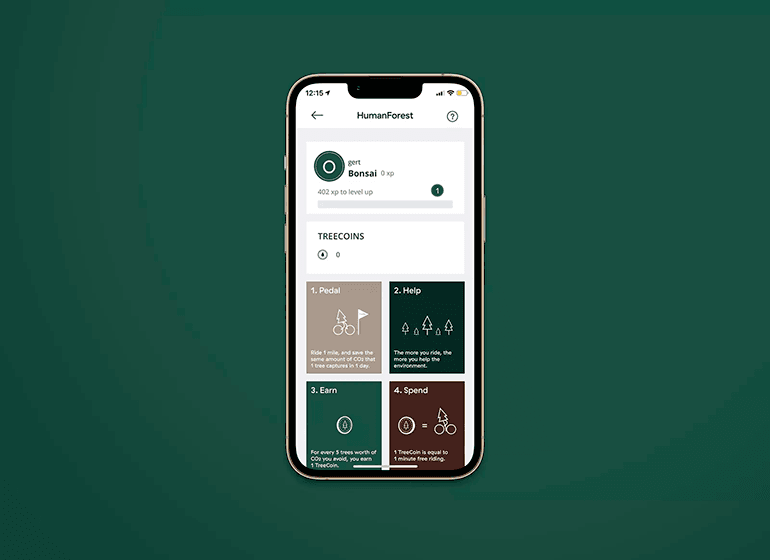
HumanForest's app visualizes the positive environmental impact of riding, making the rewards feel tangible and reinforcing the brand's green mission.
3 steps to create a bulletproof loyalty strategy for shared mobility
TL;DR: In 2026, a data-driven loyalty strategy is the primary lever for scaling shared mobility ventures. With the global market projected to reach USD 451.20 billion by 2026, operators are shifting from aggressive acquisition to retention-led growth, utilizing incentive-based models to capture an 8.68% YoY revenue increase through repeat usage.
Creating your own loyalty strategy requires a holistic approach that goes beyond simple discounts to influence long-term rider behavior. To get it right, you need to look at your whole customer journey and make strategic decisions on when to reward, what to leverage, and how to gamify the experience. As the market shifts toward "access-over-ownership" models growing at an 8.5% CAGR through 2026 your platform must offer more value than the cost of vehicle ownership.
From experience, we have devised a 3 step plan for creating the ultimate loyalty strategy for shared mobility operators to maximize revenue per user.
Get started with your own gamified loyalty strategy today. Book an expert-led workshop & learn the exact next steps you need to take!
How to implement your own loyalty & rewards program
A successful loyalty strategy is the primary driver for shared mobility operators aiming to capture a share of the $451.20 billion market projected for 2026. By converting casual riders into power users through gamified incentives, platforms can capitalize on the 8.68% YoY growth in bike-sharing and e-scooter demand. Once you’ve created your loyalty strategy, you can either go about it on your own or join forces with our expert team. You can easily set up and integrate the new features straight into your shared mobility application. And if you use Wunder Mobility, our direct integration will make this even faster!
In our experience helping operators scale, we’ve found that the most effective loyalty strategy relies on real-time feedback loops. Our gamification software fuels this with over 20 interactive features such as in-app rewards, challenges, quizzes, and polls! According to market data from GMI Research, the consumer shift toward loyalty-aligned "access-over-ownership" models is driving an 8.5% CAGR through 2033. Our software is built for this flexibility and autonomy, allowing the user experience to be changed swiftly from a simple control panel, live into your app, ensuring your rewards stay ahead of market trends.
Michael Stewarts @Human Forest - "Personally, I really like the control panel of StriveCloud, and I think it is easy to use. I can instantly implement changes without having to wait 24 hors or more to deploy."

This interface showcases how gamification software can integrate achievements and progress tracking directly into a user's profile, boosting engagement by visualizing the rider's journey within your loyalty strategy.
FAQ's
TL;DR: By 2026, a robust loyalty strategy is the primary engine for capturing a share of the projected $451 billion shared mobility market. In our experience, moving beyond transactional rides to loyalty-aligned models reduces long-term user costs and capitalizes on the massive shift toward "access-over-ownership" among younger demographics. Retaining just a fraction of your user base through targeted rewards can significantly stabilize revenue in a volatile market.
Why is customer loyalty important in shared mobility?
Customer loyalty ensures you extract maximum lifetime value from your existing user base a critical factor as the market matures. By 2026, the global shared mobility sector is projected to reach USD 451.20 billion, growing at an 8.68% YoY rate. In this environment, a loyalty strategy is a major growth driver because it insulates operators from rizing acquisition costs. Our data suggests that markets fueled by user incentives for return trips in bike-sharing and e-scooters see much higher resilience against local competitors.
Why do shared mobility operators need a loyalty & rewards program?
A loyalty & rewards program is essential for capturing the "access-over-ownership" trend currently dominating millennial and Gen Z consumer habits. This shift is expected to drive an 8.5% CAGR through 2033, as repeat usage of shared platforms consistently proves more cost-effective for users than vehicle ownership. In our experience, these programs do more than just offer discounts; they build community. A well-structured loyalty & rewards program reduces price sensitivity, meaning your users stay for the value and experience rather than jumping to whichever app offers the cheapest ride that morning.
Do rewards really create loyalty?
Rewards alone do not create loyalty, but a comprehensive loyalty strategy gives those rewards purpose and psychological weight. To be effective, rewards must be well-timed and feel earned through platform engagement. Industry data indicates that by 2026, the car-sharing and bike-sharing rewards market will hit USD 406.52 billion, driven by strategies that increase "time-on-platform." When you combine extrinsic perks (like free minutes) with intrinsic motivators (like carbon-saving badges), you transform a simple utility into a daily habit, significantly increasing the revenue generated per active user.
Keep reading
.avif)