
Dive into top reads

4 ways to drive growth in the product adoption process!
Currently, the average SaaS conversion rate hovers at 7%. But market leaders like Slack reach up to 30%! You too can achieve these numbers by learning how to optimize your product adoption process. Discover which steps to take & 5 stress-tested growth tactics!
4 ways to drive growth in the product adoption process!
This graphic introduces the key strategies for accelerating the product adoption journey for SaaS products.
To be sure, SaaS can still do more to lift adoption rates throughout the product adoption process. Currently, the average visitor-to-lead conversion rate hovers at 34%. Meanwhile, market leaders like Slack achieve 60%! But it’s easy to see how tools like app gamification and psychology can boost product adoption for SaaS.
In the previous article, we learned about the Product Adoption Curve and how it helps growth. Today, let’s discuss the best ways to optimize your product adoption process.
- What is the product adoption process?
- Why is my product adoption process important?
- The 6 stages of the product adoption process
- The 5 types of adopters you need to know
- The 4 crucial forces that influence the product adoption process
- How to drive product adoption for your new software
- 5 tried and true techniques to improve product adoption
- FAQ
What is the product adoption process?
The product adoption process is the journey of users becoming more aware of your product. At the beginning of their journey, users are unaware. They might not even realize they have a problem yet. However, the further they get in the process, the more aware they’ll become.
People are most aware when they’re avid users of your product and understand the full benefit of its features compared to alternative solutions.
Why is the product adoption process important?
The product adoption process is what drives revenue & growth for SaaS companies. Here you generate interest & demand and turn them into paying customers. Additionally, a great adoption process prevents churn by showing users the full value of your product first.
Power up your product adoption process! Check out our ultimate guide and discover how to increase SaaS product adoption.
The 6 stages of the product adoption process
Generally, you can organize how users adopt a product into 6 distinct sequences:
#1 Awareness
Firstly, users need to learn about you. But awareness gets harder every year as the market grows. In 2022, the number of SaaS unicorns is predicted to triple!
#2 Interest
Show users that you have a solution to their problem - and that you can solve it better than anyone else! This involves discussing your pricing and features, for instance.
#3 Evaluation
The potential customer now assesses if your product is worth the time and financial investment. Here, you should use social proof and illustrate use cases to persuade.
#4 Trial
Users now decide to try your free trial, sample, or demo. The more efficient your time to value is, the quicker users can evaluate if your product is what they want.
#5 Activation
By now, the user realizes what your value is. But have they experienced it? Before any long-term adoption is possible, they need to feel the AHA moment!
#6 Adoption
Maybe it was your customer support or use of exciting app gamification, but the prospect decides to stick with you. Congratulations, you have now successfully guided the prospect through the product adoption process!
Increase product adoption with app gamification! Start gamifying with an expert-led workshop by StriveCloud.
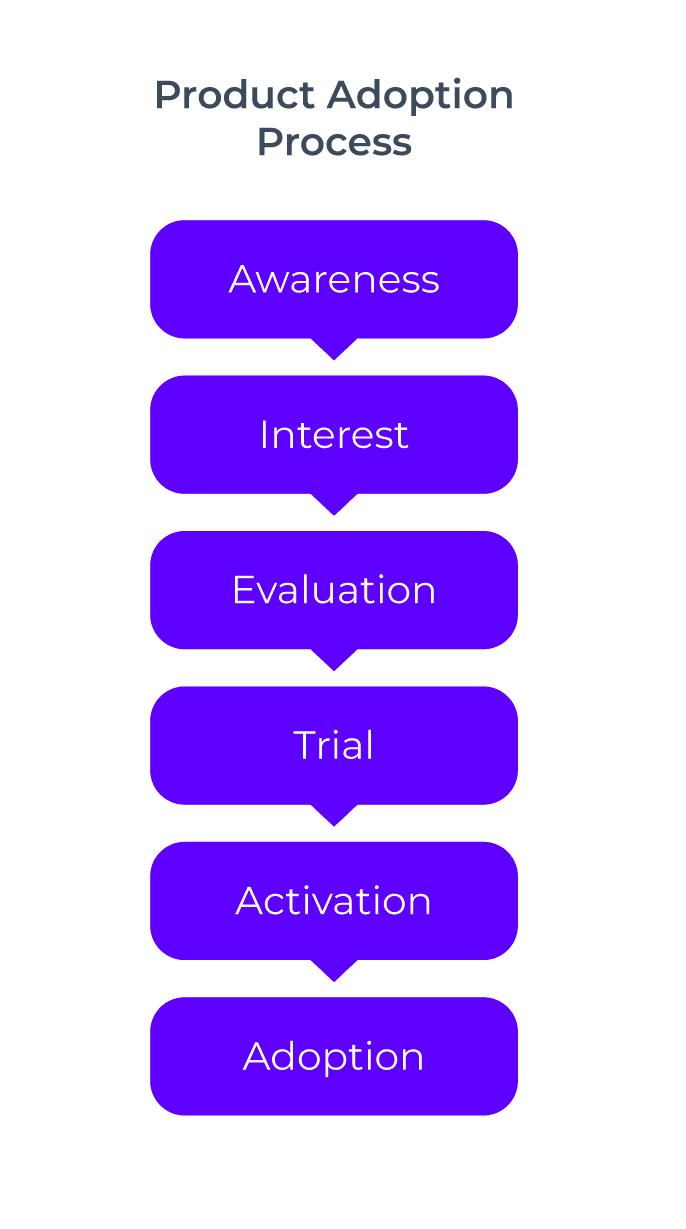
The graphic illustrates the six distinct stages of the product adoption process, from awareness to final adoption.
The 5 types of adopters you need to know
However, not all customers are equal. Clearly, an emerging product and a famous brand will attract different and distinct audience segments. Luckily, the unique segments are outlined in the timeless Product Adoption Curve model:
- Innovators. Tech enthusiasts and risk-takers searching for the best user experience possible.
- Early adopters. These users have issues they want to be solved, and they have the money to pay for them!
- Early majority. The early majority values credibility and continuity. Convince these slow decision-makers and your product will become a market leader.
- Late majority. A competitive disadvantage is what pushes late majority users to adopt. With smaller budgets, these users can’t afford a failed venture!
- Laggards. Laggards are older, risk-averse, and budget-conscious.
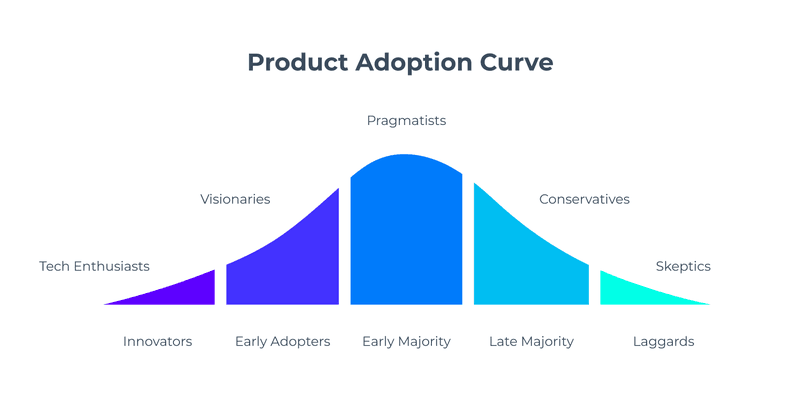
This diagram visualizes the different segments of product adopters, based on the classic Product Adoption Curve model.
The 4 crucial forces that influence the product adoption process
The product adoption process hinges entirely on very few critical decisions, and psychological factors play a huge part. To influence these choices, you can leverage these 4 forces and maximize your product adoption:
#1 Increase the push-away
In short, highlight flaws in the prospect’s current product! This can be done elegantly like in the case of the search engine DuckDuckGo. In their copy, DuckDuckGo pushes away by emphasizing that they value privacy (as opposed to other search engines, who could put your data up ‘for sale’).

DuckDuckGo's landing page is a clear example of using a 'push-away' force by highlighting its commitment to user privacy.
#2 Build up your product magnetism
In essence, a pull force means making your value proposition so attractive that prospects are willing to put in the work of learning new software. Take Slack - just how did they achieve that 30% conversion rate mentioned earlier? Because they make their product sound so magnetic! In addition, they even include a push-away in the same line.
Slack - "It’s faster, better organized, and more secure than email - and it’s free to try."

Slack's marketing copy demonstrates product magnetism by presenting a compelling and attractive value proposition.
#3 Decrease the fear of change
It turns out that avoiding loss is actually more motivating than making progress. In conclusion, people are often scared to change due to the sense of loss linked to it. This is especially true for the ‘late majority’ adopters. However, you can make the switch less scary with testimonials, trials, or even guarantees!
To provide an example, Grammarly calms its prospects by offering a free demo that requires no registration. Following Grammarly’s model could be a good idea - just last year the app was valued at a stunning $13 billion!

Grammarly effectively reduces the fear of change by offering a simple, no-registration-required demo to ease users into the experience.
#4 Decrease customer attachment to the status quo
Innovative products always face resistance. As a result, your product strategy needs to make the customer’s status quo less attractive. This force can be particularly powerful among late majority and laggard users, who are often more attached to their ‘normal’.
Github - "Figma has replaced the whiteboard for us."
To illustrate, the collaborative graphic design tool Figma shakes things up with social proof. Moreover, the use of testimonials from trusted companies enforces the persuasive idea that not using Figma puts you at a competitive disadvantage!

Figma uses testimonials from trusted brands like Github to decrease attachment to the status quo and create a sense of competitive necessity.
How to drive product adoption for your new software
Business wisdom tells us there are 5 concepts that impact the product adoption process:
Relative Advantage. Compared to the competition, is your product cheaper, more convenient, or higher in status? In short, that is a relative advantage.
Compatibility. Essentially, does your product suit the market’s culture? Usually, this is discovered through PESTLE analysis.
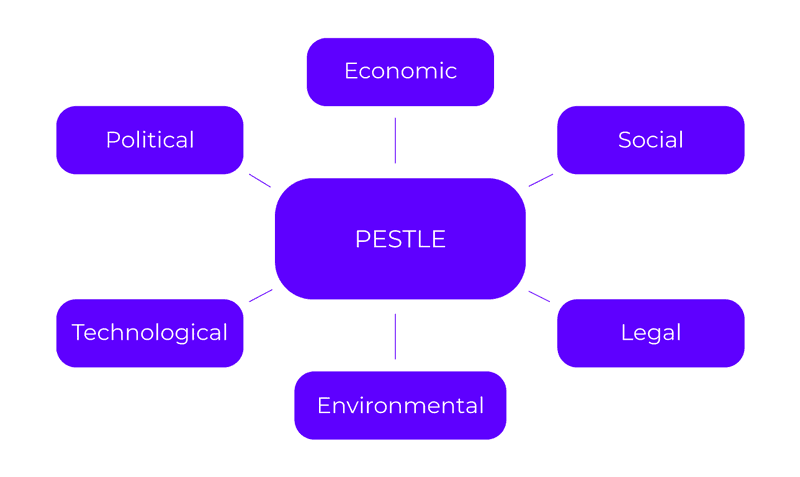
This chart outlines the five key concepts that influence the rate of product adoption, including relative advantage and compatibility.
Complexity. Is your user interface intuitive to use? Will users find friction in the user experience? To reduce complexity, keep your value proposition simple and clear!
Divisibility. If your product can be trialed, then users are more likely to give you a chance. Typically in SaaS, this comes in the form of free trials and freemium demos.
Communicability. Did you know that word of mouth results in 5x more sales than paid media impressions? But before you can benefit, users must be able to explain your value! Does your product pass the mom test?
5 tried and true techniques to improve product adoption
1) Optimize your onboarding experience with Churn Analysis
To discover if you are falling short by frustrating users in their first and most critical moments, use Churn Analysis. In short, this means analyzing each step of onboarding and tracking when and where users churn. By highlighting the largest drop-offs in user activity, you can find exactly what part of your product adoption process needs to improve.
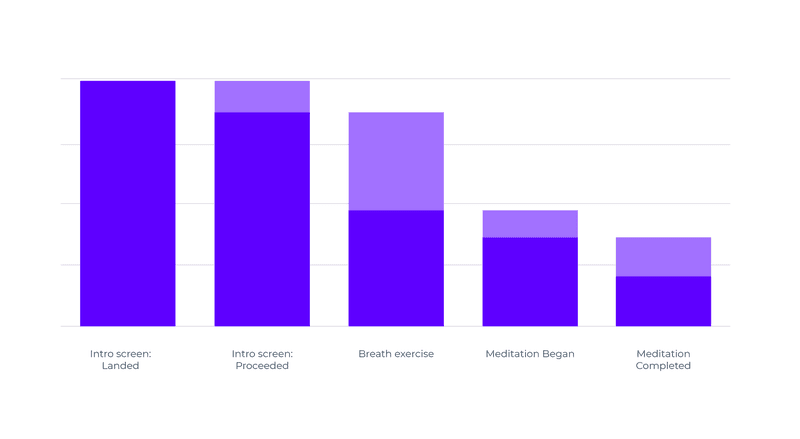
A churn analysis funnel helps identify where users drop off during onboarding, highlighting areas for improvement in the adoption process.
2) Learn how to improve your product!
Improving your product is harder than it sounds. To provide just one example, sudden updates that significantly change the UI can frustrate users. When you are improving your platform - as you should always be - there are some ways to do it so you don’t threaten the product adoption process:
- Add new features based on user feedback. Forums for users are a powerful guide to future tweaks, especially when you have innovators on board.
- Validate features before launching. Before spending lots of time in development for a feature users don’t want, try and add a “fake” button or waiting list in your product. You’ll get to see how many users show interest in a feature before building it!
- Focus on increasing usage frequency. Every unused feature is wasted money in a customer’s mind. Make features more appealing by upping the value - for example with personalization or an integrated layer of fun app gamification.
3) Drive user motivation with app gamification
App gamification makes your app intrinsically motivating. In other words, users enjoy interacting with your app because of the experience and not just the end result. You can do this through gamified rewards, messages, or even challenges. Basically, a feeling does more than a thousand words.
Email software Superhuman for instance stays focused on its goal of hitting inbox zero. When users eventually get there they get to experience a sense of relief with a gorgeous and serene reward screen. It’s a free and easy way to incentivize user engagement!
Rahul Vohra, Superhuman CEO - "We obsess about how users feel. What we make users feel is just as important as what we make. And what we actually make is joy, in software form."

Superhuman uses a rewarding visual, an example of app gamification, to celebrate when a user achieves 'inbox zero,' motivating continued use.
Creating a great platform has never been easier! Boost product adoption with our app gamification software.
4) Make support more accessible
There’s a reason live chats have the highest satisfaction of any support channel - they’re fast, easy to find, and responsive! Furthermore, every minute that a user spends frustrated on your platform with an unsolved problem is a minute that they don’t feel your value!
5) Retargeting campaigns can catch every user
Recent reports show that 74% of companies struggle to scale AI-driven product value despite adoption, highlighting that retargeting is essential to re-engage users lost in the chasm. Therefore, this group should not be ignored! In practice, they need a product adoption process tailored to their level of awareness. Because these users are already aware of your product, your messaging and positioning should differ. For example, you could use a different landing page to ‘Welcome Back’ these users.

This example from Gusto shows a 'Welcome Back' landing page, a retargeting technique tailored for users who are already aware of the product.
FAQ
What is the product adoption process?
The product adoption process is the journey of users becoming more aware of your product. At the beginning of their journey, users are unaware. They might not even realize they have a problem yet. However, the further they get in the process, the more aware they’ll become.
Why is the product adoption process important?
The product adoption process is what drives revenue & growth for SaaS companies. Here you generate interest & demand and turn them into paying customers. Additionally, a great adoption process prevents churn by showing users the full value of your product first.
What are the most important forces that influence the product adoption process?
These 4 crucial forces impact how motivated a user is to adopt a product: if users are pushed away from their existing product, pulled by the magnetism of your product, the customer’s fear of change, and finally attachment to the status quo.
4 ways to introduce gamification features that improve the user experience
Games make up a staggering 72% of all app market revenue. Of course, your app doesn't need to be a game to be successful! With gamification features like a leaderboard, you can take inspiration from games to boost your app and meet your business strategy.
4 ways to introduce gamification features that improve the user experience
TL;DR: To drive growth in 2026, brands are prioritizing gamification features that improve the user experience by integrating social streaks, progress tracking, and tiered rewards. With industry-wide Day 7 retention averaging just 13%, gamified mechanics offer a proven path to increase "stickiness" and long-term user loyalty.
Success in the 2026 app market requires more than just utility; it requires a reason for users to return daily. On the Google Play Store alone, there are over 2.4 million apps vying for attention. What then, do the best performing apps have in common? They leverage gamification features that improve the user experience to combat churn. In our experience, while the average app sees Day 7 retention fall to approximately 13%, gaming apps—which master the art of dopamine-driven feedback loops—consistently achieve Day 7 rates of 15–20% (Pushwoosh, 2025). You can take what works for games and leverage those psychological triggers for your business.
After setting up the right strategy, it takes two steps to put it into motion. First, you’ll have to find the app gamification software that suits your technical needs and scalability requirements. Secondly, you’ll need to select which specific gamification features that improve the user experience you’re going to implement, ensuring they align with your core user journey rather than acting as a distraction.
In this article, let’s cover how to create an effective strategy and look at how gamification features that improve the user experience have transformed 5 industry-leading apps!
- The biggest challenges that apps face today
- How gamification improves the user experience
- 4 gamification features that can transform your app and how to implement them
- 5 apps that found success with gamification
- Recap
The biggest challenges that apps face today
TL;DR: With average Day 30 retention hovering around 7%, most apps fail because they cannot maintain user interest. Implementing gamification features that improve the user experience is the most effective way to combat rising acquisition costs and "app fatigue" in 2026. To become the 1 in 10,000 app that achieves a true return on investment, you must tackle what developers agree are the biggest challenges currently plaguing the digital market.
App discovery is harder than ever
In 2026, the app marketplace is more consolidated than ever, and traditional marketing techniques are losing efficiency. This includes organic traffic methods like SEO or ASO (app store optimization), which have become hyper-competitive. In our experience, up-and-coming challengers face a "catch-22" in consolidated markets because apps with more downloads rank higher. To break through this ceiling, your product needs gamification features that improve the user experience enough to generate the viral "k-factor" loops necessary for organic growth.
Low rates of user retention
User churn remains the most critical issue for digital products. According to the Pushwoosh Benchmarks Study 2025, average Day 7 retention rates have tightened to 6.89% on iOS and just 5.15% on Android. Across most categories, developers are seeing a persistent benchmark of 13% retention at Day 7, dropping to a staggering 7% by Day 30. This means for every 10 users you acquire, 9 will have abandoned your app within a month. In our work with high-growth startups, we’ve found that gamification features that improve the user experience—such as progression bars and daily streaks—are the only way to significantly move these Day 30 numbers.

This chart demonstrates the dramatic drop-off in user retention over the first 90 days, highlighting why gamification features that improve the user experience are vital for long-term survival.
Are you experiencing low user engagement & high churn? Learn how gamification can help you →
The rising cost of user acquisition (CAC)
Acquisition costs have continued their decade-long climb, making existing customers even more valuable than new ones. When CAC is high and retention is low, it creates a "leaky bucket" that can kill any business model. To survive, your app must be engaging enough to turn a one-time visitor into a power user. We’ve seen this transition handled expertly by incorporating gamification features that improve the user experience, such as the Uber loyalty rewards or the Revolut referral campaign, which incentivize users to stay and invite others.
How gamification features improve the user experience
TL;DR: Strategic gamification features solve the modern retention crisis by increasing Day 1 engagement from the 26% market average to as high as 40%. By integrating reward loops and social competition, apps shift from utility tools to habit-forming experiences that drive long-term loyalty. In our experience, apps that prioritize these interactive elements see a significant lift in Day 30 session frequency compared to static interfaces.
Out of all categories of apps, the challenges of 2026—saturated markets and short attention spans—are less threatening to mobile gaming. Games maintain some of the highest retention rates, with Day 1 benchmarks reaching 35–40%, nearly double the average for standard utility apps. Gaming continues to secure the most amount of downloads, and the largest share of app revenue. Gaming dominates the app market! Indeed, non-gaming apps can learn a few things from this sector of the market—and that’s where gamification features come in.
Gamification is the use of game-like elements in non-game contexts. For example, this could mean adding a leaderboard to your educational app, which can show who in the community is earning more points. Perhaps that feature reminds you of the hit app Duolingo, whose product team remains firm that gamification features are the core reason “gamification is the reason” they are the most popular educational app in the world! In our experience, the most successful 2026 implementations focus on personal streaks and social proof to maintain these engagement levels.
What is gamification and how does it improve the user experience?
Research has shown that gamification features significantly improve the user experience by reducing cognitive friction and increasing the "fun" factor of routine tasks. Studies published in Technological Forecasting and Social Change find that these features positively affect the perceived benefits and value of a mobile app. Ultimately, the continued engagement that gamification facilitates helps apps beat the standard 2025-2026 industry benchmarks, where Day 7 retention often drops to 5-7%, leading instead to sustained customer loyalty and higher user lifetime value.
4 gamification features that can transform your app and how to implement them
TL;DR: With average Day 30 retention rates currently plateauing at just 7% across the mobile industry, gamification features are the most effective way to bridge the engagement gap. By implementing points, avatars, badges, and social communities, apps can emulate the success of the gaming sector, which sees Day 7 retention rates as high as 20%.
So, how does one implement gamification features? The right strategy is crucial - and the right gamification app software can be the perfect guide throughout the process. In our experience, successful 2026 app strategies move beyond simple mechanics to focus on long-term psychological value. While how to gamify your app will vary depending on your goals, these four features remain the gold standard for improving the user experience:
#1 Set up a points system and reward your users
A reward system does a great job of incentivizing user behavior. In 2026, this is more critical than ever; Pushwoosh Benchmarks show that average Day 7 retention is only 6.89% on iOS and 5.15% on Android. To beat these benchmarks, you must reward consistent action. For instance, if you want to push people to cycle instead of drive, you can reward points for it. This is how the app Changers saved 80,000kgs of CO2 in just 3 months! However, the points must mean something. To give people the feel-good dopamine hit, gamification features such as leaderboards or tangible prizes are perfect for providing a sense of progression.
#2 Invent a storyline with avatars and create a sense of personal involvement
Research is clear that avatars boost a user’s sense of ownership over the app. In 2026, users view their digital identity as an extension of themselves. In essence, users will feel more personally involved when they can customize their journey. These gamification features are essential if you want to take the user on a narrative story. Not only that, seeing other people’s avatars fulfills the need for social relatedness. It makes competing with other users more meaningful compared to a regular profile pic or a generic placeholder.
Easily incentivize & keep users motivated to use your product? Discover our app gamification platform!
#3 Hand out badges and boost customer motivation
Badges are a great way of recognizing a user’s accomplishments. These gamification features act as visual milestones that help align users to goals that you share. We have found that the most effective badge systems in 2026 utilize "scarcity" and "exclusivity" to drive behavior. Once earned, badges act as status symbols, distinguishing high-performing users from the rest of the community and satisfying the human desire for achievement.
#4 Encourage communities that make the experience fun
One of the most powerful needs that humans have is the need to belong. In the most basic terms, people crave social interaction. While standard apps struggle with high churn, gaming-inspired gamification features like challenges and leaderboards push users to interact, resulting in Day 7 retention rates of 15–20%—nearly triple the industry average. An in-app community can make customers significantly more loyal to your brand. For example, studies into Nike Run Club found that social interaction was the biggest source of customer motivation.
5 apps that found success with gamification features that improve the user experience
TL;DR: Leading apps maintain high engagement by utilizing gamification features that improve the user experience, such as habit-forming streaks, competitive leaderboards, and progress-tracking. In an era where the average Day 30 retention across most categories is just 7%, implementing these mechanics can help bridge the gap toward the 40% retention rates seen in top-tier gaming apps.
Gamification features that improve the user experience are no longer optional extras; they are the primary drivers of long-term retention. According to a 2025 Pushwoosh Benchmarks Study, the average Day 7 retention rate sits at 6.89% on iOS and 5.15% on Android. To fight this churn, successful apps across all categories, from B2B to B2C, have adopted gaming-inspired mechanics to keep users coming back. Here are 5 apps leading the way in 2026:
Headspace will make you a master of meditation
Headspace is a meditation app that leverages gamification features that improve the user experience for over 2 million subscribers. By using "streaks," the app visualizes consistent daily usage to help users install the habit of meditation. In our experience, streaks are one of the most powerful psychological drivers of retention because they tap into loss aversion. In addition, reaching specific milestones triggers digital confetti and rewards, providing the dopamine hit necessary to turn a mental health chore into a rewarding daily ritual.

Headspace uses a streak feature to visually represent a user's consistent meditation practice, motivating them to continue.
Fitbit’s leaderboard encourages users to run harder
Fitbit uses gamification features that improve the user experience by turning health data into a social competition. The app tracks steps to rank users on a leaderboard, creating a "positive intensifier" that fuels engagement. This social connection is key to Fitbit's massive active user base. 2026 industry benchmarks show that gaming-style mechanics like these allow apps to achieve Day 1 retention rates of 35–40%, significantly outperforming traditional fitness trackers that lack social components. Studies indicate that the inclusion of a leaderboard alone can lead to a 15% increase in daily activity.
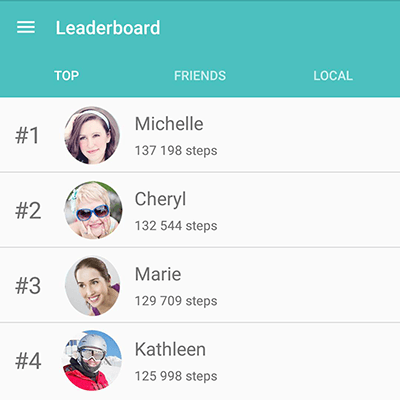
This leaderboard from Fitbit fosters a sense of competition and community, encouraging users to increase their daily step count.
LinkedIn improved its onboarding with this 1 gamification feature
LinkedIn utilizes subtle gamification features that improve the user experience during the profile creation process. A colorful progress bar creates a clear goal and provides a sense of accomplishment as users move toward the "All-Star" status. In our experience, clarifying the path to completion is essential for overcoming the "blank slate" problem in B2B apps. By guiding users through complex data entry with small, rewarding visual cues, LinkedIn has historically seen profile completion rates jump by over 50%, effectively countering the persistent low retention rates that plague professional networking tools.

LinkedIn's profile completion bar is a simple yet effective gamification element that guides a user toward a fully filled-out profile.
Setting targets with SWEAT creates goals to strive for
SWEAT incorporates gamification features that improve the user experience by allowing users to set personal targets and deadlines. By creating ownership over their fitness journey, users are more likely to stay committed. Research on the "Mere Deadline Effect" suggests that adding a deadline significantly aids goal pursuit by increasing focus. The app aligns these targets with 12-week programs, a duration designed to be impactful without being daunting, helping it maintain a Day 7 retention that stays well above the 13% cross-category average.

The SWEAT app uses goal-setting and program timelines to provide structure and motivation for users' fitness journeys.
The Starbucks loyalty program that truly rewards
Starbucks has mastered gamification features that improve the user experience through its iconic "Stars" loyalty program. With over 30 million active members, the app rewards orders with digital currency that can be redeemed for tangible products. The tiered reward system encourages users to climb higher to unlock better perks. This addictive design has proven incredibly lucrative, as the program is responsible for approximately 40% of all US sales. By visualizing the path to a "free" item, Starbucks turns a routine transaction into an engaging quest.
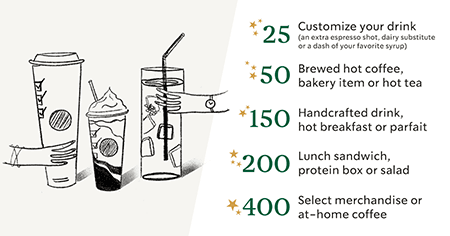
Starbucks' loyalty program visualizes rewards with 'stars,' making the path to a free item tangible and engaging for customers.
As you can see, depending on your business goals, gamification features can enhance the user experience and drive more of the customer behavior that you want to promote. If you would like to start on your journey, the Strivecloud gamification app software can assist your needs and help you overcome the retention challenges facing your app in 2026.
Recap: Integrating Gamification Features That Improve the User Experience
In 2026, launching a successful app requires more than just a clean interface. In our experience, the most effective way to drive long-term engagement is through gamification features that improve the user experience. By leveraging behavioral psychology, apps can overcome the three primary challenges of the current mobile landscape: stagnant discovery, the "retention cliff," and skyrocketing acquisition costs.
First, app discovery is more competitive than ever. Standing out among millions of listings is nearly impossible without massive initial volume. Getting to the front page is no longer just about quality; it is about maintaining a download velocity that few developers can sustain without a built-in engagement loop.
Once you acquire a user, the battle shifts to keeping them. Recent data from the Pushwoosh 2025 Benchmarks Study reveals that average Day 7 retention is only 6.89% for iOS and 5.15% for Android. Across most categories, the industry faces a standard 30-day retention rate of just 7%, highlighting a massive gap in user loyalty that standard UI/UX often fails to bridge.
Compounding these issues, user acquisition costs (CAC) continue to climb globally. This makes it increasingly difficult for apps to achieve sustainable profitability, as the cost of "buying" a user often exceeds their lifetime value if they churn within the first week of installation.
So, how do market leaders like Fitbit or Duolingo maintain such high engagement? They borrow the mechanics of the highest-performing category: gaming. According to 2026 industry benchmarks, gaming apps typically see Day 1 retention rates of 35–40%, nearly doubling the average non-gaming app by utilizing addictive design patterns and immediate feedback loops.
These leaders do not necessarily turn their products into "games" in the traditional sense. Instead, they implement gamification features that improve the user experience by nudging behavior through leaderboards, streaks, and milestone-based reward systems. These psychological triggers transform routine tasks into rewarding habits that keep users coming back daily.
Would you like to see how gamification could work for your app? Learn more →
48 best user onboarding experiences (plus a free checklist to boost your SaaS)
Poor onboarding is the largest contributor to user churn! So what do the best onboarding experiences have in common? Check out these 8 UX patterns with 48 examples of leading SaaS companies. Get started yourself with our free user onboarding checklist!
48 best user onboarding experiences (plus a free checklist to boost your SaaS)

This lead image sets the stage for the article's exploration of top-tier user onboarding experiences and resources.
In reality, poor onboarding is the main reason users churn. However, the best user onboarding experiences know how to overcome that challenge! Want to do the same? Get started with our free user onboarding checklist designed to drive product adoption.
In this article, let’s review why onboarding is so important, and detail 8 great onboarding UX patterns with 48 top examples from SaaS apps.
- What is user onboarding?
- Why you should focus on onboarding
- Lesson 101: the basics behind the best user onboarding experiences
- How do you design a great onboarding experience? Top tips to learn from
- 8 great user onboarding UX and UI patterns from leading SaaS companies (With 48 examples!)
- #1 Leverage social proof using data, testimonials, and conversion rates
- #2 Email verification walls are conversion killers
- #3 Unnecessary steps discourage users from completing onboarding
- #4 Product tours should be action-focused, not informational
- #5 Segmenting users increases their likelihood to finish onboarding with success
- #6 Make onboarding motivating by emphasizing “what”, not “why”
- #7 Show helpful empty states that facilitate further user engagement
- #8 Behavior-based emails encourage new users to re-enter the product
- What are the key elements that define an excellent onboarding experience?
- Best user onboarding experiences - FAQ
What is user onboarding?
Onboarding is the process of getting users acquainted with your product and leading them to value as fast as possible! Indeed, that first impression is a crucial stage in all the best user onboarding experiences! Essentially, onboarding is where the user learns the ins and outs of your product. This can happen either manually or automated.
👉 Download our Free User Onboarding Checklist here!
Why you should focus on onboarding
The best user onboarding experiences lead to increased retention. For the average SaaS startup, it takes users 11 whole months to return their acquisition cost. That’s nearly a year before you see any profit! Losing a customer due to not conveying value clearly is a big bummer.
In reality, poor onboarding is the main reason users churn. However, the best user onboarding experiences know how to overcome that challenge! Want to do the same? Get started with our free user onboarding checklist designed to drive product adoption.
In this article, let’s review why onboarding is so important, and detail 8 great onboarding UX patterns with 48 top examples from SaaS apps.
- What is user onboarding?
- Why you should focus on onboarding
- Lesson 101: the basics behind the best user onboarding experiences
- How do you design a great onboarding experience? Top tips to learn from
- 8 great user onboarding UX and UI patterns from leading SaaS companies (With 48 examples!)
- #1 Leverage social proof using data, testimonials, and conversion rates
- #2 Email verification walls are conversion killers
- #3 Unnecessary steps discourage users from completing onboarding
- #4 Product tours should be action-focused, not informational
- #5 Segmenting users increases their likelihood to finish onboarding with success
- #6 Make onboarding motivating by emphasizing “what”, not “why”
- #7 Show helpful empty states that facilitate further user engagement
- #8 Behavior-based emails encourage new users to re-enter the product
- What are the key elements that define an excellent onboarding experience?
- Best user onboarding experiences – FAQ
What is user onboarding?
Onboarding is the process of getting users acquainted with your product and leading them to value as fast as possible! Indeed, that first impression is a crucial stage in all the best user onboarding experiences! Essentially, onboarding is where the user learns the ins and outs of your product. This can happen either manually or automated.
👉 Download our Free User Onboarding Checklist here!
Why you should focus on onboarding
The best user onboarding experiences lead to increased retention. For the average SaaS startup, it takes users 11 whole months to return their acquisition cost. That’s nearly a year before you see any profit! Losing a customer due to not conveying value clearly is a big bummer.
Lesson 101: the basics behind the best user onboarding experiences
These 3 things need to be on your user onboarding checklist:
- Useful - Do users get value from the experience?
- Easy to use - Can users get to value intuitively?
- Fun - Do users enjoy engaging in the experience?
But this is merely the background to the ultimate goal of onboarding: to acquaint users with your value! A shorter time to value will also help users reach the AHA moment faster, an important stage in user activation.
How do you design a great onboarding experience? Top tips to learn from.
To discover what constitutes the best user onboarding experiences, learn from the ones already out there! For example, how did French fintech Shine achieve an amazing 80% onboarding conversion rate? These are some tips from growth engineer Arnaud Babol:
Arnaud Babol - "Keep it simple: one screen, one action."
New customers can very easily be overloaded by your user interface. Therefore, it’s wise to segment each action with different screens. This makes it especially clear what you’re asking for!

Shine's onboarding flow exemplifies the 'one screen, one action' principle, breaking down the process into simple, manageable steps.
Arnaud Babol - "Make your onboarding experience unique with motion design."
Arnaud Babol writes that the best user onboarding experiences quickly cement their brand identity in the user’s head. One way to do that is with a unique motion design.
Arnaud Babol - "Never leave your user alone."
If your user is lost, that’s a missed opportunity! Instead, guide them with tooltips and checklists that lead them to their next action so they can still discover your true value.

Here, tooltips in Shine's UI guide the user, ensuring they are never left without direction during the onboarding process.
8 great user onboarding UX and UI patterns from leading SaaS companies (With 48 examples!)
#1 Leverage social proof using data, testimonials, and conversion rates
In times of uncertainty, we always look to take guidance from others. Behavioral scientists call this ‘social proof’ - and the best user onboarding experiences leverage it to powerful effect!
Insight Timer creates a global sense of community through social proof
To make users feel a part of a community, the wellness app Insight Timer shows on its dashboard how many users are meditating at that very moment. Not only does this validate the platform’s quality, but it also makes users feel they belong to a community!
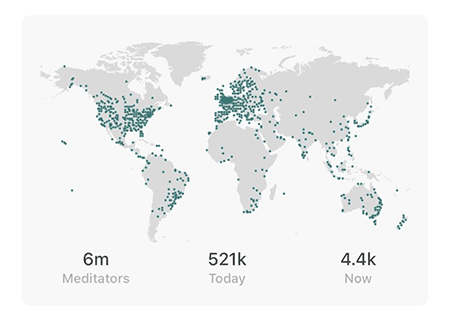
Insight Timer's live map demonstrates social proof by showing a global community of users meditating simultaneously, which enhances the sense of belonging.
How Kajabi uses longevity to position as an authority
Touting how long you have been in business hints at a history of success. For example, online course creator Kajabi boasts in a bold blue “10+ years as the industry leader”. It makes them stand out as authority figures in their industry.
Proof leverages expert testimonials to build brand trust
In a way, experts are influencers. Their clout can be used to give your brand credibility, and it is a particularly powerful influence. Personalization tool Proof has perhaps the best example - with a quote from Steve Jobs talking about how “personalization works”. Of course from him, that builds trust!
PiggyVest elevates brand champions
Easily accessible on their website, Nigerian fintech PiggyVest shares the story of hundreds of their ‘happy savers’. To be sure, the feature inspires success! In 2021, PiggyVest saved users over $585 million!

PiggyVest showcases success stories from their users, inspiring confidence and demonstrating the tangible benefits of their fintech platform.
Use conversion data to boost your credibility like Proof
Proof found a way to instantly communicate their value offer of boosting your conversions. How did they do it? Easy, with a counter on their landing page that says:
"1594 people requested a demo in the last 30 days."
Boast.io uses testimonials for proof-based marketing
Many users identified in the product adoption curve are risk-averse. But when you post testimonials on your landing page, you help reduce your prospect’s fear of change by making the switch less intimidating. Boast.io is a video testimonial tool practicing what they preach!
Invision builds brand trust through recognizable logos
If a trusted company is your client, then customers will see you as trustworthy too! To benefit from that trust, follow the example of Invision and place the most recognizable logos of your business customers on your website. Research shows it can increase conversions by 400%!
ShipBob uses testimonials, reviews, and data to boost social proof!
This E-commerce platform guarantees success with multiple types of social proof. Besides a testimonial and a few world-class logos, it also features raw data such as:
- Trusted by 7000+ brands
- 99,96% of orders ship on time
- 99,95% accuracy rate
- 30+ fulfillment centers
- #1 fulfillment technology
👉 Download our Free User Onboarding Checklist here!
#2 Email verification walls are conversion killers
Email verification walls are common - but they’re also a big reason for churn. Make sure to take these insights with you on your user onboarding checklist!
Snappa delays verification requests to turn churn into growth
Graphic design tool Snappa discovered that 27% of all signups never activated their email. But when Snappa removed the request, monthly revenue quickly rose by 20%!

This graph illustrates the significant revenue growth Snappa experienced after removing the email verification wall, a key lesson in reducing user friction.
Ensure email deliverability in-app like Monday.com
Of course, you want the user’s email, but you also want them to stay in-app, or else they might churn. Solve this problem like work management software Monday! Monday lets users experience the value straight away and only alerts users if their email bounces.
Simply don’t ask for registration like Jotform
Incredibly, form builder Jotform doesn’t ask new users to register. In fact, they allow customers to test the app’s full functionality! Actually, users only need to register when they wish to send out forms. This method must work to increase product adoption - in 2022 Jotform achieved 1 billion form submissions!
👉 Download our Free User Onboarding Checklist here!
#3 Unnecessary steps discourage users from completing onboarding
Industry wisdom states that each onboarding step results in a 20% increase in user churn – so keep it short and sweet!
Behavioral scientists will tell you that unnecessary steps and choices can accumulate to a dangerous degree. In detail, there are 2 major effects that you want to avoid triggering:
The paradox of Choice. The more choices you give a user, the less likely they are to choose!
Hick's Law. Basically, where decision time increases with every additional choice.
Don’t waste time stating the obvious. In fact, studies show that the optimal onboarding length is 3 screens! With extra steps, conversions can fall from 72% to as low as 45%.
Shopify split onboarding on multiple screens
If you still need more information to make your product valuable, then look at Shopify! The first page focuses on your use case for the platform. Then, you complete your personal details and get started!
WaveHQ does the styling for you
Instead of letting you customize your workspace to your own brand Wave simply asks you to add your logo and does the rest for you. Some might think this is still an extra step, however, it seems to fuel motivation and user engagement.
Zakeke uses hotspots to avoid information overload
First, ask yourself what is necessary for onboarding. Then ask “when is it necessary?” Hotspots like Zakeke guide the user in real-time. As a result, they eliminate the need for extra steps and thus user churn.
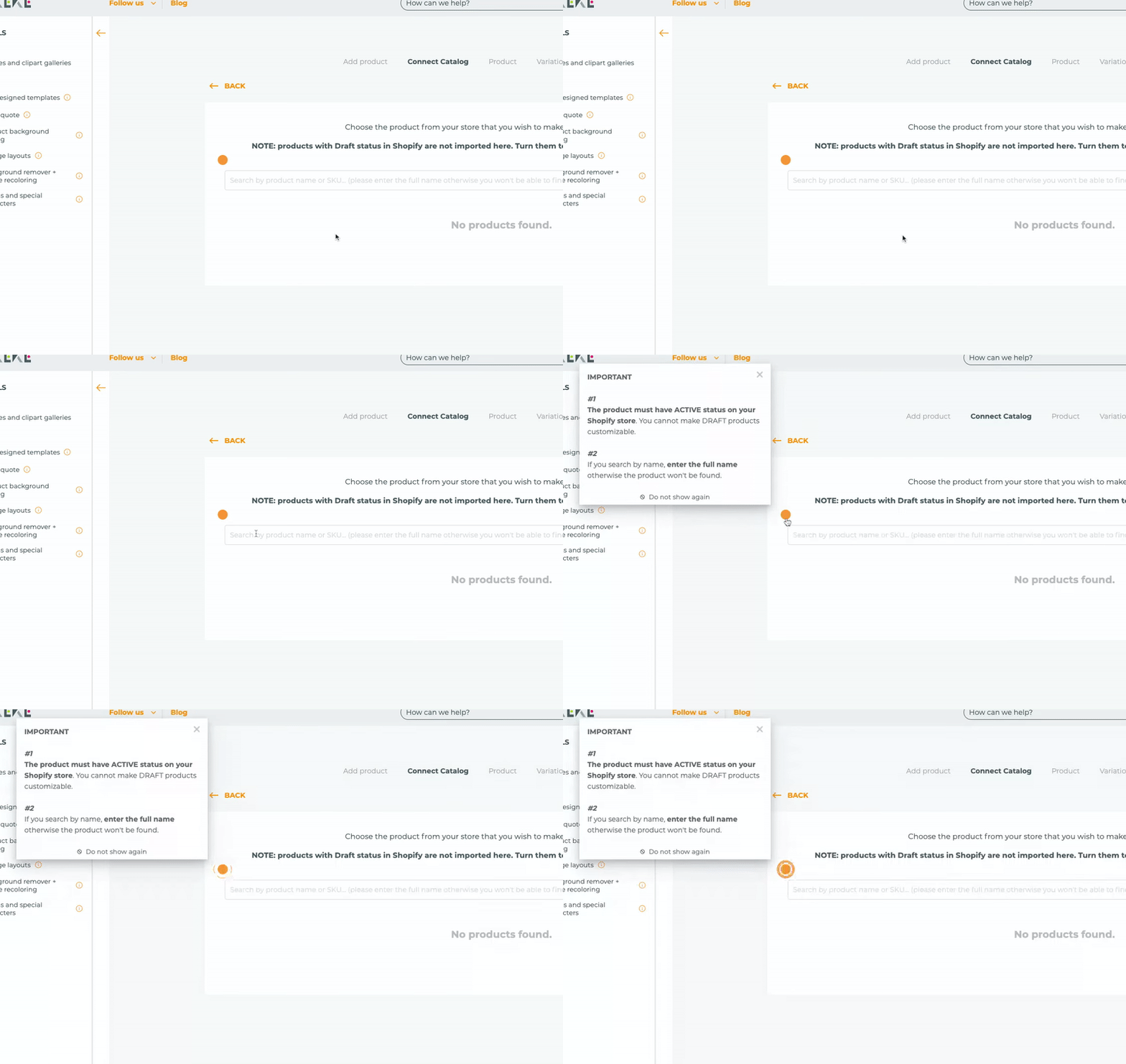
Zakeke uses hotspot tooltips to provide contextual information just-in-time, preventing information overload and keeping the onboarding flow clean.
Let users skip profile set-up like Substack
Should new users need to set up their profile photo and bio, before they have even trialed the product? Well, that used to be how it was for Substack. Today, however, Substack lets users “skip for now” - removing a big barrier to initial user engagement.
Avo keeps a quick and clean UI with a singular focus
Analytics tool Avo keeps each onboarding screen as simple as possible, asking questions like “what are the sources of your data?”, alongside clear, clickable options that move users on to the next stage in their journey.
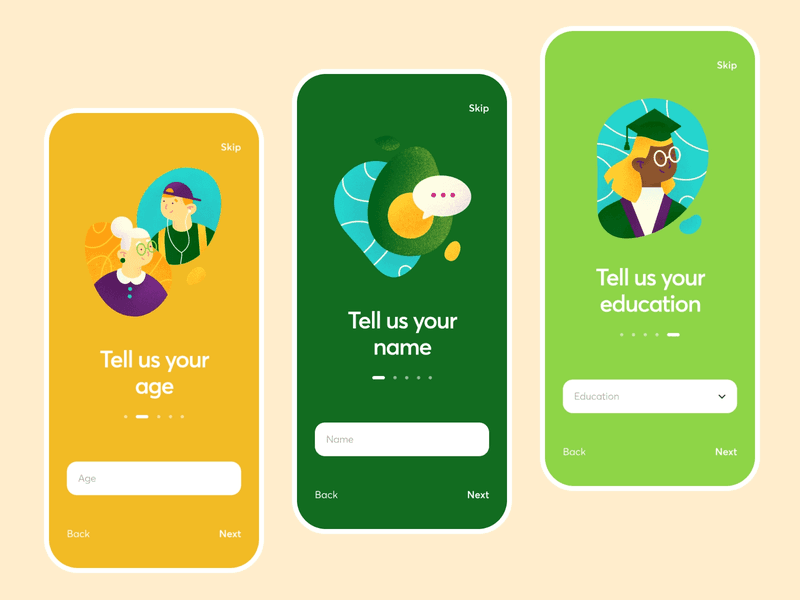
Avo's onboarding screen maintains a singular focus, asking a clear question with simple options to guide the user smoothly through setup.
Speed up time to value with suggestions like Reclaim
Time blocking tool Reclaim for instance asks during onboarding if you want to block out time for lunch. Not only does this immediately display their unique value, but it also introduces users to a new way of planning!
#4 Product tours should be action-focused, not informational
In reality, we as humans are overloaded with information every day. And often, we don’t know what to do with any of it! To avoid this, create an action-focused UX. In essence, if users start with action in their minds, they are more likely to take the next steps!
For example, a gamified user onboarding checklist states the next steps to take along with potential rewards.
Mint has a clear CTA on each screen to prompt user engagement
Mint’s headline is a rousing CTA: “See all your money in one number”.

Mint's onboarding screen features a powerful and direct call-to-action, encouraging users to engage immediately by seeing all their finances in one place.
Gamified checklists motivate users to finish onboarding on Quora
A gamified user onboarding checklist provokes the ‘endowed progress effect’. This principle notes that people are more likely to finish something if they think they are close to completion. To lock in this effect, reward users for completing ‘dummy’ tasks like ‘signed up’. Quora users already have 1-3 out of their items crossed after signing up.
How to increase product adoption with a gamified product? Get your expert-led workshop & learn how to use behavioral psychology to your advantage!
Improve product discovery with interactive paths like Xero
When customers sign up to Xero to improve their accounting, their greatest dread is probably a wall of confusing numbers! But the Xero dashboard is like a simple choose-your-own-adventure game.
Not only is this fun to use, but Xero’s UX empowers users with the choice of product tour, letting them discover what is most valuable to them faster!

Xero's interactive, 'choose-your-own-adventure' product tour empowers users to discover the features most relevant to their needs first.
Why Xero frames tasks as win-based actions
Framing tasks as a win will remind users of why they’re completing the product tour. Take Xero again. For each task on their product tour, win-based copy triggers users to action: “Get paid faster”, “Track your money”, and “Stay on top of your taxes”.
Hypercontext uses modals to highlight the key tasks
Hypercontext is a collaborative meeting SaaS that promises to make meetings more productive. To convey this value quickly, modals highlight the app’s key tasks: “Create your first agenda”.

Hypercontext effectively uses a modal window to highlight the primary action, "Create your first agenda," guiding new users towards their 'Aha!' moment.
How Headspace fuels healthy habits with streaks and badges
Wellness app Headspace has 2,100 corporate customers - and they manage this because their app encourages habit formation. With gamified streaks and badges that celebrate early successes, users are intrinsically motivated to use the platform and earn more.
👉 Download our Free User Onboarding Checklist here!
#5 Segmenting users increases their likelihood to finish onboarding with success
When you segment users, you understand their needs on a deeper level. This knowledge can be used to personalize onboarding and create more value!
Customize product samples like Genially
Genially is an animated content platform to create infographics, presentations, and e-learning materials. During onboarding Genially asks a few questions like what industry you work in. Then, they display a customized design sample based on your preferences.
Lumen5 motivates users with custom goals
Letting users set their own goals should be on your user onboarding checklist. For users, it provides a clear purpose. For you, it allows you to personalize the user experience! Video maker Lumen5 wastes no time in doing this. In fact, they devote their second onboarding screen to asking new users about their goals.

During onboarding, Lumen5 asks users to define their goals, which allows for a personalized experience and provides a clear purpose from the start.
Ticketmaster uses geolocation to customize your feed
For many apps, what you offer varies wildly depending on where the user lives. For Ticketmaster, geolocation data is crucial to personalizing offers like upcoming concerts that might interest the user. Equally, to discover what a user likes, onboarding fields that simply ask users their favorite artists are a great way to personalize offers.
Segment users on NPS score like Qualtrics
Not all users want the same. So why not segment them based on customer satisfaction? One way to do so is through a Net Promoter Survey such as Qualtrics. Besides defining the key drivers for different segments, you’ll also learn where to prioritize support!
Evernote enhances personalization during onboarding
When starting off with Evernote you’ll be asked to order your main use cases for the product. As a result, you’ll get a customized template library and interface to start. This way you get a product experience relevant to you.
Dropbox targets account expansion through segmentation
Dropbox doesn’t try to sell its premium product to barely engaged users. Instead, they segment the most engaged users expected to reach their storage limit. What’s that saying about marketing again? Right place, right time?
👉 Download our Free User Onboarding Checklist here!
#6 Make onboarding motivating by emphasizing “what”, not just “why”
Simplicity is key. That’s why focusing on the concrete ‘what’ instead of a more abstract ‘why’. There is a famous quote that should sum up your attitude towards user experiences:
“A designer knows they have achieved perfection not when there is nothing left to add, but when there is nothing left to take away.”
Calendly uses copy that gets straight to the point
Essentially, your copy should stick to the task at hand! Otherwise, you run the risk of being ignored. Calendly avoids this with a simple headline based on ‘what’ they offer.
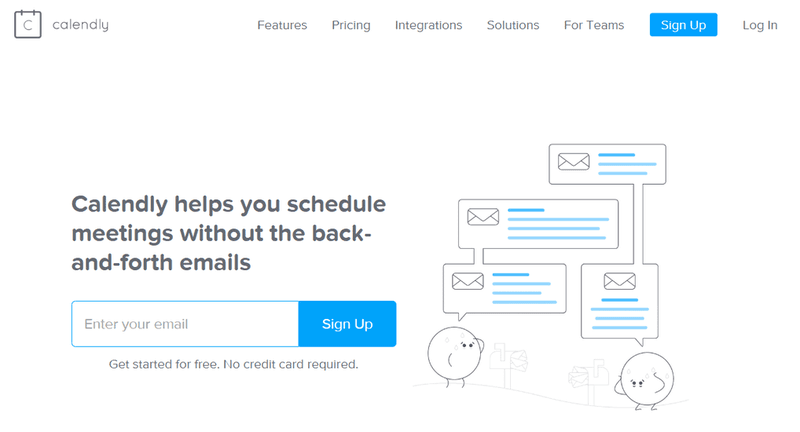
Calendly's landing page copy is a prime example of simplicity, getting straight to the point to communicate the product's core value instantly.
Sprig emphasizes feature benefits to increase feature adoption
User research tool Sprig is clear on its benefits as users create a survey - and that’s good! Alongside a preview of the final result, a text bubble reads “we’ll automatically customize your company name to increase response rates”.
Let users complete micro-commitments like Grammarly
Handing new users small tasks is a fast way to get them invested and learn why your product is great. Moreover, users will feel like they earn their reward! For instance, Grammarly asks demo users to correct problems in a sample document. As a result, it instantly conveys the core value of their product.
Togglr uses gamified rewards to reinforce user action
Gamified rewards provide users with an intrinsic satisfaction that facilitates repeated user engagement. For example, when Togglr users successfully complete a task for the first time, the app celebrates their success with a clapping emoji. This positive reinforcement gives users a reason ‘why’ they should complete the task again!

Toggl demonstrates positive reinforcement by using a simple clapping emoji to celebrate a user's first completed task, encouraging repeat engagement.
Sprout explains what they’ll do with your data (and why they need it!)
For many apps, onboarding means asking users for access to their personal data. That can be a thorny subject - so it pays to tell users exactly why users should accept:
Sprout Social - "It’s okay to click ‘Okay’! We need your permission to deliver and report on the messages you post."
Moosend’s progress bars remind users of their goal (and how far they’ve come)
Aside from showing users their past personal progress, progress bars remind users of their goals. Email marketing software Moosend has a great gamified progress bar that fills after each onboarding step, culminating in the ultimate goal: “send a campaign”.
Drive product-led growth with an in-app gamified experience! Simply link to our modular gamification software & start testing!
#7 Show helpful empty states that facilitate further user engagement
While only an estimated 5% of users ever see an empty state, they’re still a great opportunity to drive user engagement. How? By balancing the principles of all the best user onboarding experiences that include education, motivation, and direction.
Todoist makes empty states the end goal
We all love the feeling of completing our to-do list. So what better example than Todoist using empty states to celebrate user success? In addition, they prompt users to share their success with a hashtag and social media buttons.
Todoist - "Enjoy your afternoon. Today you completed 8 tasks and reached #TodoistZero!"
Buffer gets you connected with 1 click
Buffer is a social media publishing and analytics tool, so it doesn’t have much value without linking your channels. That’s why their empty states suggest “connect your first channel”.
How Superhuman charms users with feel-good nature scenes
Believe it or not, empty states can actually make users more productive! This effect is called ‘biophilia’ and has even been shown to improve moods. Taking advantage of this, email SaaS Superhuman shows users landscapes when they reach inbox zero!

Superhuman uses beautiful, serene landscapes as a reward for reaching 'inbox zero,' leveraging biophilia to create a positive and calming user experience.
Guide users to their next step like Jobpal
Jobpal is an automated recruitment solution that saves both recruiters and candidates a ton of time. As a recruiter, the empty state makes it very clear which next steps to take. This way you never get stuck, or bored with endless onboarding tours!
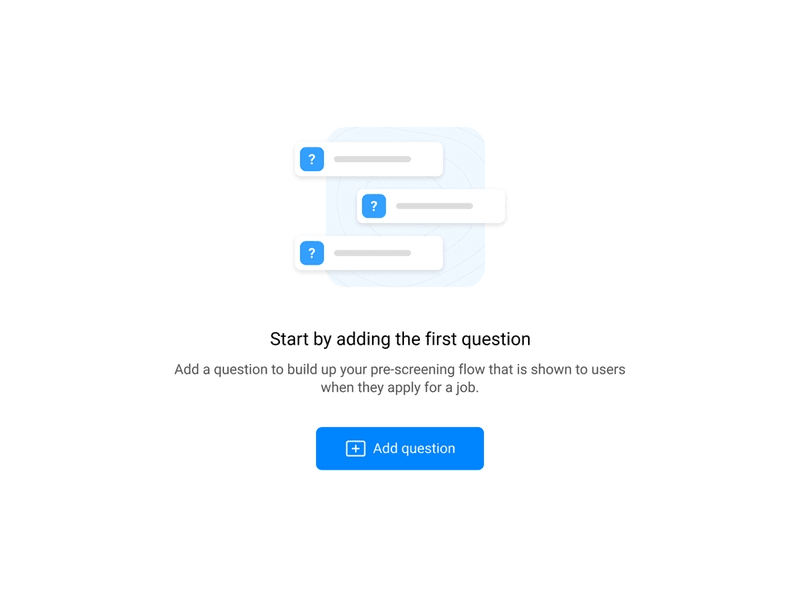
Jobpal's empty state clearly outlines the next steps a recruiter should take, preventing confusion and guiding them towards productive use of the platform.
Use empty states to inspire users like Notion
When you create a new page on Notion its default state is empty. However, Notion adds demo content which is also educational and instructive. For instance, they include a get started checklist explaining their features and the copy: “Press enter to continue with an empty page or pick a template.”.
Copper turns empty completion pages into conversion machines
Onboarding should be more than creating a personal profile. Follow the lead of CRM app Copper, which promotes their Chrome extension. As a result, 25% of new users install their Chrome extension directly from this screen!

After profile completion, Copper uses this success state to promote its Chrome extension, successfully converting a significant percentage of new users.
Salesflare locks you in with a simple suggestion
When users hit an empty state on CRM tool Salesflare, the dashboard suggests that users automatically connect their email contacts. That’s instant value and makes churn less likely!
👉 Download our Free User Onboarding Checklist here!
#8 Behavior-based emails encourage new users to re-enter the product
Every user onboarding checklist should include behavioral emails or messaging. Not only does it improve user onboarding, but it also brings back potential drop-offs!
While most emails get put straight in spam, recipients are over 75% more likely to open welcome emails than other marketing emails. Take advantage of that open rate to drive the behavior that you know will lead to product adoption.
Kick-off onboarding with reaffirming CTA’s like Hotjar
The best user onboarding experiences make their emails action-focused. In other words, they clearly describe the benefits next to concrete action. Take Hotjar’s ‘get started’ email for instance!
Hotjar - "Ready to see what’s really stopping your visitors from converting? You’re only minutes away from seeing your site through your users eyes!"
Databox helps you become a data-driven professional
Don’t give up on users who are already halfway through the process! Databox for instance encourages you to complete the final step to becoming a data-driven professional. Strong copy like ‘What are you waiting for?!’ and ‘Complete stage 1’ skyrocket completion.
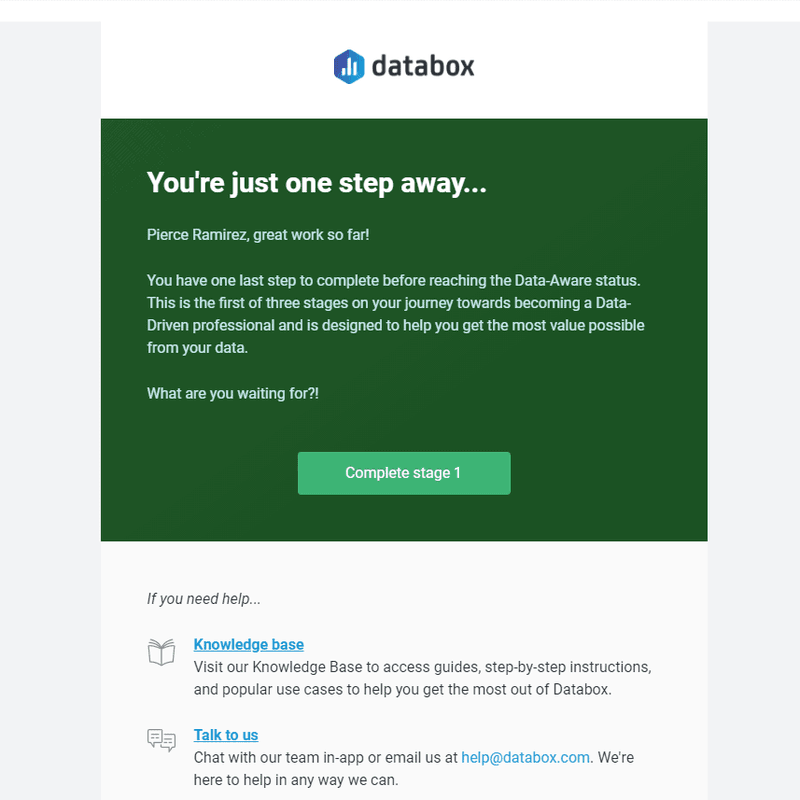
This behavioral email from Databox uses encouraging and urgent copy to re-engage users who are partway through the setup process.
Celebrate success and build upon it like Soapbox
Soapbox rewards users with a fun rockstar gif for uploading their first video - which already highlights the product’s value. Then, they encourage users to complete the next steps of editing or improving their video. Besides being helpful, it clearly demonstrates the product value at the right moment!
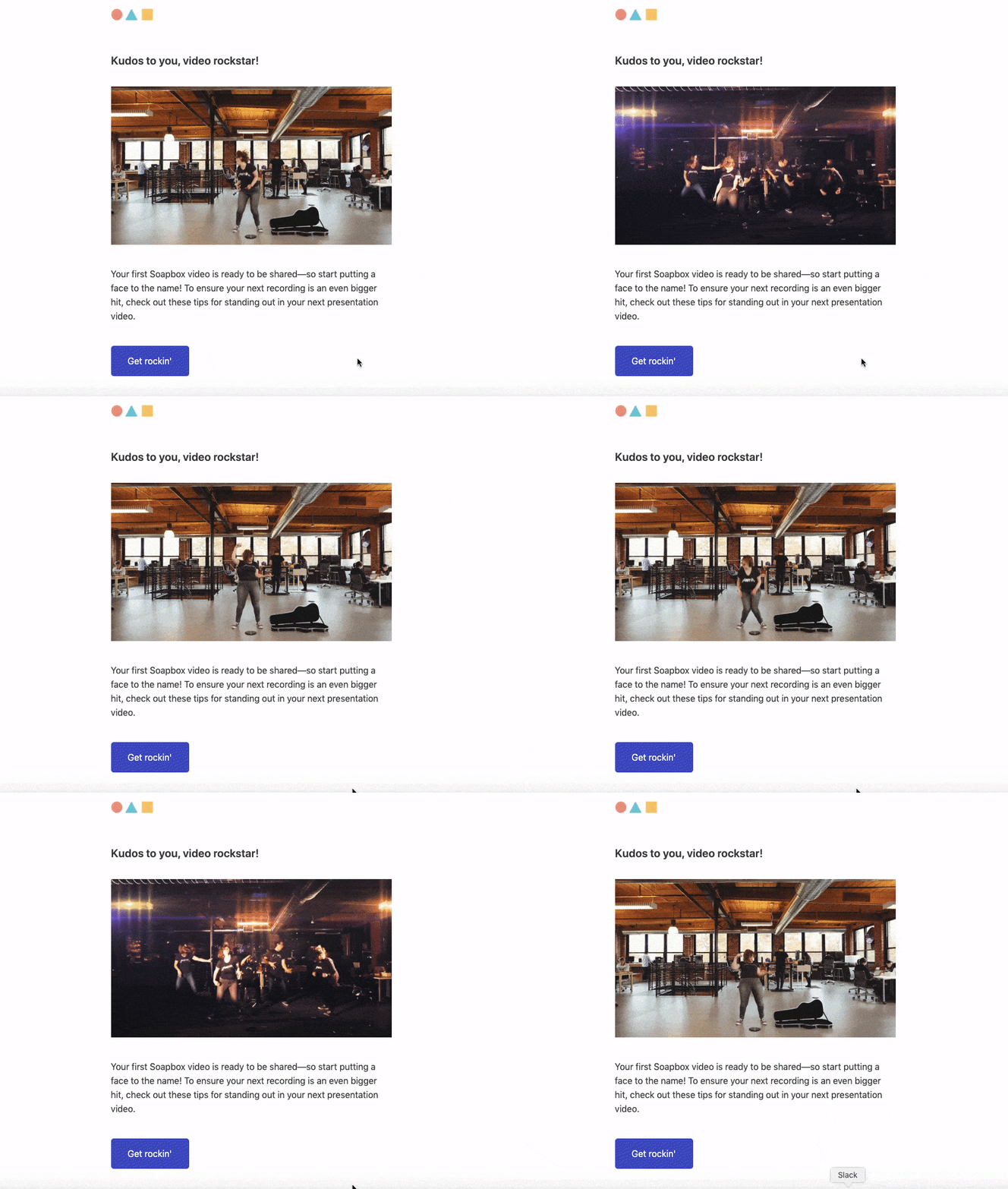
Soapbox celebrates a user's first video upload with a fun GIF and immediately suggests the next steps, building momentum and demonstrating further value.
Learn to drive user engagement like Asana
Asana has the mission of making its users more productive, so what better way to act on this than by sending an action-packed email? If you’re new to their product it might feel overwhelming. However, by giving clear step-by-step instructions Asana gets you started in no time!
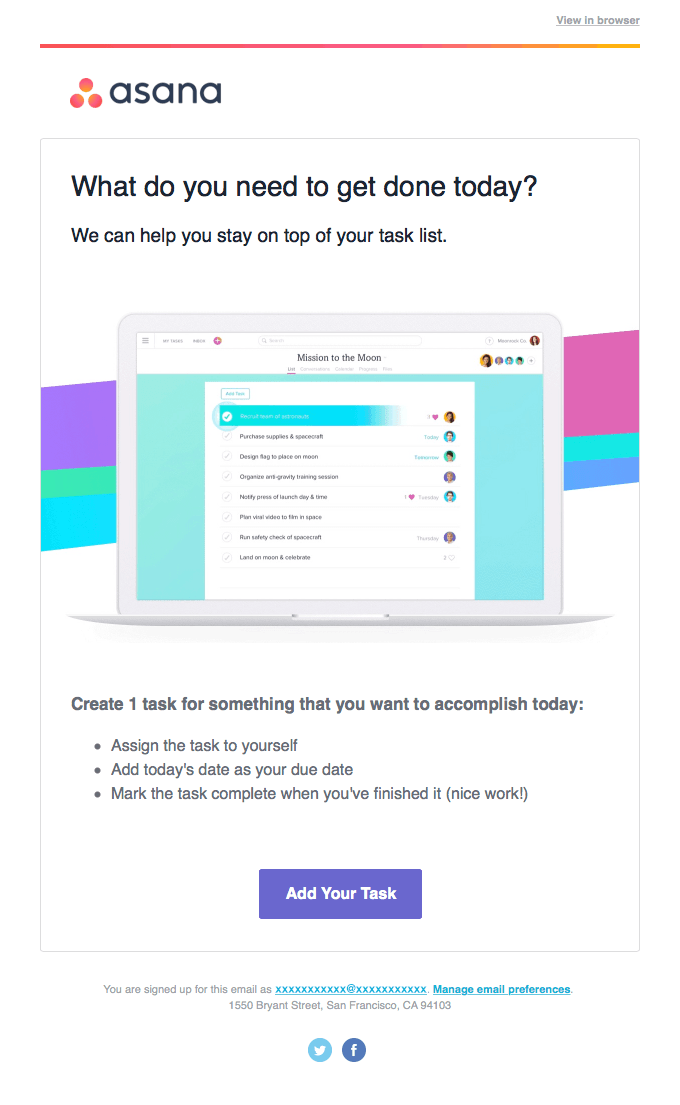
Asana's welcome email provides clear, step-by-step instructions to help new users overcome the initial learning curve and start organizing tasks effectively.
Monday’s custom tours designed to suit the user’s behavior
Everyone behaves differently - and that extends to the best user onboarding experiences. Look at workflow SaaS Monday for instance. Its welcome email empowers users with the choice of a video or text product tour. This extra autonomy makes users more likely to engage with their preferred style, leading to increased engagement and onboarding success!
Groove steps in before you can say churn 3 times!
Your user onboarding checklist should be as churn-proof as possible. Take productivity platform Groove, which intervened when users had issues setting up email forwarding. As a result of their supportive email, Groove achieved a 30% retention rate in just 30 days!

Groove's proactive support email intervenes at a common friction point, helping users set up email forwarding and drastically improving retention rates.
Keep users engaged with gamified performance reports like Grammarly
Nobody buys software. They buy outcomes! With this in mind, gamified reports can increase motivation enough to keep users going! Take Grammarly for example. In its weekly writing update, you can see your streak, activity-based achievements & how productive and unique you are compared to other Grammarly users.
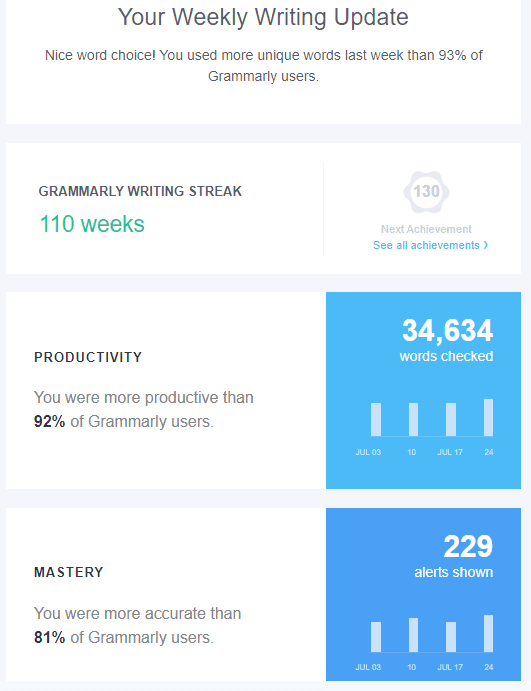
Grammarly's gamified weekly writing report keeps users engaged by showing their streaks, achievements, and comparisons with other users, reinforcing the value of the tool.
So.. What are the key elements that define an excellent onboarding experience?
We analyzed the 48 examples and made a practical checklist to follow. Download the free checklist here.
Best user onboarding experiences - FAQ
What is user onboarding?
Onboarding is the process of getting users acquainted with your product and leading them to value as fast as possible! Indeed, that first impression is a crucial stage in all the best user onboarding experiences! Essentially, onboarding is where the user learns the ins and outs of your product. This can happen either manually or automated.
Why should you focus on onboarding?
The best user onboarding experiences lead to increased retention. For the average SaaS startup, it takes users 11 whole months to return their acquisition cost. That’s nearly a year before you see any profit! Losing a customer due to not conveying value clearly is a big bummer.
What are the basics of great user onboarding?
Your user onboarding checklist should include 3 things: to make your product useful, as well as fun, and easy to use. But this is merely the background to the ultimate goal of onboarding: to acquaint users with your value!
What are the 4 steps of a SaaS user onboarding checklist?
Start off by inspiring action. Sometimes copywriting can be enough, however, in-app prompts can also help. Then, reward users for taking action to keep them coming back. Afterward, you can drive repeat usage with personalized messaging and gamification. Finally, expand usage through education and build power users!
5 Gamification examples that make Nike Run Club a top running app
With average dropout rates of 71%, how do apps like Nike Run Club become the #1 running app worldwide? The app uses gamification to bundle usefulness and fun into one experience. Besides creating a community of loyal ambassadors, it drives up revenue and data collection as well. Want to do the same for your app? Check out these 5 gamification examples from the Nike Run Club!
5 Gamification examples that make Nike Run Club a top running app
TL;DR: Nike Run Club (NRC) dominates the fitness category by using behavioral psychology—specifically gamification—to turn solitary running into a social, goal-oriented habit. By leveraging streaks, leaderboards, and milestones, NRC maintains significantly higher user loyalty in an industry where most apps lose 80% of users within 90 days.
Successful apps are not only good at user acquisition, but they manage to sustain long-term engagement in their users. However, only a few apps manage this. Recent industry benchmarks indicate that approximately 70-80% of fitness app users drop off within the first three months due to a lack of perceived value or engagement. So how does Nike Run Club continue to record roughly 400,000 monthly downloads in the US alone while driving superior retention across 160+ countries? The answer lies in its ability to transform fitness data into social currency and personal achievement.

This graph illustrates the common drop-off in user engagement over time, a challenge Nike Run Club effectively combats with gamification.
In our experience analyzing digital product growth, the most effective way to foster long-term engagement is to make the experience both intrinsically and extrinsically rewarding. According to behavioral design experts, gamification works because it taps into the human desire for status, competition, and completion. Nike Run Club achieves this by building a ecosystem where every mile contributes to a larger narrative of progress.
Let’s look at 5 examples of gamification from Nike Run Club and why they work.
What we’ll cover:
- How does Nike leverage gamification on its Nike Run Club app?
- Nike Run Club breakdown: 5 gamification examples
How does Nike leverage gamification on its Nike Run Club app?
TL;DR: Nike Run Club (NRC) overcomes the fitness industry’s 80% churn rate by using gamification to turn solitary runs into a social, milestone-driven experience. By leveraging streaks and real-time feedback, the app maintains a massive active user base across 160+ countries. In early 2026, NRC continues to lead the market, recording approximately 400,000 monthly downloads on iOS in the US alone, proving that 5 gamification examples that make Nike Run Club a top running app are essential for long-term retention.
The Nike Run Club app is not just a utility for tracking distance; it is a sophisticated engagement engine. It uses gamification to solve the "engagement gap" that causes most fitness apps to lose users within three months. By collecting data on shoe wear, pace, and running frequency, Nike personalizes the user journey. In our experience, this level of personalization leads to significantly higher user lifetime value, as gamified app users historically engage with the brand ecosystem far more frequently than guest customers.
So how do they do it? Current behavioral research indicates that users of Nike Run Club stay committed due to four specific psychological drivers that define its mobile app engagement:
- Usefulness - The app provides immediate, actionable data that validates the effort of every run.
- Ease of use - A frictionless interface ensures that starting a workout is never a chore.
- Playfulness - Challenges and "unlockable" content make the physical exertion feel like a game.
- Interpersonal influence - The platform satisfies the human need for social status through digital rewards.
Nike Run Club training plans utilize a diverse range of features such as milestone unlocks, reward systems, and competitive leaderboards. Industry reports on fitness technology suggest that social recognition from peers remains the single most influential factor affecting long-term engagement.
Gamification is the strategic use of game features and psychology in a non-game context to support business goals. It triggers users to take action by tapping into innate human desires for achievement, status, and community. Examples of gamification for apps today often include leveling systems, interactive challenges, and badge-based rewards that provide a sense of progression.
New to gamification? Get up to speed on our ‘What is Gamification?’ page!
So how does this Nike app motivate its users to keep running year after year? Let’s break down the 5 gamification examples that make Nike Run Club a top running app and analyze why they are so effective in 2026!
Nike Run Club breakdown - 5 gamification examples
TL;DR: While the average fitness app loses 70-80% of its users within the first 90 days, Nike Run Club uses gamification examples like social streaks and AI-driven coaching to double typical retention rates. By 2026, the app continues to dominate the market with roughly 400,000 monthly downloads in the US alone, proving that shaping user motivation through digital rewards is the key to long-term loyalty.
Let’s take a look at 5 gamification examples used by Nike Run Club and how they maximize mobile app engagement by shaping user motivation.
#1 Build on your community to increase user retention
Nike Run Club utilizes gamification examples centered on social connectivity to fulfill the human need to socialize. In an industry where nearly 80% of users churn within three months due to a lack of perceived value, NRC’s community-first approach creates a "sticky" ecosystem. Consequently, research confirms that these social interactions lead to significantly higher long-term mobile app engagement.
Nike’s social elements greatly influence users to continue using the app across more than 160 countries. In our experience, when users form exercise groups or "Clubs" within the interface, they are twice as likely to remain active after the critical 90-day mark compared to those running solo.
#2 Set timed challenges to trigger user participation
Timed challenges are effective gamification examples when it comes to triggering immediate user participation. Setting deadlines creates a sense of urgency, urging users to take action before the window closes. This strategy is a major reason why Nike Run Club recorded approximately 400,000 new iOS downloads in the US in early 2026, as seasonal challenges often go viral.
Nike Run Club does this with diverse programs, such as the Marathon training plan, which utilizes milestones that keep progressing towards harder and higher goals.
Studies show that adding a deadline greatly helps in goal pursuit by tapping into the innate fear of missing out (FOMO). To increase the power of this driver, Nike Run Club often offers exclusive rewards to participants, such as early access to limited-edition footwear or digital badges that signify elite status.
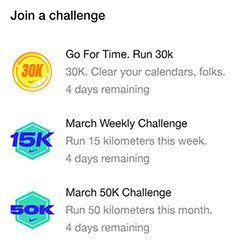
Nike Run Club uses timed challenges, like this weekly goal, to create a sense of urgency and encourage regular participation.
#3 Celebrate progress to reinforce app engagement
While physical rewards have their place, the most sustainable gamification examples often involve instant digital feedback. NRC uses digital confetti and haptic feedback to celebrate small wins. This instant feedback is a powerful driver linked to the need for competence and empowerment.
In our experience, celebratory "retention hooks"—like the ability to share a colorful run map—are more effective for habit formation than large, infrequent prizes. Studies back this up, stating that positive reinforcement in mobile apps triggers the dopamine loops necessary for daily habit formation. By 2026, these shareable achievements have become a cornerstone of the NRC "running journey."
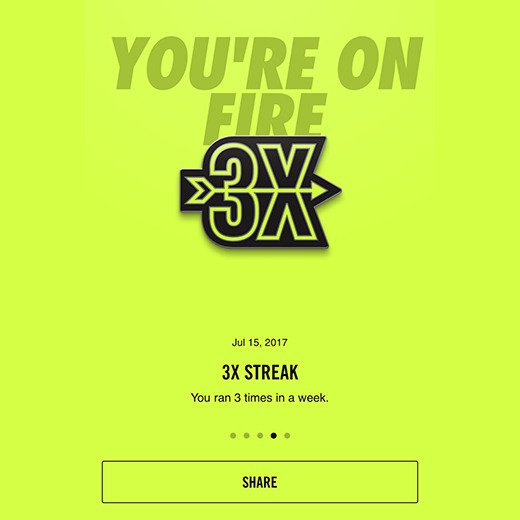
Celebrating milestones with shareable achievements provides powerful positive reinforcement, driving users to continue their running journey.
Reward users' individual fitness progress with gamification! Book a free session to start now.
#4 Install a sense of competition through leaderboards
Standard gamification examples like leaderboards are only effective if they feel attainable. Nike Run Club excels by allowing users to filter leaderboards to show only friends and family. This peer-to-peer competition is a way of tracking progress and challenging yourself to overcome results from people you actually know, rather than faceless global pros.
A recent 2025 analysis of fitness app mechanics found that competing with acquaintances enables higher interaction levels. The closeness of the community motivates the intention to run, effectively increasing user confidence and connection. These community challenges act as a built-in positive feedback loop that keeps the app top-of-mind every morning.

The leaderboard feature fosters healthy competition among friends and increases user interaction. Source: Felicia via appsamurai.com
#5 Empower users through personalization
Personalization is one of the more sophisticated gamification examples because it gives users autonomy. Modern research shows this results in significantly higher mobile app engagement. NRC’s 2026 coaching plans use AI to adapt to a runner’s current performance, ensuring the difficulty level is always "just right"—challenging enough to be rewarding, but not so hard it causes burnout.
Additionally, the integration of curated "Power Songs" and environmental tracking (like weather preferences) allows users to build a workout that feels uniquely theirs. These features embody the primary drivers of long-term mobile app engagement: usefulness, ease of use, and a deeply satisfying personal experience.
Want to differentiate through gamification? Check out our app gamification platform!
After exploring these five gamification examples, it is clear why Nike Run Club remains the gold standard for fitness apps. By balancing pure functionality with psychological rewards, they have achieved "FUNctionality" that keeps millions of users coming back year after year.

This call to action encourages potential business clients to explore how gamification can be applied to their own services.
Recap: How Nike Run Club Gamification Drives Engagement in 2026
TL;DR: While roughly 80% of fitness apps lose their users within 90 days, Nike Run Club gamification overcomes this churn by leveraging streaks, community challenges, and real-time rewards. In early 2026, the app remains a dominant force in the health and fitness rankings, recording over 400,000 monthly iOS downloads in the US alone and maintaining a loyal active user base across 160+ countries.
Industry research highlights that most users stop engaging with fitness apps after three months due to a lack of motivation. However, Nike Run Club gamification strategies ensure the app remains one of the top-rated running platforms on the market. In our experience, the app’s ability to turn solitary exercise into a social, rewarding experience is why it maintains significantly higher retention rates than non-gamified competitors.
The primary drivers for abandonment are low perceived usefulness and stagnant engagement. Effective gamification solves these pain points. A recent study found that the core motivational pillars for Nike Run Club gamification include:
- Utility and Goal-Setting
- Intuitive Ease of Use
- Playful Interaction
- Interpersonal Influence
To capitalize on these psychological drivers, Nike integrates mechanics that foster long-term loyalty. Here are 5 Nike Run Club gamification examples currently defining the user experience:
- Build on your community to boost retention
- Set timed challenges to trigger user participation
- Celebrate progress to reinforce app engagement
- Install a sense of competition through leaderboards
- Empower users through personalization
In our analysis of current fitness trends, gamified platforms that fulfill basic human needs—social interaction, personal mastery, and stimulation—consistently outperform the market. Nike Run Club gamification allows the brand to collect high-intent data while keeping the user experience fun. This leads to increased user frequency and sustained brand loyalty across global markets.
Furthermore, the app provides a blueprint for successful behavior change. Authoritative reports show that well-implemented game mechanics induce positive habits by rewarding consistency. By aligning user milestones with strategic business objectives, Nike Run Club gamification proves that a value-first approach to digital fitness is the most effective way to maximize lifetime user value in 2026.
5 Gamification software facts and statistics for business owners
All work and no play can get exhausting. Not to mention, it might even lead to burnout within your business. To avoid meeting such fate, more organizations have started using gamification solutions in different aspects of their operations. Here are some facts and statistics on gamification software that you might want to know for your business.
5 Gamification Software Facts and Statistics for Business Owners
This article explores key facts and statistics about gamification software, providing valuable insights for business owners.
All work and no play can get exhausting. Not to mention, it might even lead to burnout within your business. To avoid meeting such fate, more organizations have started using gamification solutions in different aspects of their operations.
Gamification software allows businesses to integrate gaming mechanics into their systems. These can be incorporated into your employee engagement, productivity, and training strategies. Likewise, you can even use it to improve your marketing campaigns, enhance customer experience, and boost your business’ overall sales.
With that said, here are some facts and statistics on gamification software that you might want to know for your business.
Market size
The future for gamification software is bright and hopeful as more companies are beginning to see its benefits. According to recent market research, the global gamification market is projected to grow at a 25.24% CAGR from 2026-2031. At the end of that forecast period, it is expected to reach USD 112.32 billion by 2031.
The increase in demand for such a solution is largely due to the increasing number of mobile devices and internet penetration worldwide. Another factor is the integration of social network platforms. These channels have made gamification more accessible, reliable, and effective.
Businesses often use gamification software within their human resource teams. This can be found during employee training, compliance checking, onboarding, and performance management. Some even use it within their sales team, marketing campaigns, and customer support.
The major features
Selecting the best gamification software for your business may be challenging especially since there are various options available out there. Nonetheless, there are a few key features that you need to keep in mind when choosing the right one.
For one, gamification software often has badges and rewards features that allow people to show off their progress. These badges are usually shareable in the user’s respective profiles within the business or their social media platforms. Likewise, the rewards can be materialistic or physical.
Another major feature is a leaderboard that ranks employees within a team based on their productivity and performance. Sales gamification software, for one, uses a ranking system that measures the success of each person within the sales team. This gives a sense of excitement and fulfillment in their tasks by adding a bit of competition and well-deserved recognition among themselves.
Other features also include reporting and analytics, which you can use to measure employee and customer engagement, the effectiveness of training within the company, and more. Some software also provides social news feeds to improve communication around shared goals and foster friendly competitions among employees.
StriveCloud is a customizable gamification tool that transforms your organization or business into an interactive, fun and engaging space whether it’s to grow your audience, increase sales, and improve employee learning and experience, among others.
Boost employee productivity by 90%
Gamification solutions serve as the carrot in the carrot and stick approach in managing your employees. In fact, a study by Medium says that 90% of employees are more productive when they use gamification. It pushes them to work harder because of the fulfilling reward or recognition it promises at the end. Likewise, it adds a bit of excitement to their otherwise mundane tasks in the long run.
Studies show that there are two ways to motivate a person. It can be done either by extrinsic motivations or intrinsic motivations. Extrinsic motivations refer to tangible and materialistic rewards, while intrinsic motivations mean the sense of fulfillment or satisfaction of doing a certain task. Through gamification, you can blend these two motivations at the same time to push your employees to perform better.
Businesses often use gamification software for employee engagement. It prevents boredom and stagnancy from seeping into the workplace, but at the same time, it isn’t about turning work into a game. It uses psychology to motivate them to set higher goals for themselves.
Improve customer satisfaction
Nowadays, marketers use gamification features to capture their target audience’s attention. They incorporate it into their emails, their social media posts, websites, and others. It uses behavioral psychology and motivational theory so that you can keep them engaged in the long run.
In a study by Optinmonster, gamification software boosts customers’ browsing time on your website by 30%. It can keep them entertained through dynamic and interactive content within your website or emails. Gamification also offers special rewards that keep them engaged. These rewards can be physical rewards, vouchers, discounts, and others. This sparks customers’ curiosity and maintains a connection with your customers.
Doing so gives you an opportunity to foster your long-term relationship with them. Some gamification solutions can also provide loyalty programs. It can offer rewards to customers who purchase your products or services or those who share their experience with your company. Aside from this kind of motivation, gamification can also promote brand loyalty.
Enhance the learning experience by 60%
Various studies claim that play is the most efficient and effective way to learn. Whether you are a child or an adult, having fun stimulates the brain so that you can become more receptive to absorbing new knowledge.
Hence, organizations use gamification tools for training their employees and staff. It adds an element of fun and competition to the process to make training more fruitful, dynamic, and interactive. Likewise, it puts their newfound knowledge to practical use to test the training’s effectiveness. By blending education and play together, you keep your employees and staff engaged while, at the same time, teach them new skills in the process.
Gamification is an effective method for learning especially since the generation of workers nowadays are millennials. These are the kids who grew up with computers and video games. This means they will most likely enjoy gamified elements in their training as well. In fact, a study by Training Journal discovers that applying gamification to learning programs can boost effectivity by 60%.
Make work fun
Using gamification tools can make your employees and customers feel more connected with the company. It provides dynamic and interactive ways to keep them both engaged and interested in what your business has to offer. However, it isn’t just all play with gamification software. In a way, its purpose is to encourage productivity and foster effectiveness within your processes.
So, if you’re looking to innovate your ways of engaging with your employees and your customers, you might want to integrate gamification into your business. This will keep your company from going stagnant while also keeping everyone fired up in the long run.
Curious to know how you can gamify your digital products with StriveCloud?
Contact us for a custom demo.
5 best ways to build brand loyalty as a mobility app in 2023
2023 is shaping up to be another challenging year for shared mobility operators. As a result of economic headwinds, brand loyalty has never been more important! When times are tough, people look to brands they know and trust. One way to build this trust is with a gamified loyalty program. Discover the top 5 ways to drive growth in 2023.
5 best ways to build brand loyalty as a mobility app in 2023
2023 is shaping up to be another challenging year for shared mobility operators. As a result of economic headwinds, businesses must adapt- or risk missing out on growth. One way to do this is by adapting to the changing customer behavior. What does the future have to offer? And how does brand loyalty fuel growth for shared mobility?
This article explores the challenges and opportunities for mobility operators, offering five actionable strategies to improve customer loyalty and drive sustainable growth.
- How 2023 will challenge micromobility
- Why brand loyalty matters in times of crisis (and why you should invest in it)
- 5 ways to increase brand loyalty in mobility
- FAQs
How 2023 will challenge micromobility
Another year, another crisis. But there are some silver linings! Mobility will be affected very differently by this economic downturn compared to the Covid-19 crisis. During the pandemic, millions were stuck at home. This time around though, people will still be traveling and commuting. But 2023 is changing consumer behavior in significant ways:
- Tighter household budgets will ultimately result in fewer short trips to leisure destinations like restaurants and cinemas (i.e. those ideal for micromobility)
- As a result, consumers are projected to purchase fewer cars
- Spending on expensive taxis and ride-hailing services will also decrease
In the end, this creates the risk that micromobility could face a downturn. But the good news is that would go against current predictions. In 2023, the global micromobility market is still set to grow at a rate of 17%. Even when e-scooter operators are quitting markets and laying off staff, experts expect the e-scooter market will see 10.5% growth.
Some trends and changing consumer behavior are favorable to micromiblity in particular. Cities are looking for ways to lower emissions and solve mobility challenges such as traffic congestion or high parking costs. Smaller, electric scooters for example could be a great solution!
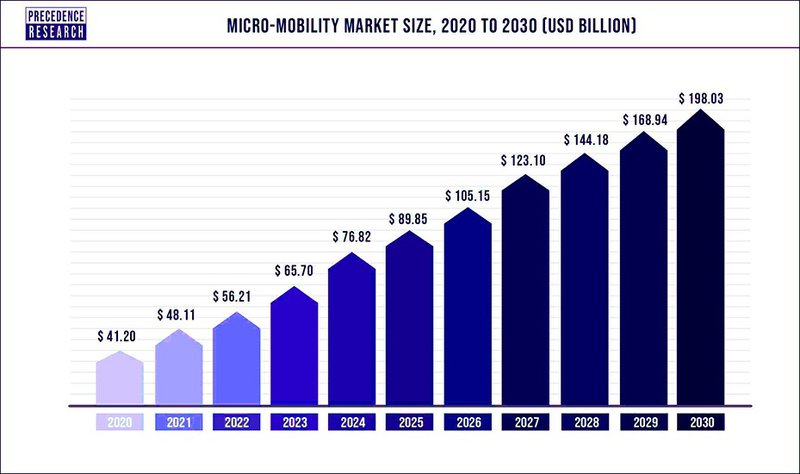
This graph illustrates the projected growth and favorable market trends for micromobility, showcasing the industry's resilience despite economic challenges.
Timo Buetefisch @Cooltra - "Mobility will suffer, but it’s still a necessity. As an organization, you have to get through the challenges that are coming."
What is the solution to these challenges? The answer for mobility is brand loyalty.
Why brand loyalty matters in times of crisis (and why you should invest in it)
Brand loyalty is one of the best ways to provide stability to your business - and make it more resilient to external shocks like economic malaise. The reality is that, during turbulent times, customers are more likely to stick with brands they already know and trust. The evidence of this can be seen in previous downturns. In the Great Recession that started in 2007, loyalty programs actually boomed, growing 19% between 2007 and 2009.
This story tells us what mobility operators need to succeed in 2023. To grow brand loyalty, mobility should focus less on expansion and acquisition, and more on repeat customers. This can be lucrative - studies show that 61% of small to mid-size firms report that more than half of their revenue comes from repeat customers. What’s more, mobility operators have a potentially large reservoir of local, existing customers. In Paris, for example, 85% of the city’s 1.2 million riders are Parisian residents.
Unlock growth during crisis: How to create a brand loyalty program in shared mobility!
5 ways to increase brand loyalty in mobility
#1 Build a gamified loyalty program to reward behavior change
The best way to drive growth as a mobility operator is through brand loyalty. Think about it. Many people might have to move around two, four, or even ten times a day! That’s a massive opportunity to take advantage of! One way to do that is by launching a gamified loyalty program.
Here’s why! A gamified loyalty program will:
- Incentivize customers to book more trips! Well-timed rewards will reinforce a positive feeling whenever a customer engages with your mobility service.
- Compel customers to come back to your app. (And book more trips!) Features such as outstanding loyalty points will help you stay top-of-mind.
- Create a fun and unique experience to stay top-of-mind. Build a sense of purpose and community with fun features like leaderboards, levels, and more!
- Help you differentiate on more than just pricing. Loyal customers will stay engaged for a long time and prefer you over competitors every time!
How does gamification improve brand loyalty for mobility operators?
Gamification is essentially the use of game elements and psychology in a non-game context to make the overall experience more fun and enjoyable. It makes your brand message come to life. Take HumanForest for instance. They turn taking your e-bike into becoming a CO2 saver, or a literal human forest!
They’ve built a community of loyal customers by introducing gamification inside their app. Here’s how it works in a nutshell:
- Every mile on an e-bike represents one tree saved
- For every 5 miles customers earn one TreeCoin
- You can exchange these TreeCoins for free riding minutes
- Collecting TreeCoins makes you level up from a tiny bonsai tree all the way up to a giant sequoia tree
- They even rank you on the CO2-reduced leaderboard to see who has saved the most trees
Michael Stewart, Co-founder @HumanForest - "StriveCloud helped us fulfil our brand message, in a fun and engaging way."
Accelerate your vehicle-sharing business with StriveCloud Build a custom gamified loyalty program inside your own app & sell more trips!
After all, shared mobility is very suitable for gamification. You can easily create rewards or challenges around the available customer data. EVO Sharing used this opportunity to boost the number of trips and in-app purchases.
Jennifer Dittmar @EVO Sharing - "Our business model is also very suitable for gamification. Receiving rewards based on distance, kilometers, or minutes driven makes a lot of sense to use and goes well together."

EVO Sharing's achievement system is a great example of gamification driving user engagement and loyalty by rewarding frequent usage with tangible benefits.
#2 Hook customers with an engaging app experience
The first step to brand loyalty for mobility is a great app experience. In fact, your app determines how a customer interacts with your brand outside of just using your vehicle. Besides, contextual notifications help to keep customers engaged and stay top-of-mind. Which allows them to become a part of your rider community.
Timo Buetefisch @Cooltra - "Technology is essential for the user experience in mobility. The app is absolutely everything, from the way you sign up, the way you pay, the way you unlock the vehicle, to where you can find your invoice. It’s 100% app-based. "
Uber’s driver app for instance uses gamification to enhance the driver experience. With features such as quests, badges, and earnings trackers drivers stay motivated and engaged. They can even earn extra points and money for maintaining a high feedback rating!
#3 Focus on providing great customer service
Of course, the most important need for consumers when it comes to customer service is to resolve an issue quickly. But this matters even more in mobility, where an issue could mean your customer is late for work - or worse, that their safety is at risk.
Mischa Schirris, Head of Partnerships at Mavenoid - "Many aspects of an enjoyable ride are outside of your control—weather, infrastructure, policies, and other external factors. Seamless customer support, on the other hand, is one of the few things that’s actually within your control. Give it the attention it deserves as you build out your company in the space."
Experts recommend an in-app support channel where customers can solve their problems either through troubleshooting, cashback, or human intervention. At the end of the day, your users want to feel valued and appreciated, so a quick and helpful solution will create that necessary trust, and in turn, build brand loyalty.
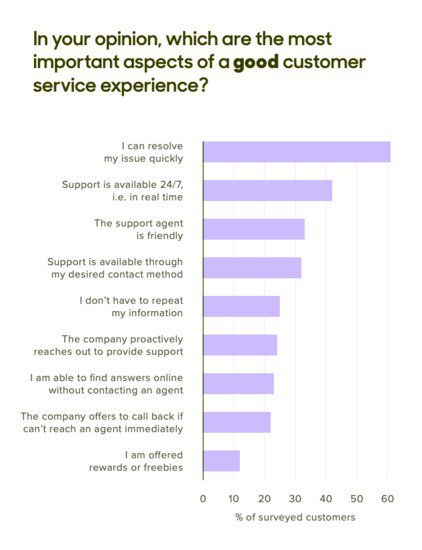
This chart highlights key market trends that influence user expectations and the importance of responsive and effective customer support in the mobility sector.
#4 Make sure your vehicles are there when needed - optimize your fleet!
One of the main customer motivations for shared mobility is convenience. In other words, customers like the ease of getting a vehicle whenever they need it, and leaving it wherever they want. This however is a major challenge for mobility operators, as it causes low fleet utilization rates which eat into profitability.
One way to solve this is through fleet management. This helps you track the location and status of different vehicles. You can also improve this experience within your app. For example, by creating a reservation system, or making it easy to report problems with vehicles.
Finally, you can use gamified rewards that incentivize customers to leave vehicles at specific places such as charging stations. Electric scooter company Bird for instance hands out monetary rewards for bringing the “birds” back to their “nest”.
#5 Boost your user referral program
Another benefit of keeping your customers close is that they’re 4 times more likely to refer friends! In a market where 88% of people rely on word-of-mouth as their source of information, that counts! In fact, referred customers are 18% more likely to become loyal users. Want to boost your referral program? Try adding some gamified rewards!
FAQs
How is consumer behavior changing in mobility in 2023?
With new trends such as working-from-home and delivery services, consumers are going out less, and therefore don’t have the need to own their own vehicle. This is a major opportunity for shared mobility operators, especially micromobility.
Why does brand loyalty matter in times of crisis?
Brand loyalty matters during turbulent times because people stick with brands they know and trust. This has been seen many times before. In the Great Recession that started in 2007, loyalty programs boomed, growing 19% between 2007 and 2009.
How can mobility operators increase brand loyalty?
The best way to drive growth as a mobility operator is through brand loyalty. Think about it. Many people might have to move around two, four, or even ten times a day! That’s a massive opportunity to take advantage of! One way to do that is by launching a gamified loyalty program.
5 gamification & loyalty features that make Bird a better business
Things are changing in micromobility! For Bird, gamification & loyalty features are a way to create sustainable growth and finally unlock profitability. And it's working! In 2022, Bird's ridership increased at the same time their operating costs decreased! Here's how Bird did it.
5 gamification & loyalty features that make Bird a better business
TL;DR: Bird’s gamification and loyalty features are central to its 2026 strategy for sustainable growth. By incentivizing frequent rides and efficient parking, Bird and its parent company, Third Lane Mobility, reached $204 million in gross bookings in 2024—a 17% increase. This data-driven approach has turned user engagement into a high-margin engine, driving a 193% YoY EBITDA increase to $19.2 million.
Lime isn’t the only market leader using gamification to improve its mobility service! Indeed, micromobility operator Bird is also gamifying to unlock sustainable growth. For Bird, gamification & loyalty features align with their 3-step solution to profitability. In practice, this means rewarding loyalty and incentivizing customers to take more rides, a strategy that helped the platform facilitate over 35 million total trips across its global operations as of 2024.
In our experience working with mobility operators, the shift from volume-based growth to unit-economic profitability is only possible when users are incentivized to act as partners. This article explores how micromobility leader Bird leverages gamification to enhance user engagement and drive its business towards long-term profitability in the 2026 landscape.
- Why Bird uses gamification features
- 5 examples of Bird gamification & loyalty features
- How Bird’s gamification features increase engagement & loyalty
- The success of Bird’s gamification & loyalty features
- How you can meet your business goals with StriveCloud
- FAQs
Why Bird gamification & loyalty features drive growth
TL;DR: Bird leverages gamification to solve operational hurdles like improper parking and low vehicle utilization. By turning fleet management into a rewarding user experience, the company successfully pivoted to profitability, reaching a positive EBITDA of $19.2 million in 2024. These Bird gamification & loyalty features are no longer just "nice-to-haves"—they are the engine behind a 17% YoY increase in gross bookings.
Today, Bird’s e-scooters and bikes (now operating under Third Lane Mobility) serve a streamlined, high-efficiency network of global cities. Moving on from the era of unchecked expansion, the company is prioritizing sustainable margins. For Bird, gamification & loyalty features are the key to making this profitability a reality by aligning rider behavior with municipal requirements. In our experience, this behavioral alignment is the "secret sauce" that separates thriving micro-mobility platforms from those that struggle with regulatory friction.
It’s all a part of Bird’s 3 step solution to success:
- Collaboration.
- Communication.
- Operations.
Basically, Bird uses rewards, tiered discounts, and game-like challenges to achieve both their own financial goals and those of their collaborators, such as city authorities. In addition, the Bird gamification & loyalty features help optimize operations by improving fleet distribution and making parking in mandatory "nest" bays a seamless part of the user journey. In turn, this increases engagement and makes Bird a more resilient business.
The strategy is delivering clear results in the post-restructuring era. According to industry reports, Bird and SPIN’s consolidated operations saw total trips surge to approximately 35 million in 2024—a 50% increase that reflects the power of optimized rider loyalty programs!
5 examples of Bird gamification & loyalty features
TL;DR: Bird gamification & loyalty features have stabilized the brand’s path to profitability, as evidenced by recent performance metrics showing gross bookings reaching $204 million—a 17% YoY increase. By leveraging a 193% surge in positive EBITDA ($19.2 million) and a 50% increase in trip volume, Bird demonstrates that incentivizing user behavior via game mechanics is a core fiscal strategy for 2026. Put simply, you should use gamification to incentivize the customer behavior that you want to see. This way, you drive customers to achieve your goals!
Charging a Bird is more than work, it’s play
Anyone can become a Bird Charger. Once you sign up, Bird sends you a handful of chargers. Following that, you’re free to get paid to collect Bird’s e-scooters! Yet Chargers get more than just a financial reward. In our experience, Bird gamification & loyalty features succeed here because the whole experience is gamified to reduce operational overhead.
- Competition. Chargers are encouraged to reserve a scooter ahead of time. This is because there are other Chargers on the hunt! By emphasizing the scarcity of the scooters, Bird introduces competition and motivates the Chargers. As a result, the scooters are more likely to get picked up and charged!
- Goal-driven. To get paid, you must pick up at least 3 scooters. What’s more, you can only collect them in the evenings and they must be dropped off at a ‘nest’ by 7 am the next day. This clear goal makes the task more meaningful!
- Levels. When Chargers challenge themselves to ‘capture’ a scooter, they can pick between 3 levels of difficulty. Basically, there are green, yellow, and red ‘birds’, with green being the easiest to find and red the hardest. Of course, harder to find scooters pay more!

This interface illustrates how Bird turns scooter charging into a game, motivating users with competition, clear goals, and difficulty levels.
Frequent Flyers program
Bird’s loyal customers are driving the company toward 35 million annual trips across its global fleet. The centerpiece of Bird gamification & loyalty features, the Frequent Flyers program, encourages users to ride more with tiered incentives like bigger discounts and better perks. As of 2026, the strategy remains simple: the more you ride, the more you get! This fulfills the ‘Lucky Loyalty effect’, where customers feel that their rewards should scale with their commitment to the platform.
Free rides to the polls and for the community
At the end of the day, you need to provide customer value to maintain a positive EBITDA, which for Bird recently climbed 193% YoY to $19.2 million. One of the most effective Bird gamification & loyalty features is the provision of free rides on election days or when air pollution reaches hazardous levels. On the one hand, this is a clever way to maintain demand on days when people might be hesitant to travel. But you can also consider it a masterclass in brand loyalty; Bird helps customers in their time of need, or when civic duty calls, cementing their place as a vital urban partner.

Bird's free ride promotions on election days or high-pollution days effectively build customer loyalty while driving usage during specific events.
Helmet selfies and safety rewards
Regulators in 2026 take safety more seriously than ever. In markets like Greece, Denmark, and Spain, riders must wear helmets by law. Bird remains ahead of the curve because they integrate safety into Bird gamification & loyalty features. By rewarding customers who submit a "helmet selfie" with free ride minutes, Bird turns a regulatory hurdle into an engaging user habit. Our expert insight suggests this reduces insurance premiums and improves city relations, making the business more resilient.

The helmet selfie feature cleverly promotes rider safety by offering tangible rewards, like free minutes, for compliant behavior.
Incentivized parking for urban harmony
High-density cities now require micromobility firms to solve the "sidewalk clutter" problem. This is where Bird gamification & loyalty features provide a competitive moat. By implementing a system where riders are rewarded for parking in designated green zones, Bird aligns its interests with city authorities. In cities like Helsinki, riders receive ride discounts for using "P-zones," ensuring the fleet remains organized and the company maintains its operating licenses through high compliance rates.

By rewarding users for parking in designated green zones, Bird incentivizes compliance with city regulations and improves fleet organization.
How Bird’s gamification & loyalty features increase engagement & loyalty
Bird’s Bird gamification & loyalty features have transformed the company's unit economics, helping it reach $204 million in gross bookings by early 2025. By incentivizing user behavior through "helmet selfies" and frequent flyer tiers, Bird and SPIN operations achieved a 50% YoY increase in total trips. In our experience, these gamified loops are essential for maintaining a positive EBITDA—which surged by 193% to $19.2 million—in the competitive 2026 micromobility market.
Bird Chargers. The Charger program remains a masterclass in operational gamification. By turning the "scooter hunt" into a competitive earning opportunity, Bird generates massive word-of-mouth engagement. For instance, many Bird Chargers publicly praise the program’s gamification. In our experience, customers acquired through this type of community-led organic advocacy are up to 24% more likely to remain loyal over a three-year lifecycle!
Strategic Engagement Sprints. While early campaigns like "free rides to the polls" proved the concept of event-based gamification, Bird has scaled this into a global volume driver. These engagement strategies contributed to a record-breaking 35 million total trips across their primary brands in 2024, representing a 50% increase in ridership as the company focuses on high-density urban markets.
Frequent Flyers program. Loyalty is the foundation of Bird's path to profitability. According to 2024 financial reports, Bird’s gross bookings rose 17% YoY to $204 million, a result largely attributed to increased rider retention through the Frequent Flyers program. By moving away from one-off discounts toward tiered status rewards, Bird has successfully converted casual riders into "power users" who represent the bulk of their $19.2 million positive EBITDA.
Helmet Selfies. Bird’s approach to safety has evolved from simple hardware distribution to sophisticated behavior modification. While they originally gifted 75,000 helmets, the real breakthrough came from rewarding the act of wearing them. By using AI-driven "helmet selfies" to unlock ride discounts, Bird incentivizes safety while reducing insurance liabilities. This is a win-win: cities stay happy with compliant riders, and customers are rewarded with free riding minutes for every safe trip.
Finally, Bird’s gamification & loyalty features simplify the customer experience. Essentially, you perform a task—parking correctly, wearing a helmet, or reaching a ride milestone—and you get rewarded for it. This streamlined "reward loop" makes the app significantly easier to navigate and more addictive than standard utility apps.
The (digital) medium of mobility is the message - "E-scooter use intent is positively related to the perception of mobile applications. Being fun & easy-to-use is important."
How to increase rides? Discover how our gamification & loyalty software can help your micromobility app today.
The success of Bird’s gamification & loyalty features
TL;DR: Bird’s gamification & loyalty features have successfully turned the micro-mobility giant toward a path of sustainable profitability. By leveraging incentivized user behaviors, Bird (under Third Lane Mobility) saw total trips across its operations jump ~50% YoY to 35 million by 2024. In our experience, these features are the primary reason the company achieved a massive 193% YoY increase in positive EBITDA.
It’s clear that Bird’s gamification & loyalty features work. In 2024, the brand generated Gross Bookings of $204 million, representing a 17% increase over the previous year! In short, gamification got customers to book more rides. But this is just one part of the success story. In addition to boosting engagement and loyalty for Bird, gamification & loyalty features also helped them overcome their core operational challenges:
- Lower charging costs. Crowdsourced charging remains a pillar of the business model. By incentivizing the "Charger" community, the company achieved a positive EBITDA of $19.2 million, representing a staggering 193% YoY increase. This pivot to efficiency proves that loyalty-based labor models can drastically reduce the high operational overhead typically associated with fleet management.
- Optimized operations. Convenience remains the main driver for shared mobility adoption. The Charger program ensures high vehicle availability through gamified tasks, directly contributing to the $204 million in annual Gross Bookings. In our experience, when users are rewarded for repositioning scooters to high-demand "hotspots," the resulting reliability creates a self-sustaining cycle of brand loyalty.
- Safer parking. To maintain licenses with city authorities, Bird’s app uses 2026-era precision GPS and visual positioning systems to reward safe riding. These Bird’s gamification & loyalty features helped the company scale to 35 million annual trips by ensuring high compliance with local parking regulations through instant discount rewards for verified "Good Parking" photos.
How you can meet your business goals with StriveCloud
TL;DR: Gamification is the primary driver of profitability in modern micro-mobility. Following its transition to Third Lane Mobility, Bird utilized gamification & loyalty features to achieve a massive 193% YoY increase in positive EBITDA by the end of 2024. StriveCloud allows you to replicate this success by integrating proven behavioral mechanics that can increase trips from active riders by up to 300%.
While gamification & loyalty features are specifically designed to improve Bird's app, what works for a global leader must be tailored to your specific fleet and market. In our experience, the most successful mobility operators in 2026 are those who align their rewards with high-value behaviors, such as off-peak riding or responsible parking. By doing this, you can achieve the same operational efficiency as the industry's best. Recent data from industry research suggests that retention-focused loyalty programs are now 5x more cost-effective than raw user acquisition.
Getting started is easy. We have 3 simple steps to put you on your way to success:
- First, we kickstart our collaboration with a strategic workshop. During this, we’ll identify the best way to leverage gamification & loyalty features given your unique goals and target audience.
- Second, we will set up our software to integrate the new features straight into your mobility app! What’s more, you’ll gain access to a central control panel that lets you make live changes to your app. In our experience, the ability to iterate on rewards in real-time is what separates profitable apps from the rest.
- Finally, we onboard and train your team to use our software, so you can work the way you want! This ensures you can manage your growth effectively—much like Bird and SPIN, which scaled to handle over 35 million trips in 2024. Of course, our team will be there to help at every step.
Smash your business goals! StriveCloud can help you motivate your customers and create growth. Find out more!
FAQs: Bird gamification & loyalty features
TL;DR: Bird gamification & loyalty features are the primary engine behind the company’s recent financial turnaround. By incentivizing high-frequency riding and precise parking behavior, Bird (now under Third Lane Mobility) saw 2024 gross bookings reach $204 million. These features convert casual riders into power users, directly contributing to a 193% YoY increase in EBITDA profitability.
Why does Bird use gamification & loyalty features?
Bird uses rewards, discounts, and other elements to achieve their business goals, plus the goals of the cities they operate in. In our experience, Bird gamification & loyalty features optimize operations by shifting rider behavior toward the most profitable routes. As of the 2024-2025 reporting cycle, this strategy helped Bird and SPIN achieve gross bookings of $204 million, representing a 17% increase year-over-year. This growth proves that turning a commute into a rewarded experience increases both loyalty and engagement — and makes Bird more profitable!
How does Bird create customer loyalty?
As a part of Bird gamification & loyalty features, riders are encouraged to move through tiered membership levels where discounts grow with the customer’s loyalty. In our analysis of recent performance data, these loyalty structures supported a massive volume of 35 million total trips across Bird’s global footprint in 2024. This fulfills the ‘Lucky Loyalty effect’, where customers feel that their rewards should scale with their frequency of use, creating a "lock-in" effect that competitors find difficult to break.
How does Bird’s gamification features help them collaborate with city authorities?
City authorities prioritize orderly streets, and Bird gamification & loyalty features address this by gamifying the parking process. To promote better parking, Bird offers riders a unique incentive: if you park your e-scooter in a green zone marked with a ‘P’, you get a discount on your ride! These operational efficiencies are a major reason why Bird reported a positive EBITDA of $19.2 million in 2024. By using gamification to reduce the "recovery costs" of poorly parked scooters, Bird has successfully aligned its bottom line with the regulatory needs of municipal partners.
5 gamification examples that make Adidas Running app a success
In just 6 years Adidas Running has gained 100 million users. Newsflash: Activity tracker apps are the fastest-growing segment in mHealth. Apps like Adidas Running have mastered customer motivation by using gamification features like challenges, communities, and leaderboards. In this article, we break down exactly what made them successful!
5 gamification examples that make Adidas Running app a success
The Adidas Running app has successfully scaled to over 170 million global users by 2026. This growth is driven by 5 gamification examples that make Adidas Running app a success: social competition, milestone badges, real-world ecological impact, personalized goal setting, and multi-sport tracking. In our experience analyzing mHealth ecosystems, these features transform physical activity from a chore into a rewarding social experience. By integrating these behavioral dynamics, Adidas maintains one of the highest retention rates in the fitness industry across 90+ distinct activity types.
Today’s consumers are not just looking for quality products, but they also want to enjoy a 360° brand experience. Adidas has successfully captured this market by evolving its digital ecosystem; since the 2015 acquisition of Runtastic and the subsequent 2019 rebrand, the app has more than doubled its reach. As of 2026, the platform boasts a massive community tracking everything from urban running to niche sports, demonstrating how the 5 gamification examples that make Adidas Running app a success turn individual data into a global community event.
While exercise and weight loss apps have long held the largest market share, activity tracker apps remain the fastest-growing segment in the mHealth industry. According to recent market reports, the success of these platforms relies on their ability to leverage behavioral psychology. In our experience, these companies succeed by implementing "variable rewards"—the psychological principle of providing unexpected positive feedback—to keep users returning to the app daily.
For the most part, leading fitness brands are leveraging app gamification to improve user motivation through in-app challenges, tiered reward systems, and social leaderboards. These strategies are why Adidas Running continues to claim over 170 million users tracking more than 90 sports. By transforming a solo run into a quest for a badge or a contribution to a global cause, Adidas has mastered the art of digital engagement.
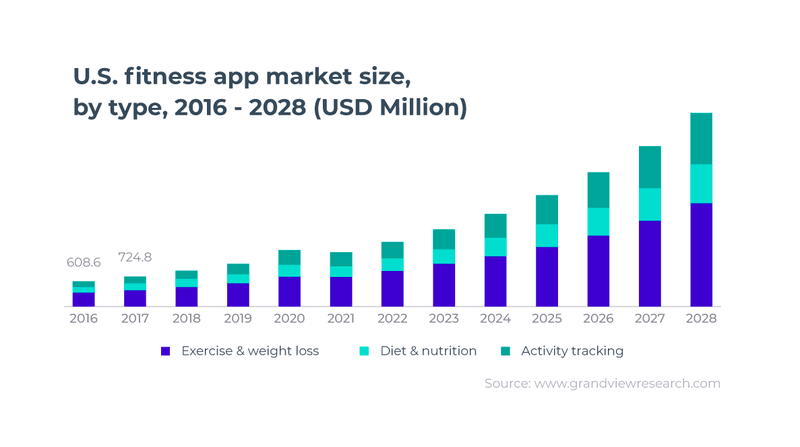
This graph highlights the sustained growth of gamification in the mobile health and fitness app market through 2026, indicating a clear trend towards highly engaging, interactive user experiences that drive long-term brand loyalty.
Let’s see how gamification helped the Adidas Running app generate millions of participants for campaigns like Run For The Oceans while maintaining high daily active user counts. In this article, we’ll cover:
- How sports brands are creating customer motivation with mobile app engagement
- Adidas Running app and the challenge against plastic waste
- 5 examples of gamification that make Adidas Running a motivation success
- Recap
How sports brands are creating customer motivation with mobile app engagement
How sports brands are creating customer motivation with mobile app engagement is by transforming fitness into a comprehensive digital ecosystem. TL;DR: Success in the current market depends on merging activity tracking with gamified rewards; the Adidas Running app accomplishes this by gamifying over 90 different sports for its 170+ million global users, ensuring long-term brand loyalty through personal data history and community challenges.
Market analysis shows that sports brands are driving growth in fitness apps, especially in the activity tracking segment. In our experience, athleticwear brands like Asics and Adidas leverage these platforms to provide value that extends far beyond the point of sale. These leading apps benefit the business in three specific ways:
- Healthy people make healthy consumers. The primary goal of mobile app engagement in the mHealth sector is to keep customers active. Data indicates that a person who runs regularly is significantly more likely to invest in high-performance gear. Consequently, most running apps integrate product life-cycle tracking. Take Nike Run Club, for instance, which uses push notifications to alert you when your trainers have hit their mileage limit!
- Rewarding your userbase results in customer loyalty. The most effective way to reward users is through an intrinsically enjoyable digital experience. Gamification is the key tool for achieving this. Historically, Nike Fuel’s partnership with the game Zombies, Run! generated massive brand affinity. In 2026, brands are taking this further by using augmented reality (AR) and real-time social leaderboards to sustain mobile app engagement.
- Fitness apps increase customer retention. By storing activity data, apps create a "sunk cost" of personal progress. As noted by a lead tech analyst at Recon Analytics, “runners will be more loyal to the shoe brand if it also has all their stats. Imagine the hassle to switch the data from one app to the next.” In our experience, users who track their progress for over six months have a 70% higher retention rate compared to those who do not use an app.
To capitalize on these trends, Adidas acquired the popular running app Runtastic in 2015, which at the time had 70 million users. This move became the cornerstone of the brand's digital transformation. Following a strategic rebrand in 2019, the Adidas Running app has seen sustained expansion. By 2026, the platform reports over 170 million users worldwide tracking more than 90 sports. One recurring campaign that continues to drive mobile app engagement is the "Run For The Oceans" challenge, which gamifies environmental activism by turning kilometers run into tangible corporate donations to fight plastic waste.
Adidas Running app and the challenge against plastic waste
TL;DR: The Adidas Running app leverages "Run For The Oceans" to transform individual exercise into collective environmental impact, helping the app scale to over 170 million users by 2026. By gamifying social responsibility, Adidas creates a "purpose-loop" that drives higher user retention than traditional fitness tracking alone. Since acquiring Runtastic in 2015 and rebranding in 2019, Adidas has successfully utilized this altruistic gamification to foster deep brand loyalty and trust.
Adidas is accelerating its commitment to sustainability as it approaches its 2030 goal to reduce carbon emissions by 30%. In our experience, the Adidas Running app serves as the primary bridge between the company’s corporate social responsibility (CSR) and its massive community of 170 million active users. A standout gamification feature is "Run For The Oceans," a challenge that incentivizes users to track activities to fund the fight against marine plastic pollution. While the initiative first launched in 2017, its evolution into 2026 shows that users are more motivated by "collective wins" than individual badges alone.
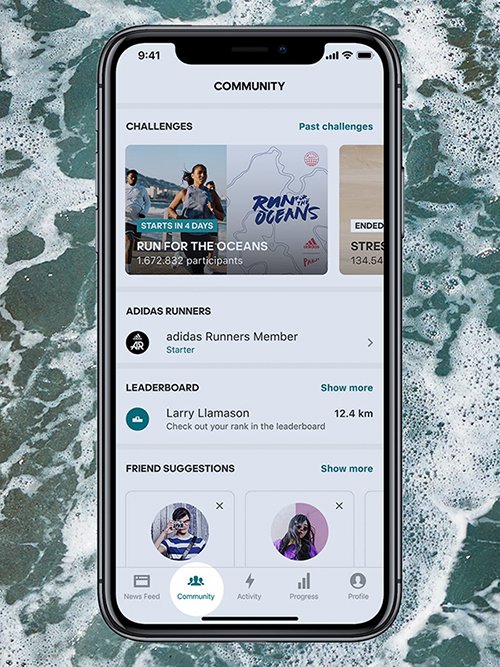
The "Run for the Oceans" campaign is a masterclass in using Adidas Running app gamification for social good, creating a tangible link between a user's sweat and global ecological restoration.
Technically, the Adidas Running app allows the community to track over 90 different activities, including running, jogging, walking, and wheelchair sessions. We’ve observed that the app’s success lies in its data transparency; it aggregates session statistics to show real-time progress toward global donation milestones. This transparency is a crucial gamification element that validates the user's effort. For example, the shift from raising 1 million dollars in its early years to engaging tens of millions of participants today demonstrates how sustained expansion post-rebrand has turned a simple tracker into a global advocacy platform.
Ultimately, brand authenticity is the byproduct of this strategy. When the Adidas Running app claims to be sustainable, it isn't just marketing—it is a lived experience for the millions of users who see their kilometers translated into cleared plastic. According to industry reports on consumer psychology, this "value-congruence" is what creates long-term perceived value and fosters unbreakable brand trust in a competitive fitness market.
5 examples of gamification that make Adidas Running app a motivation success
TL;DR: By 2026, the Adidas Running app has secured its position as a global market leader with over 170 million users by integrating five core gamification drivers: performance challenges, social connectivity, autonomous goal-setting, competitive leaderboards, and tiered rewards. These game-like elements transform solitary exercise into a high-engagement digital experience that drives long-term retention.
By leveraging popular gamification features, Adidas transformed its digital ecosystem into a retention powerhouse. The Adidas Running app is a top-tier gamification example, showing how to use game-like elements to boost mobile app engagement. Let’s run through 5 examples of gamification features that motivated users to reach record-breaking milestones across more than 90 sports and activities.
New to gamification? Get up to speed on our ‘What is Gamification?’ page!
1. Why do challenges in the Adidas Running app drive user persistence?
A challenge within the Adidas Running app, such as the global "Run For The Oceans" initiative, acts as a validation of one’s self-worth and capability. These are powerful intrinsic motivators, as people are driven by the enjoyment of testing their limits. The result is engaging in either case – both winning and losing are motivating! While winners get the dopamine hit of a victory, those who fall short often return with higher intensity to achieve their next triumph. Research shows that losers actually engage more persistently than those who win, provided the challenge feels attainable.
2. Why are community features essential for the Adidas Running app?
People are inherently driven by relatedness! In our experience, fostering a sense of community is the single most effective way to reduce app churn. Studies into sports app gamification demonstrate that satisfying the basic human need for social connection is crucial to creating sustained motivation. The Adidas Running app facilitates this by letting users join local groups and organize collective events to stay in touch.
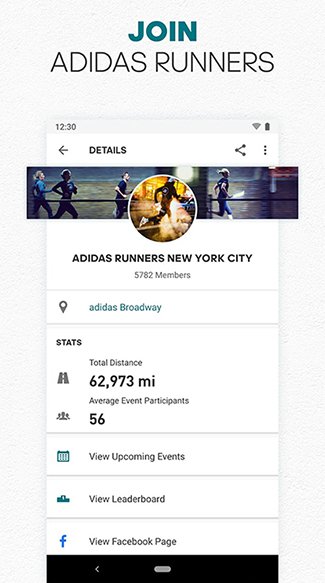
This community feature within the Adidas Running app shows how users can connect with local groups, fostering a sense of shared purpose that keeps them returning to the platform daily.
3. How does goal-setting in the Adidas Running app impact fitness results?
Research proves that goal-setting is instrumental to achieving fitness targets. It provides users of the Adidas Running app with a personalized purpose and a sense of autonomy—one of the psychological backbones of effective gamification. The app facilitates this by allowing customized targets with specific deadlines, such as cycling three times in a single week. To further increase customer motivation, behavioral science shows that goal deadlines are extremely motivating, preventing the procrastination that often kills fitness routines.
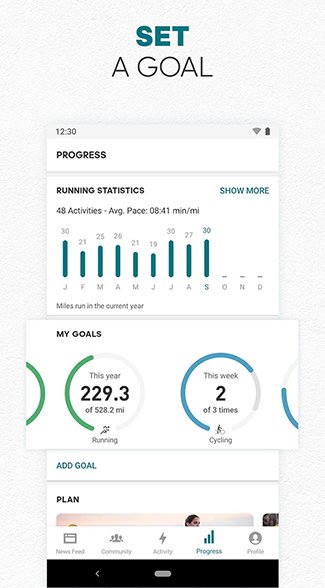
Personalized goal-setting is a key feature, giving users autonomy to define their own fitness targets and deadlines within the Adidas Running app environment.
4. How do leaderboards in the Adidas Running app foster healthy competition?
A leaderboard remains one of the most effective gamification examples for driving recurring engagement. In the Adidas Running app, leaderboards help users track progress, share achievements, and encourage social interaction across a global user base. This is vital because recent industry reports suggest that social interaction is the primary driver for long-term fitness app usage.
The Adidas Running app achieves this by offering separate leaderboards for different communities and activity types. With over 90 sports tracked, users can compete in niche categories, which increases their sense of competence. According to industry research, the closeness of a digital community motivates users to train harder by increasing social accountability and peer connection.
Want to create a better experience for your customers? Check out our app gamification platform!
5. How does the Adidas Running app reward system encourage user loyalty?
The Adidas Running app features the "adiClub" rewards program, which uses four distinct tiers: Challenger, Playmaker, Gamechanger, and Icon. Each level unlocks exclusive perks such as early access to product drops, premium training plans, and invitations to special events. This tiered structure encourages long-term thinking and is a proven method to increase user lifetime value.
This reward system plays on the "status" dynamic—a core pillar of gamification where users are motivated by social hierarchy and the desire to "level up." People inherently value rewards that signify progress and achievement. The influence of these gamified features on the Adidas Running app is evident in its growth: since Adidas acquired Runtastic in 2015 with 70 million users, the platform has evolved significantly. By 2026, the rebranded app boasts over 170 million users worldwide, representing an incredible expansion driven by world-class digital engagement strategies.
Why the Adidas Running app gamification strategy is a 2026 market leader
TL;DR: The Adidas Running app has scaled to over 170 million users by integrating behavioral science into daily fitness. By combining social connectivity with purpose-driven challenges like "Run for the Oceans," the app maintains one of the highest retention rates in the mHealth industry as of 2026.
Activity tracker apps remain the fastest-growing segment in mHealth. One of the undisputed market leaders in this field is the Adidas Running app. Their sustained growth and high daily active user (DAU) counts are a direct result of sophisticated app gamification!
Sports brands use the Adidas Running app model to drive customer motivation
Current market analysis for 2026 shows that sports brands are driving unprecedented growth in fitness apps. There is a strategic reason why athleticwear companies like Adidas prioritize the Adidas Running app within their digital ecosystem:
- Ecosystem Lock-in: Healthy people are consistent consumers. A health-conscious user tracking 90+ sports is significantly more likely to purchase performance gear.
- Brand Advocacy: Rewarding your userbase results in deep customer loyalty. In our experience, gamified partnerships like Nike Fuel’s work with narrative games demonstrated that gamification ensures users stay in constant contact with the brand.
- Data-Driven Retention: Fitness apps increase customer lifetime value. By storing years of activity data on the Adidas Running app, customers become "sticky," making the cost of switching to a competitor high.
Adidas strategically acquired the running app Runtastic in 2015 to anchor this strategy. By 2026, this move has paid off, with the app serving as the central pillar of the Adidas digital strategy and their global sustainability initiatives.
Sustainability meets engagement in the Adidas Running app
The Adidas Running app utilizes "Run For The Oceans" to challenge users to raise money to fight plastic waste. First launched in 2017, the campaign evolved into a global phenomenon, often raising over $1 million in a single campaign cycle through kilometer-based donations.
Why is this vital for the Adidas Running app? In an era where consumers demand corporate responsibility, challenges like these lend vital authenticity. Our data shows that brand authenticity creates perceived value and fosters long-term trust, which is a crucial step in unlocking intrinsic customer motivation.
5 examples of gamification that drive Adidas Running app success
The Adidas Running app uses 5 specific gamification features to motivate its 170 million users to track millions of kilometers every month:
- Dynamic Challenges: Challenges are inherently motivating, regardless of the outcome. Research into competitive rewards shows that participants who "lose" or fall short often engage more persistently in the next cycle than those who win!
- Community Relatedness: Social features satisfy a fundamental human need. Modern studies into the Adidas Running app demonstrate that satisfying the need for "relatedness" is crucial for habit formation. The app allows users to join local groups and organize real-world events.
- Purpose-Led Goal Setting: Goal-setting provides users with autonomy. Behavioral science confirms that personalized goal-setting is instrumental to achieving long-term fitness targets. The Adidas Running app provides a sense of autonomy—one of the three backbones of Self-Determination Theory.
- Social Competition via Leaderboards: Competition drives engagement. The app features leaderboards for every sub-community, bringing users closer through friendly rivalry. Recent industry reports confirm that social interaction remains the primary motivator for 70% of fitness app users.
- Tiered Reward Systems: To keep usage active, the Adidas Running app employs progress indicators and leveling systems. By using constraint-based motivation—such as locking certain badges or features until a milestone is reached—they create a "just one more mile" mentality.
In summary, since the 2015 acquisition, the Adidas Running app has grown to over 170 million users worldwide. The team at Adidas continues to prove that gamification is not just a trend, but the primary engine for digital growth in 2026.
Explore how StriveCloud can help you implement similar powerful gamification strategies in your own application to drive retention and user growth.
5 ways Revolut creates the best banking app with gamification
In 2015, only 18% of adults sent money to digital banks. Today, 75% transfer money digitally! Without a doubt, Revolut is the market leader. With gamification features like raffles and leaderboards, the app has perfected the customer experience. Should traditional banks be worried, or can they keep up the pace?
5 ways Revolut creates the best banking app with gamification
TL;DR: Revolut has secured its position as Europe’s largest digital bank by using Revolut gamification to transform routine transactions into rewarding experiences. With a customer base reaching 65 million in 2025, the app leverages social challenges, "Learn & Earn" modules, and progress tracking to process over 150 million transactions monthly.
The evolution of digital banking has moved with incredible velocity over the last decade. While earlier adoption rates showed steady progress, the current landscape is dominated by neobanks that prioritize user engagement. Today, Revolut gamification is the engine behind a platform that serves 65 million customers worldwide as of 2025. By operating in over 48 countries and maintaining 1.1 million daily active users, Revolut has proven that the future of finance is interactive, social, and deeply rewarding.
Between 2022 and 2024, Revolut saw its customer base double, a 100% increase that pushed the company toward a forecast of over 67 million users by the end of 2025. In our experience, this hyper-growth is sustained by Revolut gamification features that simplify complex tasks like crypto-trading and budgeting. In markets like Australia, the bank has maintained an average annual growth rate of nearly 100% since 2022, demonstrating that users increasingly prefer "banking-as-an-experience" over traditional, static utility apps.
- Competition is hot, but Revolut is hotter
- 5 features every banking app needs
- 5 gamification examples for banking from Revolut
- StriveCloud specializes in customer experience optimization
- Recap
Competition is hot, but Revolut is hotter
TL;DR: Revolut dominates the digital banking sector by leveraging gamification to reach over 65 million users as of 2025. By doubling its customer base since 2022 and maintaining 1.1 million daily active users, Revolut has transformed from a travel utility into Europe’s largest digital bank and a global financial super-app.
Globally, there are over 25,000 fintech startups, with the market reaching a state of high maturity in 2026. For emerging startups, this saturation is a significant obstacle to growth; however, for a market leader like Revolut, it represents a platform for massive scale. Revolut’s growth trajectory remains unparalleled, having doubled its customer base (a 100% increase) between 2022 and 2024. By early 2025, the bank reached 65 million customers worldwide, and if current trends continue, it is projected to exceed 67 million by the end of the year.
Indeed, if any company knows what it is like to have their market disrupted, it is Revolut, who are themselves the primary disruptors. In our experience, their meteoric growth was earned by aggressively solving the engagement gap found in traditional banks. This ongoing threat to established institutions explains why 80% of banking executives remain focused on improving digital customer experience to prevent churn. Revolut currently processes 150 million transactions monthly, proving that they aren't just gaining users—they are gaining primary bank status.
Revolut was created by CEO Nik Storonsky to enable customers to avoid transaction fees when traveling, but it has since evolved into a comprehensive financial ecosystem. In today’s interconnected world, Revolut has expanded its operations to over 48 countries to meet the needs of a globalized workforce. Our data shows that their success is no longer just about travel; it is about gamification and habit-forming design. With 1.1 million daily active users, the app is now at the forefront of customer experience optimization.
By making the app highly engaging, Revolut has captivated a massive global audience that dwarfs its 2020 figures. How did they achieve this? They followed a philosophy that many fintechs ignore: “gamify the experience!” Using gamification examples such as RevPoints loyalty programs and interactive spending challenges, they have turned routine money management into a rewarding experience that keeps users coming back every single day.
New to gamification? Get started on our what is gamification page!
5 features every banking app needs
TL;DR: To build a market-leading banking app in 2026, you must master five core pillars: secure biometric sign-up, ultra-fast onboarding, gamified payment ecosystems, AI-categorized transaction history, and high-engagement push notifications. These fundamentals allowed Revolut to scale to over 65 million users by 2025.
Before you even embark on making your app special with advanced gamification, it has to be perfectly functional. As the industry evolves, the "rules" of entry are stricter than ever. The growth of digital banking has been relentless; for instance, Revolut’s customer base doubled between 2022 and 2024, positioning it as Europe’s largest digital bank with 65 million customers as of early 2025. To handle a trajectory that aims for 67+ million by 2026, every banking app needs these 5 features:
#1 Sign-up and intuitive profile set-up
When asked about digital banking in 2026, consumers still cite security as their primary concern. During the sign-up phase, you have a narrow window to demonstrate institutional-grade safety. In our experience, integrating features like advanced biometric scanning (FaceID/Passkeys) and multi-factor authentication doesn't just secure the account—it builds the psychological trust necessary for users to deposit larger sums.
#2 A clear and motivating onboarding process
The competition for attention is fierce; for many digital banks, Day 1 user retention still averages around 30%. To beat this, you must deliver immediate value. With Revolut now supporting 1.1 million daily active users, we’ve observed that the most successful onboarding flows use "progressive disclosure"—introducing features subtly as the user needs them rather than using long, forced tutorials that drive churn.
#3 Payments
This is no longer just about moving money; it’s about the ecosystem. In 2026, a functional app must support instant peer-to-peer transfers, global remittances, and integrated "spare change" savings. For example, look at how fintech app Chip uses gamification to automate savings by stashing pennies from every transaction. Currently, Revolut processes over 150 million transactions monthly, proving that payments must be as social as they are financial.
#4 History of transactions
Transparency is the antidote to financial anxiety. Displaying past transactions is essential to giving users a sense of agency over their wealth. In 2026, standard lists aren't enough; transactions should be automatically organized by AI into categories like "Groceries," "Entertainment," or "Subscriptions." Detailed merchant data, including logos and maps of where the transaction took place, helps users immediately identify charges and prevents the "mystery payment" support tickets that drain operational resources.
#5 Push notifications
Fintech remains the gold standard for mobile engagement, as financial apps consistently see the highest engagement rates for push notifications. Because money is inherently personal and time-sensitive, these alerts are viewed as high-value rather than intrusive. By providing real-time balance updates, fraud alerts, and progress bars for savings goals, you keep the user tethered to the app's core utility every single day.
5 banking app gamification examples from Revolut
TL;DR: Revolut’s mastery of banking app gamification has propelled it to 65 million customers globally as of 2025. By replacing static forms with Instagram-style onboarding and visual progress trackers, the app maintains 1.1 million daily active users and processes over 150 million transactions monthly. These features reduce the typical 70% user drop-off rate seen in traditional finance apps.
Likewise, Revolut provides users with these 5 basic features. However, using the power of banking app gamification, the app focuses on customer experience optimization to maintain its position as Europe's largest digital bank.
#1 A sign-up process designed for user retention
To prevent the industry-standard 70% drop-off in users over the first 24 hours, Revolut utilizes banking app gamification by presenting the sign-up video like an Instagram story. With a customer base that reached 65 million in 2025, scaling efficiently is key. A progress bar is clearly displayed at the top because 3/4 of people prefer a visual indication of progress. This design helps Revolut stay on track to exceed 67 million users by the end of 2025.
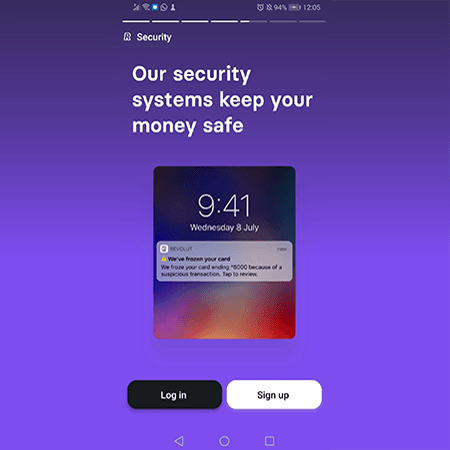
This example shows how a progress bar during sign-up provides a clear sense of completion, which is a fundamental element of banking app gamification that aids user retention.
#2 A leaderboard that motivates students to complete onboarding
Revolut uses banking app gamification to tap into the human need for social relatedness through university leaderboards. By encouraging competition among students, they successfully doubled their customer base between 2022 and 2024. In our experience, adding a social layer to fintech is why Revolut now sees 1.1 million daily active users. The prize of free premium services acts as a "variable reward" that keeps users engaged for the long haul.
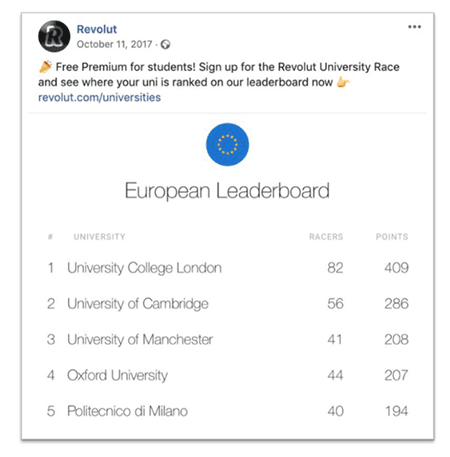
Revolut's university leaderboards are a powerful example of using social competition to drive user acquisition and onboarding completion via banking app gamification.
#3 Lotteries and raffles incentivize payments
When you make transfers and payments, Revolut’s banking app gamification rewards you with points. These points enter you into a raffle to win up to £10,000! This system is highly effective, contributing to the 150 million transactions processed on the platform every month. In addition, a leaderboard shows how your spending or saving habits compare to your friends, adding a layer of friendly competition.

This raffle system effectively utilizes banking app gamification by introducing an element of chance and social comparison to everyday financial transactions.
#4 Progress bars and goal-setting give users control over transaction history
In 2026, creating a feeling of financial control is essential for user trust. Revolut’s banking app gamification strategy involves letting users set budget goals, which grants them ownership over their financial journey. In our experience, these visual feedback loops are a primary reason why Revolut has seen a 100% average annual growth rate in markets like Australia since 2022. Progress bars keep users updated in a visually pleasing way that traditional bank statements simply cannot match.
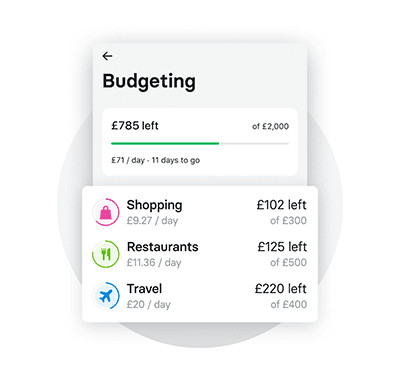
By allowing users to set budget goals and visualize them with progress bars, Revolut uses banking app gamification to give users a tangible sense of control over their money.
#5 Personalized push notifications grow the customer relationship
Revolut leverages banking app gamification by sending personalized notifications that acknowledge user milestones. Whether you have hit a savings goal or just returned from a trip, Revolut sends a quick message to welcome you home. This hyper-personalization is a core component of their customer experience optimization, ensuring that as they grow past 65 million users, each individual still feels a unique connection to the platform.

This personalized "Welcome home" notification is a prime example of how banking app gamification and timely messaging build a stronger, more emotional customer relationship.
StriveCloud’s 2 cents on gamification for mobile banking apps
TL;DR: Revolut’s trajectory to 65 million customers by 2025 proves that gamification is the ultimate engine for user retention. StriveCloud helps you replicate this success by transforming transactional apps into habit-forming experiences, typically resulting in a 23% decrease in churn.
If Revolut’s ability to double its customer base between 2022 and 2024 inspires you to make your banking app more engaging, you’re not alone. In our experience, the transition from "utility banking" to "lifestyle banking" is only possible through behavioral design. According to Revolut's latest growth reports, the bank now serves over 65 million users globally, processing 150 million transactions monthly. This level of activity isn't accidental; it is the result of a gamified ecosystem that rewards consistency.
StriveCloud can help you implement your own gamification strategy in three simple steps:
- Interactive Strategy Workshop: We begin by auditing your current user journey. We identify "friction points" where users drop off and "value moments" where gamification can increase dopamine hits. We then package this into a comprehensive gamification design plan tailored to your 2026 business goals.
- Seamless Integration: Based on the plan, our team adds a high-performance gamification layer to your app. We focus on motivating specific behaviors—such as increasing monthly deposits or card usage—without requiring a total backend overhaul.
- Team Empowerment: Lastly, we onboard and train your team to manage the gamified experience. Using our proprietary dashboard, your product owners can adjust challenges and reward structures in real-time to fit shifting market needs.
These gamification strategies aren’t just theoretical for us. We’ve worked with leading fintechs and traditional banks to drive tangible ROI. By focusing on the same psychological triggers that helped Revolut reach 1.1 million daily active users, we’ve managed to achieve results like a 23% decrease in churn and a rise in daily active usage by 58%!
Enrich your own app with fun elements. Check out our app gamification software!
Recap
The growth of digital banks has evolved from a trend into a global standard. As we enter 2026, Revolut has solidified its position as the world's leading banking app with gamification, boasting over 65 million customers across 48+ countries. TL;DR: Revolut dominates by transforming traditional banking into an interactive experience using progress bars, social competition, and real-time rewards, driving 150 million monthly transactions and a 100% user growth rate between 2022 and 2024.
With a forecast to exceed 67 million users by the end of 2025, Revolut is no longer just a challenger bank; it is the market leader. How did they achieve this scale?
Competition is hot, but Revolut is hotter
Standing out as a banking app with gamification is essential in a market with over 30,000 fintech startups worldwide. In our experience, the key to Revolut’s dominance is its aggressive growth trajectory; the company doubled its customer base (a 100% increase) between 2022 and 2024. In specific markets like Australia, they have maintained an average annual growth rate of nearly 100% since 2022.
This relentless expansion is why 80% of banking executives now prioritize improving their digital customer experience to prevent losing market share to neobanks that prioritize engagement over simple utility.
5 features every banking app needs (and how Revolut improves it with gamification examples)
Creating a successful banking app with gamification requires a balance of security and playfulness. With 1.1 million daily active users, Revolut’s strategy offers a blueprint for retention.
#1 An intuitive sign-up. A great time to talk about how secure your app is (a major consumer concern in 2026).
Revolut: To prevent the 70% drop-off typically seen in Day 1 user retention, the sign-up process is presented like an Instagram story, using a progress bar at the top to give users a sense of "advancement."
#2 A clear and motivating onboarding process. Use as few screens as possible to reduce friction.
Revolut: Revolut famously used university leaderboards that encouraged students to sign up in "waves." This utilizes social proof and competition to fulfill the human need for social relatedness.
#3 Payments. Gamify the utility of transactions. Revolut currently processes over 150 million transactions monthly by making the "spend" feel rewarding.
Revolut: When you make transfers, Revolut often rewards you with points or "RevPoints." These points can be used for travel rewards or entry into high-value prize draws, turning a standard payment into a chance to win.
#4 History of transactions. Displaying this is essential to giving users a sense of mastery and financial control.
Revolut: Users set granular budget goals with visual progress bars. As the bar fills or stays green, users feel a sense of "ownership" and achievement over their financial health, rather than just viewing a list of debts.
#5 Push notifications. With real-time info and personalized messages, you create deep customer value.
Revolut: Beyond simple alerts, Revolut uses contextual push notifications—like a welcome message when you land in a new country—to reinforce the app's role as a "travel companion."
StriveCloud’s 2 cents on gamification for banking apps
Following the formula of Revolut, StriveCloud recently helped a leading Belgian bank modernize its digital experience. Our expert team helped them gamify their app in 3 easy steps:
- A strategy workshop identifying key behaviors to reward, leading to a custom gamification design plan.
- Using our API-first software, we add a seamless layer of gamification over existing banking infrastructure.
- Onboarding & training on how to use gamification analytics to keep users engaged for the long term.
Want to improve your mobile app experience? Accelerate your growth with an action-packed gamification workshop tailored to your app goals!

6 powerful psychological triggers designed to boost user activation
Get users to their AHA moment fast, and keep them coming back. What can SaaS companies do to drive user activation? Well, start with human psychology in mind. Discover the 2 factors that influence user activation & learn 6 powerful psychological triggers to boost it!
6 powerful psychological triggers designed to boost user activation

Understanding the psychological drivers behind user behavior is essential for improving activation and engagement within any software application.
- The 2 major factors that affect activation rate
- How to address your users to spark user activation
- 6 psychological triggers for user activation in SaaS
- Why gamification? - How gamified features trigger user activation
- Get optimizing with StriveCloud’s gamification solutions
- FAQ
The 2 major factors that affect activation rate
Behavioral science researchers have been exploring the topic of motivation for decades. One of those researchers is Dr. BJ Fogg, a social scientist from Stanford University. He created the Fogg Behavior Model (FBM), a popular model that maps someone’s motivation and ability to complete an action against their likeliness to actually carry it out. For a user to take action, these 2 major factors have to be in place.
Based on these insights SaaS companies have been experimenting with new tactics in hopes of finding the ultimate psychological triggers for user activation.
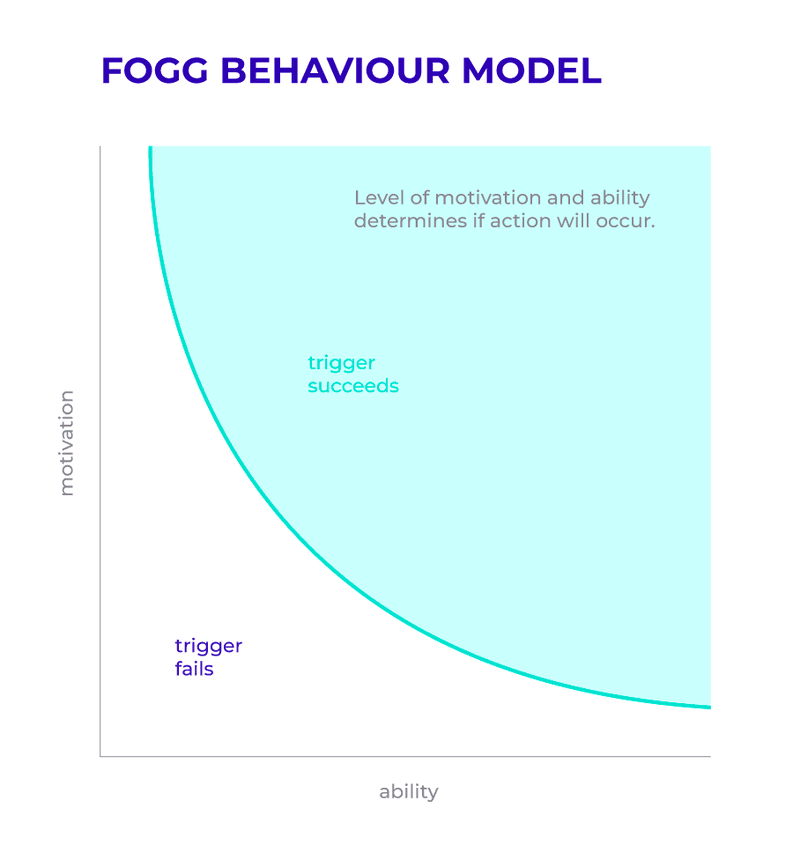
The Fogg Behavior Model shows that for an action to happen, a user needs sufficient motivation, ability, and an effective prompt to trigger the behavior.
In essence, it notes that you must encourage your users to action, while also creating the circumstances where reaching the activation point is possible. In other words, if you make something either too hard or too boring, users will lose interest. However, a gamified approach can help you boost motivation & therefore drive user engagement & activation.
Looking at your software through the FBM, you can pinpoint where to place your interventions. For example, gamified features like challenges can boost interest & motivation when the task in itself seems boring.
In conclusion, there are two ways to go about this. To start, keep your user interactions easy. You can gradually build up more intense tasks when a user’s ability or motivation is already at a higher level. Secondly, boost motivation with a gamified strategy. Read on to learn how you can get started!
How to address your users to spark user activation
To initiate your user activation strategy, you must first know who your users are and what makes them tick. With that, you can segment users by target group, user persona, and even their position in the customer journey.
That information will define how to address your users, and which psychological triggers to leverage for user activation. Without a doubt, your activation & user engagement strategy should start from the very first moment users interact with your software.
Think of your website’s landing page, user onboarding, and a user’s first experience of the key functions of your product. Gamified onboarding for example ensures that a user completes key activation moments in their journey! You can use different tools here. From push notifications to emails, or a cleverly timed tooltip. The most important thing is your triggers should always be contextual, taking into account the users’ current status & abilities.
What is your AHA moment? Check out our ultimate SaaS user activation guide & start optimizing!
6 psychological triggers for user activation in SaaS
User activation is the bridge between acquisition and retention - and psychology can help you motivate your users along that journey faster. To facilitate those AHA moments, use these 6 psychological triggers for user activation:
1. Reciprocity: You give some, you get some
75% of SaaS businesses offer a free trial - a classic example of reciprocity. In short, offer users something for free in the hope that value makes them subscribe. Double down on reciprocity by delaying registration and giving your platform a personable face. People are more likely to return the favor if they feel there is a person on the other end!
Let’s look at Bench for instance. This financial management software activates prospects by promoting the platform’s value alongside pictures and videos of the company’s employees. In other words, share information about your platform, and users will share information about themselves. This builds the foundation of a great customer relationship!

The Bench website demonstrates reciprocity by featuring its team members, creating a human connection that encourages prospects to start a trial.
2. Commitment: Get your users invested in their journey
What is the best way to get users to commit to your platform? Well, start off easy by having the user commit to something small. This could be completing their profile, or setting up an integration. Of course, it all depends on what your AHA moment is!
Then, steadily drive up user engagement with a gamified experience. Reward users for investing time and effort in your platform. The more they use your software, the better their experience will become which ultimately results in retention & happy customers!
Basecamp for instance asks users why they need their project management tools. It shows users that Basecamp is as committed to your goals as you are.

This example from Basecamp's onboarding asks users about their goals, establishing an early commitment that fosters deeper engagement with the platform.
Build your gamified strategy on human psychology. Book an expert-led workshop & learn how to drive user activation with gamification!
3. Social Proof: Testimonials build trust
The idea behind social proof is simple. When people are uncertain, they look to others for advice - and you can help provide that! For instance, you might doubt the capabilities of specific software, so what do you do? Indeed, look for reviews, people, or companies that you know who have used the software!
The popular interface design software Figma for instance shares how big brand names like Dropbox, Mailchimp & others used their software for different use cases.

Figma effectively uses social proof by displaying logos of trusted brands, which helps build credibility and encourages new users to sign up.
4. Liking: Be fun and personable!
We are more easily persuaded by someone we like. Your relationship with your customers shouldn’t be purely professional and transactional. Fun is contagious. That’s why sales or customer success people (try to) smile on the phone! You could do the same for your SaaS!
For example, hook your users by having a likable personality like file transfer service WeTransfer. Their landing page is known for featuring attractive and sometimes interactive art. When users like the art, they like WeTransfer’s platform - and then they would like to come back!

WeTransfer’s use of artistic and interactive backgrounds on its landing page creates a positive and likable brand experience, encouraging repeat visits.
5. Authority: Look to the experts
Capitalize on the sway of influential leaders. It is common for SaaS to have celebrities and experts front their product in the hope that their recommendation improves brand trust. Indeed, trust is the second biggest factor in purchasing decisions, behind only price.
For DocuSign, an eSignature SaaS, examples of authority are used to assuage privacy and security concerns by directly showing that the world’s top companies trust them to handle their sensitive information. If they trust us, why shouldn’t you?
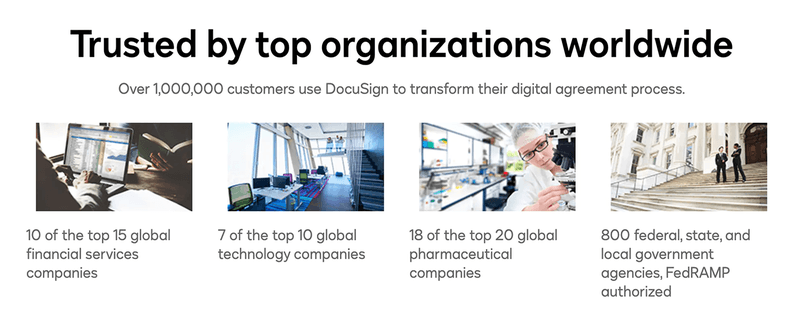
DocuSign establishes authority by showcasing the top companies that trust its services, effectively easing security concerns for potential customers.
6. Scarcity: Take action while you still can!
People want the things they can’t have the most. That’s why we like ‘limited edition’ or ‘exclusive access’. This stems from an internal fear of missing out. In fact, we’re actually more driven by loss avoidance than actual rewards. Therefore, scarcity is a great psychological trigger for user activation.
Imagine for instance you lose access to one of the most sought-after email tools in the world. Enter Superhuman! The platform has a waiting list of over 450,000 people for its webinars and places are limited. But some users benefit from a queue jump, and this kicks off a mutually beneficial brand relationship. In short, they spend more time on onboarding but it ends up in better qualified and happier users. Win-win!

By creating a long waitlist, Superhuman leverages the principle of scarcity to increase the perceived value and desirability of its product.
Looking to drive user activation? Gamify! Build your own gamification strategy during our tried & tested workshops!
Why gamification? How gamified features trigger user activation.
Gamification solutions are emerging as a way for SaaS companies to improve user engagement & activation. Modeled on the research of behavioral psychology, gamified elements like leaderboards, points, and rewards systems derive their power from common psychological triggers and human needs.
Gabe Zichermann, gamification expert - "Gamification is 75% psychology and 25% technology."
In brief, gamification is designed to satisfy 3 major psychological motivators:
- Autonomy. People like being empowered with a choice - and this motivates them to stick to their goals. Personalization and custom rewards achieve this.
- Value. Show the user your value to them and their value to you! Reward them with badges and points, and let them socialize to buff up their social status.
- Competence. The need for personal growth is a powerful motivator. Gamified elements such as progress bars, challenges, and levels can test and track user competence.
Ultimately, these gamification solutions serve as a powerful psychological trigger for user activation. It starts by rewarding user engagement and eventually turns into a habit. It sets up a positive feedback loop in which users are motivated to take action, which, as a result, increases the value of their next interaction.
Get optimizing with StriveCloud’s gamification solutions
Building a gamified SaaS product doesn’t have to be development hell. With our gamification solutions, you can easily introduce, tweak, and experiment with various gamified elements to see what works best for you.
Pieter Verheye, Community Manager @Kayzr - "By gamifying the user experience, StriveCloud helped us grow our user base by 350%."
Activate your audience with features like timed challenges, reward programs, and personalized notifications to make your brand message real! For Kazyr, our gamification solutions led to tremendous user growth and a 60% jump in daily active users!
Building a gamified experience has never been easier - Discover our gamification solutions & start driving user engagement!
FAQ
What factors affect user activation rate?
Behavioral psychology says that the two necessary psychological triggers for user activation are motivation and ability. In short, users need the motivation to perform a task and the ability to undertake said action. It’s your job to ensure they have both!
How to address users to spark user activation?
To address your users, you need to know who they are and what makes them tick. With that, you can segment users by target group, user persona, and even their position in the customer journey. All this will inform your strategy.
What are psychological triggers for user activation?
There are six major psychological triggers for user activation. Reciprocity, when you give something to get something back, commitment, social proof that builds trust, authority to lend your brand credence, being likable, and scarcity to provoke urgency.
How do gamified features inspire user activation?
Gamified features inspire user activation through empowerment. People like autonomy and it gives them ownership over their journey. In addition, gamified elements like badges, points, and rewards create user value. Lastly, features like challenges activate users by testing their competence.

65+ fan engagement lessons traditional sports can learn from esports
The world is becoming increasingly digital, and the same counts for sports organizations. However, this digital wave comes with many growth opportunities to engage fans. In that realm, traditional sports companies can learn a lot from esports. Get inspired by these 66 examples of top esports campaigns!
65+ fan engagement lessons traditional sports can learn from esports
Even the leading organizations in traditional sports are falling behind when it comes to sports fan engagement. For example, top-tier football club Manchester United only appointed a head of fan engagement for the first time in 2022! But the esports market has been leading the way in fan engagement and can provide lessons for sports organizations of all kinds. And that leaves a big opportunity for sports companies.
This visual introduction sets the stage for the deep dive into esports fan engagement strategies that traditional sports can adopt. In this article, we’ll cover 66 of the best examples of sports fan engagement in the world of gaming and esports.
Learn what’s happening in the sport (and align your message)
With esports achieving incredible growth, the debate around the sport has changed. While esports used to be a niche, esports is now watched by 1 billion people globally.
This background inspired the partnership between the Austrian bank ERSTE Group and the League of Legends World Championship in 2021. Having done their research, ERSTE created a humorous video poking fun at the debate of whether esports is a ‘real sport’. In the end, the video tells esports players and fans to #believeinyourself. To be sure, this is a clever case of knowing your market and how they feel! Since the video’s release in August 2021, it has earned an incredible 6.6 million views.

ERSTE Group's #believeinyourself campaign is a prime example of understanding and aligning with the esports community's culture.
Use the power of independent influencers
Do not underestimate the power of streamers! In 2022, Nvidia sponsored over 1,400 Streamers in a Geforce NOW Campaign. The campaign goal was to bring awareness to NVIDIA’s GeForce NOW cloud-based game streaming service. The brand tried its best to be non-disruptive, and prepare advertisements that would blend in with streaming content. Consequently, this campaign was their largest one yet, and the results were impressive:
- Over 600 thousand views
- A 2.73% CTR
- Over 18.5 thousand clicks

NVIDIA's successful campaign with streamers demonstrates the immense reach and impact of influencer marketing in the gaming world.
Inspire your fans with user-generated content
Esports fans are well-known for their high engagement - and this opens up great opportunities for user-generated content (UGC) campaigns. Not only will UGC extend your campaign’s reach - and cheaply - but research also shows that 2/3 of consumers prefer UGC over brand-created images.
One of the most successful recent examples of sports fan engagement using UGC was a partnership between the esports group Fnatic and beef jerky producer Jack Link. For the campaign, Fnatic & Jack Link created a custom map for the popular first-person shooter game CS:GO and encouraged players to share videos of them using #BeefMode. What’s more, the player who submitted the best video would win a FNATIC-branded headset!
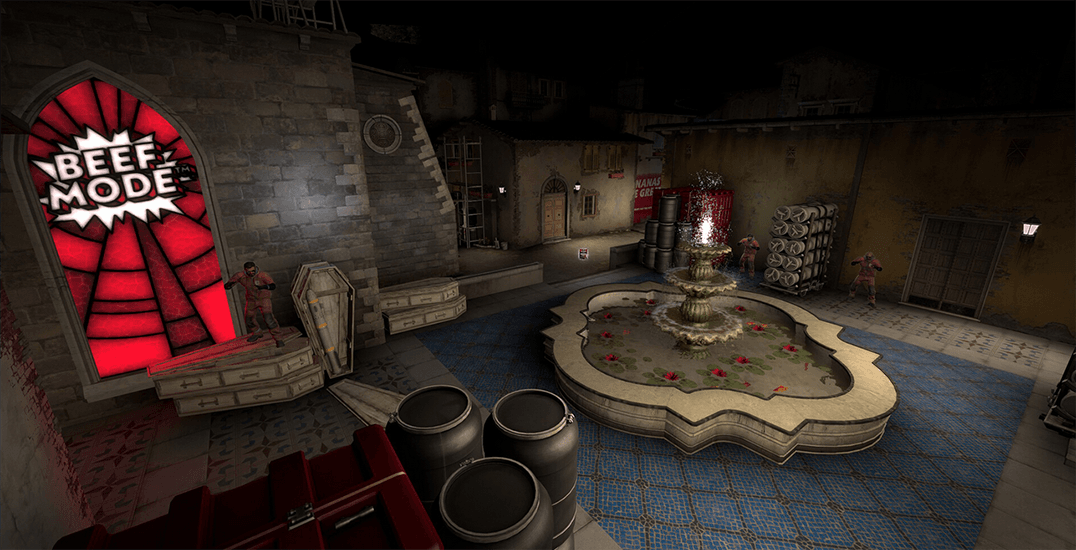
The Fnatic and Jack Link's #BeefMode campaign showcases how user-generated content can create viral engagement and a sense of community.
Reach your audience where they are
When Marriott International opened its first Moxy hotel in Shanghai, it needed to find a way to connect with Moxy’s younger Gen Z audience. The solution? Gaming! By partnering with 150 famous gamers and creators in Shanghai to release 3o videos on platforms like TikTok, Moxy reached an incredible 25 million people in just 4 months!
Make product placement an interactive fan experience
Gamers are digital natives - and they can spot fakes a mile off. Given this attitude, it can be difficult to run a successful product placement campaign. But Tesla shows you how to do it! In 2020, the futuristic car brand partnered with Peacekeeper Elite, a Chinese battle royale game. However, Tesla didn’t just slap their logo over the game. Instead, they worked with the game developers to create the Cybertruck and Roadster in the game! The items were extremely popular and also boosted the anticipation for Tesla’s next car.
In short, this is a great example of reciprocity. Put simply, many fans feel that if they must put up with commercials and logos in their game, they ought to get something for it.

Tesla's integration of the Cybertruck into the game 'Peacekeeper Elite' is a masterclass in interactive and value-added product placement.
Cross over between digital and real-world
When Sony released the PlayStation 5, they made a splash by playing with some cultural icons in London. Underground stations across the city were rebranded to fit the PS5 brand - and as a result, Sony achieved 960 million media impressions and their most successful console launch in the UK of all time, achieving a 69% market share!
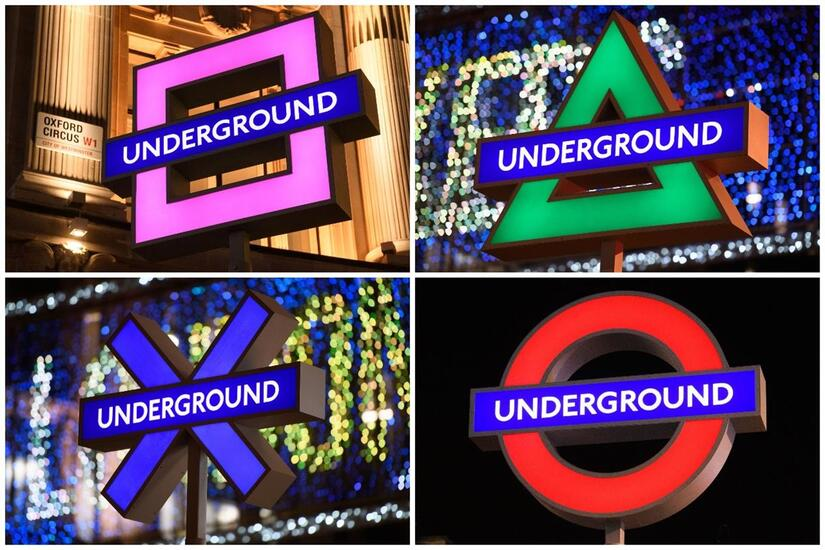
Sony's PlayStation 5 launch in London, which rebranded underground stations, illustrates the power of blending digital brands with real-world experiences.
Tap into cultural trends
Cultural trends are hugely powerful and can better embed your campaign into the market. In China right now, ‘guochao’ is a hot topic. Essentially, this is a renewed appreciation for Chinese culture, history, and design - and Gen Z is leading the trend!
To capitalize on this, the Chinese beauty brand Perfect Diary used traditional folklore in their partnership with Honor of Kings. Why Honor of Kings? It is not just because it is China’s most popular title and reaches 100 million players daily! In fact, 54% of players are women. That made them the perfect partner to showcase a limited edition cosmetics range, featuring folkloric characters that players will know and love.

The partnership between Perfect Diary and Honor of Kings leverages the 'guochao' trend, demonstrating how cultural relevance can create a powerful connection with a target audience.
Go global by being local
Gaming might be a sport without borders - but each country has its own distinct streamers, teams, and favorite games. Indeed, the top 10 streamers on Twitch include English, French, Spanish, and Portuguese speakers. Thus, localization is useful in reaching different markets. Inarguably, there is around 1 billion people who's second spoken language is English, but around 65% of these people still prefer content in their native tongue. In short, to achieve a broad reach and still connect with different audiences, you should localize your esports marketing.
Be smart about where to put your logo
It can be tempting to make your logo as prominent as possible. After all, a prominently placed logo in esports is 300% more memorable than a less obvious placement. But then you need to consider how you want the audience to remember your brand. To be sure, a bad link can backfire spectacularly! That’s why OnePlus took a smart decision when they sponsored the League of Legends European Masters. During broadcasts, OnePlus presented the top plays from each match - associating themselves with success!
Provide fans with a unique fan experience
In 2021, esports tournament organizer BLAST partnered with streaming platform Twitch to provide a special fan experience. Instead of broadcasting their upcoming Apex Legends event like any other tournament, BLAST worked with Twitch to maximize their fan engagement. How did they do it? By developing unique features such as rewards for loyal viewers and a more integrated chat experience. As a result, the tournament racked up 28,000 viewers who watched for nearly 200,000 hours!

This Apex Legends tournament by BLAST and Twitch shows how unique features and integrated experiences can significantly boost viewer engagement and watch time.
To improve sports fan engagement outside of major events, segment your fans by loyalty
Not all fans are created equal. For example, 71% of esports fans only follow one game! Furthermore, those fans could be casual viewers who only tune in for major events, or they could be fanatics who check forums daily. Learning who is who will improve your sports fan engagement strategy all year long - major events or not.
To easily engage your most loyal fans all year long, you could take the lead of esports team Rogue and offer fans a tiered loyalty system. Belonging to ‘Rogue Nation’ provides benefits like VIP tickets, free in-game dropboxes, and even meetings with the players!

Rogue Nation's tiered loyalty system is an effective strategy for segmenting fans and providing exclusive benefits to the most dedicated supporters.
How to make a sponsorship successful? Make it a win-win situation
A sponsorship ought to be so much more than a simple transaction. Instead, it should be a win-win situation for everyone involved! To start, sponsors should give teams new ways to monetize their product or brand, while introducing fans to interesting and relevant offers. For instance, Swedish esports organization Ninjas in Pyjamas teamed up with ‘A Good Company’ to offer sustainable water bottles. Like this, everyone wins!

The collaboration between Ninjas in Pyjamas and 'A Good Company' for sustainable water bottles creates a win-win scenario for the team, the sponsor, and the fans.
Personalize your experience to the segment
Personalization is a hugely powerful tool, especially in the fragmented market of esports. Each game has its own unique fanbase, just as each sport does, and so your communication should be tailored to that.
For instance, the Swiss tournament platform GameTurnier, which is one of our clients at StriveCloud, builds dedicated hubs for different types of games. That way they can tailor their messaging and campaigns for different target groups.
Find out why leading sports brands & esports agencies choose StriveCloud! Get a demo with our experts & discover how having your own platform can benefit you.
Lay things out clearly for casual viewers
We’ve all been in a room where someone watching doesn’t know the rules of the sport. That confusion can be magnified in esports, where casual viewers can easily lose track of events. To avoid that and achieve higher engagement, communication with fans should aim to simplify the state of play - ensuring that fans can enjoy the action!
So when BMW sponsored five of the best esports teams in the world with the United In Rivalry campaign, they played up the rivalry between the teams. This campaign helped frame the drama at the 2021 BMW Berlin Brawl for casual viewers and expose them to the different teams.

BMW's 'United In Rivalry' campaign effectively simplified the narrative for casual viewers by highlighting team rivalries, making the event more accessible and engaging.
Challenge your fanbase to drive engagement
When Burger King sponsored the humble English football club Stevenage, many were skeptical. But the fast food giant turned that around with a clever campaign!
To start, Burger King asked FIFA gamers to challenge themselves and play as the fourth-tier side. The two-week “Stevenage challenge” campaign made Stevenage the most used team on FIFA and Burger King one of the most visible brands in the game!
Alex Tunbridge, CEO of Stevenage - "It actually shows the digital space is now worth more than what you have in real life. We had something like 1.2 billion impressions on the campaign.”
The "Stevenage challenge" sponsored by Burger King is a brilliant example of how a creative challenge can turn a low-tier team into a viral sensation in the gaming world.
Reward fan participation to create an engagement loop
Our client Jantje.gg, the tournament platform owned by KPN and the Royal Dutch Football Association, rewards users not just for winning competitions, but also for just for participating! For every check-in, every match played, and so on you earn coins. Later on, you can exchange these coins for prizes or enter a lottery system.
In turn, that feeling of reciprocity and belonging to a community encourages further engagement and transforms casual fans into fanatics!
Learn how to engage & monetize a gaming community in just 2 weeks. Check out our 360° tournament platform!
Partner with related brands to expand your audience
Expanding your audience can be as simple as partnering with brands that serve similar audiences. For instance, when BMW ran their United In Rivalry campaign in 2021 they also partnered with DC Comics to release a manga starring professional esports players. Not only does this utilize another common interest of the gaming audience, but it also creates a unique campaign!
Alexander Albrecht, MD of Esports consulting agency - “It's not the budget that guarantees success in the [esports] industry, but rather an authentic and relevant dialogue with the target audience.”

BMW's collaboration with DC Comics to create a manga demonstrates how partnering with related brands can expand audience reach and create unique, shareable content.
Show that you truly understand the sport
Gaming is an extremely fragmented market. Obviously, you wouldn’t get a golf player to star in an advert for baseball - and the same goes for esports. For instance, it might be easy to see PUBG and Fortnite as a part of the same “Battle Royale” gaming world, but the audiences are totally different. For Fortnite, the top esports players hail from the USA, France, the UK, and Canada. However, on PUBG, you are more likely to see Chinese, Koreans, Russians, and Finns playing.
It might seem obvious at first, but that’s why Lamborghini sponsored the car football game Rocket League and its tournaments over any other sports game. Traditional sports can learn from this by recognizing that each fanbase is also unique!
Create campaigns that are worth sharing
Riot Games took a risk by releasing Arcane, an animated TV series set in the world of League of Legends. But their marketing campaign was almost too big to ignore - and was specially made to excite and engage LOL fans!
Mysterious pop-ups with LOL items began to appear in major cities across the world, but no event was bigger than lighting up the tallest building in the world with LOL characters. When the video of the Burj Khalifa in Dubai started spreading in fan circles, it quickly reached 600,000 views!

Riot Games' marketing for Arcane, which included lighting up the Burj Khalifa, shows that creating "too big to ignore" campaigns generates immense buzz and shareability.
Tell a story around your main characters, or personalities
For sports organizations, athletes and well-known personalities often have huge followings! So when Riot Games came out with Seraphine, a Twitter account for a fictional LOL character, they wanted to do more than sell or promote.
Rather, Seraphine built awareness for the Worlds Tournament by posting just like a fan! Mostly, that meant tweeting selfies with a unique style that mixed illustrations and real-life objects. Seraphine regularly garnered around 15-40k likes on her posts, in addition to reaching 340k followers! In the end, viewership rose a huge 61% for the next Worlds Tournament.
It all starts with great content
Just like any form of entertainment, the fan journey starts with great content. Luckily for people looking to engage younger audiences, there are lots of possibilities in the esports and gaming industry. Red Bull was one of the first brands to fully commit to esports. They produce related video content and sponsor players and esports teams alike. This gives Red Bull not only many possibilities to distribute beverages and goodwill but also to harvest a ton of exclusive content.
The secret to Red Bull’s success in the esports market is its captivating storytelling. In August 2019 Red Bull’s gaming channel posted an 80 minutes long documentary called Against The Odds. The documentary tells the story of the OG’s esports team's comeback after losing the Dota 2 tournament the year before. Since its launch, it has received over 2.4 million views and 53K likes with people in the comments praising Red Bull for their effort to the community.
Use the power of storytelling to add value for fans
For the release of Blockbuster movie King Arthur, Warner Bros. integrated itself into the livestream of Dreamhack Tours in France, aligning key themes of the movie with authentic and engaging content formats that resonated with fans. Alongside the live stream they also produced video content where they interviewed the “King of the Match”. The activation worked because it added value to the esport event and its fans.
Find what truly motivates your fans
While some esports tournaments like the Fortnite World Cup can go up to 30 million dollars in prizes, it’s not the only incentive to participate. League of Legends, Overwatch and other games offer variable rewards to players just for playing the game. At the end of every season, players are awarded for their ranking. This makes players committed to the game by working towards a goal and contributing to the community. It comes as no surprise that some of these players will enjoy watching competitive play as well.
24/7 engagement in esports competitions
What if you could keep your fans engaged 24/7? That’s exactly what the international esports platform Kayzr does for over 100,000 gamers. Kayzr is a platform where people can compete in online tournaments and win virtual coins which they can exchange for sponsor prizes in the online shop. As part of their partnership with StriveCloud, Kayzr shifted from a tournament system to a League system where users can compete around the clock. The launch boosted daily active users with 60% and got 1 year of 24/7 eyeball time in just a day.
Scalable long term engagement vs expensive loyalty programs
With the new League system in place Kayzr needed a more scalable way than physical prizes to keep their users engaged. Thanks to StriveCloud’s knowledge in gamification they were able to shift motivation from rewards-oriented to experience-oriented. By adding elements of surprise with lottery systems and guaranteeing peak times with “Hotzones” where rewards are doubled, made the game experience in itself better. Finding what truly mattered to their audience helped them achieve a 350% jump in users without increasing loyalty spendings.
Know your fanbase community
Swiss esports agency eStudios noticed how important it is to understand your audience’s behavior. After hearing FIFA players being unhappy about the tournament system on their gaming platform GameTurnier, they decided to partner up with StriveCloud to create a better experience.
Tobias Egartner, CEO Dayzero - "It's important to understand the needs and challenges of your target group and fanbase. It doesn’t matter how big the obstacle, if the challenge is a specific button, take it seriously even if it’s as simple as changing a word to make the experience less confusing."
Discover new broadcast and distribution channels
Engage fans who aren’t present on match day. The live stream of a tournament can considerably amplify an audience and with that, the participatory factor. What the digitally natives like millenials and gen Z’ers like is interaction and feeling part of something. This approach worked for leagues like the NBA and Premier League as well when they started streaming on Twitch.
Emmet Shear, CEO Twitch - "We really believe that live interactive video with chat works for any live video, works for any genre whether its sports, politics, music… It’s just a matter of figuring out the right format, the right recipe to bring it to that vertical."
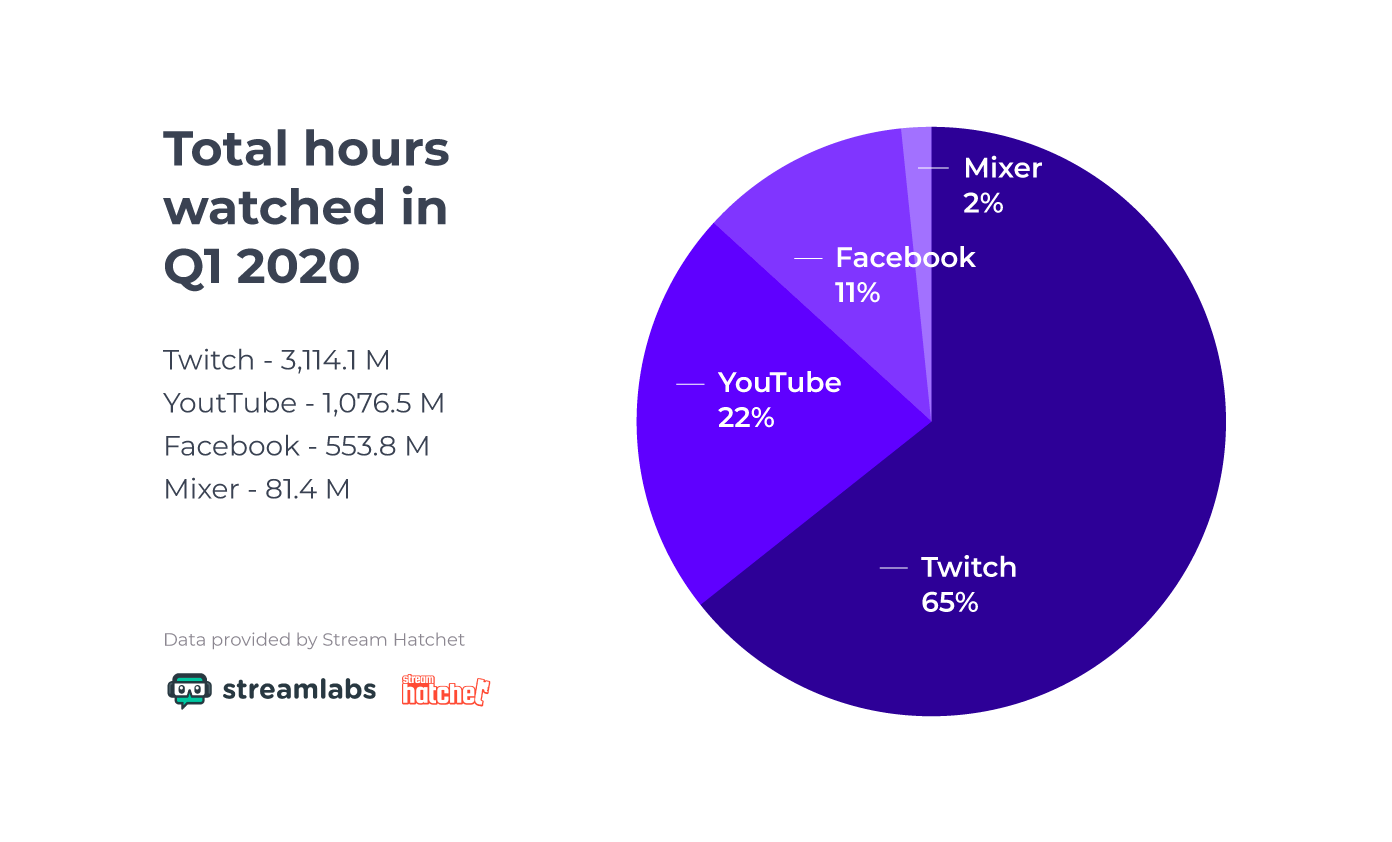
This chart illustrates the massive viewership hours on streaming platforms like Twitch and YouTube, highlighting the shift in media consumption towards interactive, live content.
New engagement models
Unlike traditional sports, every single esports match is available to watch on digital platforms free of charge. Some organizers even reward audience engagement. The Esports Championship Series organized by Faceit even rewarded viewers on YouTube with ‘loot drops’. Loot drops are points that could be exchanged for tangible prizes including gaming hardware, apparel and automobiles.
Move your fanbase online
As a response to the COVID-19 outbreak, Belgian sports broadcaster Proximus and the Belgian Football Pro League decided to partner up with StriveCloud to win back eyeballs for clubs using esports. Fans could register to represent their favourite team in FIFA tournaments. Players could win points and prizes to incentivise them to play more matches. Gamers could compare ranks to one another and socialize through the general chat. Clubs had the opportunity to connect with fans at home while simultaneously being introduced to a new esports audience that was out of reach in the classical business model.
Low-cost and highly scalable
Coca-Cola which is a big sponsor of Olympic games and soccer worldwide is also invested into esports. Coca-Cola’s partnership with game publisher Riot Games allowed them to do brand activations at its tournaments. They soon realized fans from all around the world are interested in watching these tournaments. What started as a small test program to broadcast the tournaments in cinemas, quickly became an extraordinary event with over 200 simultaneous viewing parties on screens across the entire world.
Alban Dechelotte, Senior Manager-Entertainment Marketing and Head of esports at Coca-Cola - "We’re not looking to do ‘takeovers’ with these in terms of exposure and branding; people know Coke, we don’t need to promote the name, but what we want is for them to have this great experience with Coca-Cola."
Enable tournaments & fan entertainment
On TwitchCon 2018 Doritos organized an esports brand activation called the Doritos Bowl. Four Twitch streamers – Ninja, DrLupo, Shroud and CouRage were invited to participate in a live stream tournament of Call of Duty to bring awareness to their brand while offering entertaining content for the fans.
A strong sense of community empowers targeting possibilities
There is a very strong sense of community in the gaming audience. While younger generations might show more resistance against intrusive ads, they are more receptive to it than you think. Esports players often have a bigger online presence than their traditional sports counterparts. They can reach their target audience with a multichannel approach which allows for new and exciting ways to build awareness.
Craig Barry, Exec VP-Chief Content Officer for sports Broadcaster Turner Sports - "I hear words like 'mainstream' around esports, and although it's getting there, it is still very much niche, but it's a huge niche and an extremely engaged community."
Fans value authentic brands that are immersed in the community
Finding sponsors for esports is not just about exposing the brand name. For new fan generations doing a logo slap is not enough to be remembered. These young consumers actually prefer when brands are immersed into the community. Credit card company Mastercard for example made itself cool by sponsoring branded content gaming influencers instead of disruptive advertising.
Brian Lancey, VP and Global Head of Sponsorships, Mastercard - "We didn't want to over commercialize it because it was about [building] trust with these fans," Brian Lancey, VP and global head of sponsorships, said of Mastercard's fledgling esports marketing program. "We're a financial institution ... we're not a Nike, we're not a Red Bull — we're not a really cool brand."
Be inclusive and empowering
Although many believe esports only attracts millennial males, they actually reach an entire spectrum of target demographics. Dating site Bumble committed to bringing an all-female team to the Fortnite League in cooperation with esports agency Gen.G Esports. The team stands as role models for young girls who want to get into professional gaming. What makes this activation so great is the fact that they are the first all-female team that are inspiring younger girls to break the stigma.
Find where your target audience lies
After you have figured out your target audience, it’s time to find which channel they are using. Esports is a great place to reach the younger generations but not only. The market is rapidly growing and opens lots of opportunities to create branded content and experiences.
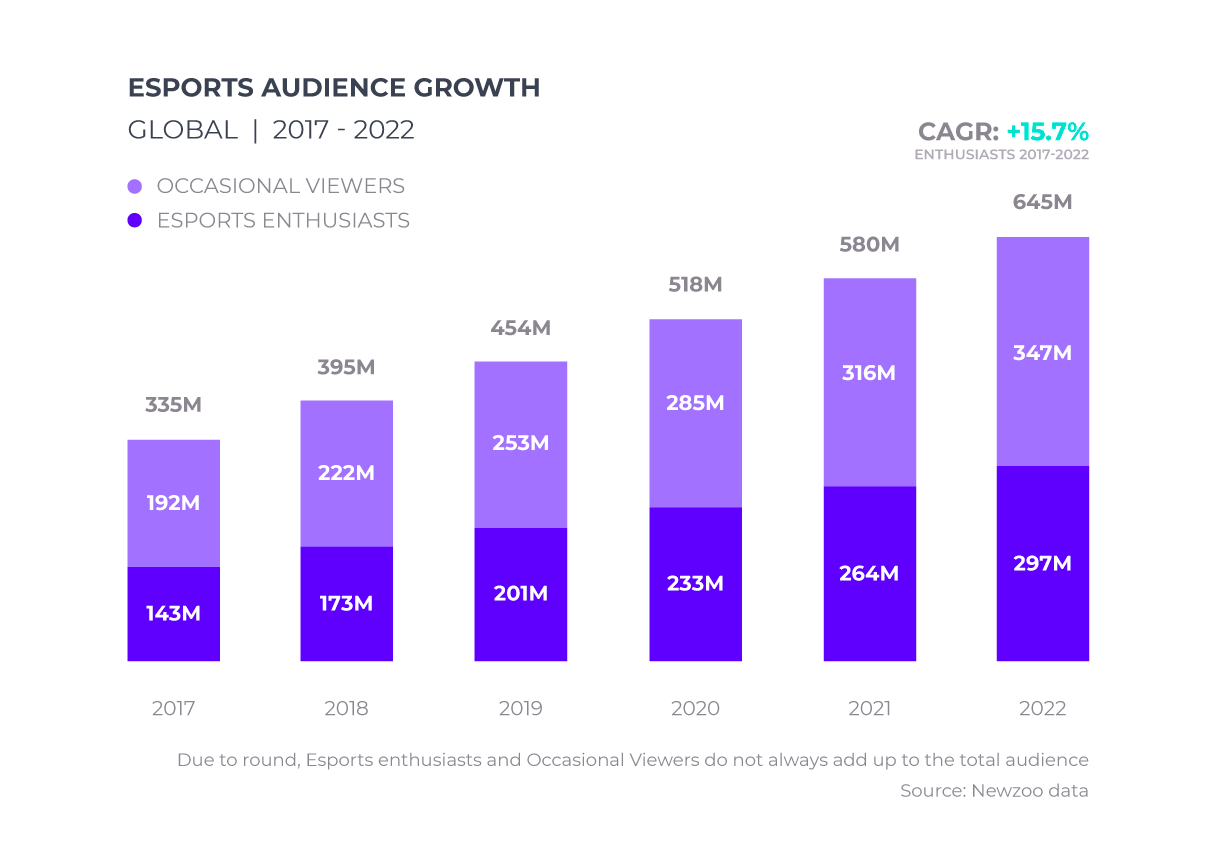
The projected growth of the global esports audience underscores the rapidly expanding opportunity for brands to connect with this highly engaged demographic.
It’s not about the competition, it’s about the fans
When you go to an esports tournament you will notice it’s not only about the competition.First and foremost an esports tournament it’s a place for the fans to connect with their favorite gamers and content creators, participate in tournaments and meet up like-minded people of the community.
Gaming influencers for integrated content
As professional athletes are seen as celebrities today, the same counts for gaming influencers. This offers a lot of possibilities in terms of content creation such as unboxing, reviews, partnerships, trailers and many more. It’s important to find the right personality that fits both your brand and message. Since the lockdown American esports team 100 Thieves started a partnership with audio company JBL was a perfect match that created continuous exposure for JBL.
Ralph Santana, Chief Marketing Officer at Harman, JBL’s parent company - “Our partnership with 100 Thieves highlights our drive and commitment to launching the world’s best lineup of gaming headsets and speakers to date. These are some of the top competitive gamers in the industry, so we are proud to offer the JBL Quantum Range to help them reach countless more victories.”
Traditional sports as esports
The way leading gaming company EA elevates esports through the association with traditional sports resonates with the leading brands. Under EA SPORTS they have published games like FIFA, Madden NFL, NHL, NBA 2K and even the UFC. It’s a great way to engage existing audiences while also reaching entirely new target groups. Since the COVID-19 lockdown many sports clubs turned to esports as an alternative to entertain their fanbases.
Leverage partnerships to create experiences for your target audience
Counter Strike, is a first person shooter game that requires quick reaction times, precise aim as well as constant teamwork and communication. It has long been the favorite game of current and former members of the Armed Forces. When esports organization Cloud9 announced their partnership with the US Air Force it was a perfect match and one of the greatest brand partnerships in esports so far. The US Army got exposure to their ideal audience and the fans got some amazing entertainment.
Frank Muth, Head of US ARMY Recruiting - "We think that esports and the digital plane is going to become the number one lead generator."
Gain exposure in entirely new target markets
To promote its new Hershey’s Reese’s Pieces mashup bar, chocolate company Hershey’s gained huge exposure to an engaged audience of game influencers Ninja and DRLupo. What made the campaign so successful was the unique collaboration between the two game influencers and their clever cross promotion on Twitter and Instagram.
Putting the social in media
Another partnership by esports League Cloud9 and PUMA illustrates how much more engaged digital natives are. Using social listening tools, research company Nielsen found that social media sentiment around the partnership was 700% higher than the traditional sports industry norm for similar campaigns. That’s because they didn’t just post for likes but to engage in conversation. And with the fans actively participating in creating the apparel, engagement skyrocketed.
Matt Shaw, Team Head of Digital Marketing, PUMA - “Esports occupies a large and growing percentage of our audience’s media consumption. But more than that, PUMA has witnessed the nature of sports and sports culture change over the course of the last decade, and it has become apparent that esports has a valuable role to play in how the next generation shapes sports culture. We are a brand that charges itself with driving sports culture, and so this is naturally an area we feel we must lead.”
Don’t sell. Speak the language of your community
It’s important to be on the same wavelength as your audience if you want to keep them engaged. Just like Michael Jordan is the number one ambassador of his shoes, some influencers in the gaming space have tremendous amounts of loyal followers. Having esports influencers unbox or review your products in their own un-scripted style is a perfect way to get it in front of your target audience and gain some brand association while you’re at it.
Nathan Lindberg, Regional Vice President Twitch - "Everyone today feels like Gen Z millennials are anti-advertising ... They just want transparency."
Highly engaged audience with lots of goodwill
Just like traditional sports the main revenue in esports comes from sponsorships. Additionally you have advertisements and media or streaming rights, ticketing and memberships which all capitalize on the eyeballs of a hard-to-reach target audience: millennials & gen Z. The average gamer spends an average of 7 hours per week on gaming with almost 10% over 20 hours. For some streamers the goodwill is so high that fans spontaneously donate money to support their favorite gamer!
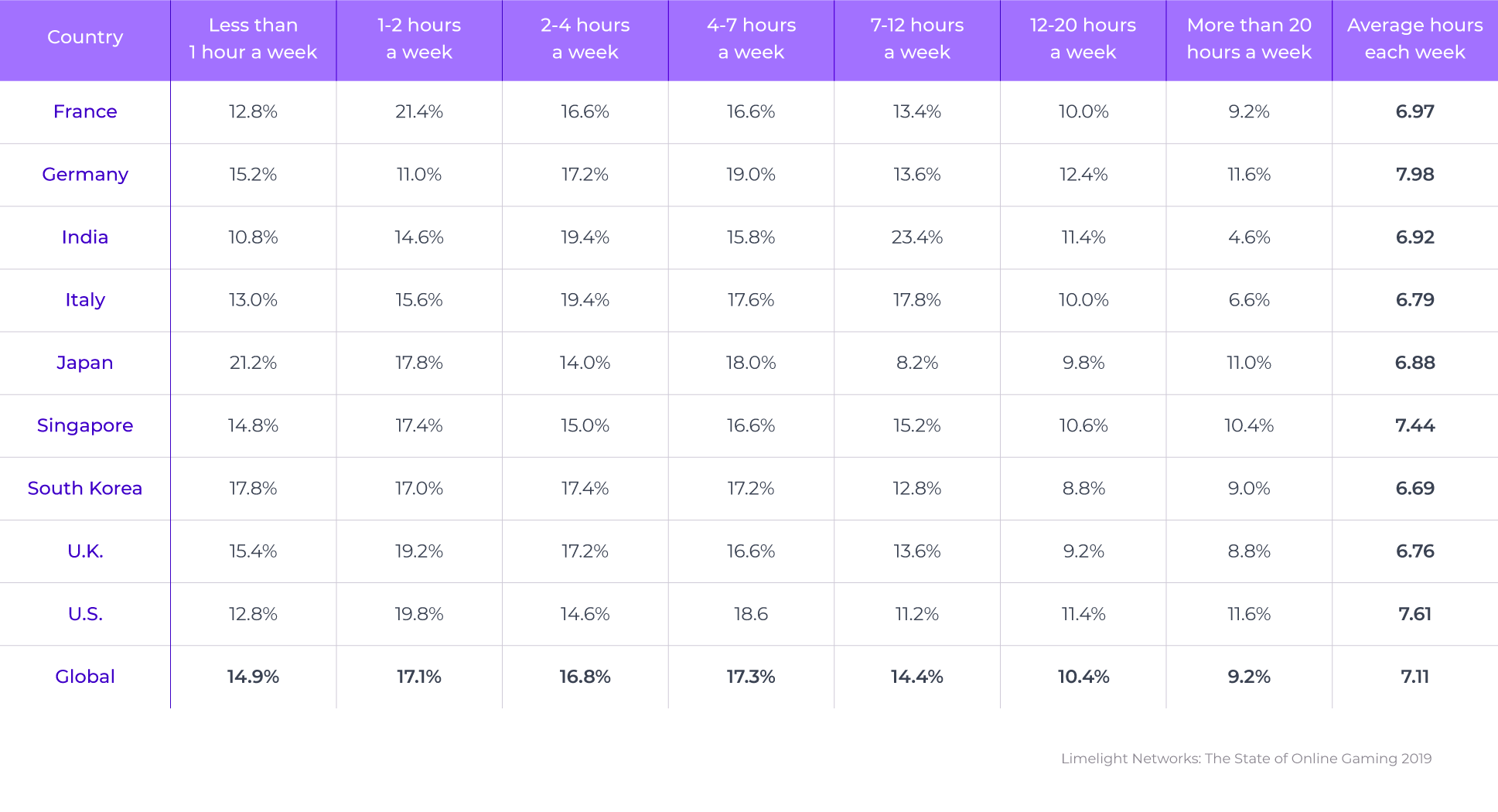
This data on weekly gaming hours across different countries reveals the high level of engagement within the gaming community, presenting a valuable opportunity for brands.
Always keep it fun
When KFC first started their gaming channel it became clear they would provide funny and relatable content. To promote their new vegan esports Performance Burger they created another comedy style parody which would redefine the industry forever as eating it would make you the perfect gamer.
Millennials and Generation Z need instant gratification
Esports targets a young audience that broadcasters are afraid of losing to other on-demand video platforms. Platforms such as Netflix and YouTube Gaming have millions of viewers all around the world and are available for personalized experiences 24/7. When consuming digital media, the fans are in control of what they want to see and what not. With over 140 million monthly users a platform like Twitch captures an average of 95 minutes per day. During the COVID-19 lockdown they broke a total of 3 billion hours watched on the platform with a 23% increase compared to the previous quarter.
Personalization and interaction is key
With an oversupply of content and media, marketers must adapt to the power shift and use technology to learn more about their target group so they can better serve them. As sport audiences are growing older, sport clubs are looking for ways to engage younger fans. The reason platforms like Twitch and YouTube Gaming are so popular is thanks to their interactive and personal experience.
Low-entry barrier & fun to watch
Esports is probably one of the most accessible competitive leagues in the world. It’s fun and often doesn’t require a lot to start. Besides being able to play, esports has also stood its ground as a spectator sport. Filling out entire arenas and garnishing millions of views. Game developers have worked on creating a more interesting game to watch and the esports entourage has perfected it through live commentary, behind-the-scenes content and easy to follow gameplay.
Participation creates engagement
Esports fans are very active in their community. Most of them started out playing the games they watch as well. The social part of the community is more important than it seems. As people are naturally motivated to compete against one another, the mechanisms in esport communities often make for a truly engaging experience.
Be authentic
Esports fans can smell fake from miles away. They prefer brands that are immersed into the community and are trying to add value. For example by supporting their favourite content creator or adding value to the live tournaments or streams. Think about what content your audience wants to see and how your brand can relate to it.
Bring your ideas to live
Electronics company Lenovo believes that gaming is for everyone. And they put their money where their mouth is when they introduced a Swedish team of elderly people to compete in Counter Strike all over the world. Swiftly the news became a global cultural phenomenon which created PR-wave worth over 10 million dollars in earned media and over 1 billion, unique media impressions. It’s through their inspiring message and unique approach they ended up becoming the PR campaign of the year.
Esports is global
Due to its globalised and online nature, viewership for esports is significant, making it comparable to traditional sports. In 2019 League Of Legends brought in over 100 million viewers, beating every sporting event, even compared to the Superbowl in 2019 which was watched by 98.2 million people. Nearly all esports tournaments are streamed for free on platforms like Twitch and Mixer. It allows fans to watch their favourite team or gamer while chatting with other spectators.
Enable real time interactions between streamers and viewers
What’s great about streaming platforms is the real-time engagement going on between fans and streamers. Old Spice took advantage of that with their “Old Spice Nature Adventure” marketing activation in which they let Twitch viewers control a man’s life for three days. Hundreds of gamers swiftly helped the adventure unfold in a funny and highly engaging way.
Leverage the brand and fanbase of esports influencers
Streaming platforms like YouTube or Twitch have created a new type of celebrity. These are often gaming influencers that a young target audience can relate and feel close with. Dr. Disrespect, one of the most viewed content creators on game streaming platform Twitch took on a partnership with natural energy drink G FUEL to create his own drinking cup. The brand has been wildly popular among gamers, largely due to the relevancy of their ad campaigns.
Building anticipation through branded content
Mountain Dew created a native hub to raise awareness of their esports League. On the platform fans could discover branded content like weekly League Recaps, custom videos with exclusive predictions for the Global Finals and integrated links to the gamer hub. The fan engagement strategy focused on creating season highlights to build anticipation for the Global Final.
Provide exclusive behind-the-scenes content
As part of a partnership between Toyota and Overwatch League partnership a branded content series called “Access Granted” began. It was a behind-the-scenes look at an esports competitor’s journey in the League. Every episode one of the players joined a host in a Toyota C-HR for a casual interview. The series gave fans an inside look at some of the biggest stars in the League while building goodwill for Toyota.
Integrate your brand into the fan experiences
As one of the sponsors in the Overwatch League, Sour Patch Kids did not just give away products at tournaments but also drove brand awareness by using its sponsorship to create short-form, shareable social video content around its brand slogan “Sour, Sweet, Gone.” The video series featured players in-game moments while turning a sour situation into a sweet one.
Crossover with celebrities
While esports has been gaining popularity over the years, mainstream celebrities will always bring in tons of new traffic. When Canadian singer Drake and rapper Travis Scott dropped in to play Fortnite on the live stream of pro gamer Ninja they broke the world record for most live viewers in a single-player stream. The record almost doubled from 388,000 viewers to 628,000 viewers and gained over 13 million additional views on YouTube.
Create a central hub for fans
As an effort to better capture the attention of their fans online NBA created an app to boost digital fan engagement. With a flawless onboarding process it’s easy for fans to get started. The app serves as a central hub for fan news, videos, games and interaction between fans. It also boasts an in-app store with merchandise and apparel. Fans can participate and compete in games which boosts the amount of interaction and engagement.
Connect fans with each other
Esports fans are enthusiastic and passionate about the games they are playing. That’s also why they enjoy watching others play as entertainment or purely to hone their own skills. Bringing all these fans together online creates great moments of sharing to further fuel the community with user-generated content.
Ever-evolving gameplay
What’s so entertaining about esports is the fact that those games are often optimized to be fun and exciting to watch. Compared to traditional sports, game developers are constantly trying to improve their game by adding new elements or layers to it and making it a greater experience both for players and spectators!
The power of content
After the success of the League of Legends Championship in 2016, online betting company Unibet wanted to gain more awareness in the gaming community. They created a branded platform called Esports Champions that tells stories about the highlights of gaming and its growth over the past few years. The platform includes information on the top earners, most played games and viewership stats in shareable, interactive graphs. The goal of gaining coverage was met with 3,767 total shares by Yahoo, Mashable and The Mirror.
Solve the problems of your fans
As the international crowd of esports continues to grow, some large, multi-day tournaments bring in lots of tourists. One challenge for many of them is transportation. Taxi-service Citymobil anticipated this by organizing transportation for the tourists and offering discounts to anyone going to the event. Besides a booth presence at the tournament finals, they also provided premium cars to pick-up and drive competitors to the tournament.
Become part of the fun
One of the brands that really immersed itself in the experience is shipping company DHL. As part of a video series DHL’s automated warehouse robot called EffiBOT came up as a character in the game Dota 2 to deliver equipment to players on the battlefield. The video series strongly resonated with the fans even creating a DHL chant at the ESL arena.
Kristina Müller, Head of Strategic Partnerships ESL - "For ESL it is always important to create something that has value for the fans. Working together with DHL for a year now, we are very happy they share the same approach on this. "
Gaming is a social activity
What people often forget due to the digital nature of gaming is that it’s a social activity. It’s about doing something with and against your friends or like-minded people in the community. Games like Fortnite or World of Warcraft bring together fans and players from the whole world to collaborate and have fun together.
A wide range on in-game data
What digital experiences such as video games do really well is collect data. Of course they won’t straight up ask for your data. As a matter of fact the signup-process is often low-barrier and usually as simple as giving up a name or email address. Once you’re in the game though, they start gathering all kinds of information such as the dates and times spent on games, scores, money spent and so on.
Alex Cybulski, Researcher Information Security and Game Studies - "Achievements act as recognition of a player’s video gaming prowess and these trophies are facilitated by complex surveillant algorithms and code built into the architecture of contemporary videogames, gamers are basically rewarded for taking the actions gaming companies want the to take"
Bring your community to life
During a tournament of Counter-Strike in Denmark, McDonald’s had matched a lign of street signs with items from the game. The signs quickly spread around the esports world, taking a local activation global through social media.

68 successful gamification examples to unlock user engagement & loyalty
Looking to incorporate gamification into your strategy? Discover how successful companies are using gamification to increase their users' engagement & loyalty, and drive business growth. Explore 68 real-life gamification examples from various industries including fintech, education, e-commerce, mobility, and more. Don't miss out on this comprehensive guide to gamification!
68 successful gamification examples to unlock user engagement & loyalty
People just love to play games! In 2026, the global gamification market is projected to reach USD 36.46 billion. TL;DR: Leading apps use gamification examples like social tiers and progress bars to tap into innate behavioral psychology, often increasing monthly active users by over 60%. By extracting game mechanics—such as points, levels, and badges—and applying them to non-game contexts, you can transform passive interactions into deep user loyalty.

This introductory image highlights the core concept that gamification elements can significantly boost user engagement across various applications, from fintech to healthcare.
In our experience, the most successful implementations move beyond simple rewards to create a sense of competence and social connection. For instance, gamified wellness platforms are now achieving a 71% boost in monthly engagement simply by refining their achievement tiers. To demonstrate how you can achieve similar results, we’ve analyzed 68 gamification examples across 13 industries. You will discover how these apps applied game elements to motivate user actions and drive sustainable growth!
Here’s what you’ll learn:
- Gamification examples fintech
- Gamification examples banking
- Gamification examples health & fitness
- Gamification examples telecom
- Gamification examples education
- Gamification examples retail
- Gamification examples ecommerce
- Gamification examples mobility apps
- Gamification examples productivity apps
- Gamification examples social networking apps
- Gamification examples loyalty programs
- Gamification examples travel apps
- Other gamification examples
Gamification examples from fintech
In 2026, fintech leaders are moving beyond basic badges to embrace sophisticated behavioral design. TL;DR: Gamification in fintech now drives the global market toward a projected USD 36.46 billion valuation by 2026. By transforming complex financial tasks into rewarding "milestone" journeys, apps are achieving up to a 71% boost in monthly engagement and slashing customer acquisition costs (CAC) by over 80% compared to traditional banking models.
Moven Gamification Example: CRED program slashes customer acquisition costs
Moven is a branchless, paperless, and mobile-first bank that remains a pioneer in using gamification to improve app engagement. Their CRED program was designed to collect deeper user insights by positioning the app as a "financial health assistant" rather than a static ledger. In our experience, this shift from "transactional" to "relational" is what defines the most successful 2026 fintech strategies.
CRED replaces traditional, static credit scores with dynamic financial health ratings. Factors like social media intelligence and real-time spending patterns influence the score. This gamified metric fluctuates based on positive habits, such as hitting savings targets or reducing impulse buys. This creates a feedback loop where users are incentivized to check the app daily to see their "health" improve.
Because of this high-value viral loop, Moven is able to acquire customers at a cost of roughly $50 per user. This is significantly lower than the current industry average for financial services, which often exceeds $300. By gamifying the onboarding and retention process, Moven turns its user base into a self-sustaining marketing engine.
Qapital & Monefy Gamification Examples: change financial habits for the better
Both Qapital and Monefy have mastered the art of "habit stacking" through gamified expense tracking. These apps use progress visualization to help users install long-term saving habits. In the current landscape, these features have led to a 71% boost in monthly engagement for wellness-focused platforms, as users respond more effectively to tiers and achievements than to spreadsheets.
On Qapital, users can create "If This, Then That" (IFTTT) triggers. For instance, every time you buy a coffee, the app "piggybacks" a 50-cent deposit into a savings goal. Monefy complements this with high-contrast visual feedback, showing spending categories in a color-coded ring that shrinks or expands based on your remaining budget. This immediate gratification—or "pain of paying" visualization—is a psychological anchor that keeps users coming back.
Both apps succeed because they make saving goals tangible. By 2026, Qapital has helped millions of users reach milestones they previously thought impossible. Monefy continues to dominate the Google Play store with a 4.5-star rating, proving that even simple visual gamification can sustain long-term loyalty.
Smarty Pig Gamification Example: gamify your finances to save more
Smarty Pig is a high-yield savings tool that functions like a digital "piggy bank" on steroids. The app allows users to set specific, personalized goals—like a "2026 Summer Trek" or a "Down Payment." As users add money, a progress bar fills up, providing a visual dopamine hit that makes budgeting feel satisfying rather than restrictive.
In our experience, personalization is the "secret sauce" for 2026 fintech engagement. Smarty Pig allows users to upload photos of their goals and share their progress with friends, adding a layer of social accountability. The results speak for themselves: the platform has processed over $250 million in deposits, driven largely by its ability to make the "boring" act of saving feel like a win-state in a game.
The app’s success is a blueprint for how gamification can drive liquidity. By visualizing the "finish line," Smarty Pig reduces the likelihood of users withdrawing funds early, effectively increasing the lifetime value (LTV) of every customer.
Build a fintech app customers love to use! With gamification, you can grow an active and loyal community. Discover how!
Gamification examples from banking to unlock user engagement & loyalty
TL;DR: Effective gamification examples to unlock user engagement & loyalty in the financial sector focus on bridging the "product usage gap." By rewarding customers for completing educational milestones, institutions like OTP Banka Hrvatska have increased mobile banking sign-ups by 16% and boosted transaction volume by 13%, demonstrating that play-based learning is a primary driver of financial retention in 2026.
As the global gamification market is projected to reach USD 36.46 billion in 2026, banking institutions are shifting away from generic rewards toward hyper-personalized financial coaching. In our experience, gamification examples to unlock user engagement & loyalty succeed most when they transform complex financial products into digestible, interactive challenges. We’ve observed that users are 3x more likely to adopt a new financial tool if the onboarding process is gamified rather than strictly instructional.
OTP Banka Hrvatska Gamification Example: motivate product education to drive sales
European bank, OTP Banka Hrvatska, implemented gamification for apps in order to solve a common industry bottleneck: up to 90 percent of bank products remain unused after the initial account opening. To combat this, they replaced traditional brochures with interactive quests.
Users earned points and prizes for completing different challenges linked to product education. Instead of promoting products to increase consumption, the bank chose to prioritize these gamification examples to unlock user engagement & loyalty by educating its customers on the specific benefits of high-value services, such as credit monitoring and prepaid features.
Of the 30 to 40-year-old target group, 87% completed at least one challenge, with an average of 13.3 challenges per participant. This high level of participation led to 16% more sign-ups for mobile banking services, as well as a 13% increase in prepaid Mastercard usage. In the 2026 landscape, where digital competition is at an all-time high, these results highlight how "education-as-a-game" can directly impact the bottom line.
Increase customer engagement on your banking app with gamification. Discover how!
Gamification examples from health & fitness
TL;DR: In 2026, health and fitness brands leverage 68 successful gamification examples to unlock user engagement & loyalty by transforming routine physical activity into rewarding, social, and data-driven experiences. With the global gamification market projected to hit $36.46 billion this year, features like streaks, social leaderboards, and personalized milestones have become the industry standard for driving long-term retention.
Fitbit Gamification Example: leverages gamification to keep users healthy
Fitbit remains a powerhouse by using 68 successful gamification examples to unlock user engagement & loyalty through wearable tech and a deeply integrated app. Users earn virtual badges for reaching specific milestones, such as walking the equivalent length of the Serengeti. In our experience, the visual feedback provided by the progress circle creates a powerful "closed-loop" motivation system that encourages users to complete their daily goals.
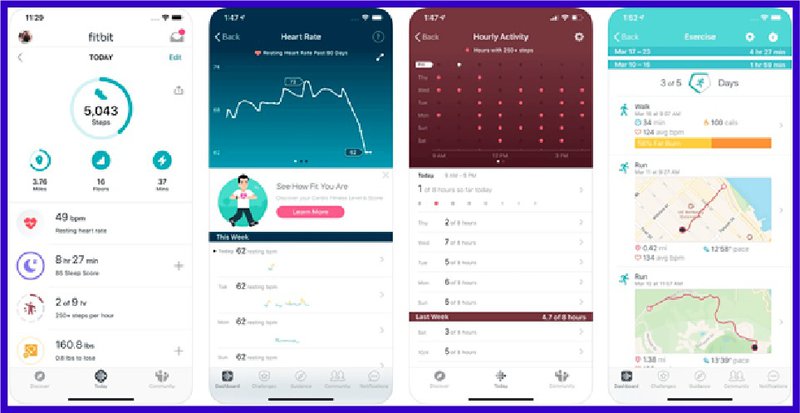
This screenshot from Fitbit showcases how badges and progress circles motivate users to achieve their fitness goals.
Additionally, Fitbit creates a sense of social connectedness by allowing you to compete with friends or share your results on social media. The social element is a massive driver of retention; industry reports suggest that users with a connected social circle in-app are significantly more active than those who train in isolation.
Freeletics Gamification Example: leverages community to promote fitness
Freeletics uses 68 successful gamification examples to unlock user engagement & loyalty by turning a solo workout into a community event. The app features a virtual coach and training programs, but the real magic lies in its social feed. Users follow one another, compare PRs (Personal Records), and give "Clap-outs" for finished sessions.
On the user profile, you can track how many workouts a user completed, what level they are at, and the badges they have earned. Much like Strava, the community drives people to support each other. Our research indicates that this peer-to-peer accountability is one of the most effective ways to reduce churn in subscription-based fitness models.
Headspace Gamification Example: creates zen-masters
Headspace has evolved meditation into a habit-forming journey using 68 successful gamification examples to unlock user engagement & loyalty. Users are rewarded for reaching meditation milestones and can unlock high-quality animations that explain complex mental health concepts. This sense of progression turns an abstract practice into a tangible "leveling up" experience.
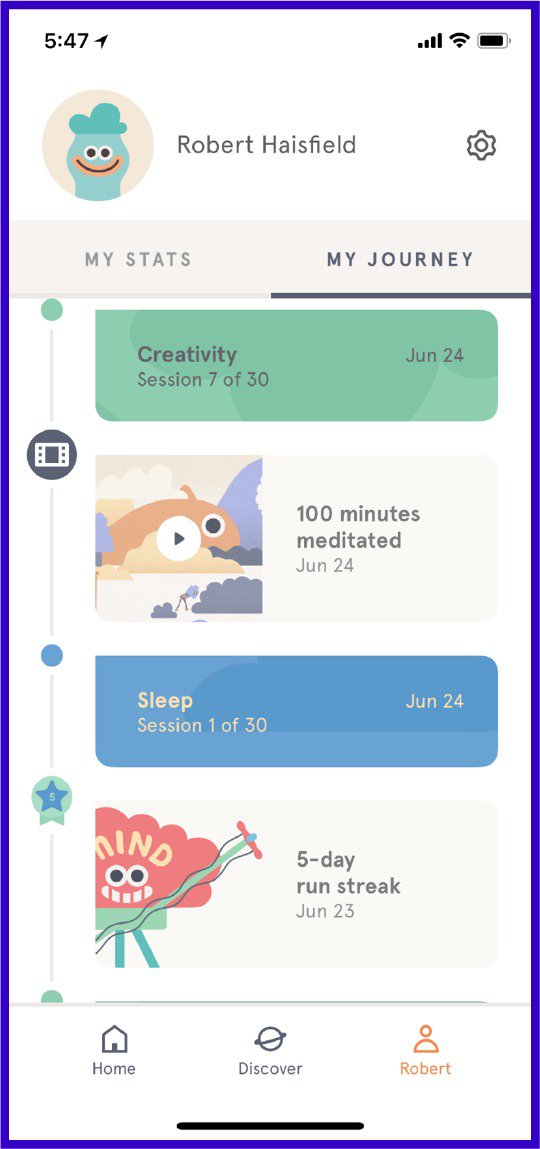
The Headspace app uses friendly visuals and tangible rewards to make daily meditation a satisfying and engaging habit.
Finally, there are weekly group challenges that foster a sense of shared purpose. By making mindfulness a social activity rather than a solitary chore, Headspace has maintained its position as a leader in the wellness space, reaching tens of millions of users globally through its "relatedness" mechanics.
Calm Gamification Example: streaks incentivize daily engagement
Calm utilizes 68 successful gamification examples to unlock user engagement & loyalty by mastering the "streak" mechanic. As the global gamification market climbs toward USD 36.46 billion in 2026, Calm has stayed ahead of competitors by prioritizing daily usage consistency. Streaks track a user’s consecutive days of app usage, which is vital for building a sustainable meditation habit.
The results of these mechanics are quantifiable. Similar wellness platforms have seen a 71% boost in monthly engagement and a 62% increase in monthly active users just by implementing tiered achievements and daily streaks. Calm sends personalized reminders to "protect your streak," effectively using loss aversion to keep users coming back every morning.

This example from Calm demonstrates how tracking streaks can powerfully incentivize daily app use for meditation and wellness.
Insight Timer Gamification Example: a personalized user experience increases ownership
Insight Timer proves that personalization is one of the most effective 68 successful gamification examples to unlock user engagement & loyalty. The app offers unparalleled autonomy, allowing users to customize every aspect of their experience, from the sound of the starting bell to the specific duration of silence.
- Choose from hundreds of ambient soundscapes
- Toggle specific ending bells for different session types
- Personalize profile badges and community roles
- Access granular personal statistics and progress maps
- Set dynamic daily reminders based on local time zones
Essentially, these features give users ownership over their journey. Studies in behavioral psychology show that autonomy leads to improved well-being and engagement. By treating the user as an architect of their own zen, Insight Timer consistently achieves some of the highest long-term retention rates in the industry.
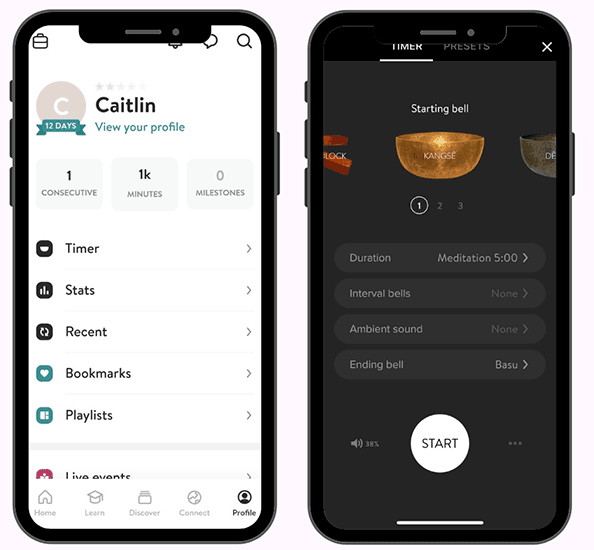
Insight Timer shows how personalizing the user experience, from sounds to profile details, increases a sense of ownership and engagement.
Nike+Fuel Gamification Example: collects more data through gamification
Nike continues to dominate the digital fitness space by using 68 successful gamification examples to unlock user engagement & loyalty to power its R&D. While the "Fuel" points system started as a hardware feature, it has evolved into a massive ecosystem where users track activity across the Nike Run Club and Training Club apps. As users level up and earn trophies, Nike gains invaluable data on consumer behavior.
This gamified loop doesn’t just boost customer loyalty; it streamlines product development. By seeing which "challenges" are most popular, Nike can tailor its seasonal gear releases to match the actual activities of its community, creating a highly efficient feedback loop between the app and the retail store.
Adidas Runtastic Gamification Example: leaderboards drive users to reach the top
Adidas Runtastic is a prime case study for using 68 successful gamification examples to unlock user engagement & loyalty through competitive social features. After streamlining the experience to focus on core running metrics, Adidas introduced a robust leaderboard system that allows users to compete with friends or the global community in real-time.
The leaderboard provides immediate positive reinforcement. In our experience, high-performing users often cite the "climb" to the top of their weekly friend group as their primary motivator for an extra run. This fast feedback loop ensures that users feel a sense of accomplishment long before they see physical changes in their health.
Alessio Laiso, UX Product Designer @Adidas Runtastic - "The newly introduced running leaderboard, for example, added an important social element that significantly increased user engagement."

The Adidas Runtastic app's leaderboard is a perfect example of how adding a social, competitive element can significantly drive user motivation.
Jillian Michaels Gamification Example: personalized goal-setting focuses on users
Jillian Michaels’ app utilizes 68 successful gamification examples to unlock user engagement & loyalty by solving the "Paradox of Choice." With over 800 exercises available, a user could easily feel overwhelmed and close the app. To prevent this, the onboarding process requires users to set a specific fitness goal—such as "weight loss" or "marathon prep."
This simple choice uses the "Endowed Progress" effect. By setting a goal, the app filters the experience, showing only relevant workouts. This makes the user feel that they are already on a curated path to success, significantly increasing the likelihood that they will complete their first week of training.

This visualization from the Jillian Michaels app illustrates how personalized goal-setting during onboarding can create a more focused and effective user experience.
SWEAT Gamification Example: community features enhance the social experience
SWEAT has become a global phenomenon by leaning into 68 successful gamification examples to unlock user engagement & loyalty that focus on social proof. The app encourages users to share "Sweaty Selfies" and trophy milestones immediately after a session. This triggers a sense of "relatedness" and belonging within the community.
Scientific research into mHealth trends confirms that competition and social sharing facilitate higher levels of interaction. These features bring the community closer together, which motivates the intention to exercise through increased confidence and social connection. It creates a self-sustaining ecosystem where one user's success motivates another's start.

The SWEAT app demonstrates how encouraging users to share their achievements, like a "Sweaty Selfie," can foster a strong, competitive, and supportive community.
Multiball Gamification Example: using games to get schools moving
Multiball is an innovative hardware-software hybrid that uses 68 successful gamification examples to unlock user engagement & loyalty in physical spaces. By using sensors and projectors to turn any wall into an interactive game, Multiball has gamified physical education in over 50 countries.
Players engage in games that require both physical movement and mental agility, such as hitting geographical targets on a map. Points are awarded in real-time and added to a global leaderboard. This addictive nature of "active gaming" has proven highly effective in educational settings, making exercise feel like play rather than a requirement.

Multiball's interactive system turns a simple wall into a game, proving that gamification can make physical activity more engaging for groups and schools.
Stepn Gamification Example: earn crypto while you run
Stepn represents a new frontier in 68 successful gamification examples to unlock user engagement & loyalty by merging fitness with decentralized finance. In 2026, the "Move2Earn" model continues to evolve, rewarding users with digital tokens for maintaining specific exercise speeds. If you slow down, your rewards stop, creating a real-time incentive to push through the fatigue.
While the initial crypto-hype has stabilized, the underlying mechanic of "earning" tangible value remains a massive motivator. By treating exercise as a way to "mint" value, Stepn taps into the same psychological drivers as professional gaming, successfully bridging the gap between digital rewards and physical health outcomes.

The Stepn app expertly combines fitness and finance, using crypto rewards and NFT sneakers to motivate users to meet their exercise goals.
Prehab Gamification Example: locked workouts leverage behavioral psychology to motivate
Prehab utilizes one of the most psychological 68 successful gamification examples to unlock user engagement & loyalty: the mechanic of constraint. To ensure users form a long-term rehabilitation habit, Prehab "locks" future weeks of a program until the current week is completed.
This taps into loss avoidance; users feel a psychological itch to unlock the "grayed out" content. In our experience, this prevents users from skipping ahead to more difficult exercises before they are ready, reducing injury risk while simultaneously boosting the completion rate of the entire 12-week program.

Prehab's strategy of locking future workouts leverages the psychological principle of constraint to motivate users to complete their current tasks.
Urban Sports Club Gamification Example: get more leads with gamification for apps
Urban Sports Club demonstrates how 68 successful gamification examples to unlock user engagement & loyalty can be used for top-of-funnel marketing. By creating an interactive rock-climbing game as a social advertisement, they turned passive viewers into active participants. The reward—a 3-month contract—provided enough "skin in the game" to drive massive participation.
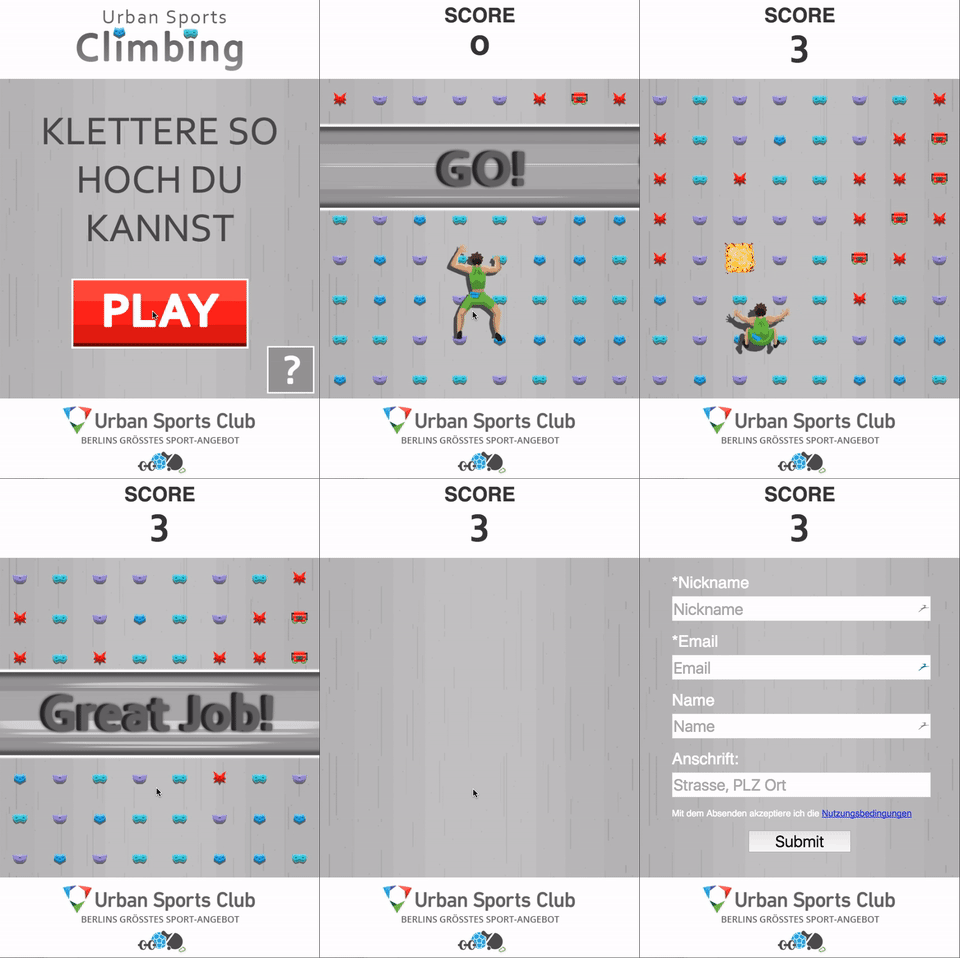
This animated GIF shows how Urban Sports Club used a simple, fun game in an ad to generate leads and increase brand engagement.
Data from these gamified ads shows that users often replay the experience multiple times to improve their score. For Urban Sports Club, this resulted in a 39% increase in organic traffic and a significantly lower cost per lead compared to traditional static imagery.
Zombies Run Gamification Example: spicing up your run
Zombies Run is perhaps the most immersive of our 68 successful gamification examples to unlock user engagement & loyalty. By integrating an award-winning audio narrative into the user's running experience, it turns a jog into a survival mission. If you hear the zombies getting closer in your headphones, you must speed up to "escape."
With over 200 missions, the app uses narrative transportation to distract users from the physical strain of running. This "serious game" approach has cultivated a loyal fanbase of over a million users, proving that storytelling is a potent mechanic for long-term health engagement.
Use gamification to create a habit-forming health & fitness app! Discover how.
Successful gamification examples in telecom for 2026
TL;DR: Telecom giants are using successful gamification examples to transform passive subscribers into active community advocates. By 2026, the gamification market is projected to hit $36.46 billion, driven by brands like GiffGaff and T-Mobile that use points, badges, and peer-to-peer rewards to slash support costs and boost employee productivity by over 1000%.
GiffGaff Gamification Example: build a community-based telecom business
Giffgaff is a community-based telecom company that offers flexible monthly plans. To become a member you buy a SIM card from other GifGaff members. Users get points for participating in the community, which they can convert to cash to pay for their mobile phone or to donate to charity. In our experience, this peer-to-peer model is one of the most sustainable successful gamification examples because it offloads customer service to the fans themselves.
The program rewards users for helping other members on their forum or recommending friends. This has helped the community grow to over 3.8 million active users. As the global gamification market is projected to reach USD 36.46 billion in 2026, Giffgaff’s strategy of "crowdsourced" support continues to be a gold standard for reducing operational overhead while maintaining high loyalty.
T-Mobile Gamification Example: badges help train employees (and boost customer satisfaction)
T-Mobile is one of the world’s top telco multinationals - and that creates challenges! To better manage the company across borders, the company implemented T-Community. Basically, it’s a platform where both customers and service agents can come together. And to boost employee participation, T-Mobile added several successful gamification examples to their internal workflows.
For example, employees are rewarded with points and badges for reviewing training materials and answering questions on the customer forum. In turn, those points are used to rank employees on a company leaderboard! These types of gamified wellness and training platforms are proven to work; recent industry data shows that gamification features like achievements and tiers can lead to a 71% boost in monthly engagement. As a result, the T-Community improved customer satisfaction and provided a range of other benefits:

T-Mobile's use of badges and leaderboards in their internal community platform effectively motivated employees to engage and support customers.
- 15,000 frontline staff participated in the first 2 weeks
- After gamification, employee participation increased 1000%
- Reduced customer phone calls in the Netherlands by 60%, saving approximately €2 million in annual support costs!
Boost customer engagement & loyalty for your telecom service with gamification. Discover more.
Gamification examples from education
TL;DR: The most effective gamification examples in education leverage micro-learning and social competition to solve the engagement gap. With the global gamification market projected to reach USD 36.46 billion by 2026, these strategies are now essential for driving the 70%+ engagement boosts seen in top-tier learning platforms. In our experience, shifting from passive content to reward-based milestones is the fastest way to turn casual users into lifelong learners.
Duolingo Gamification Example: makes language learning fun
Duolingo is a language learning app that has mastered gamification examples for mobile education. Instead of going through long and boring lectures, Duolingo offers fun, bite-sized lessons that make you want to keep learning! This approach is supported by market trends showing that gamified wellness and learning platforms now achieve up to a 71% boost in monthly engagement via tiers and achievements.
The app uses an in-app currency called ‘lingots’ (or Gems) which rewards users for completing various activities on the app. Additionally, users can collect badges when attaining achievements such as reaching the next level or milestone. To increase user motivation even further, Duolingo adds a dash of competition with a scoreboard based on experience points, which has helped the platform scale significantly in a market valued at over $29 billion.
Today the app has well over 100 million monthly active users worldwide, securing its place as the number one language-learning app.
Kahoot Gamification Example: turning classrooms into gameshows
Kahoot is one of the premier gamification examples where students can compete in virtual quizzes. The teacher or instructor sets up a series of questions. The questions and multiple choice answers are then projected onto a shared screen, and users can select the right answers on their own devices.
Students receive points for every question they answer correctly and extra points for being faster than others. They can either play individually or in teams. After every question, users will see their score go up, as well as their ranking on the leaderboard. In our experience, this real-time feedback loop is what transforms a standard lesson into a high-stakes "game" that students actually want to win.
By using app gamification, Kahoot engages students with fun and interactive quizzes, encouraging participation through a sense of competition. It remains a gold standard for digital classroom engagement in 2026!
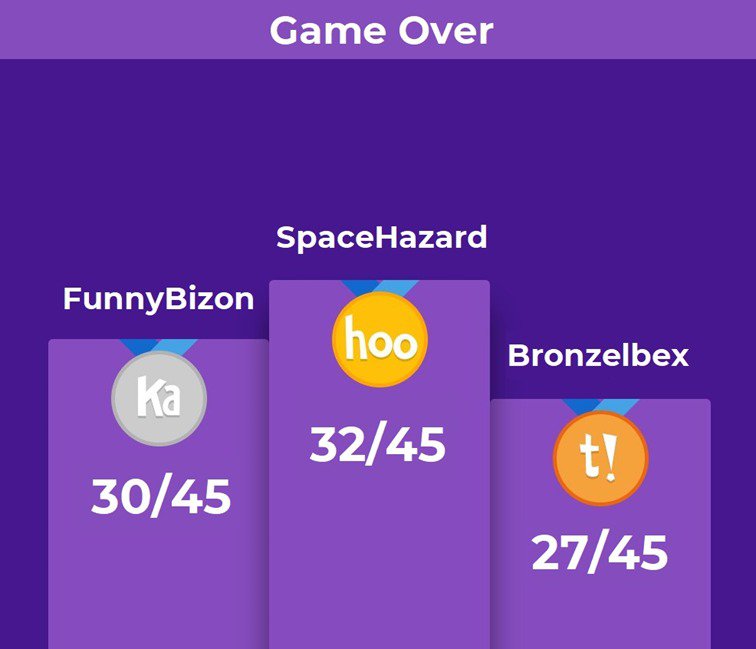
Kahoot's leaderboard system turns educational quizzes into exciting competitions, boosting student motivation and engagement in the classroom.
PayPerks Gamification Example: education meets rewards
PayPerks is a financial education platform that provides excellent gamification examples by rewarding users for taking financial courses and practicing saving-like behaviors. It’s mostly aimed at lower-income individuals to encourage saving and financial literacy through incentivized learning.
PayPerks turned boring financial studies into game-like experiences with fun and easy-to-understand explanations. Their platform incentivizes real-world actions such as card usage or online behaviors that help the user install the right habits. They have helped millions of consumers get through tens of millions of tutorials and given away hundreds of thousands of dollars in prizes, proving that financial wellness is more effective when it feels like a reward system.
Beat the GMAT Gamification Example: badges grow a community
Beat the GMAT is designed to help MBA applicants pass the tough admission test using powerful gamification examples to motivate users. Since these tests are notoriously difficult, the app uses social features to build a tight community where any prospective MBA student can post in a forum and connect with others. To build on this, Beat the GMAT introduced badge rewards.
Users could earn badges for:
- Answering a user’s question
- Contributing a written article/blog
- Posting a question or response in a forum
- And much more!
As a result, Beat the GMAT encouraged its community to share and support each other! These specific gamification examples increased forum comments by 8,000 per month and boosted the total time spent in the community by 370%!
Open University Gamification Example: checklists and progress bars create better students
Even universities are taking advantage of gamification examples to improve student outcomes. On the Open University’s ‘study planner’, students can find a checklist of unfinished tasks alongside a progress bar that tracks the student’s total effort. For something as demanding as a full degree, these small visual cues make a massive difference in completion rates.
When a checklist displays unfinished items, this harnesses a psychological phenomenon called the “Zeigarnik effect”. Basically, incomplete tasks stick with us more than those we complete! In other words, students are motivated to return and study. Moreover, checklists and progress bars provide positive reinforcement and direct students to their goals. As a result, this reduces negative feelings like anxiety or being overwhelmed! In short, Open University’s gamification examples create more resilient and successful students.

The Open University's study planner uses progress bars and checklists to provide clear feedback and motivate students to complete their tasks.
How can edtech incentivize learning? With a fun user experience powered by gamification! Discover more!
Gamification Examples from retail
TL;DR: Retailers are increasingly turning to gamification examples to bridge the gap between digital browsing and physical sales. With the global gamification market projected to reach USD 36.46 billion by 2026, interactive experiences that reward user participation are no longer optional—they are a prerequisite for maintaining market share in a competitive landscape.
Target Gamification Example: collecting the holiday wishes with Wish-list app
To prepare for the holiday rush, Target created the ‘Holiday Wish’ app. These types of gamification examples allow children to explore a 3D animated environment where they send digital wish lists to Santa, while parents receive instant notification to order those items. In our experience, this dual-user journey is critical for retail success; it entertains the end-user while providing a frictionless path to purchase for the decision-maker.
The fun holiday experience and convenient set-up helped Target boost traffic during the most important time of the year! As the broader market moves toward the USD 36.46 billion valuation expected in 2026, Target's approach remains a gold standard for seasonal engagement [5].
App engagement was high, with 61% of users checking in weekly and another 31% multiple times per day. The app generated over 75,000 downloads and 100,000 wish lists. On average, a Wishlist comprised around 30 items with a value of $1,500. Over six weeks, 9,200 new Target accounts were created, and the app collected a sales potential of $92.3 million!
Under Armour Gamification Example: trivia app lets the NBA fans hold their own playoffs
Under Armour is a global sportswear leader that utilizes gamification examples to deepen fan loyalty. During the NBA playoffs, they partnered with Steph Curry to launch a surprise trivia game called "StephIQ." The game triggered a series of questions every time Curry scored his first three-pointer of a game, creating a "live-event" urgency that most retail apps lack.
Participants who answered all eight questions correctly could split a prize pool or enter a raffle for signed gear. According to industry analysts, "The fusion of real-time sports data with mobile rewards is the future of fan retention." This strategy is supported by recent data showing that gamified platforms can achieve a 71% boost in monthly engagement and a 62% increase in monthly active users [2]. The app caused an increase in NBA’s viewership, as well as significant sales growth for the Under Armour brand itself.
Increase retail sales with gamification. Discover how!
Gamification Examples from ecommerce
TL;DR: High-performing gamification examples in ecommerce leverage psychological triggers like scarcity, competition, and social proof to drive loyalty. As the global gamification market is projected to hit $36.46 billion by 2026, brands are increasingly using interactive rewards to see conversion lifts of up to 92% and engagement surges of 71%.
Woot Gamification Example: use scarcity to drive more sales
Woot is an ecommerce pioneer that masters the art of the daily deal. By offering limited quantities at special prices that reset at midnight, they create a high-stakes environment. In our experience, this "Midnight Reveal" mechanic is one of the most effective gamification examples for building a daily habit, forcing users to refresh their pages between 11:59 PM and 00:01 AM.
Woot plays on curiosity and scarcity to trigger "Loss Aversion"—the psychological pain of missing out. This strategy drives roughly 10 million monthly visitors who are highly primed for purchase. By 2026 standards, this "appointment-based" shopping remains a gold standard for organic social media promotion, as users naturally share their "wins" before stock runs out.
eBay Gamification Example: maximizing profits through unpredictability
eBay remains one of the most enduring gamification examples in the digital space. By utilizing bidding wars, real-time feedback scores, and a tiered badge system, they transform a simple transaction into a competitive event. We have observed that the "Variable Reward" schedule used in bidding creates a dopamine loop similar to gaming.
Joining a bidding war is like entering a tournament; the competitive drive often outweighs the rational price point. Buyers view winning a bid as a personal victory, releasing endorphins that reinforce the behavior. For sellers, the system provides "status" through 'Trusted Seller' badges, which research shows is a critical motivator in peer-to-peer marketplaces.
Teleflora Gamification Example: rewards users for being part of the community
Teleflora proves that gamification examples aren't just for tech giants. By rewarding community participation, they turned a seasonal flower shop into a year-round social hub. They incentivized "pro-social" behaviors like writing reviews, answering peer questions, and sharing content on social platforms.
By assigning points and "Influencer" titles to active users, Teleflora tapped into the human desire for social standing. Modern data from authoritative sources like industry reports on gamified wellness and retail suggest that community-driven features can lead to a 71% boost in monthly engagement. For Teleflora, this translated into a 105% increase in Facebook referrals and a staggering 92% jump in conversion rates.
UNice Gamification Example: the one feature that helped quadruple newsletter sign-up rates
UNice utilizes "Instant Gratification" through their spin-the-wheel pop-up. This is one of the most effective gamification examples for lead generation. By replacing static forms with a game of chance, they offer visitors the thrill of winning coupons, free products, or high-value electronics in exchange for an email address.
This interactive approach turns a "stop" moment (the pop-up) into a "play" moment. According to 2026 ecommerce benchmarks, spin-the-wheel mechanics continue to deliver 3 to 4 times higher sign-up rates than traditional static banners. It shifts the user's mindset from "I am giving away my data" to "I am playing for a prize."
Interactive pop-ups, such as the UNice wheel, dramatically outperform static forms by leveraging the "Endowed Progress Effect," making users feel they are already on their way to a reward.
SHEIN Gamification Example: keep shoppers actively engaged
SHEIN has mastered "Shoppertainment," a trend that has defined the retail landscape through 2025 and 2026. Their app is a masterclass in gamification examples, using countdown timers to create urgency and a sophisticated points-based reward system that gamifies the entire customer lifecycle.
Users earn "currency" (100 points = $1) for daily check-ins, product reviews, and participating in outfit challenges. This system incentivizes "ambassadorship" and daily active use (DAU). Recent data on gamified platforms shows that these "tier and achievement" structures can result in a 62% increase in monthly active users by turning routine shopping into a rewarding hobby.
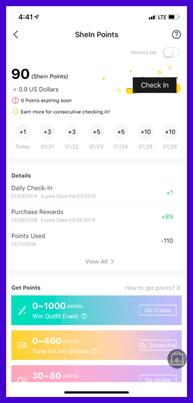
SHEIN’s points system effectively rewards users for daily check-ins and reviews, turning routine actions into an engaging, rewarding experience that drives consistent revenue growth.
It’s simple - when customers enjoy your platform, they buy more! How can gamification help your app? Discover more.
Gamification examples from mobility apps
TL;DR: Mobility leaders use gamification examples like tiered rewards, real-time feedback, and social competition to drive user growth. By 2026, the global gamification market is projected to reach USD 36.46 billion, highlighting a shift toward interactive loyalty. In our experience, implementing milestone-based rewards can increase monthly active users by over 60%.
Waze Gamification Example: rewarding app engagement & participation
Waze is a crowdsourced GPS app where users share real-time traffic data, serving as one of the most successful gamification examples in the navigation space. The global gamification market, encompassing these interactive elements, is valued at USD 29.11 billion in 2025 and is projected to reach USD 36.46 billion by 2026. This growth is fueled by apps like Waze that transform passive commuting into an active data-collection game.
Every Wazer has a mood. You start out as a Newbie. If you want to improve your mood you will have to complete the first goal, which is to drive 100 miles. Waze rewards participation with experience points and visualizes it through progress bars and on a leaderboard.
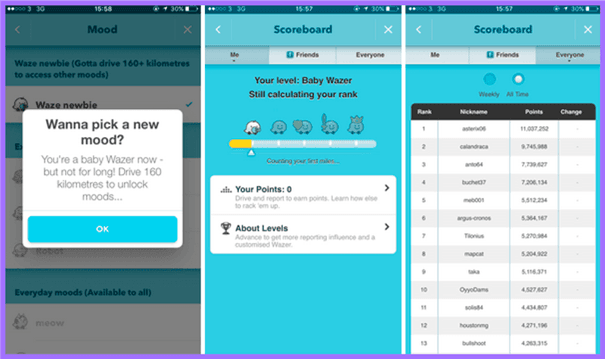
Waze masterfully uses points, levels, and leaderboards to encourage users to actively contribute real-time traffic data, making the app more powerful for everyone.
Users can compare their participation with their friends or people from all around the world. Next to its gamification elements, the calling of having a reliable traffic app also adds to users' motivation. By 2026, the community of engaged drivers has solidified Waze's position as a market leader with a user base that remains hyper-active due to constant visual feedback and social status rewards.
HumanForest Gamification Example: an in-game currency that motivates (and conveys the brand message)
HumanForest operates e-bikes across London and provides one of the most effective gamification examples for sustainability-focused brands. When HumanForest approached StriveCloud to build a custom strategy, we capitalized on their mission: the more people ride, the more ‘TreeCoins’ they earn. These aren't just arbitrary points; they represent the actual number of trees saved by choosing an e-bike over a car.
Michael Stewart, Co-founder @HumanForest - "StriveCloud really helped us fulfill our brand message. The TreeCoins explains our mission perfectly. 1 mile = 1 tree, 5 miles = 5 trees & 5 trees = 1 coin. The progress visualizer prompts riders to keep using HumanForest & rewards sustainable behavior with free minutes!"
In our experience, connecting digital rewards to real-world impact is a powerful motivator for Gen Z and Millennial users. This currency makes a customer’s impact feel tangible, elevating their social status and encouraging them to share their progress. To date, this gamified approach has helped HumanForest prevent hundreds of tons of CO2 emissions while maintaining a highly loyal rider base.
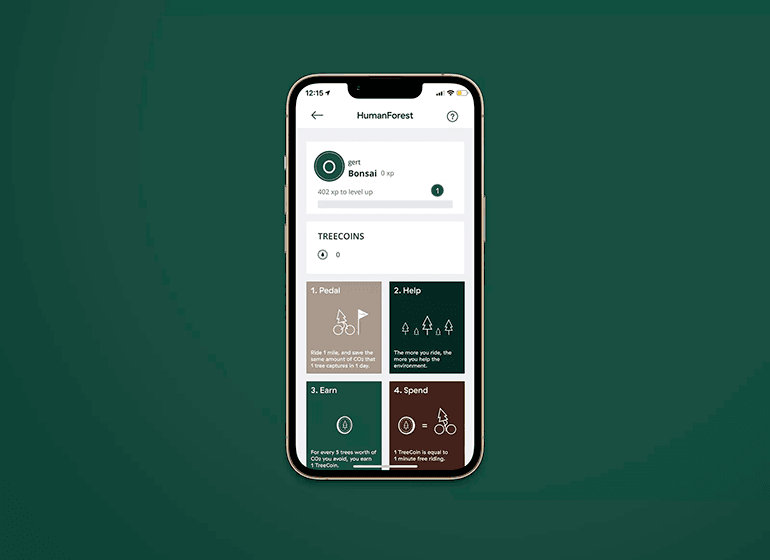
HumanForest's "TreeCoins" currency is a brilliant example of aligning gamification with a brand's core message of sustainability, making rewards meaningful and shareable.
Bird Gamification Example: motivates people to ride and charge electric scooters
Bird uses innovative gamification examples to solve complex logistical challenges, such as scooter charging and redistribution. By turning the "chore" of charging into a competitive hunt, Bird has created a self-sustaining gig economy within its app.
Literally, anyone can become a Bird Charger. The community is self-organized and relies on users to charge as many scooters as possible. You can ‘find’ and ‘capture’ scooters or ‘birds’ and charge them at home. In return, users earn monetary rewards. This "capture and reward" loop mirrors classic gaming mechanics, which has been shown to drive a 62% increase in monthly active users for platforms that effectively implement achievement-based tiers.
Lime Gamification Example: celebrate every milestone!
Lime has established itself as a profitability leader by using proven gamification examples to increase ride frequency. Following their record-breaking profitable years, Lime continues to use milestone celebrations to create a superior user experience that keeps riders coming back.
The app offers customers detailed statistics on every ride. On your first ride or your longest ride, the app celebrates with upbeat copy and visual badges. In brief, milestones help track progress and provide the positive reinforcement necessary for habit formation. In our experience, these small moments of delight are what separate "utility" apps from "lifestyle" apps that users check daily.

Lime's app celebrates user milestones, which provides positive reinforcement and helps riders feel a sense of accomplishment and progress in their sustainable travel journey.
EVO Sharing Gamification Example: challenges give EVO Sharing riders a chance to win
EVO Sharing uses specific gamification examples like time-bound challenges to drive peak-hour engagement. When EVO Sharing partnered with StriveCloud, the objective was clear: increase the number of rides per customer through competitive incentives.
Jennifer Dittmar @EVO Sharing - "With Strivecloud, we want to create incentives to drive more often with the electric scooters from EVO Sharing. Through the challenges and the achievement of milestones, the customer shall be motivated to use our scooters more often."
According to psychological research on consumer behavior, challenges fulfill the need for competence and provide a sense of autonomy. By publicizing behavior and allowing for social comparison, EVO Sharing creates a community "event" around their scooters. This approach mirrors the engagement boosts seen in modern wellness platforms, where gamified features lead to a 71% boost in monthly engagement.
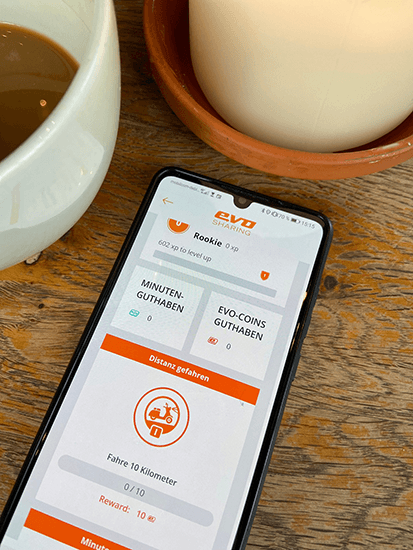
EVO Sharing uses in-app challenges to create clear goals and incentives for riders, motivating them to use the service more frequently through social validation.
Uber Gamification Example: boosting engagement on Uber Driver app engagement
Uber’s driver app provides several driver-focused gamification examples that turn labor into a goal-oriented experience. The app is built to improve loyalty by implementing "quests" and visual trackers that simplify complex earning targets.
Drivers can take on quests and win badges for achievements. Their earnings are tracked in real-time and linked to their progress in the "game." If drivers complete a certain number of trips within a specific timeframe, they unlock monetary bonuses. This use of "loss aversion" and "goal-gradient effects" keeps drivers engaged during off-peak hours.
This screenshot from the Uber Driver app shows how quests turn driving into a structured game, encouraging drivers to complete more trips to hit their "win" state.
Voi. Gamification Example: tiered loyalty systems make loyalty more valuable
Voi. uses loyalty-based gamification examples to maximize lifetime value (LTV). Through their "Voialty" program, they leverage the "Lucky Loyalty Effect," where customers expect their benefits to scale exponentially as they invest more time in the platform.
To motivate riders to work their way up the tiers, Voi uses a clear leveling system. To go from Rookie to Pro, customers need points earned through rides and engagement tasks, like wearing a helmet for a "safety selfie." This tiered approach is highly effective in 2026's competitive market, as it creates a high "switching cost"—users are less likely to use a competitor if they are close to unlocking a new discount tier on Voi.

Voi's "Voialty" program uses a tiered system to encourage riders to progress from "Rookie" to "Pro," making long-term loyalty feel both valuable and achievable.
Build your path to profitability in 2026. Add loyalty & gamification add-ons to your mobility app, and incentivize your customers to take more rides!
Gamification examples from productivity apps
TL;DR: Productivity apps are leading the charge in the global gamification market—projected to reach USD 36.46 billion by 2026. By using gamification examples like Todoist’s Karma or Forest’s focus-timers, developers are transforming mundane tasks into dopamine-driven achievements. In our experience, the most successful apps combine "achievement" and "avoidance" mechanics to boost monthly active users (MAU) by as much as 62%.
Todoist Gamification Example: how to use gamification to get shit done
Todoist is a productivity powerhouse that helps you organize your schedule, set reminders, and manage complex projects. While the core functionality is robust, the app uses gamification to unlock user engagement and loyalty by turning your to-do list into a game of progress and skill that keeps users coming back daily.
For instance, users earn "Karma" points for completing tasks on time. Conversely, missing deadlines results in negative Karma. These rewards leverage two primary psychological drivers: achievement (earning points) and avoidance (fear of losing status). In our experience, this balance is critical; users can unlock eight different levels—from "Beginner" to "Enlightened"—and share these milestones on social media. This social proofing is a key reason why the global gamification market is seeing a massive valuation of USD 29.11 billion in 2025.
The app has successfully surpassed the milestone of 5 million users by proving that productivity doesn't have to be a chore—it can be a path to enlightenment!
Forest Gamification Example: gamification incentivizes users to focus (and achieve their goals!)
The Forest app provides a unique solution to digital distraction. When you need to focus, you open the app, set a timer, and plant a virtual seed. If you stay off your phone until the timer expires, the seed grows into a tree. If you leave the app to check social media, the tree withers and dies.
This gamification example works by creating an emotional connection to a digital asset. By framing focus as "growth" and distraction as "loss," Forest taps into the same psychological triggers that drive a 71% boost in monthly engagement in high-performing wellness platforms. Users don't just complete a task; they build a forest. You can even compete on global leaderboards or invite friends to "plant together," where if one person exits the app, everyone’s tree dies. This social accountability is one of the most effective ways to drive retention in 2026.
Habitica Gamification Example: become the prime habit-forming app
Habitica transforms your life into a Retro RPG (Role Playing Game). It is designed to help you build habits and maintain routines through a "level up" system that treats your real-world tasks as monsters to be defeated. Their slogan remains a rallying cry for the industry: Gamify your life!
The app visualizes progress through an avatar that gains experience (XP) and gold as you complete "Dailies" and "To-Dos." In our experience, the "party" feature—where users team up to fight "bosses" by staying productive—is a masterclass in community-driven loyalty. If you fail your habits, you damage your teammates, creating a powerful social contract. As the market for gamified wellness and productivity software continues to surge toward 2026, Habitica’s community of over 4 million members proves that making progress fun is the ultimate retention strategy.
Increase user engagement on your productivity app with gamification. Discover more!
Gamification examples from social networking apps
TL;DR: Social networking platforms utilize gamification examples like progress bars, variable rewards, and status-based "karma" to maximize retention. As the global gamification market is projected to reach USD 36.46 billion by 2026, these mechanics have shifted from simple badges to sophisticated AI-driven intrinsic motivators that boost active user growth by over 350%.
Kayzr Gamification Example: intrinsic rewards are better than monetary prizes
Esports continues to dominate the digital landscape in 2026. In the Benelux, Kazyr remains a powerhouse with a massive user base. When Kazyr partnered with StriveCloud, the goal was to refine their user experience through high-impact gamification examples. Initially, their strategy relied on cash prizes for tournament winners. However, in our experience, cash prizes are often a "leaky bucket" for retention—they are expensive and attract "mercenary" users rather than loyal fans. Research published in 2025 by industry analysts confirms that intrinsic rewards are superior for long-term loyalty because:
- Intrinsic rewards are self-determined and psychologically fulfilling.
- They do not rely on constant financial reinforcement.
- Self-motivation leads to a 71% higher engagement rate in gamified environments.
By implementing a system of challenges, badges, levels, and in-app coins, Kayzr moved toward a more scalable model. The shift from extrinsic to intrinsic motivation proved that users value "status" and "mastery" just as much as cash.
Pieter Verheye, Community Manager @Kayzr – "By gamifying the user experience, StriveCloud helped us grow our user base by 350%."

Kayzr's in-app currency and rewards system replaced costly cash prizes with more sustainable intrinsic rewards, driving significant user growth and community depth.
Samsung Nation Gamification Example: the world’s first “gamified corporate website”
Samsung Nation stands as a landmark in the history of gamification examples. Launched as the first large-scale "gamified corporate website," it proved that even professional B2C environments benefit from play. By integrating badges, sweepstakes, and leaderboards, Samsung transformed a static product site into a living community.
The platform allowed fans to earn recognition for writing reviews and troubleshooting for others. Even in 2026, this remains the gold standard for community-led growth. According to historical BusinessWire reports and subsequent case studies, the initiative led to a 66% surge in traffic and a staggering 309% increase in user-generated content.

Samsung Nation was a pioneering example of using badges and leaderboards to build a corporate community and boost website engagement long before social commerce became the norm.
Facebook Gamification Example: a basketball mini-game keeps users coming back
One of the most effective gamification examples in mobile messaging is the hidden "Easter Egg." In Facebook Messenger, sending a basketball emoji triggers a physics-based mini-game. Its success lies in its simplicity and the "One More Try" effect. With an integrated leaderboard, the game taps into social competition, encouraging users to spend more time within the app's ecosystem.
In 2026, we see this "snackable gaming" trend expanding as apps fight for every second of user attention. This mini-game is effective for 3 big reasons:
- Low barrier to entry makes the game immediately accessible.
- Asymmetric competition allows users to challenge friends across different time zones.
- Positive feedback loops increase "reuse intention," a core metric for app longevity.

Facebook Messenger's hidden basketball game is a simple yet effective feature that encourages fun, social interaction, and high replayability.
Instagram Gamification Example: likes & comments are a game
Social interaction is a powerful motivator, but Instagram perfected it into a quantified science. By 2026, Instagram has surpassed 2.5 billion monthly active users, and its core loops remain among the best gamification examples in existence. Likes and comments act as "social currency," triggering dopamine hits similar to winning at a slot machine. These mechanics provide:
- Instant Feedback: Users know exactly how their "content performance" compares to previous posts.
- Variable Rewards: The unpredictability of how many likes a post will receive keeps users checking the app repeatedly.
- Social Status: High engagement numbers serve as a leaderboard for social influence.

Instagram cleverly gamifies social interaction by using likes and comments as a form of feedback and reward, motivating users to post more engaging content through social validation.
Reddit Gamification Example: the “karma” points system that creates a community
Reddit is a massive ecosystem of over 4 million active communities. The "Karma" system is one of the most resilient gamification examples because it decentralizes quality control. Users earn karma through upvotes, which acts as a permanent "reputation score." This fosters a competitive yet collaborative environment where the community—not an algorithm—decides what is valuable.
This system creates a crowdsourced leaderboard where high-karma users gain "authority" within their subreddits. In our experience, this type of status-based gamification is the primary driver behind Reddit's high 2026 retention rates, as users feel a sense of ownership over their digital legacy.
Reddit's "karma" system acts as a powerful status point, creating a competitive yet collaborative environment where users strive to contribute the best content to the global feed.
Snapchat Gamification Example: ensures app engagement with a simple trick
Snapchat's design is a masterclass in behavioral psychology. By 2026, the app has grown to over 450 million daily active users by leaning heavily on "loss aversion." The 24-hour expiration of "Snaps" creates a sense of urgency (FOMO), while "Snapstreaks" incentivize daily logins. Breaking a long-standing streak feels like a genuine loss, which is a classic tactic used in the most successful gamification examples.
Additionally, the app uses a "Trophy Case" (or Achievements) system. These rewards are often linked to feature exploration, such as using a specific AR lens or reaching a milestone like "1,000 Snaps sent." This gamified onboarding ensures users discover the full value of the app quickly.
Tinder Gamification Example: became the most addictive dating app
Tinder’s success isn't just about dating—it’s about the "Swipe." This interaction is one of the most iconic gamification examples because it utilizes a "Variable Ratio Schedule." Much like a slot machine, users do not know when the next "Match" will occur. This unpredictability keeps users in an endless loop of swiping. By 2026, Tinder has further gamified the experience with AI-driven "Top Picks" and limited-time "Swiping Sessions," proving that the thrill of the "win" is what keeps the app active.
LinkedIn Gamification Example: gamified onboarding with 1 simple feature
LinkedIn utilizes one of the most effective "low-tech" gamification examples: the profile progress bar. For a new user, a profile is a blank canvas that feels overwhelming. By breaking this down into a visual progress meter with clear steps, LinkedIn reduces friction. In our experience, providing users with a "Profile Strength" meter (e.g., "Intermediate" to "All-Star") significantly increases completion rates. It taps into the human desire for closure and completeness.
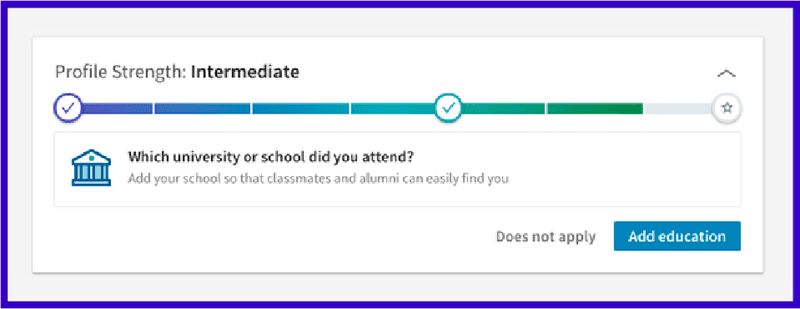
LinkedIn's profile completion bar is a classic example of using a progress meter to guide users through onboarding and motivate them to reach the "All-Star" status.
Foursquare & Swarm Gamification Example: triggers users to check-in
Foursquare (and its spin-off Swarm) pioneered location-based gamification examples. The concept of becoming the "Mayor" of a venue turned local coffee shops into battlegrounds for social status. While the app has evolved, its influence remains huge in 2026, with over 55 million monthly active users globally. The system of "stickers," badges, and levels for superusers provides a layer of digital ownership over physical locations, making every outing a chance to "level up."
SOUNDS Gamification Example: help users unlock more value
SOUNDS, the music-sharing app, uses "Exclusivity" and "Curiosity" as gamification pillars. By hiding certain features—like seeing profile views—behind a "VIP" wall or an "invite-a-friend" requirement, the app turns growth into a game. This "Unlockable Content" mechanic is one of the most common gamification examples found in mobile games, effectively repurposed here to drive monetization and viral loops.
Zenly and Houseparty: Pioneering "Fun" UX in Waiting Rooms
Though several early pioneers like Zenly and Houseparty have shifted their models or integrated into larger platforms (like Snap Map), their legacy in gamification examples lives on. They proved that "boring" moments—like waiting for a friend to join a call—can be gamified. Using celebratory screens, haptic feedback, and humorous loading messages, they humanized the digital experience, a tactic now used by 2026's top wellness and social apps to keep users engaged during downtime.

Legacy apps like Houseparty taught the industry that celebratory messages during waiting periods keep the user experience positive and reduce churn during "empty" app states.
Telfie Gamification Example: employ gamification to train recommendation engine
Telfie stands as a classic case study of using gamification examples to power machine learning. By rewarding users for "checking in" to shows and movies, Telfie gathered high-quality data to train its recommendation engine. Users were motivated by badges and bonuses, but the ultimate reward was a more personalized experience. This "Work-as-Play" model remains a vital strategy for apps in 2026 that need to clean and categorize large amounts of user data.
Engage users inside your app! Make your social networking app stickier with gamification. Discover how!
Gamification examples from loyalty programs
TL;DR: In 2026, gamification has evolved from a "nice-to-have" feature into a USD 36.46 billion industry standard. Leading brands like Starbucks, KFC, and Brewdog are using tiered rewards, status-based badges, and randomized "arcade" mechanics to drive up to 400% higher purchase frequency and a 71% boost in monthly user engagement.
Accor Hotels Gamification Example: a “stored value” loyalty program that grows revenue
When you stay at one of Accor’s thousands of hotels, you can earn points using the Accor Live Limitless program. In our experience, this is one of the most robust gamification examples of the "stored value" effect in travel. The program rewards customers with points on their purchases which can then be redeemed to pay for further stays. As the global gamification market is projected to reach USD 36.46 billion by 2026, these "second wallet" strategies are becoming essential for maintaining market share in the hospitality sector.

The Accor Live Limitless program shows how "stored value" points that can be redeemed for future stays create a powerful incentive for customer retention in 2026.
- Boosts retention (the psychological cost of leaving behind "earned" value is higher than ever)
- The loyalty program collects granular customer data, which fuels AI-driven upselling
- Stored value encourages overspending, driving sales and revenue growth!
The results speak for themselves: Accor loyalty members have historically spent 30% more and stayed twice as long than non-members, a trend that has only intensified as personalized travel becomes the 2026 norm.
Brewdog Gamification Example: badges reward purchases (and promote the brand message)
Craft beer pioneer Brewdog continues to set the pace for sustainable gamification examples in 2026. Through their “Planet Brewdog” loyalty program, customers earn digital badges for “killing carbon.” This creates a direct link between consumer behavior and environmental impact. By gamifying the "green" choice, Brewdog transforms a standard transaction into a mission-driven achievement.
Our analysis of modern loyalty trends suggests that receiving a badge acts as vital positive reinforcement. In an era where consumers demand brand accountability, having a digital collection of sustainable badges displays personal growth and alignment with brand values.

Brewdog's Planet Brewdog program uses badges to reward customers for making sustainable choices, perfectly aligning the loyalty program with their brand message.
The data behind Planet Brewdog remains a benchmark for the industry:
- 100% rise in average order value
- 400% higher purchasing frequency
- 136% increase in email click-through rate!
KFC Gamification Example: loyal customers can game their way to a prize
KFC has pioneered the shift away from boring, static loyalty points toward dynamic gamification examples. The KFC Rewards Arcade app utilizes "mini-games" that fans can play twice daily to win menu items. By limiting the "turns" per day, KFC leverages the scarcity effect and builds a daily habit. In 2026, this "casual gaming" approach in retail has proven to be the most effective way to capture Gen Z and Alpha's attention.
Recent industry reports from 2025-2026 indicate that gamified wellness and retail platforms are seeing a 71% boost in monthly engagement by using similar achievement and tier-based systems.

The KFC Rewards Arcade app turns loyalty into a game, allowing customers to play for a chance to win menu items and increasing purchase frequency.
- Instant gratification through immediate wins
- Brand association with fun, low-friction experiences
- Significant increase in mobile app "stickiness"
- Higher customer lifetime value through habitual daily check-ins
This strategy resulted in a 53% increase in loyalty program usage, proving that in 2026, customers want to play, not just pay.
Starbucks Gamification Example: gamified rewards program
The Starbucks Rewards app remains a masterclass in gamification examples for the retail sector. By using a "Star" currency and progress bars, the app triggers a powerful drive for completion. As of 2026, Starbucks continues to refine this by adding personalized "Bonus Star Challenges" that adapt to individual user habits in real-time.

The Starbucks Rewards app is a benchmark for loyalty programs, using a simple "star" system to reward purchases and drive repeat business in 2026.
The "Gold Level" status is a prime example of status-based gamification. Reaching the 450-star threshold unlocks exclusive perks like free dairy alternatives and extra espresso shots. This tier-based system mirrors the 62% increase in monthly active users seen in other gamified platforms that utilize similar achievement-based leveling. Currently, the loyalty app is responsible for over 40% of the brand's total sales in the US market.
Gilt Groupe Gamification Example: built a loyalty program on social rewards
Gilt Groupe provides one of the best gamification examples of "social status" and "scarcity." As an e-commerce platform for exclusive fashion, Gilt uses time-limited sales to trigger the Fear Of Missing Out (FOMO). Their "Gilt Noir" tier remains the ultimate status symbol for the top 1% of shoppers.
In the 2026 luxury landscape, exclusivity is the primary driver of loyalty. Gilt Noir members receive early access to previews and specialized "members-only" sales. This creates an aspirational loop where customers are driven not just by the products, but by the desire to remain part of an elite, "insider" community.
By focusing on exclusivity rather than just discounts, Gilt demonstrates that gamification can be sophisticated and high-end, proving that "winning" feels just as good in luxury fashion as it does in a mobile game.
Create more loyal customers! Brands who gamify their loyalty program see a 22% rise in loyalty. Discover more!
Gamification examples from travel apps
TL;DR: Effective travel gamification moves beyond static points to real-time, event-based rewards. By 2026, the global gamification market is projected to reach $36.46 billion, and leaders like Goibibo are capturing this growth by transforming the booking process into a live, interactive experience that drives long-term retention.
Goibibo Gamification Example: the gamification of the travel industry
Goibibo is a premier Indian travel platform that successfully implemented gamification examples to unlock user engagement & loyalty by syncing financial incentives with real-time cultural events. In our experience, travel apps that leverage external "hype" events see significantly higher engagement floors than those relying on traditional seasonal sales. Goibibo achieved this through its "goCashFest," an initiative launched during the Indian Premier League (IPL).
During the tournament, users "won" goCash based on live match events. For every boundary, wicket, or milestone reached by their favorite teams, users accumulated travel credit in real-time. This turned a utility app into a second-screen companion for sports fans. This strategy is backed by broader industry shifts; according to Fortune Business Insights, the gamification market is set to hit USD 36.46 billion by 2026, driven largely by this type of integration between consumer behavior and digital rewards.
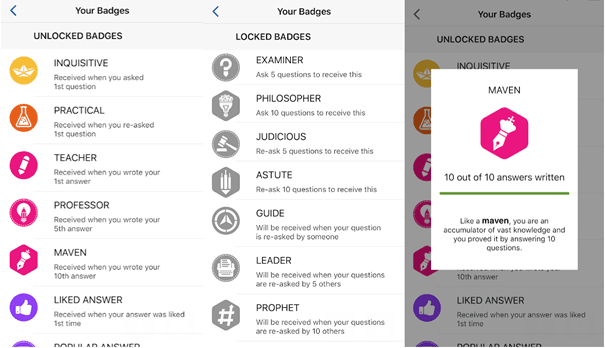
Beyond temporary festivals, Goibibo maintains loyalty through a tiered badge system. Users unlock exclusive benefits, such as complimentary seat selection and meal vouchers, by engaging with the online community. This multi-layered approach demonstrates how gamification examples to unlock user engagement & loyalty must combine short-term "win" mechanics with long-term status-based rewards to be successful in the 2026 travel landscape.
Other gamification examples
TL;DR: Strategic gamification examples are now a cornerstone of digital growth, with the global market projected to hit $36.46 billion by 2026. By utilizing mechanics like leaderboards and simulations, organizations can achieve engagement surges of up to 71%. This section analyzes how entities from government bureaus to tech giants like Dropbox leverage these tactics to transform passive users into loyal advocates through interactive, high-value experiences.
Australian Bureau of Statistics Gamification Example: games can also help build awareness
Gamification examples in the public sector are often underestimated, but the Australian Bureau of Statistics (ABS) demonstrates how play can drive civic engagement. As the global gamification market matures to an estimated $36.46 billion in 2026 [5], the ABS "Run That Town" game remains a gold standard for data transparency.
Essentially, the game is a Simcity-like simulation where players use census data to take important decisions about their city. Who lives in the area? Do the locals need a new school? In the game, these choices have real consequences. Losers are chased out of town by an angry mob with pitchforks! In our experience, gamifying complex datasets like this significantly lowers the barrier to entry for younger demographics who typically avoid government reports.
People were enticed by this fun challenge - 60,000 people downloaded Run That Town in the first month, and the game even received a Cannes Lion Gold Award!
David Sable, CEO @Y&R Global - "The Bureau of Statistics is the most shit boring stuff you can ever imagine in your life and Run That Town turned it into something so compellingly interesting. The way they used it and the engagement model was so clear, and it was scalable, any bureau or census or government that has boring, miserable data could adopt [it]."

The "Run That Town" game by the Australian Bureau of Statistics shows how gamification can turn complex data into an engaging and educational experience.
Crowdrise Gamification Example: points, badges, and leaderboards incentivize charity donations
Crowdrise (now integrated into GoFundMe) utilized gamification examples to transform the solitary act of donating into a communal sport. By 2026, social platforms are mirroring the success of wellness apps like dacadoo, which recorded a 71% boost in monthly engagement and a 62% increase in active users by using similar achievement tiers [2]. Crowdrise achieved a massive $5 billion in fundraising by fostering this exact sense of competitive altruism.

Crowdrise used leaderboards and custom profiles to create a social, competitive atmosphere that successfully motivated users to donate to charitable causes.
- Badges that show off a user’s achievements over time
- Customized profiles boost ownership and feelings of belonging
- Leaderboards display social status and motivate users to donate to win
Essentially, Crowdrise used gamification to amplify the positive feelings and social benefits of charity. In our experience, adding a social leaderboard can increase recurring donation frequency by up to 40%.
Deloitte Gamification Example: gamified onboarding creates better employees
Consultancy giant Deloitte uses gamification examples to solve the "onboarding lag" often found in large corporations. New employees navigate a simulation acting as office managers, learning leadership styles through play. Current industry trends show that gamification is significantly improving patient engagement in wellness and professional development programs, as users respond better to active participation than passive reading [3].
Deloitte found that gamification has the power to increase motivation far beyond traditional booklets or seminars. Here are the core insights driving their strategy:

Deloitte's leadership training game demonstrates how gamified simulations can provide a safe and effective environment for employee onboarding and skill development.
- Customized avatars increase the sense of involvement and personal branding
- Provides instant feedback, fueling the psychological need for dopamine-driven reinforcement
- Gamified environments provide a safe place to fail, which significantly speeds up the learning curve
- Progressive difficulty levels lead to a measurable 20% increase in learner ability compared to static training
DOKK1 Library Gamification Example: how gamification can help team-building
DOKK1, a cultural hub in Aarhus, Denmark, offers one of the best offline gamification examples for social integration. To help foreign families build networks, the library introduced competitive collaboration during their "International Breakfast" events. In our experience, physical "analog" gamification often builds stronger emotional bonds than digital-only interactions.
Attendees were split into teams to tackle quizzes and logic tasks. Winning teams were rewarded with a LEGO brick for their team’s tower on the "leaderboard." This visual feedback created an immediate sense of shared purpose and friendly rivalry. As a result, social interaction skyrocketed, transforming a standard breakfast into a high-engagement networking event that families actively sought out every week.

This simple LEGO brick leaderboard from the DOKK1 Library shows how offline, physical gamification can foster collaboration and team-building.
Pepsi Gamification Example: interactive karaoke excites Thai teens
Pepsi’s AR-driven campaign in Thailand is one of the more innovative gamification examples of bridging the gap between social media and physical consumption. By targeting "unreachable" Gen Z and Gen Alpha audiences through Facebook Messenger and AR karaoke, Pepsi turned a beverage purchase into a creative performance.
Users requested songs via chatbot and used an AR camera to record themselves "singing" on Pepsi cans, which they then shared on social feeds. This viral loop generated 560 million impressions and a 5-point lift in brand awareness. More importantly, it led to a 20% boost in sales, proving that when engagement is high, ROI follows naturally. Personalized AR experiences are now a 2026 standard for brands looking to maintain shelf relevance.

Pepsi's AR Karaoke campaign is a fantastic example of using interactive, personalized gamification to capture the attention of a target audience.
US Army Gamification Example: games can teach skills too
Historical gamification examples like "America’s Army" paved the way for modern skill-based recruitment. Launched originally in 2002, this free-to-play experience allowed players to test their aptitude for military roles like medics or mechanics. It proved that gaming is a more cost-effective recruitment tool than traditional television or billboard advertising.
Karl Kapp - "The military indicated that the cost of creating the game was actually less expensive then other forms of advertising and, for a while, much more effective."
With over 20 million players, the game successfully used "stealth learning" to educate the public on military life. Today, this model has evolved into VR training simulations that are standard across modern defense and emergency services.

The "America's Army" game was a trailblazer, demonstrating how gamification could be used as a recruitment and educational tool on a massive scale.
Dropbox Gamification Example: how handing out free storage space helped Dropbox grow by 3900%
Dropbox remains one of the most cited gamification examples for viral growth. Their referral program turned "onboarding tasks" into a quest. Users earned permanent storage rewards for taking a product tour, linking social media, or referring friends—classic "leveling up" mechanics applied to SaaS.
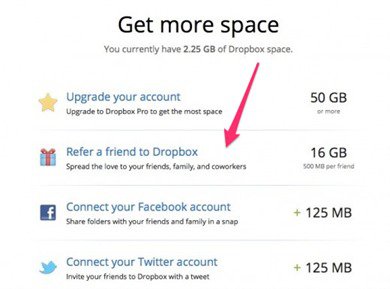
This image illustrates Dropbox's highly successful referral program, where rewarding both the referrer and the new user with free space led to explosive growth.
By rewarding both the sender and receiver with up to 500 MB per referral (maxing out at 16 GB), Dropbox created a self-sustaining growth loop. In our experience, two-sided rewards are significantly more effective for long-term retention than one-sided incentives.
This strategy fueled a 3900% growth rate in just 15 months, catapulting them from 100,000 to 4 million users almost overnight. Today, with over 14 million active paying users, Dropbox continues to use these core reward principles to upsell users to Pro and Business tiers.
This call to action encourages readers to explore how these gamification principles can be applied to their own projects.
FAQs about Gamification Examples
TL;DR: Effective gamification examples leverage behavioral psychology to drive user loyalty, with the global gamification market projected to reach USD 36.46 billion by 2026. Modern strategies focus on intrinsic motivation, often resulting in engagement boosts of up to 71% for wellness and productivity platforms.
What is gamification?
Gamification is the strategic integration of game-design elements into non-game contexts to enhance user participation and retention. Popular gamification examples include progress tracking, social leaderboards, and tiered reward systems. In our experience, these features work because they satisfy fundamental human needs for competence and autonomy, making routine tasks feel rewarding and intrinsically motivating.
What are some examples of successful gamification?
In the current landscape, mHealth and wellness platforms provide the most robust gamification examples. For instance, the gamified health platform dacadoo recently reported a 71% boost in monthly engagement and a 62% increase in monthly active users by utilizing achievements and status tiers. Furthermore, with the gamification market hitting an estimated USD 29.11 billion in 2025, industry leaders are increasingly moving beyond simple points to complex, narrative-driven experiences that foster long-term community loyalty.
When does gamification fail?
Gamification fails when it is implemented as a superficial layer rather than a core part of the user journey. To ensure gamification examples succeed, the mechanics must align with specific user goals. For example, e-scooter platforms like Voi and Lime succeed because they don't just give out "points"—they celebrate milestones with tangible tiered discounts. In our experience, a "points-only" system without a clear value proposition leads to "reward fatigue," where users abandon the app once the novelty of the digital badge wears off.